
Join Our JEE Preparation Group
Prep with like-minded aspirants; Get access to free daily tests and study material.
Sign in
Please select an account to continue using cracku.in
↓ →
Join Our JEE Preparation Group
Prep with like-minded aspirants; Get access to free daily tests and study material.
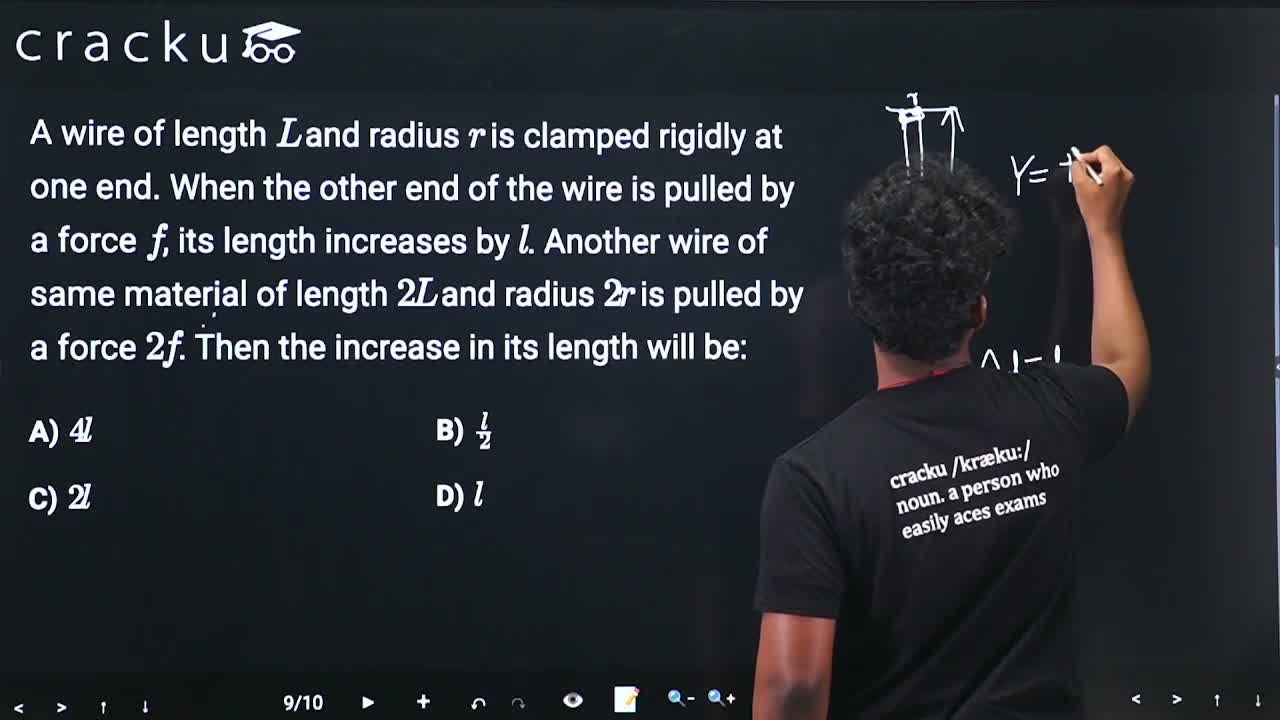
A wire of length $$L$$ and radius $$r$$ is clamped rigidly at one end. When the other end of the wire is pulled by a force $$f$$, its length increases by $$l$$. Another wire of same material of length $$2L$$ and radius $$2r$$ is pulled by a force $$2f$$. Then the increase in its length will be:
Using Young's modulus formula: $$Y = \frac{FL}{Al} = \frac{FL}{\pi r^2 l}$$
For the first wire: $$Y = \frac{fL}{\pi r^2 l}$$
For the second wire: $$Y = \frac{2f \times 2L}{\pi (2r)^2 \times l'}$$
Since both wires are of the same material (same $$Y$$):
$$\frac{fL}{\pi r^2 l} = \frac{4fL}{\pi \times 4r^2 \times l'}$$
$$\frac{fL}{r^2 l} = \frac{4fL}{4r^2 l'}$$
$$\frac{1}{l} = \frac{1}{l'}$$
$$l' = l$$
The increase in length is $$\mathbf{l}$$.
Click on the Email ☝️ to Watch the Video Solution
Create a FREE account and get:
_1.webp)

Educational materials for JEE preparation

Ask our AI anything

AI can make mistakes. Please verify important information.
AI can make mistakes. Please verify important information.


