
Join Our JEE Preparation Group
Prep with like-minded aspirants; Get access to free daily tests and study material.
Sign in
Please select an account to continue using cracku.in
↓ →
Join Our JEE Preparation Group
Prep with like-minded aspirants; Get access to free daily tests and study material.
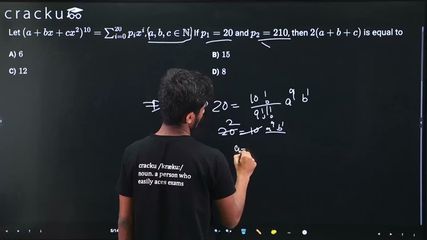
Let $$(a + bx + cx^2)^{10} = \sum_{i=0}^{20} p_i x^i$$, $$a, b, c \in \mathbb{N}$$. If $$p_1 = 20$$ and $$p_2 = 210$$, then $$2(a + b + c)$$ is equal to
$$(a + bx + cx^2)^{10} = \sum p_i x^i$$
$$p_0 = a^{10}$$
For $$p_1$$: coefficient of $$x$$ comes from choosing $$bx$$ once and $$a$$ nine times:
$$p_1 = \binom{10}{1} a^9 \cdot b = 10a^9 b = 20$$
$$a^9 b = 2$$ ... (1)
Since $$a, b \in \mathbb{N}$$, the only solution to (1) is $$a = 1, b = 2$$.
For $$p_2$$: coefficient of $$x^2$$ comes from choosing $$bx$$ twice OR choosing $$cx^2$$ once:
$$p_2 = \binom{10}{2}a^8 b^2 + \binom{10}{1}a^9 c = 45 \times 1 \times 4 + 10 \times 1 \times c = 180 + 10c = 210$$
$$10c = 30$$, $$c = 3$$
$$2(a + b + c) = 2(1 + 2 + 3) = 12$$
This matches option 3: 12.
Click on the Email ☝️ to Watch the Video Solution
Create a FREE account and get:
_1.webp)

Educational materials for JEE preparation

Ask our AI anything

AI can make mistakes. Please verify important information.
AI can make mistakes. Please verify important information.


