
Join Our JEE Preparation Group
Prep with like-minded aspirants; Get access to free daily tests and study material.
Sign in
Please select an account to continue using cracku.in
↓ →
Join Our JEE Preparation Group
Prep with like-minded aspirants; Get access to free daily tests and study material.
Let $$A = \{1, 2, 3, 4\}$$ and $$R$$ be a relation on the set $$A \times A$$ defined by $$R = \{((a, b), (c, d)) : 2a + 3b = 4c + 5d\}$$. Then the number of elements in $$R$$ is _____.
Correct Answer: 6
We are given $$A = \{1, 2, 3, 4\}$$ and a relation $$R$$ on $$A \times A$$ defined by:
$$R = \{((a, b), (c, d)) : 2a + 3b = 4c + 5d\}$$ where $$a, b, c, d \in A = \{1, 2, 3, 4\}$$. We seek all ordered pairs $$((a,b), (c,d))$$ satisfying $$2a + 3b = 4c + 5d$$.
For the left side $$2a + 3b$$ the minimum is $$2(1) + 3(1) = 5$$ and the maximum is $$2(4) + 3(4) = 20$$. For the right side $$4c + 5d$$ the minimum is $$4(1) + 5(1) = 9$$ and the maximum is $$4(4) + 5(4) = 36$$. Thus the common range where both sides can be equal is $$[9, 20]$$.
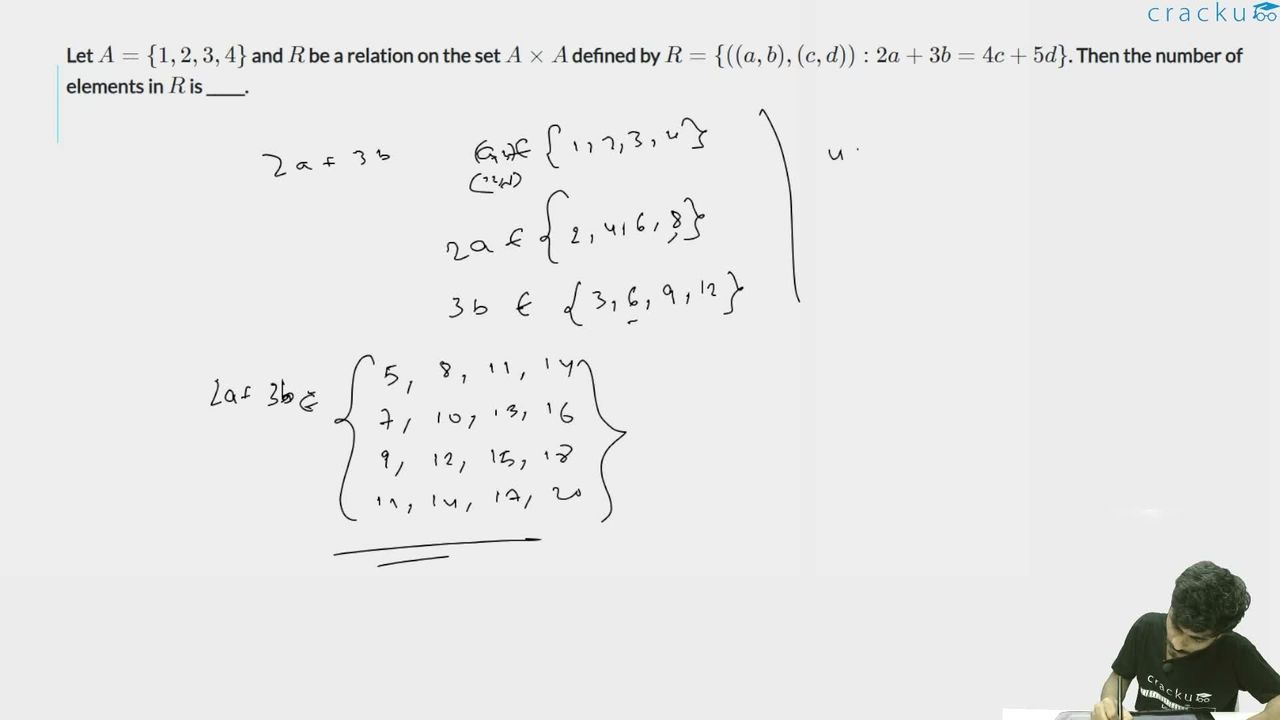
Listing all values of $$2a + 3b$$ for each $$(a, b)$$ pair yields:
a=1: b=1 → 5, b=2 → 8, b=3 → 11, b=4 → 14
a=2: b=1 → 7, b=2 → 10, b=3 → 13, b=4 → 16
a=3: b=1 → 9, b=2 → 12, b=3 → 15, b=4 → 18
a=4: b=1 → 11, b=2 → 14, b=3 → 17, b=4 → 20.
Similarly, listing all values of $$4c + 5d$$ for each $$(c, d)$$ pair and keeping only those in $$[9, 20]$$ gives:
c=1: d=1 → 9, d=2 → 14, d=3 → 19, d=4 → 24 (out of range)
c=2: d=1 → 13, d=2 → 18, d=3 → 23 (out), d=4 → 28 (out)
c=3: d=1 → 17, d=2 → 27 (out)
c=4: d=1 → 21 (out), all others out
Valid RHS values are 9 from $$(1,1)$$, 13 from $$(2,1)$$, 14 from $$(1,2)$$, 17 from $$(3,1)$$, 18 from $$(2,2)$$, 19 from $$(1,3)$$.
Matching LHS and RHS values and counting pairs yields:
Value = 9: LHS pairs with $$2a+3b=9$$: $$(a,b) = (3,1)$$ (1 pair); RHS pairs: $$(c,d) = (1,1)$$ (1 pair); number of elements: $$1 \times 1 = 1$$.
Value = 13: LHS pairs with $$2a+3b=13$$: $$(a,b) = (2,3)$$ (1 pair); RHS pairs: $$(c,d) = (2,1)$$ (1 pair); number of elements: $$1 \times 1 = 1$$.
Value = 14: LHS pairs with $$2a+3b=14$$: $$(a,b) = (1,4)$$ and $$(4,2)$$ (2 pairs); RHS pairs: $$(c,d) = (1,2)$$ (1 pair); number of elements: $$2 \times 1 = 2$$.
Value = 17: LHS pairs with $$2a+3b=17$$: $$(a,b) = (4,3)$$ (1 pair); RHS pairs: $$(c,d) = (3,1)$$ (1 pair); number of elements: $$1 \times 1 = 1$$.
Value = 18: LHS pairs with $$2a+3b=18$$: $$(a,b) = (3,4)$$ (1 pair); RHS pairs: $$(c,d) = (2,2)$$ (1 pair); number of elements: $$1 \times 1 = 1$$.
Value = 19: LHS pairs with $$2a+3b=19$$: no pair gives 19; number of elements: 0.
Adding these counts gives 1 + 1 + 2 + 1 + 1 + 0 = 6.
The number of elements in $$R$$ is 6.
Was this solution helpful?
Click on the Email ☝️ to Watch the Video Solution
Create a FREE account and get:
_1.webp)

Educational materials for JEE preparation

Ask our AI anything

AI can make mistakes. Please verify important information.
AI can make mistakes. Please verify important information.
