
Join Our JEE Preparation Group
Prep with like-minded aspirants; Get access to free daily tests and study material.
Sign in
Please select an account to continue using cracku.in
↓ →
Join Our JEE Preparation Group
Prep with like-minded aspirants; Get access to free daily tests and study material.
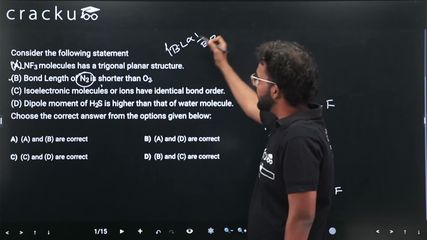
Consider the following statement
(A) NF$$_3$$ molecules has a trigonal planar structure.
(B) Bond Length of N$$_2$$ is shorter than O$$_2$$.
(C) Isoelectronic molecules or ions have identical bond order.
(D) Dipole moment of H$$_2$$S is higher than that of water molecule.
Choose the correct answer from the options given below:
Analyzing each statement:
(A) NF₃ has trigonal planar structure: NF₃ has 3 bond pairs + 1 lone pair on N → pyramidal (like NH₃), NOT trigonal planar. Incorrect.
(B) Bond length of N₂ is shorter than O₂: N₂ has bond order 3 (triple bond, length ~1.10 Å). O₂ has bond order 2 (double bond, length ~1.21 Å). So N₂ is shorter. Correct.
(C) Isoelectronic molecules or ions have identical bond order: Isoelectronic species have the same number of electrons and similar electronic configuration, so they have the same bond order. For example, CO, N₂, NO⁺ are isoelectronic with bond order 3. Correct.
(D) Dipole moment of H₂S is higher than H₂O: H₂O has a dipole moment of 1.85 D while H₂S has 0.97 D. H₂O has a higher dipole moment due to the greater electronegativity of O and the bond angle. Incorrect.
Correct statements: B and C.
This matches option 4: (B) and (C) are correct.
Was this solution helpful?
Click on the Email ☝️ to Watch the Video Solution
Create a FREE account and get:
_1.webp)

Educational materials for JEE preparation

Ask our AI anything

AI can make mistakes. Please verify important information.
AI can make mistakes. Please verify important information.
