
Join Our JEE Preparation Group
Prep with like-minded aspirants; Get access to free daily tests and study material.
Sign in
Please select an account to continue using cracku.in
↓ →
Join Our JEE Preparation Group
Prep with like-minded aspirants; Get access to free daily tests and study material.
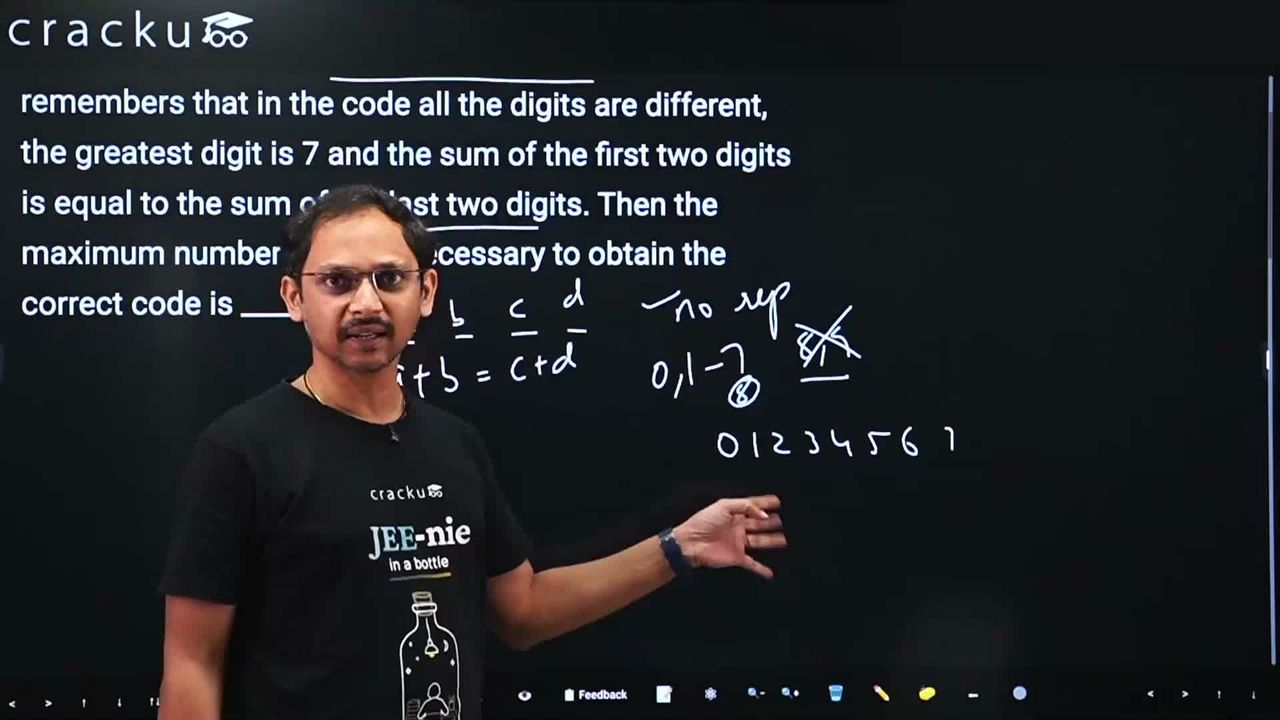
A person forgets his 4-digit ATM pin code. But he remembers that in the code all the digits are different, the greatest digit is 7 and the sum of the first two digits is equal to the sum of the last two digits. Then the maximum number of trials necessary to obtain the correct code is _____.
Correct Answer: 72
$$a + b = c + d = S \text{ with distinct digits from } \{0,1,2,3,4,5,6,7\} \text{ containing } 7$$
$$(7, x) \text{ and } (y, z) \text{ where } 7+x = y+z$$
$$x=0, S=7 \implies (y,z) \in \{(1,6), (2,5), (3,4)\} \quad \text{(3 sets)}$$
$$x=1, S=8 \implies (y,z) \in \{(2,6), (3,5)\} \quad \text{(2 sets)}$$
$$x=2, S=9 \implies (y,z) \in \{(3,6), (4,5)\} \quad \text{(2 sets)}$$
$$x=3, S=10 \implies (y,z) \in \{(4,6)\} \quad \text{(1 set)}$$
$$x=4, S=11 \implies (y,z) \in \{(5,6)\} \quad \text{(1 set)}$$
$$\text{Total valid sets of 4 digits} = 3 + 2 + 2 + 1 + 1 = 9$$
$$\text{Arrangements per set} = 2 \text{ (pair swap)} \times 2! \text{ (first pair)} \times 2! \text{ (second pair)} = 8$$
$$\text{Maximum trials} = 9 \times 8 = 72$$
Was this solution helpful?
Click on the Email ☝️ to Watch the Video Solution
Create a FREE account and get:
_1.webp)

Educational materials for JEE preparation

Ask our AI anything

AI can make mistakes. Please verify important information.
AI can make mistakes. Please verify important information.
