
Join Our JEE Preparation Group
Prep with like-minded aspirants; Get access to free daily tests and study material.
Sign in
Please select an account to continue using cracku.in
↓ →
Join Our JEE Preparation Group
Prep with like-minded aspirants; Get access to free daily tests and study material.
The number of P $$-$$ O $$-$$ P bonds in H$$_4$$P$$_2$$O$$_7$$, (HPO$$_3$$)$$_3$$, and P$$_4$$O$$_{10}$$ are respectively
The number of $$P-O-P$$ bonds is equal to the number of oxygen atoms that bridge two phosphorus atoms.
In $$H_4P_2O_7$$ (pyrophosphoric acid), two orthophosphoric acid units are joined by the elimination of one molecule of water. This results in a single oxygen atom bridging the two phosphorus atoms.
Therefore, the number of $$P-O-P$$ bonds in $$H_4P_2O_7$$ is
$$1$$
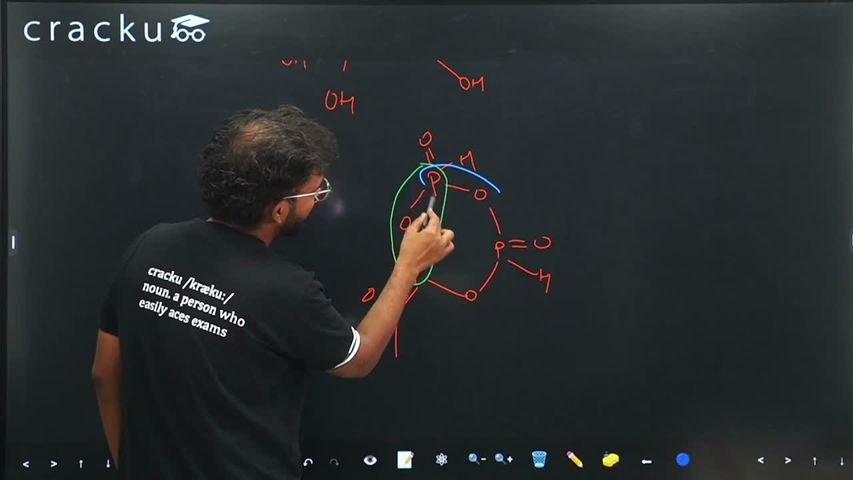
In $$(HPO_3)_3$$ (cyclotrimetaphosphoric acid), three phosphorus atoms are arranged in a cyclic structure with alternating phosphorus and oxygen atoms. Each phosphorus atom is connected to the next phosphorus atom through a bridging oxygen atom.
Therefore, the number of $$P-O-P$$ bonds in $$(HPO_3)_3$$ is
$$3$$
In $$P_4O_{10}$$, the four phosphorus atoms occupy the vertices of a tetrahedral framework. Each edge of the tetrahedron contains one bridging oxygen atom. Since a tetrahedron has six edges, there are six bridging oxygen atoms connecting phosphorus atoms.
Therefore, the number of $$P-O-P$$ bonds in $$P_4O_{10}$$ is
$$6$$
Hence, the number of $$P-O-P$$ bonds in
$$H_4P_2O_7,\ (HPO_3)3,\ P_4O{10}$$
are
$$1,\ 3,\ 6$$
respectively.
Hence, the correct answer is
$$1,\ 3,\ 6$$
Click on the Email ☝️ to Watch the Video Solution
Create a FREE account and get:
_1.webp)

Educational materials for JEE preparation

Ask our AI anything

AI can make mistakes. Please verify important information.
AI can make mistakes. Please verify important information.


