
Join Our JEE Preparation Group
Prep with like-minded aspirants; Get access to free daily tests and study material.
Sign in
Please select an account to continue using cracku.in
↓ →
Join Our JEE Preparation Group
Prep with like-minded aspirants; Get access to free daily tests and study material.
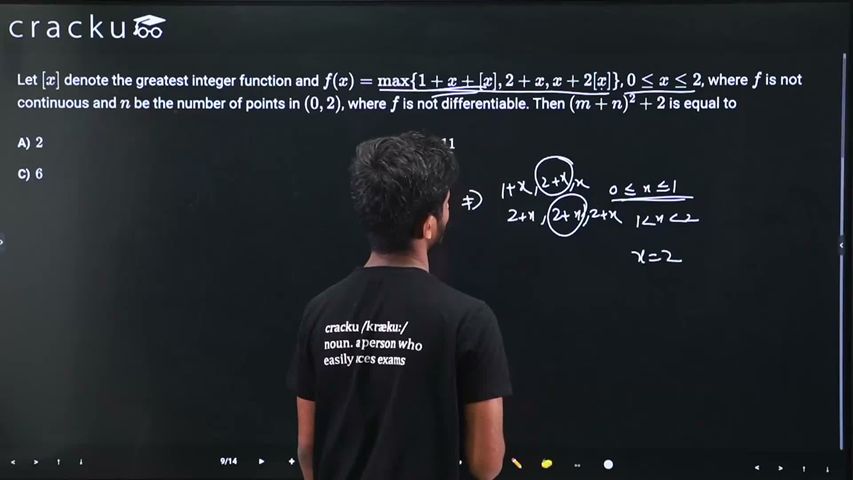
Let $$[x]$$ denote the greatest integer function and $$f(x) = \max\{1 + x + [x], 2 + x, x + 2[x]\}$$, $$0 \leq x \leq 2$$, where $$f$$ is not continuous and $$n$$ be the number of points in $$(0, 2)$$, where $$f$$ is not differentiable. Then $$(m + n)^2 + 2$$ is equal to
The given domain is $$0 \le x \le 2$$. The value of $$[x]$$ changes at the integer points $$x = 1$$ and $$x = 2$$.
Interval 1: $$0 \le x < 1 \implies [x] = 0$$
$$f(x) = \max\{1 + x + 0, \, 2 + x, \, x + 2(0)\}$$
$$f(x) = \max\{1 + x, \, 2 + x, \, x\} = 2 + x$$
Interval 2: $$1 \le x < 2 \implies [x] = 1$$
$$f(x) = \max\{1 + x + 1, \, 2 + x, \, x + 2(1)\}$$
$$f(x) = \max\{2 + x, \, 2 + x, \, x + 2\} = 2 + x$$
At the boundary point: $$x = 2 \implies [x] = 2$$
$$f(x) = \max\{1 + 2 + 2, \, 2 + 2, \, 2 + 2(2)\}$$
$$f(x) = \max\{5, \, 4, \, 6\} = 6$$
For all $$0 \le x < 2$$, the function simplifies identically to $$2 + x$$:
$$f(x) = \begin{cases} 2 + x, & 0 \le x < 2 \\ 6, & x = 2 \end{cases}$$
Since $$f(x) = 2+x$$ is a linear polynomial, it is continuous everywhere inside $$(0, 2)$$. We only need to check the boundary transition at $$x = 2$$:
$$\lim_{x \to 2^-} f(x) = \lim_{x \to 2^-} (2 + x) = 4$$
$$f(2) = 6$$
Since $$\lim_{x \to 2^-} f(x) \neq f(2)$$, the function is discontinuous at exactly one point ($$x = 2$$) in the closed interval $$[0,2]$$.
$$m = 1 \quad (\text{at } x = 2)$$
Within $$(0, 2)$$, $$f(x) = 2 + x$$.
$$f'(x) = 1$$
Since the derivative exists and is constant for all values inside $$(0, 2)$$, there are no points of non-differentiability in this open interval:
$$n = 0$$
$$\text{Value} = (1 + 0)^2 + 2 = 1 + 2 = 3$$
Was this solution helpful?
Click on the Email ☝️ to Watch the Video Solution
Create a FREE account and get:
_1.webp)

Educational materials for JEE preparation

Ask our AI anything

AI can make mistakes. Please verify important information.
AI can make mistakes. Please verify important information.
