Join WhatsApp Icon JEE WhatsApp Group

NTA JEE Main 11th January 2019 Shift 1 - Physics

For the following questions answer them individually

The force of interaction between two atoms is given by $$F = \alpha\beta \exp\left(-\frac{x^2}{\alpha kT}\right)$$; where $$x$$ is the distance, k is the Boltzmann constant and T is temperature and $$\alpha$$ and $$\beta$$ are two constants. The dimensions of $$\beta$$ is:

A body is projected at $$t = 0$$ with a velocity $$10 \text{ ms}^{-1}$$ at an angle of $$60°$$ with the horizontal. The radius of curvature of its trajectory at $$t = 1$$ s is $$R$$. Neglecting air resistance and taking acceleration due to gravity $$g = 10 \text{ ms}^{-2}$$, the value of $$R$$ is:

A body of mass 1 kg falls freely from a height of 100 m, on a platform of mass 3 kg which is mounted on a spring having spring constant $$k = 1.25 \times 10^6$$ N/m. The body sticks to the platform and the spring's maximum compression is found to be $$x$$. Given that $$g = 10 \text{ ms}^{-2}$$, the value of $$x$$ will be close to:

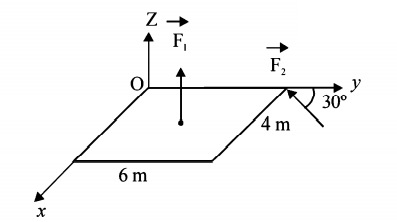
A slab is subjected to two forces $$\vec{F_1}$$ and $$\vec{F_2}$$ of same magnitude $$F$$ as shown in the figure. Force $$\vec{F_2}$$ is in XY-plane while force $$\vec{F_1}$$ acts along z-axis at the point $$(2\hat{i} + 3\hat{j})$$. The moment of these forces about point O will be:

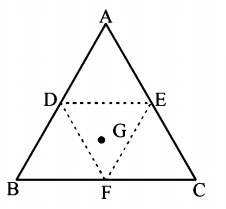
An equilateral triangle ABC is cut from a thin solid sheet of wood. (See figure) D, E and F are the mid-points of its sides as shown and G is the centre of the triangle. The moment of inertia of the triangle about an axis passing through G and perpendicular to the plane of the triangle is $$I_0$$. If the smaller triangle DEF is removed from ABC, the moment of inertia of the remaining figure about the same axis is $$I$$. Then

A satellite is revolving in a circular orbit at a height h from the earth surface, such that $$h \ll R$$ where R is the radius of the earth. Assuming that the effect of earth's atmosphere can be neglected the minimum increase in the speed required so that the satellite could escape from the gravitational field of earth is

A liquid of density $$\rho$$ is coming out of a hose pipe of radius $$a$$ with horizontal speed $$v$$ and hits a mesh. 50% of the liquid passes through the mesh unaffected. 25% loses all of its momentum and 25% comes back with the same speed. The resultant pressure on the mesh will be:

Ice at $$-20°C$$ is added to 50 g of water at $$40°C$$. When the temperature of the mixture reaches $$0°C$$, it is found that 20 g of ice is still unmelted. The amount of ice added to the water was close to (Specific heat of water = 4.2 J/g/°C, Specific heat of Ice = 2.1 J/g/°C, Heat of fusion of water at $$0°C$$ = 334 J/g)

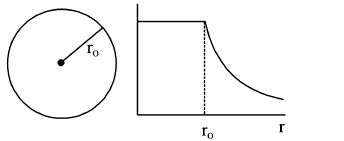
The given graph shows variation (with distance r from centre) of:

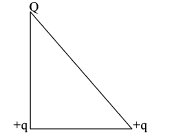
Three charges $$Q$$, $$+q$$ and $$+q$$ are placed at the vertices of a right-angle isosceles triangle as shown below. The net electrostatic energy of the configuration is zero, if the value of Q is:

In an experiment, electrons are accelerated, from rest, by applying a voltage of 500 V. Calculate the radius of the path if a magnetic field 100 mT is then applied. [Charge of the electron $$= 1.6 \times 10^{-19}$$ C; Mass of the electron $$= 9.1 \times 10^{-31}$$ kg]

There are two long co-axial solenoids of same length $$l$$. The inner and outer coils have radii $$r_1$$ and $$r_2$$ and number of turns per unit length $$n_1$$ and $$n_2$$, respectively. The ratio of mutual inductance to the self-inductance of the inner-coil is:

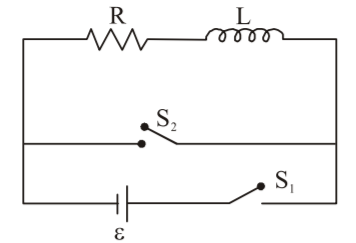
In the circuit shown, the switch $$S_1$$ is closed at time $$t = 0$$ and the switch $$S_2$$ is kept open. At some later time $$(t_0)$$, the switch $$S_1$$ is opened and $$S_2$$ is closed. The behaviour of the current I as a function of time t is given by:

An electromagnetic wave of intensity $$50 \text{ Wm}^{-2}$$ enters in a medium of refractive index 'n' without any loss. The ratio of the magnitudes of electric fields, and the ratio of the magnitudes of magnetic fields of the wave before and after entering into the medium are respectively, given by:

An object is at a distance of 20 m from a convex lens of focal length 0.3 m. The lens forms an image of the object. If the object moves away from the lens at a speed of 5 m/s the speed and direction of the image will be

If the deBroglie wavelength of an electron is equal to $$10^{-3}$$ times the wavelength of a photon of frequency $$6 \times 10^{14}$$ Hz, then the speed of electron is equal to: (Speed of light $$= 3 \times 10^8$$ m/s, Planck's constant $$= 6.63 \times 10^{-34}$$ J.s, Mass of electron $$= 9.1 \times 10^{-31}$$ kg)

An amplitude modulated signal is given by $$V(t) = 10[1 + 0.3 \cos(2.2 \times 10^4 t)] \sin(5.5 \times 10^5 t)$$. Here t is in seconds. The sideband frequencies (in kHz) are, [Given $$\pi = 22/7$$]

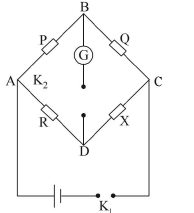
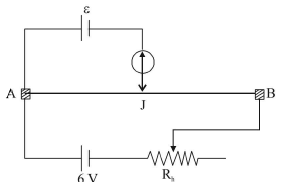
The resistance of the meter bridge AB in given figure is $$4\Omega$$. With a cell of emf $$\varepsilon = 0.5$$ V and rheostat resistance $$R_h = 2\Omega$$ the null point is obtained at some point J. When the cell is replaced by another one of emf $$\varepsilon = \varepsilon_2$$ the same null point J is found for $$R_h = 6\Omega$$. The emf $$\varepsilon_2$$ is: