
Join Our JEE Preparation Group
Prep with like-minded aspirants; Get access to free daily tests and study material.
Sign in
Please select an account to continue using cracku.in
↓ →
Join Our JEE Preparation Group
Prep with like-minded aspirants; Get access to free daily tests and study material.
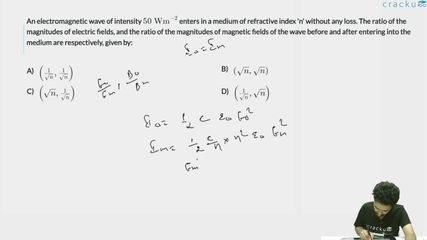
An electromagnetic wave of intensity $$50 \text{ Wm}^{-2}$$ enters in a medium of refractive index 'n' without any loss. The ratio of the magnitudes of electric fields, and the ratio of the magnitudes of magnetic fields of the wave before and after entering into the medium are respectively, given by:
For an electromagnetic wave the average intensity (the time-averaged magnitude of the Poynting vector) is related to the amplitude of its electric field by the formula
$$I=\tfrac12\,c\,\varepsilon_0\,E_0^{\,2}$$
where $$c$$ is the speed of light in vacuum and $$\varepsilon_0$$ is the permittivity of free space. The subscript ‘0’ marks quantities in vacuum (before the wave enters the medium).
After the wave enters a non-conducting, non-magnetic medium (so $$\mu=\mu_0$$) of refractive index $$n$$, the speed of the wave becomes
$$v=\frac{c}{n}$$
and the permittivity becomes
$$\varepsilon=\varepsilon_r\varepsilon_0=n^{2}\varepsilon_0 \quad\bigl(\text{because }n=\sqrt{\varepsilon_r}\bigr).$$
The intensity inside the medium is therefore
$$I=\tfrac12\,v\,\varepsilon\,E_m^{\,2} =\tfrac12\left(\frac{c}{n}\right)\!\bigl(n^{2}\varepsilon_0\bigr)\,E_m^{\,2} =\tfrac12\,c\,n\,\varepsilon_0\,E_m^{\,2}.$$
The problem states that there is no loss in intensity, so the value of $$I$$ is the same in vacuum and in the medium. Setting the two expressions equal we get
$$\tfrac12\,c\,\varepsilon_0\,E_0^{\,2} =\tfrac12\,c\,n\,\varepsilon_0\,E_m^{\,2}.$$
Cancelling the common factors $$\tfrac12\,c\,\varepsilon_0$$ on both sides gives
$$E_0^{\,2}=n\,E_m^{\,2}.$$
Taking the square root on both sides, we obtain the ratio of the magnitudes of the electric fields (before : after):
$$\frac{E_0}{E_m}=\sqrt{n}.$$
Now, for any electromagnetic wave the electric and magnetic amplitudes are related by the equation
$$E=v\,B,$$
where $$v$$ is the speed of the wave in the medium it is travelling through.
• In vacuum: $$E_0=c\,B_0\;\Longrightarrow\;B_0=\dfrac{E_0}{c}.$$
• In the medium: $$E_m=v\,B_m=\frac{c}{n}\,B_m \;\Longrightarrow\;B_m=\dfrac{E_m\,n}{c}.$$
Hence the ratio of the magnetic fields is
$$\frac{B_0}{B_m} =\frac{E_0/c}{E_m\,n/c} =\frac{E_0}{E_m\,n} =\frac{\sqrt{n}}{n} =\frac{1}{\sqrt{n}}.$$
We have therefore found
$$\left(\frac{E_0}{E_m},\;\frac{B_0}{B_m}\right) =\left(\sqrt{n},\;\frac{1}{\sqrt{n}}\right).$$
Hence, the correct answer is Option C.
Was this solution helpful?
Click on the Email ☝️ to Watch the Video Solution
Create a FREE account and get:
_1.webp)

Educational materials for JEE preparation

Ask our AI anything

AI can make mistakes. Please verify important information.
AI can make mistakes. Please verify important information.
