
Join Our JEE Preparation Group
Prep with like-minded aspirants; Get access to free daily tests and study material.
Sign in
Please select an account to continue using cracku.in
↓ →
Join Our JEE Preparation Group
Prep with like-minded aspirants; Get access to free daily tests and study material.
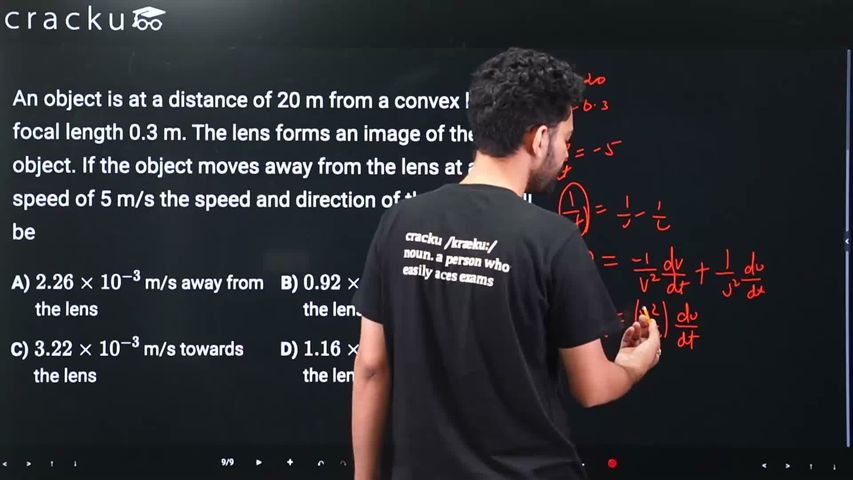
An object is at a distance of 20 m from a convex lens of focal length 0.3 m. The lens forms an image of the object. If the object moves away from the lens at a speed of 5 m/s the speed and direction of the image will be
For a thin lens we always start with the lens (Gaussian) formula, written with the Cartesian sign convention:
$$\frac{1}{f}\;=\;\frac{1}{v}\;-\;\frac{1}{u}$$
Here
$$f = +0.3\ \text{m}$$ because the lens is convex (focal length positive),
$$u = -20\ \text{m}$$ because the object lies 20 m to the left of the lens (distances measured against the direction of incident light are negative),
and we need to find the image distance $$v$$ first.
Substituting the numerical values, we have
$$\frac{1}{0.3} \;=\; \frac{1}{v} \;-\; \frac{1}{(-20)}.$$
Now evaluate the reciprocals one by one:
$$\frac{1}{0.3} = 3.333\ldots \ \text{m}^{-1},\qquad \frac{1}{-20} = -0.05\ \text{m}^{-1}.$$
So the equation becomes
$$3.333\ldots = \frac{1}{v} + 0.05.$$
Moving the second term to the left side gives
$$3.333\ldots - 0.05 = \frac{1}{v}.$$
Hence
$$\frac{1}{v} = 3.28333\ \text{m}^{-1}.$$
Therefore
$$v = \frac{1}{3.28333} \approx 0.3047\ \text{m}.$$
The positive sign of $$v$$ shows that the image is real and forms on the side opposite to the object, i.e. 0.305 m to the right of the lens.
Now we let the object start moving. The object recedes from the lens at a speed of 5 m/s. With the same sign convention, the object coordinate $$u$$ is negative and its magnitude increases, so
$$\frac{du}{dt} = -5\ \text{m/s}.$$
The lens formula involves time-dependent quantities $$u(t)$$ and $$v(t)$$ but the focal length $$f$$ is constant. Differentiating the lens equation with respect to time $$t$$ gives
$$\frac{d}{dt}\!\left(\frac{1}{v} - \frac{1}{u}\right) = 0.$$
Using the derivative $$\frac{d}{dt}\left(\frac{1}{x}\right) = -\frac{1}{x^{2}}\frac{dx}{dt},$$ we obtain
$$-\frac{1}{v^{2}}\frac{dv}{dt}\;+\;\frac{1}{u^{2}}\frac{du}{dt} \;=\;0.$$
Rearranging for the image velocity $$\dfrac{dv}{dt}$$, we find
$$\frac{dv}{dt} = \frac{v^{2}}{u^{2}}\;\frac{du}{dt}.$$
Now substitute the known values:
$$v = +0.3047\ \text{m},\qquad u = -20\ \text{m},\qquad \frac{du}{dt} = -5\ \text{m/s}.$$
First compute the ratio $$\dfrac{v^{2}}{u^{2}}$$:
$$v^{2} = (0.3047)^{2} \approx 0.09284\ \text{m}^{2},$$ $$u^{2} = (-20)^{2} = 400\ \text{m}^{2},$$
so
$$\frac{v^{2}}{u^{2}} = \frac{0.09284}{400} = 2.321 \times 10^{-4}.$$
Multiplying by $$\frac{du}{dt} = -5\ \text{m/s}$$ gives
$$\frac{dv}{dt} = (2.321 \times 10^{-4})(-5) = -1.1605 \times 10^{-3}\ \text{m/s}.$$
The negative sign means the image distance $$v$$ is decreasing with time, i.e. the image moves towards the lens. The magnitude of the speed is
$$\left|\frac{dv}{dt}\right| = 1.16 \times 10^{-3}\ \text{m/s}.$$
Hence, the image travels towards the lens at a speed of $$1.16 \times 10^{-3}\ \text{m/s}$$.
Hence, the correct answer is Option D.
Was this solution helpful?
Click on the Email ☝️ to Watch the Video Solution
Create a FREE account and get:
_1.webp)

Educational materials for JEE preparation

Ask our AI anything

AI can make mistakes. Please verify important information.
AI can make mistakes. Please verify important information.
