
Join Our JEE Preparation Group
Prep with like-minded aspirants; Get access to free daily tests and study material.
Sign in
Please select an account to continue using cracku.in
↓ →
Join Our JEE Preparation Group
Prep with like-minded aspirants; Get access to free daily tests and study material.
The resistance of the meter bridge AB in given figure is $$4\Omega$$. With a cell of emf $$\varepsilon = 0.5$$ V and rheostat resistance $$R_h = 2\Omega$$ the null point is obtained at some point J. When the cell is replaced by another one of emf $$\varepsilon = \varepsilon_2$$ the same null point J is found for $$R_h = 6\Omega$$. The emf $$\varepsilon_2$$ is:
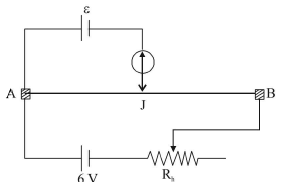
$$V_{\text{main}} = 6\text{ V}, \quad R_{AB} = 4\ \Omega$$
Case 1: $$R_h = 2\ \Omega$$, $$\varepsilon_1 = 0.5\text{ V}$$
Current in primary circuit: $$I_1 = \frac{V_{\text{main}}}{R_{AB} + R_h} = \frac{6}{4 + 2} = 1\text{ A}$$
Potential difference across wire AB: $$V_{AB1} = I_1 \cdot R_{AB} = 1 \times 4 = 4\text{ V}$$
Balancing condition for length $$AJ$$: $$\varepsilon_1 = \left(\frac{V_{AB1}}{L}\right) \cdot AJ \implies 0.5 = \left(\frac{4}{L}\right) \cdot AJ \implies \frac{AJ}{L} = \frac{0.5}{4} = \frac{1}{8}$$
Case 2: $$R_h = 6\ \Omega$$, same null point $$J$$
Current in primary circuit: $$I_2 = \frac{V_{\text{main}}}{R_{AB} + R_h} = \frac{6}{4 + 6} = 0.6\text{ A}$$
Potential difference across wire AB: $$V_{AB2} = I_2 \cdot R_{AB} = 0.6 \times 4 = 2.4\text{ V}$$
Balancing condition for same length $$AJ$$: $$\varepsilon_2 = \left(\frac{V_{AB2}}{L}\right) \cdot AJ = V_{AB2} \cdot \left(\frac{AJ}{L}\right)$$
$$\varepsilon_2 = 2.4 \times \frac{1}{8} = 0.3\text{ V}$$
Was this solution helpful?
Create a FREE account and get:
_1.webp)

Educational materials for JEE preparation

Ask our AI anything

AI can make mistakes. Please verify important information.
AI can make mistakes. Please verify important information.
