
Join Our JEE Preparation Group
Prep with like-minded aspirants; Get access to free daily tests and study material.
Sign in
Please select an account to continue using cracku.in
↓ →
Join Our JEE Preparation Group
Prep with like-minded aspirants; Get access to free daily tests and study material.
A 10 mg effervescent tablet containing sodium bicarbonate and oxalic acid releases 0.25 mL of $$CO_2$$ at T = 298.15 K and P = 1 bar. If molar volume of $$CO_2$$ is 25.0 L under such condition, what is the percentage of sodium bicarbonate in each tablet? [Molar mass of $$NaHCO_3 = 84$$ g $$mol^{-1}$$]
We have been told that the tablet liberates $$0.25\;{\rm mL}$$ of carbon dioxide when it reacts. The molar volume of the gas at the stated temperature and pressure is given as $$25.0\;{\rm L}$$ per mole.
First we put both volumes in the same unit so that the division is straightforward. Remembering that
$$1\;{\rm L}=1000\;{\rm mL},$$
we write
$$25.0\;{\rm L}=25.0\times1000\;{\rm mL}=25\,000\;{\rm mL}.$$
The definition of molar volume is
$$V_{\rm m}=\frac{V}{n},$$
so rearranging we obtain the number of moles:
$$n=\frac{V}{V_{\rm m}}.$$
Substituting the numerical values,
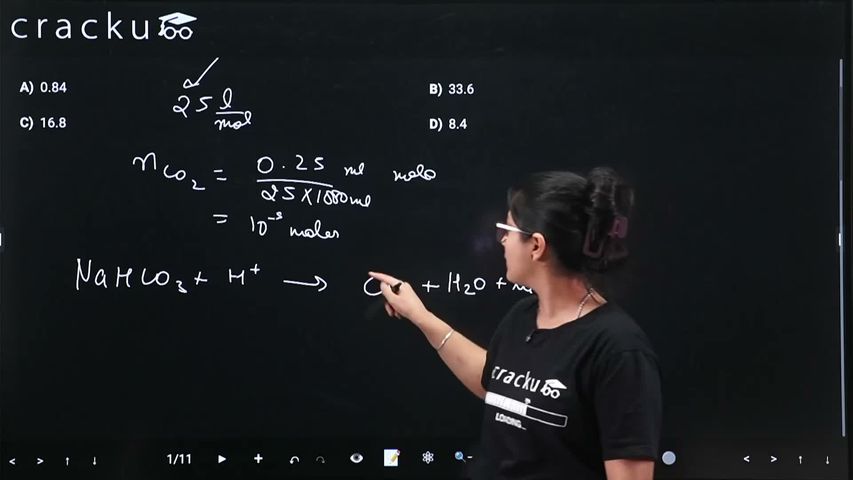
$$n_{CO_2}=\frac{0.25\;{\rm mL}}{25\,000\;{\rm mL\,mol^{-1}}} =\frac{0.25}{25\,000}\;{\rm mol} =1.0\times10^{-5}\;{\rm mol}.$$
In the effervescent reaction each mole of sodium bicarbonate produces one mole of carbon dioxide, because the neutralisation of $$NaHCO_3$$ by an acid is represented by the general step
$$NaHCO_3+H^+\rightarrow Na^++CO_2+H_2O,$$
so the stoichiometric ratio is $$1:1.$$ Therefore
$$n_{NaHCO_3}=n_{CO_2}=1.0\times10^{-5}\;{\rm mol}.$$
Next we change moles of bicarbonate to mass by using its molar mass. The relationship is
$$m=nM.$$
Substituting,
$$m_{NaHCO_3}=(1.0\times10^{-5}\;{\rm mol})(84\;{\rm g\,mol^{-1}}) =8.4\times10^{-4}\;{\rm g}.$$
Converting grams to milligrams ( $$1\;{\rm g}=1000\;{\rm mg}$$ ),
$$m_{NaHCO_3}=8.4\times10^{-4}\;{\rm g}\times1000 =0.84\;{\rm mg}.$$
The tablet itself has a mass of $$10\;{\rm mg}.$$ The percentage of sodium bicarbonate present is therefore
$$\%\;NaHCO_3=\frac{0.84\;{\rm mg}}{10\;{\rm mg}}\times100 =8.4\%.$$
Hence, the correct answer is Option D.
Was this solution helpful?
Click on the Email ☝️ to Watch the Video Solution
Create a FREE account and get:
_1.webp)

Educational materials for JEE preparation

Ask our AI anything

AI can make mistakes. Please verify important information.
AI can make mistakes. Please verify important information.
