
Join Our JEE Preparation Group
Prep with like-minded aspirants; Get access to free daily tests and study material.
Sign in
Please select an account to continue using cracku.in
↓ →
Join Our JEE Preparation Group
Prep with like-minded aspirants; Get access to free daily tests and study material.
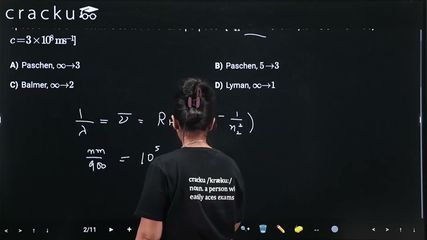
Heat treatment of muscular pain involves radiation of wavelength of about 900 nm. Which spectral line of H atom is suitable for this purpose? [$$R_H = 1 \times 10^5 \text{ cm}^{-1}$$, $$h = 6.6 \times 10^{-34}$$ Js, $$c = 3 \times 10^8 \text{ ms}^{-1}$$]
We are told that the therapeutic radiation used for heat treatment has a wavelength of about $$900\ \text{nm}$$. Our task is to look among the listed hydrogen‐atom spectral lines and find the one whose wavelength matches this value.
For the hydrogen atom, the wavenumber (that is, the reciprocal of the wavelength in centimetres) of any spectral line is given by the Rydberg formula, which we first state clearly:
$$\bar\nu = R_H\!\left(\dfrac1{n_1^{\,2}} - \dfrac1{n_2^{\,2}}\right)$$
Here
$$n_2 \gt n_1,\qquad R_H = 1 \times 10^{5}\ \text{cm}^{-1},$$
and
$$\bar\nu = \dfrac1{\lambda}\quad(\text{with }\lambda\text{ expressed in cm}).$$
The four options involve four different pairs of $$n_1$$ and $$n_2$$. We shall examine each one in turn, calculating its wavelength step by step, and then compare it with the required $$900\ \text{nm}$$.
Option A: Paschen, $$\infty \to 3$$
For a transition that starts from $$n_2 = \infty$$ and ends at $$n_1 = 3$$, the term $$1/n_2^{\,2}$$ becomes $$0$$. Substituting into the Rydberg formula we have
$$\bar\nu_A = R_H\!\left(\dfrac1{3^{2}} - 0\right) = 1 \times 10^{5}\ \text{cm}^{-1}\!\left(\dfrac1{9}\right) = \dfrac{1 \times 10^{5}}{9}\ \text{cm}^{-1}.$$
Carrying out the division,
$$\bar\nu_A = 1.1111 \times 10^{4}\ \text{cm}^{-1}.$$
Now the wavelength in centimetres is the reciprocal:
$$\lambda_A = \dfrac1{\bar\nu_A} = \dfrac1{1.1111 \times 10^{4}}\ \text{cm} = 9.000 \times 10^{-5}\ \text{cm}.$$
To convert this to nanometres we note that $$1\ \text{cm} = 10^{7}\ \text{nm}$$, so
$$\lambda_A = 9.000 \times 10^{-5}\ \text{cm}\ \times 10^{7}\ \dfrac{\text{nm}}{\text{cm}} = 9.000 \times 10^{2}\ \text{nm} = 900\ \text{nm}.$$
This is exactly the required $$900\ \text{nm}$$. Nevertheless, for completeness, we shall still evaluate the other three options.
Option B: Paschen, $$5 \to 3$$
Here $$n_2 = 5$$ and $$n_1 = 3$$. Using the Rydberg formula:
$$\bar\nu_B = R_H\!\left(\dfrac1{3^{2}} - \dfrac1{5^{2}}\right) = 1 \times 10^{5}\ \text{cm}^{-1} \left(\dfrac1{9} - \dfrac1{25}\right).$$
Calculating the bracket first,
$$\dfrac1{9} - \dfrac1{25} = \dfrac{25 - 9}{225} = \dfrac{16}{225}.$$
Hence
$$\bar\nu_B = 1 \times 10^{5}\ \text{cm}^{-1}\ \times \dfrac{16}{225} = \dfrac{1.6 \times 10^{6}}{225}\ \text{cm}^{-1} = 7.111 \times 10^{3}\ \text{cm}^{-1}.$$
The wavelength is therefore
$$\lambda_B = \dfrac1{7.111 \times 10^{3}}\ \text{cm} = 1.406 \times 10^{-4}\ \text{cm} = 1.406 \times 10^{-4}\ \text{cm}\ \times 10^{7}\ \dfrac{\text{nm}}{\text{cm}} = 1.406 \times 10^{3}\ \text{nm} = 1406\ \text{nm}.$$
This is far larger than $$900\ \text{nm}$$, hence Option B cannot be the required line.
Option C: Balmer, $$\infty \to 2$$
Here $$n_2 = \infty$$ and $$n_1 = 2$$, so
$$\bar\nu_C = R_H\!\left(\dfrac1{2^{2}} - 0\right) = 1 \times 10^{5}\ \text{cm}^{-1}\!\left(\dfrac1{4}\right) = 2.5 \times 10^{4}\ \text{cm}^{-1}.$$
The corresponding wavelength is
$$\lambda_C = \dfrac1{2.5 \times 10^{4}}\ \text{cm} = 4.0 \times 10^{-5}\ \text{cm} = 4.0 \times 10^{-5}\ \text{cm}\ \times 10^{7}\ \dfrac{\text{nm}}{\text{cm}} = 4.0 \times 10^{2}\ \text{nm} = 400\ \text{nm}.$$
This is in the visible region and again is not close to $$900\ \text{nm}$$.
Option D: Lyman, $$\infty \to 1$$
With $$n_2 = \infty$$ and $$n_1 = 1$$ we obtain
$$\bar\nu_D = R_H\!\left(\dfrac1{1^{2}} - 0\right) = 1 \times 10^{5}\ \text{cm}^{-1}.$$
Thus
$$\lambda_D = \dfrac1{1 \times 10^{5}}\ \text{cm} = 1.0 \times 10^{-5}\ \text{cm} = 1.0 \times 10^{-5}\ \text{cm}\ \times 10^{7}\ \dfrac{\text{nm}}{\text{cm}} = 1.0 \times 10^{2}\ \text{nm} = 100\ \text{nm}.$$
This is in the ultraviolet region and again does not match $$900\ \text{nm}$$.
Only Option A, the Paschen line with transition $$\infty \to 3$$, yields a wavelength of exactly $$900\ \text{nm}$$, which is the requirement for heat treatment of muscular pain.
Hence, the correct answer is Option A.
Was this solution helpful?
Click on the Email ☝️ to Watch the Video Solution
Create a FREE account and get:
_1.webp)

Educational materials for JEE preparation

Ask our AI anything

AI can make mistakes. Please verify important information.
AI can make mistakes. Please verify important information.
