
Join Our JEE Preparation Group
Prep with like-minded aspirants; Get access to free daily tests and study material.
Sign in
Please select an account to continue using cracku.in
↓ →
Join Our JEE Preparation Group
Prep with like-minded aspirants; Get access to free daily tests and study material.
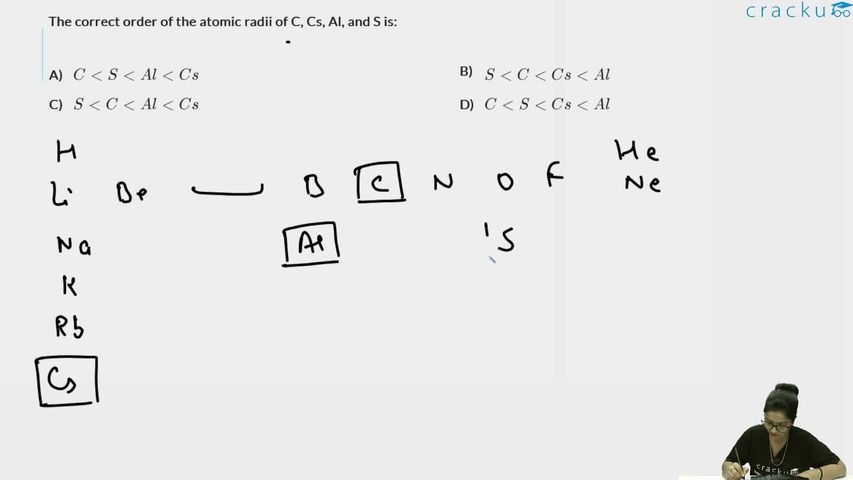
The correct order of the atomic radii of C, Cs, Al, and S is:
We recall the two chief periodic trends that govern atomic radius.
First, down a group (i.e., as the principal quantum number $$n$$ increases), the number of shells increases, so the atomic radius increases.
Second, left to right across a period, the nuclear charge $$Z$$ increases while the principal quantum number remains the same, so the effective nuclear charge $$Z_{\text{eff}}$$ felt by the outer electrons rises. This greater pull contracts the electron cloud, hence the atomic radius decreases.
Now we place each given element in the periodic table:
$$\begin{aligned} \text{C} &: \text{Group }14,\; \text{Period }2 \\ \text{S} &: \text{Group }16,\; \text{Period }3 \\ \text{Al} &: \text{Group }13,\; \text{Period }3 \\ \text{Cs} &: \text{Group }1,\; \text{Period }6 \end{aligned}$$
Because caesium (Cs) lies farthest down the table (Period 6), it possesses the most shells. By the “down-a-group” rule, it must have the largest radius of the four elements.
Next we compare the three elements that are much higher in the table: carbon (C) from Period 2 and aluminium (Al) and sulphur (S) from Period 3.
Since Period 3 elements have one more principal shell than Period 2 elements, both Al and S will naturally be larger than C. So at this stage we have
$$C < \bigl(\text{Al, S}\bigr) \; \text{and all } < Cs.$$
To decide between Al and S, we look within Period 3. Moving from left to right, atomic radius decreases. Aluminium sits in Group 13 while sulphur sits further right in Group 16. Therefore, within the same period,
$$\text{Al} \; (G13) > \text{S} \; (G16).$$
Putting every comparison together gives the ascending sequence
$$C \; < \; S \; < \; Al \; < \; Cs.$$
Thus, when written as required, the correct order of atomic radii is $$C < S < Al < Cs,$$ which exactly matches Option A.
Hence, the correct answer is Option A.
Was this solution helpful?
Click on the Email ☝️ to Watch the Video Solution
Create a FREE account and get:
_1.webp)

Educational materials for JEE preparation

Ask our AI anything

AI can make mistakes. Please verify important information.
AI can make mistakes. Please verify important information.
