
Join Our JEE Preparation Group
Prep with like-minded aspirants; Get access to free daily tests and study material.
Sign in
Please select an account to continue using cracku.in
↓ →
Join Our JEE Preparation Group
Prep with like-minded aspirants; Get access to free daily tests and study material.
Two blocks of the same metal having same mass and at temperature $$T_1$$, and $$T_2$$, respectively, are brought in contact with each other and allowed to attain thermal equilibrium at constant pressure. The change in entropy, $$\Delta S$$, for this process is:
Let the mass of each metal block be $$m$$ and let the specific heat of the metal at constant pressure be $$c_p$$. For a given block, its heat capacity at constant pressure is therefore
$$C_p = m\,c_p.$$
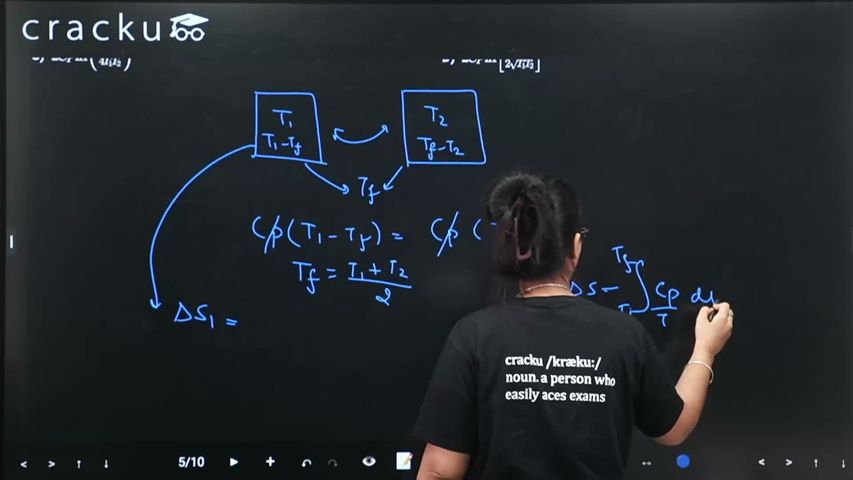
One block is initially at temperature $$T_1$$, the other at $$T_2$$. They are brought into thermal contact while the external pressure remains constant, and no heat is exchanged with the surroundings. Consequently the heat that flows out of the hotter block is absorbed by the colder block, and the combined system reaches a common final temperature, which we shall denote by $$T_f$$.
Because both blocks have the same heat capacity $$C_p$$, the condition of conservation of energy reads
$$C_p\,(T_1 - T_f) = C_p\,(T_f - T_2).$$
Canceling $$C_p$$ on both sides and rearranging gives
$$T_1 - T_f = T_f - T_2,$$
$$2T_f = T_1 + T_2,$$
$$T_f = \dfrac{T_1 + T_2}{2}.$$
Now we calculate the total change in entropy. The entropy change of a body whose temperature changes (reversibly) from $$T_i$$ to $$T_f$$ at constant pressure is obtained from the formula
$$\Delta S = \int_{T_i}^{T_f}\dfrac{C_p}{T}\,dT = C_p\ln\!\left(\dfrac{T_f}{T_i}\right).$$
Applying this to each block:
Entropy change of block 1 (initial temperature $$T_1$$):
$$\Delta S_1 = C_p\ln\!\left(\dfrac{T_f}{T_1}\right).$$
Entropy change of block 2 (initial temperature $$T_2$$):
$$\Delta S_2 = C_p\ln\!\left(\dfrac{T_f}{T_2}\right).$$
The total entropy change of the isolated two-block system is the sum:
$$
\begin{aligned}
\Delta S &= \Delta S_1 + \Delta S_2 \\
&= C_p\ln\!\left(\dfrac{T_f}{T_1}\right) + C_p\ln\!\left(\dfrac{T_f}{T_2}\right) \\
&= C_p\left[\ln T_f - \ln T_1 + \ln T_f - \ln T_2\right] \\
&= C_p\left[2\ln T_f - \ln(T_1T_2)\right] \\
&= C_p\ln\!\left(\dfrac{T_f^{\,2}}{T_1T_2}\right).
\end{aligned}
$$
Substituting the expression for $$T_f$$ obtained earlier,
$$T_f = \dfrac{T_1 + T_2}{2},$$
we have
$$
\begin{aligned}
\Delta S &= C_p\ln\!\left[\dfrac{\left(\dfrac{T_1 + T_2}{2}\right)^{\!2}}{T_1T_2}\right] \\
&= C_p\ln\!\left[\dfrac{(T_1 + T_2)^{2}}{4T_1T_2}\right].
\end{aligned}
$$
This expression is positive whenever $$T_1 \neq T_2$$, in agreement with the Second Law of Thermodynamics.
Hence, the correct answer is Option A.
Was this solution helpful?
Click on the Email ☝️ to Watch the Video Solution
Create a FREE account and get:
_1.webp)

Educational materials for JEE preparation

Ask our AI anything

AI can make mistakes. Please verify important information.
AI can make mistakes. Please verify important information.
