
Join Our JEE Preparation Group
Prep with like-minded aspirants; Get access to free daily tests and study material.
Sign in
Please select an account to continue using cracku.in
↓ →
Join Our JEE Preparation Group
Prep with like-minded aspirants; Get access to free daily tests and study material.
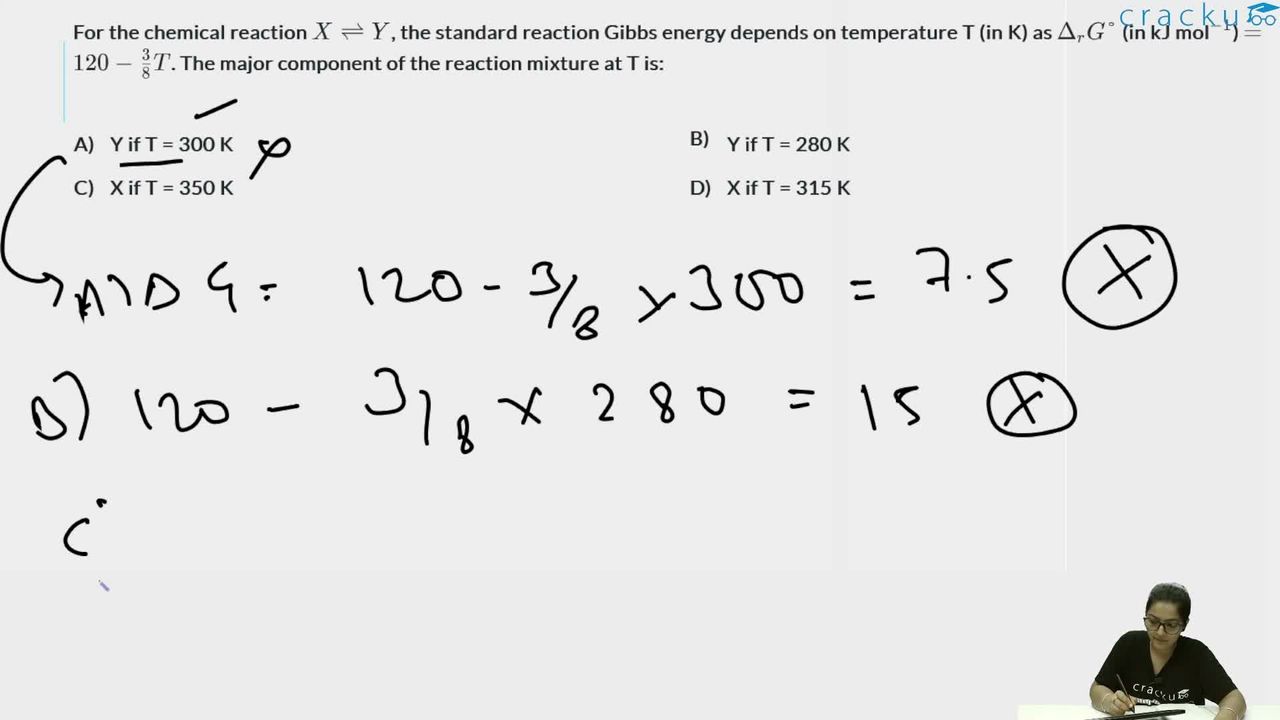
For the chemical reaction $$X \rightleftharpoons Y$$, the standard reaction Gibbs energy depends on temperature T (in K) as $$\Delta_r G°$$ (in kJ mol$$^{-1}$$) $$= 120 - \frac{3}{8}T$$. The major component of the reaction mixture at T is:
We start with the given temperature-dependence of the standard reaction Gibbs energy for the equilibrium
$$X \; \rightleftharpoons \; Y$$
The expression supplied in the question is
$$\Delta_r G^{\circ} \; (\text{kJ mol}^{-1}) \;=\; 120 \;-\; \dfrac{3}{8}\,T$$
where $$T$$ is the temperature in kelvin.
To decide which species is the major component at a particular temperature, we recall the fundamental thermodynamic relation
$$\Delta_r G^{\circ} \;=\; -\,R\,T \,\ln K$$
Here $$R$$ is the universal gas constant and $$K$$ is the equilibrium constant for the reaction $$X \rightleftharpoons Y$$.
When $$\Delta_r G^{\circ}<0$$, the right-hand side (product Y) is favoured, so $$K>1$$ and Y becomes the predominant species. Conversely, when $$\Delta_r G^{\circ}>0$$, the left-hand side (reactant X) is favoured, so $$K<1$$ and X predominates.
We now evaluate $$\Delta_r G^{\circ}$$ at each temperature mentioned in the options.
First we substitute $$T = 300\;\text{K}$$:
$$\Delta_r G^{\circ} \;=\; 120 \;-\; \dfrac{3}{8}\times 300 \;=\; 120 \;-\; 112.5 \;=\; 7.5 \;\text{kJ mol}^{-1}$$
The value is positive, so X is favoured, not Y. Hence Option A is incorrect.
Next we substitute $$T = 280\;\text{K}$$:
$$\Delta_r G^{\circ} \;=\; 120 \;-\; \dfrac{3}{8}\times 280 \;=\; 120 \;-\; 105 \;=\; 15 \;\text{kJ mol}^{-1}$$
This is again positive, meaning X is favoured, not Y. Thus Option B is incorrect.
Now we substitute $$T = 350\;\text{K}$$:
$$\Delta_r G^{\circ} \;=\; 120 \;-\; \dfrac{3}{8}\times 350 \;=\; 120 \;-\; 131.25 \;=\; -11.25 \;\text{kJ mol}^{-1}$$
The value is negative, so Y is favoured, not X. Therefore Option C is incorrect.
Finally we substitute $$T = 315\;\text{K}$$:
$$\Delta_r G^{\circ} \;=\; 120 \;-\; \dfrac{3}{8}\times 315 \;=\; 120 \;-\; 118.125 \;=\; 1.875 \;\text{kJ mol}^{-1}$$
This is a positive number, implying $$K<1$$, so the reactant X is present in greater amount than Y. Hence X is the major component at 315 K.
Among the four choices, only Option D matches this conclusion.
Hence, the correct answer is Option D.
Was this solution helpful?
Click on the Email ☝️ to Watch the Video Solution
Create a FREE account and get:
_1.webp)

Educational materials for JEE preparation

Ask our AI anything

AI can make mistakes. Please verify important information.
AI can make mistakes. Please verify important information.
