
Join Our JEE Preparation Group
Prep with like-minded aspirants; Get access to free daily tests and study material.
Sign in
Please select an account to continue using cracku.in
↓ →
Join Our JEE Preparation Group
Prep with like-minded aspirants; Get access to free daily tests and study material.
Consider the reaction $$N_2(g) + 3H_2(g) \rightleftharpoons 2NH_3(g)$$. The equilibrium constant of the above reaction is $$K_P$$. If pure ammonia is left to dissociate, the partial pressure of ammonia at equilibrium is given by (Assume that $$P_{NH_3} \ll P_{total}$$ at equilibrium)
We are given the equilibrium reaction
$$N_2(g)+3H_2(g)\rightleftharpoons 2NH_3(g)$$
and its equilibrium constant in terms of pressure, $$K_P$$, is defined for the forward (synthesis) direction as
$$K_P=\frac{(P_{NH_3})^{2}}{P_{N_2}\,(P_{H_2})^{3}}.$$
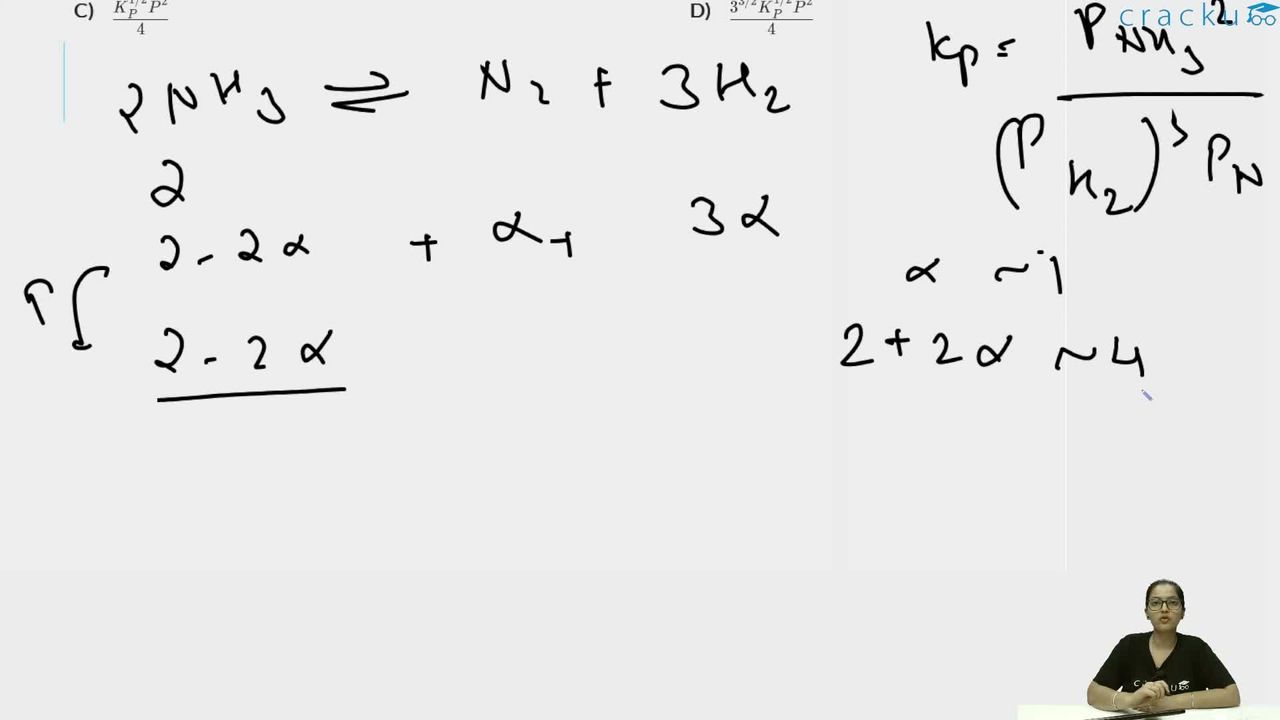
Suppose a sample of pure ammonia is introduced into a closed vessel at an initial pressure $$P$$. Because only ammonia is present at the start, it dissociates according to
$$2NH_3(g)\rightarrow N_2(g)+3H_2(g).$$
To keep every ratio integral, let us begin with two moles of $$NH_3$$. We now introduce the degree of dissociation $$\alpha$$, which is the fraction of the initial ammonia that actually decomposes.
Initial moles :
$$NH_3:~~2,\qquad N_2:~~0,\qquad H_2:~~0.$$
Change on dissociation :
$$NH_3:-2\alpha,\qquad N_2:+\alpha,\qquad H_2:+3\alpha.$$
Moles at equilibrium :
$$NH_3:2(1-\alpha),\qquad N_2:\alpha,\qquad H_2:3\alpha.$$
The total number of moles present at equilibrium is therefore
$$n_{\text{tot}}=2(1-\alpha)+\alpha+3\alpha=2+2\alpha.$$
Let the total pressure at equilibrium be the same symbol $$P$$ (the vessel is rigid and kept at constant temperature, so the letter $$P$$ will now represent the total pressure at equilibrium). The partial pressures are obtained from mole‐fraction ratios:
$$P_{NH_3}=P\frac{2(1-\alpha)}{2+2\alpha},\qquad P_{N_2}=P\frac{\alpha}{2+2\alpha},\qquad P_{H_2}=P\frac{3\alpha}{2+2\alpha}.$$
Because the problem tells us that at equilibrium $$P_{NH_3}\ll P_{\text{total}}$$, the dissociation is almost complete, that is, $$\alpha\approx1$$. Hence the denominator $$2+2\alpha\approx4$$ can be taken as the constant 4 for all three expressions. Introducing this approximation, we write
$$P_{NH_3}\approx P\frac{2(1-\alpha)}{4}=\frac{P}{2}(1-\alpha),$$
$$P_{N_2}\approx P\frac{\alpha}{4},\qquad P_{H_2}\approx P\frac{3\alpha}{4}.$$
Now we substitute these values into the equilibrium‐constant expression that we quoted at the very start:
$$K_P=\frac{(P_{NH_3})^{2}}{P_{N_2}(P_{H_2})^{3}} =\frac{\Bigl(\dfrac{P}{2}(1-\alpha)\Bigr)^{2}} {\Bigl(\dfrac{\alpha P}{4}\Bigr) \Bigl(\dfrac{3\alpha P}{4}\Bigr)^{3}}.$$
We carry out the algebra carefully, step by step.
First, square the numerator:
$$\Bigl(\dfrac{P}{2}(1-\alpha)\Bigr)^{2} =\dfrac{P^{2}(1-\alpha)^{2}}{4}.$$
Next, write the product in the denominator:
$$\Bigl(\dfrac{\alpha P}{4}\Bigr) \Bigl(\dfrac{3\alpha P}{4}\Bigr)^{3} =\dfrac{\alpha P}{4}\; \dfrac{27\alpha^{3}P^{3}}{64} =\dfrac{27\alpha^{4}P^{4}}{256}.$$
Placing numerator over denominator we get
$$K_P=\frac{\dfrac{P^{2}(1-\alpha)^{2}}{4}} {\dfrac{27\alpha^{4}P^{4}}{256}} =\frac{P^{2}(1-\alpha)^{2}}{4}\; \frac{256}{27\alpha^{4}P^{4}} =\frac{64}{27}\, \frac{(1-\alpha)^{2}}{\alpha^{4}P^{2}}.$$
Now isolate $$(1-\alpha)^{2}$$:
$$\bigl(1-\alpha\bigr)^{2}=K_P\,\frac{27}{64}\,\alpha^{4}P^{2}.$$
Because almost all the ammonia dissociates, we may put $$\alpha\approx1$$ on the right‐hand side (but we must retain $$(1-\alpha)$$ on the left because it is small but non‐zero). Replacing $$\alpha^{4}$$ with 1 we have
$$\bigl(1-\alpha\bigr)^{2}=K_P\,\frac{27}{64}\,P^{2}.$$
Taking the positive square root (partial pressures cannot be negative):
$$1-\alpha=\sqrt{K_P}\,\frac{\sqrt{27}}{8}\,P =\sqrt{K_P}\,\frac{3\sqrt{3}}{8}\,P.$$
Finally, insert this value into the earlier expression for the partial pressure of ammonia:
$$P_{NH_3}\approx\frac{P}{2}\,(1-\alpha) =\frac{P}{2}\; \sqrt{K_P}\, \frac{3\sqrt{3}}{8}\,P =\frac{3\sqrt{3}\,\sqrt{K_P}\,P^{2}}{16}.$$
Because $$3\sqrt{3}=3^{3/2}$$, we can rewrite the result in the compact form
$$P_{NH_3}=\frac{3^{3/2}\,K_P^{1/2}\,P^{2}}{16}.$$
Hence, the correct answer is Option A.
Was this solution helpful?
Click on the Email ☝️ to Watch the Video Solution
Create a FREE account and get:
_1.webp)

Educational materials for JEE preparation

Ask our AI anything

AI can make mistakes. Please verify important information.
AI can make mistakes. Please verify important information.
