
Join Our JEE Preparation Group
Prep with like-minded aspirants; Get access to free daily tests and study material.
Sign in
Please select an account to continue using cracku.in
↓ →
Join Our JEE Preparation Group
Prep with like-minded aspirants; Get access to free daily tests and study material.
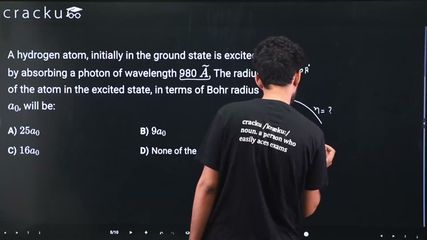
A hydrogen atom, initially in the ground state is excited by absorbing a photon of wavelength 980 $$\widetilde{A}$$. The radius of the atom in the excited state, in terms of Bohr radius $$a_0$$, will be:
For a hydrogen atom the energy of the level having principal quantum number $$n$$ is given by the Bohr formula
$$E_n=-\dfrac{13.6\ \text{eV}}{n^2}.$$
The atom is initially in its ground state, so its initial energy is
$$E_1=-13.6\ \text{eV}.$$
When it absorbs a photon of wavelength $$\lambda=980\ \text{\AA},$$ the energy of that photon is obtained from the relation $$E=\dfrac{hc}{\lambda}.$$
Using the useful constant $$hc\approx12400\ \text{eV\;\AA},$$ we have
$$E=\dfrac{12400\ \text{eV\;\AA}}{980\ \text{\AA}}=12.653\ \text{eV}\;(\text{approximately}).$$
This entire photon energy raises the electron from $$n=1$$ to some higher level $$n=n_f$$, so the energy conservation condition is
$$E=E_{n_f}-E_1.$$
Substituting the Bohr energies we obtain
$$12.653= \left(-\dfrac{13.6}{n_f^{2}}\right)-(-13.6)=13.6\left(1-\dfrac{1}{n_f^{2}}\right).$$
Dividing both sides by $$13.6$$ gives
$$1-\dfrac{1}{n_f^{2}}=\dfrac{12.653}{13.6}=0.9301.$$
Hence
$$\dfrac{1}{n_f^{2}}=1-0.9301=0.0699,$$
and therefore
$$n_f^{2}=\dfrac{1}{0.0699}\approx14.3.$$
The nearest integral value satisfying this is $$n_f=4$$ (because $$4^{2}=16$$ gives almost the same energy, whereas $$n=3$$ would be far off).
Thus the electron is excited to the fourth orbit.
For the Bohr model the radius of the $$n^{\text{th}}$$ orbit is
$$r_n=n^{2}a_{0},$$
so for $$n=4$$ we have
$$r_4=4^{2}a_{0}=16a_{0}.$$
Hence, the correct answer is Option C.
Was this solution helpful?
Click on the Email ☝️ to Watch the Video Solution
Create a FREE account and get:
_1.webp)

Educational materials for JEE preparation

Ask our AI anything

AI can make mistakes. Please verify important information.
AI can make mistakes. Please verify important information.
