
Join Our JEE Preparation Group
Prep with like-minded aspirants; Get access to free daily tests and study material.
Sign in
Please select an account to continue using cracku.in
↓ →
Join Our JEE Preparation Group
Prep with like-minded aspirants; Get access to free daily tests and study material.
Three charges $$Q$$, $$+q$$ and $$+q$$ are placed at the vertices of a right-angle isosceles triangle as shown below. The net electrostatic energy of the configuration is zero, if the value of Q is:
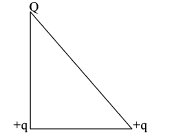
Hypotenuse distance between charge $$Q$$ and the rightmost charge $$+q$$: $$r = \sqrt{a^2 + a^2} = \sqrt{2}a$$
$$U_{\text{total}} = \sum_{i < j} \frac{kq_iq_j}{r_{ij}}$$
$$U_{\text{total}} = \frac{k(+q)(+q)}{a} + \frac{k(Q)(+q)}{a} + \frac{k(Q)(+q)}{\sqrt{2}a}$$
$$U_{\text{total}} = 0 \implies \frac{kq^2}{a} + \frac{kQq}{a} + \frac{kQq}{\sqrt{2}a} = 0$$
$$q + Q + \frac{Q}{\sqrt{2}} = 0 \implies Q\left(1 + \frac{1}{\sqrt{2}}\right) = -q$$
$$Q\left(\frac{\sqrt{2} + 1}{\sqrt{2}}\right) = -q \implies Q = \frac{-\sqrt{2}q}{\sqrt{2} + 1}$$
Was this solution helpful?
Create a FREE account and get:
_1.webp)

Educational materials for JEE preparation

Ask our AI anything

AI can make mistakes. Please verify important information.
AI can make mistakes. Please verify important information.
