
Join Our JEE Preparation Group
Prep with like-minded aspirants; Get access to free daily tests and study material.
Sign in
Please select an account to continue using cracku.in
↓ →
Join Our JEE Preparation Group
Prep with like-minded aspirants; Get access to free daily tests and study material.
In the figure shown below, the charge on the left plate of the $$10\mu F$$ capacitor is $$-30\mu C$$. The charge on the right plate of the $$6\mu F$$ capacitor is:
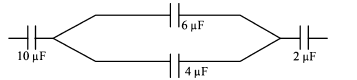
Given charge on the left plate of the $$10\ \mu\text{F}$$ capacitor is $$-30\ \mu\text{C}$$.
Magnitude of total charge flowing into the circuit combo: $$Q_{\text{total}} = 30\ \mu\text{C}$$
Since the $$10\ \mu\text{F}$$ capacitor is in series with the parallel combination of $$6\ \mu\text{F}$$ and $$4\ \mu\text{F}$$, the total charge splits between them:
$$Q_{\text{total}} = Q_6 + Q_4 = 30\ \mu\text{C}$$
Potential difference across the parallel branch is identical: $$V_p = \frac{Q_6}{6} = \frac{Q_4}{4} \implies Q_4 = \frac{4}{6}Q_6 = \frac{2}{3}Q_6$$
$$Q_6 + \frac{2}{3}Q_6 = 30 \implies \frac{5}{3}Q_6 = 30 \implies Q_6 = 18\ \mu\text{C}$$
The left plate of the $$10\ \mu\text{F}$$ capacitor is negative, meaning current/charge enters from the right side of the circuit, making the right plates of the parallel combination positive.
Was this solution helpful?
Create a FREE account and get:
_1.webp)

Educational materials for JEE preparation

Ask our AI anything

AI can make mistakes. Please verify important information.
AI can make mistakes. Please verify important information.
