
Join Our JEE Preparation Group
Prep with like-minded aspirants; Get access to free daily tests and study material.
Sign in
Please select an account to continue using cracku.in
↓ →
Join Our JEE Preparation Group
Prep with like-minded aspirants; Get access to free daily tests and study material.
In a Wheatstone bridge (see fig.), Resistances P and Q are approximately equal. When $$R = 400\Omega$$, the bridge is balanced. On interchanging P and Q, the value of R, for balance, is $$405\Omega$$. The value of Y is close to
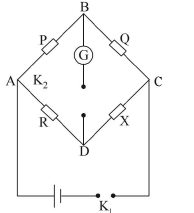
First recall the Wheatstone-bridge balance condition. When no current flows through the galvanometer, the ratio of the resistances in one pair of opposite arms equals the ratio in the other pair, i.e.
$$\dfrac{P}{Q}= \dfrac{R}{Y}$$
Here $$P$$ and $$Q$$ are approximately equal resistances in the two upper arms, $$R$$ is the variable resistance in a lower arm, and $$Y$$ is the fixed resistance in the remaining lower arm that we have to find.
We are given two different balance situations:
First balance - the arms are $$P,Q,R,Y$$ in that order and balance is obtained with $$R_1=400\;\Omega$$. Using the balance condition, we write
$$\dfrac{P}{Q}= \dfrac{R_1}{Y}$$
Substituting $$R_1=400\;\Omega$$ gives
$$\dfrac{P}{Q}= \dfrac{400}{Y} \quad -(1)$$
For convenience introduce the ratio
$$k=\dfrac{P}{Q}$$
Equation (1) then becomes
$$k = \dfrac{400}{Y}\quad\Longrightarrow\quad Y = \dfrac{400}{k} \quad -(2)$$
Second balance - now $$P$$ and $$Q$$ are interchanged, so the arms are $$Q,P,R,Y$$. Balance is obtained with a new resistance value $$R_2 = 405\;\Omega$$. Again applying the balance condition, but with the new order, we obtain
$$\dfrac{Q}{P}= \dfrac{R_2}{Y}$$
Since $$\dfrac{Q}{P}=\dfrac{1}{k}$$ and $$R_2=405\;\Omega$$, this becomes
$$\dfrac{1}{k}= \dfrac{405}{Y} \quad -(3)$$
Cross-multiplying equation (3) gives
$$Y = 405\,k \quad -(4)$$
Now we have two separate expressions for $$Y$$, namely equation (2) and equation (4). Because they represent the same resistance, we equate them:
$$\dfrac{400}{k}= 405\,k$$
Multiplying both sides by $$k$$ to clear the denominator, we get
$$400 = 405\,k^2$$
Solving for $$k^2$$,
$$k^2 = \dfrac{400}{405}$$
Taking the (positive) square root,
$$k = \sqrt{\dfrac{400}{405}}$$
We next substitute this value of $$k$$ back into either equation (2) or equation (4) to find $$Y$$. Using equation (4):
$$Y = 405\,k = 405\,\sqrt{\dfrac{400}{405}}$$
To simplify, notice that
$$405\,\sqrt{\dfrac{400}{405}} = \sqrt{405^2}\,\sqrt{\dfrac{400}{405}} = \sqrt{405}\,\sqrt{405}\,\sqrt{\dfrac{400}{405}}$$ $$= \sqrt{405}\,\sqrt{400} = \sqrt{405\times400}$$
Therefore,
$$Y = \sqrt{400\times405}\; \Omega$$
Calculating the product inside the square root,
$$400\times405 = 162{,}000$$
and taking the square root:
$$Y = \sqrt{162{,}000}\; \Omega \approx 402.5\; \Omega$$
Hence, the correct answer is Option D.
Was this solution helpful?
Click on the Email ☝️ to Watch the Video Solution
Create a FREE account and get:
_1.webp)

Educational materials for JEE preparation

Ask our AI anything

AI can make mistakes. Please verify important information.
AI can make mistakes. Please verify important information.
