Join WhatsApp Icon JEE WhatsApp Group
JEE Ray Optics Questions

JEE Ray Optics Questions

Question 1

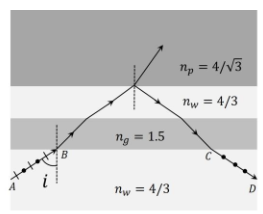
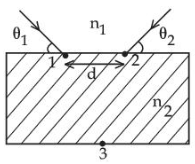
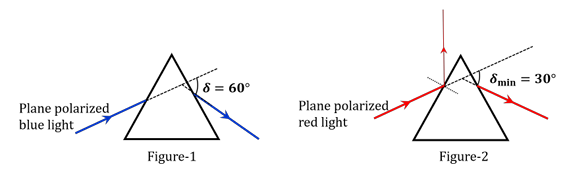
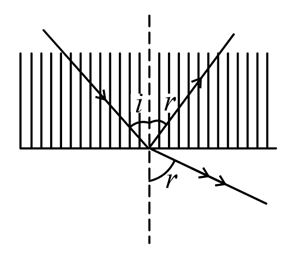
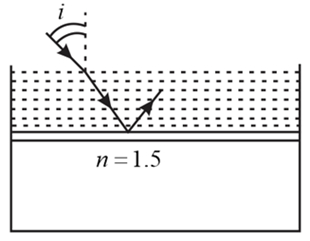
As shown in the figure, a ray $$AB$$ of unpolarized light enters from water of refractive index $$n_w=4/3$$ into a medium of refractive index $$n_p=4/\sqrt{3}$$ after passing through a glass plate of refractive index $$n_g=1.5$$ and a layer of water. At a particular incident angle $$i$$ the reflected ray $$CD$$ is polarized in the direction as shown in the figure. The value of $$i$$ (in degrees) is:

image
Question 2

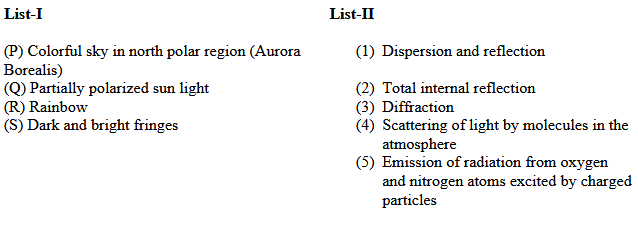
In the List-I, four optical effects are mentioned. The physical phenomena of light which are essential to describe these optical effects are given in List-II. Choose the option which describes the correct match between the entries in List-I to those in List-II.

image
Question 3

Consider an equilateral prism (refractive index $$\sqrt{2}$$). A ray of light is incident on its one surface at a certain angle $$i$$. If the emergent ray is found to graze along the other surface then the angle of refraction at the incident surface is close to ______.

Question 4

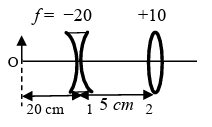
A thin convex lens of focal length 5 cm and a thin concave lens of focal length 4 cm are combined together (without any gap) and this combination has magnification $$m_{1}$$ when an object is placed 10 cm before the convex lens. Keeping the positions of convex lens and object undisturbed a gap of 1 cm is introduced between the lenses by moving the concave lens away, which lead to a change in magnification of total lens system to $$m_{2}$$.
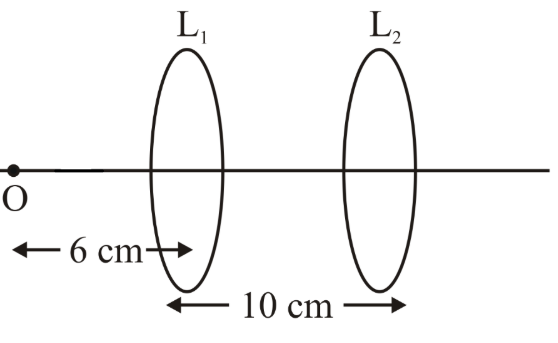
The value of $$ \mid\frac{m_{1}}{m_{2}}\mid $$ is______.

Question 5

A beam of polychromatic light passes through a thin prism of prism angle $$6^\circ$$. The refractive index of the material of the prism varies with wavelength $$(\lambda)$$ as $$n(\lambda)=\alpha\lambda+\dfrac{\beta}{\lambda^2}$$, where $$\alpha=3\,\mu\mathrm{m^{-1}}$$ and $$\beta=0.096\,\mu\mathrm{m^2}$$. If $$\lambda_{\min}$$ is the wavelength at which the angle of minimum deviation $$D_m$$ is smallest, then the correct value of $$D_m$$ at $$\lambda_{\min}$$ is

Question 6

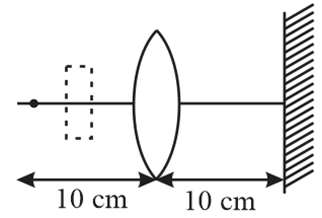
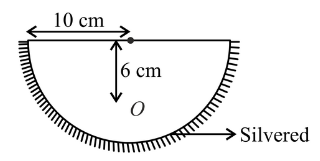
A thin biconvex lens is prepared from the glass ($$\mu = 1.5$$) both curved surfaces of which have equal radii of 20 cm each. Left side surface of the lens is silvered from outside to make it reflecting. To have the position of image and object at the same place, the object should be placed, from the lens at a distance of __________ cm.

Question 7

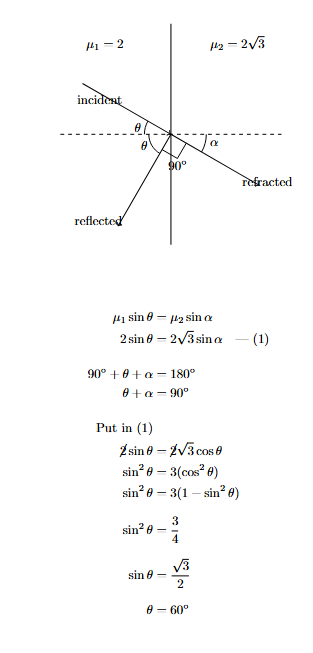
Au unpolarised light is incident at an inteiface of two dielectric media having refractive indices of 2 (incident medium) and $$2\sqrt{3}$$ (medium) respectively. To satisfy the condition that reflected and refracted rays are perpendicular to each other, the angle of incidence is ___.

Question 8

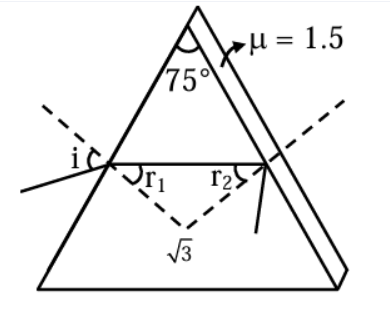
A prism of angle $$75^{o}$$ and refractive index $$\sqrt{3}$$ is coated with thin film of refractive index 1.5 only at the back exit surface. To have total internal reflection at the back exit surface the incident angle must be______.
($$\sin 15^{o}$$ = 0.25 and $$\sin 25^{o}$$ = 0.43)

Question 9

In parallax method for the determination of focal length of a concave mirror, the object should always be placed:

Question 10

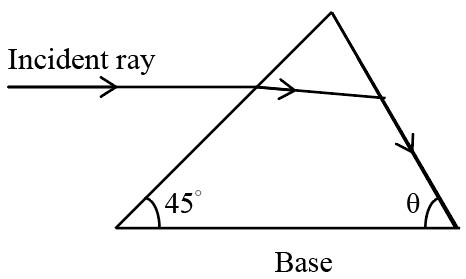
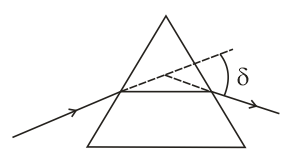
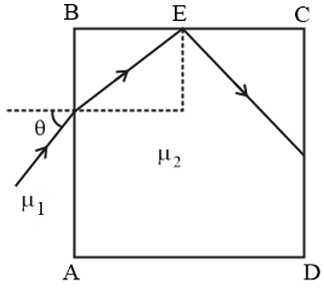
As shown in the diagram, when the incident ray is parallel to base of the prism, the emergent ray grazes along the second surface.

37 slot 2

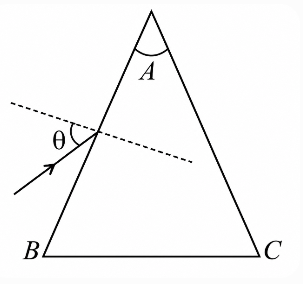
If refractive index of the material of prism is $$\sqrt{2}$$, the angle $$\theta$$ of prism is.

Question 11

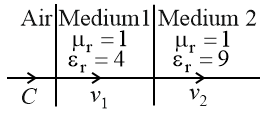
Consider light travelling from a medium A to medium B separated by a plane interface. If the light undergoes total internal reflection during its travel from medium A to B and the speed of light in media A and B are $$2.4\times10^{8}m/s\text{ and }2.7\times10^{8}m/s$$ respecti vely, then the value of critical angle is :

Question 12

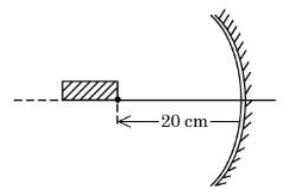
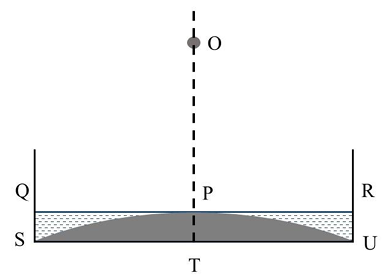
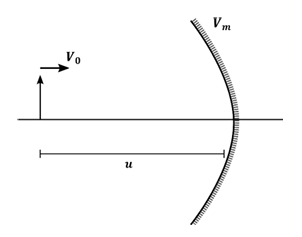
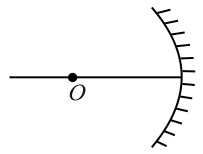
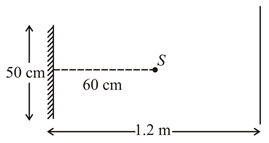
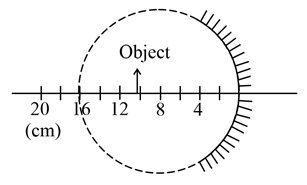
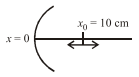
A rod of length 10 cm lies along the principal axis of a concave mirror of focal length 10 cm as shown in figure. The length of the image is _____ cm.

image
Question 13

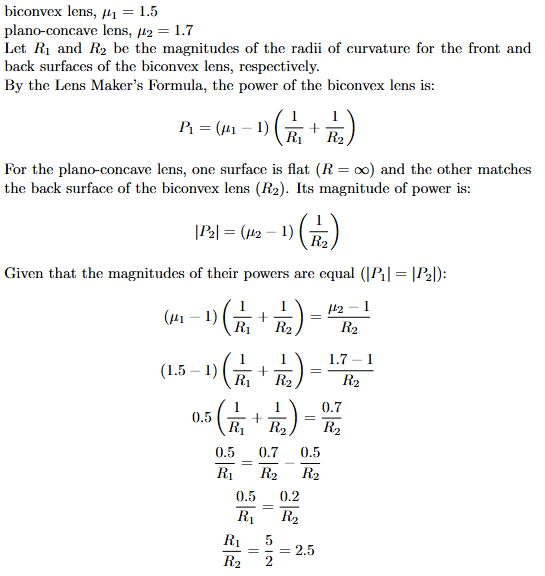
The magnitudes of power of a biconvex lens (refractive index 1.5) and that of a piano-concave lens (refractive index = l.7) are same. If the curvature of plano-concave lens exactly matches with the curvature of back surface of the biconvex lens, then ratio of radius of curvature of front and back smface of the biconvex lens is________.

Question 14

A double convex lens made of glass of refractive index $$1.5$$ and radii of curvature of the curved surfaces $$20\,\mathrm{cm}$$ each is immersed in a liquid of refractive index $$n_L$$. The correct plot showing the variation of the power, in the units of diopter ($$D$$), as a function of $$n_L$$ is:

Question 15

A ray of light passing through an equilateral prism is having velocity $$2.12 \times 10^8$$ m/s in the prism material, then the minimum angle of deviation is _______ degrees.

Question 16

A thin convex lens and a thin concave lens are kept in  contact and are co-axial. Which of the following statements is correct for this combination of two lenses ?

Question 17

For a thin symmetric prism made of glass (refractive index 1.5), the ratio of incident angle and minimum deviation will be __________.

Question 18

A convex lens is made from glass material having refractive index of 1.4 with same radius of curvature on both sides. The ratio of its focal length and radius of curvature is ______.

Video Solution
Question 19

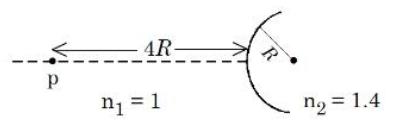
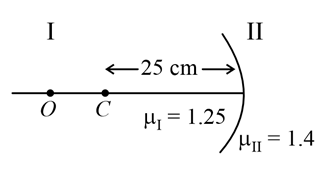
A spherical interface lens of radius $$R$$ separates two media of refractive indices 1 and 1.4 respectively as shown in the figure below. A point source is placed at a distance of $$4R$$ in front of spherical interface. The magnitude of the magnification of point source image is _______.

image
Question 20

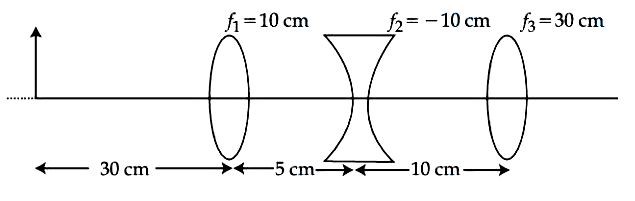
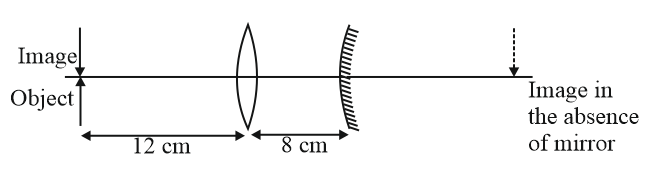
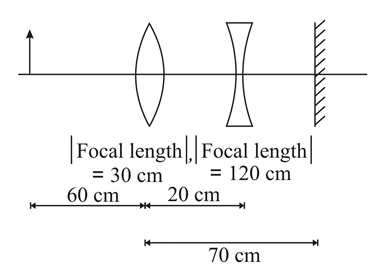
An object AB is placed 15 cm to the left of a convex lens P of focal length $$10 cm$$. Another convex lens Q is now placed $$15 cm$$ right of lens P . If the focal length of lens Q is 15 cm,  final image is______.

Question 21

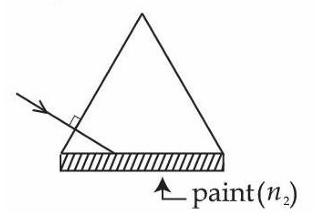
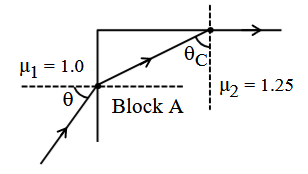
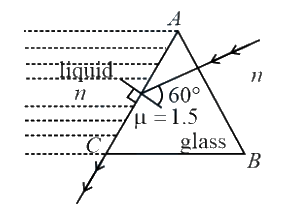
One side of an equilateral prism is painted by a transparent material of refractive index $$n_2$$. The refractive index of prism is 1.6. The minimum value of $$n_2$$ required for total internal reflection from painted face is ________ .

image
Question 22

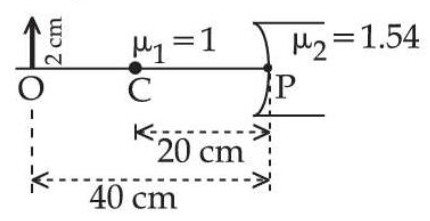
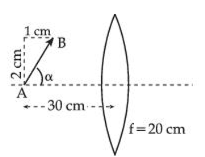
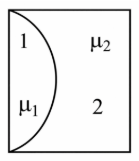
Refer the figure given below. $$\mu_1$$ and $$\mu_2$$ are refractive indices of air and lens material. The height of image will be __________ cm.

image
Question 23

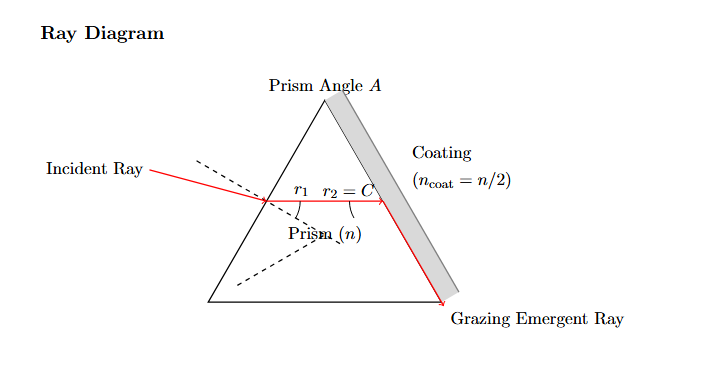
The exit surface of a prism with refractive index n is coated with a material having refractive index $$\frac{n}{2}$$. When this prism is set for minimum angle of deviation, it exactly meets the condition of critical angle. The prism angle is ___ .

Question 24

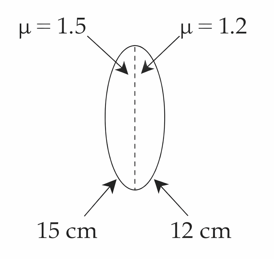
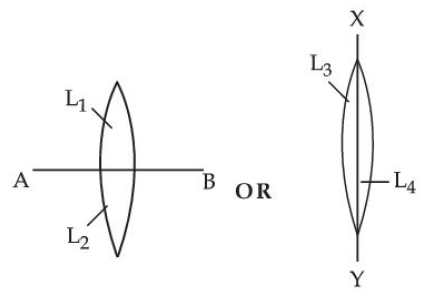
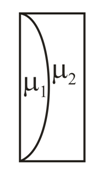
A biconvex lens is formed by using two thin planoconvex lenses, as shown in the figure. The refractive index and radius of curved surfaces are also mentioned in figure. When an object is placed on the left side of lens at a distance of 30 cm from the biconvex lens, the magnification of the image will be:

image
Question 25

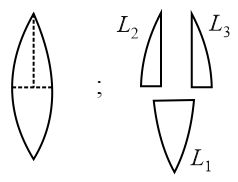
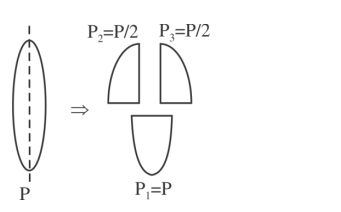
A compound microscope is designed with two symmetric biconvex lenses. The objective lens is cut vertically, creating two identical plano-convex lenses. One of them is used in place of original objective lens. To retain same magnification keeping the object distance unchanged, the tube length has to be

Question 26

Angle of minimum deviation is equal to the half of the angle of prism in an equilateral prism. The refractive index of the prism is __________.

Question 27

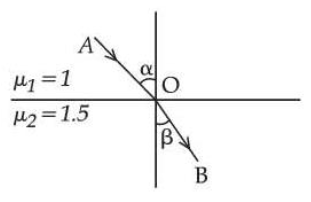
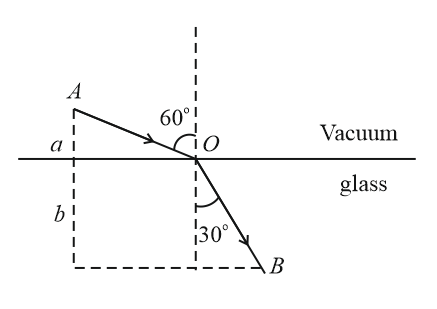
Light ray incident along a vector $$\vec{AO}$$ ($$\vec{AO} = 2\hat{i} - 3\hat{j}$$) emerges out along vector $$\vec{OB}$$ ($$\vec{OB} = C\hat{i} - 4\hat{j}$$) as shown in the figure below. The value of C is __________.

image
Question 28

A thin prism with angle 5° of refractive index 1.72 is combined with another prism of refractive index 1.9 to produce dispersion w ithout deviation. The angle of second prism is ____ .

Question 29

Distance between an object and three times magnified real image is 40 cm. The focal length of the minor used is ___ cm.

Question 30

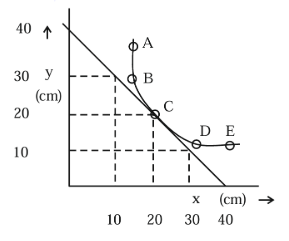
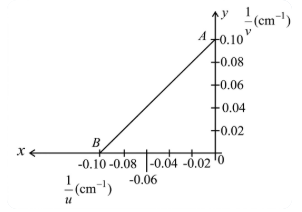
Five persons $$P_{1},P_{2},P_{3},P{4}, \text{and} P_{5}$$ recorded object distance (u) and image distance (v) using same convex lens having powei· +5D as (25,96), (30,62), (35,37), (45,35)
and (50,32) respectively. Identify correct statement

Question 31

For a transparent prism, if the angle of minimum deviation is equal to its refracting angle, the refractive index n of the prism satisfies.

Question 32

In a microscope of tube length 1O cm two convex lenses are arranged with focal length of 2 cm and 5 cm. Total magnification obtained with this system for normal adjustment is $$(5)^{k}$$ The value of k is ___.

Question 33

The size of the images of an object, formed by a thin lens are equal when the object is placed at two different positions 8 cm and 24 cm from the lens. The focal length of the lens is _______ cm.

Question 34

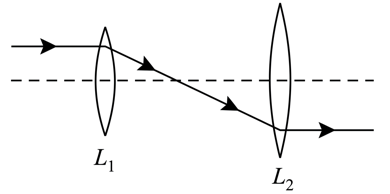
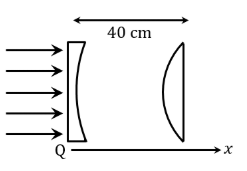
A collimated beam of light of diameter 2 mm is propagating along x-axis. The beam is required to be expanded in a collimated beam of diameter 14 mm using a system of two convex lenses. lf first lens has focal length 40 mm, then the focal length of second lens is ____ mm.

Question 35

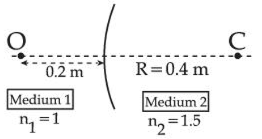
A parallel beam of light travelling in air (refractive index 1.0) is incident on a convex spherical glass surface of radius of curvature 50 cm. Refractive index of glass is 1.5. The rays converge to a point at a distance $$x$$ cm from the centre of the curvature of the spherical surface. The value of $$x$$ is ____ cm

Question 36

A convex lens of refractive index 1.5 and focal length f = 18 cm is immersed in water. The difference in focal lengths of the given lens when it is in water and in air is $$\alpha \times f$$. The value of$$\alpha$$ is______.
(refractive index of water = 4/3)

Question 37

If sunlight is focused on a paper using convex lens, it starts burning the paper in shortest time when the lens is kept at 30 cm above the paper. If the radius of curvature of the lens is 60 cm then the refractive index of the lens material is $$\frac{\alpha}{10}$$. The value of $$\alpha$$ is _________.

Question 38

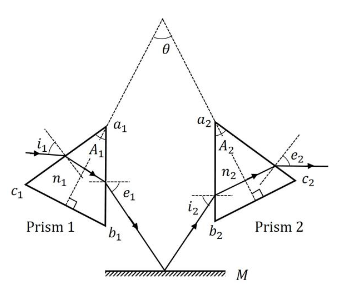
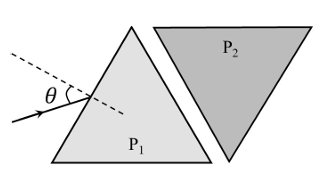
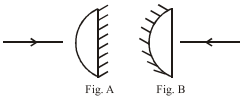
Consider two isosceles prisms 1 and 2 with prism angles $$A_1$$ and $$A_2$$ and refractive indices $$n_1$$ and $$n_2$$, respectively, as shown in the figure. The faces $$a_1b_1$$ and $$a_2b_2$$ are parallel to each other and perpendicular to the mirror $$M$$. If a ray of light is incident on the face $$a_1c_1$$ and emerges from the face $$a_2c_2$$, then the correct statement(s) is/are:

image
Question 39

A concave mirror of focal length 10 cm forms an image which is double the size of object when the object is placed at two different positions. The distance between the two positions of the object is __________ cm.

Question 40

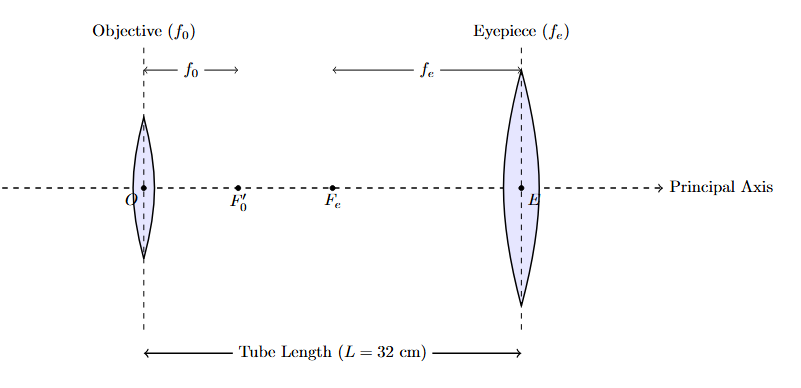
In a microscope the objective is having focal length $$f_{0}=2 \text{cm}$$ and eye-piece is having focal length $$f_{e} = 4 \text{cm}$$ The tube length is 32 cm. the magnification produced by this microscope for normal adjustment is _______.

50,000+ JEE Students Trusted Our Score Calculator

Predict your JEE Main percentile, rank & performance in seconds