
Join Our JEE Preparation Group
Prep with like-minded aspirants; Get access to free daily tests and study material.
Sign in
Please select an account to continue using cracku.in
↓ →
Join Our JEE Preparation Group
Prep with like-minded aspirants; Get access to free daily tests and study material.
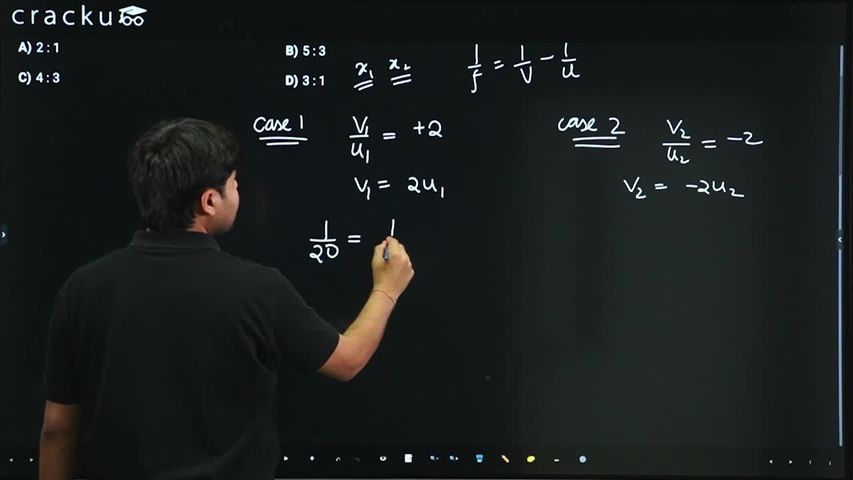
A convex lens of focal length 20 cm produces images of the same magnification 2 when an object is kept at two distances $$x_1$$ and $$x_2$$ ($$x_1 > x_2$$) from the lens. The ratio of $$x_1$$ and $$x_2$$ is:
We have a thin convex lens whose focal length is given as $$f = +20\ \text{cm}$$ (positive sign because a convex lens is converging).
For any lens the lens (Gaussian) formula is first stated:
$$\frac1f = \frac1v - \frac1u$$
where $$u$$ is the object distance (measured from the lens, taken negative for a real object on the incident-light side) and $$v$$ is the image distance (taken positive for a real image, negative for a virtual image).
The linear (lateral) magnification produced by the lens is defined as
$$m = \frac{h_i}{h_o} = \frac v u.$$
According to the question the magnitude of magnification is the same in two different situations and its value is $$|m| = 2$$. Thus, one situation corresponds to $$m = -2$$ (real, inverted image) and the other to $$m = +2$$ (virtual, erect image). Let the corresponding object distances be $$u_1$$ and $$u_2$$ and their magnitudes be $$x_1$$ and $$x_2$$ respectively. The condition given is $$x_1 > x_2$$, so naturally $$|u_1| > |u_2|$$.
First we treat the case $$m_1 = -2$$.
Because $$m_1 = \dfrac{v_1}{u_1} = -2,$$ we can write
$$v_1 = -2u_1.$$
Substituting this relation into the lens formula, we obtain
$$\frac1f \;=\; \frac1{v_1} - \frac1{u_1} \;=\; \frac1{-2u_1} - \frac1{u_1}.$$
Simplifying the right-hand side step by step,
$$\frac1{-2u_1} - \frac1{u_1} \;=\; -\frac1{2u_1} - \frac1{u_1} \;=\; -\frac1{2u_1} - \frac{2}{2u_1} \;=\; -\frac{3}{2u_1}.$$
Equating this to $$\dfrac1f$$ and putting $$f = +20\ \text{cm}$$ gives
$$\frac1{20} = -\frac{3}{2u_1}.$$
Cross-multiplying,
$$2u_1 = -3 \times 20,$$
$$u_1 = -\frac{60}{2} = -30\ \text{cm}.$$
The magnitude of the object distance is therefore
$$x_1 = |u_1| = 30\ \text{cm}.$$
Now we analyse the case $$m_2 = +2$$.
Because $$m_2 = \dfrac{v_2}{u_2} = +2,$$ we have
$$v_2 = 2u_2.$$
Substituting in the lens formula once again,
$$\frac1f = \frac1{v_2} - \frac1{u_2} = \frac1{2u_2} - \frac1{u_2}.$$
Simplifying term by term,
$$\frac1{2u_2} - \frac1{u_2} = \frac1{2u_2} - \frac{2}{2u_2} = -\frac1{2u_2}.$$
Setting this equal to $$\dfrac1{20}$$ yields
$$\frac1{20} = -\frac1{2u_2}.$$
Cross-multiplying,
$$2u_2 = -20,$$
$$u_2 = -10\ \text{cm}.$$
Thus the magnitude of the second object distance is
$$x_2 = |u_2| = 10\ \text{cm}.$$
Finally we determine the required ratio:
$$\frac{x_1}{x_2} = \frac{30}{10} = 3 : 1.$$
Hence, the correct answer is Option D (3 : 1).
Was this solution helpful?
Click on the Email ☝️ to Watch the Video Solution
Create a FREE account and get:
_1.webp)

Educational materials for JEE preparation

Ask our AI anything

AI can make mistakes. Please verify important information.
AI can make mistakes. Please verify important information.


