
Join Our JEE Preparation Group
Prep with like-minded aspirants; Get access to free daily tests and study material.
Sign in
Please select an account to continue using cracku.in
↓ →
Join Our JEE Preparation Group
Prep with like-minded aspirants; Get access to free daily tests and study material.
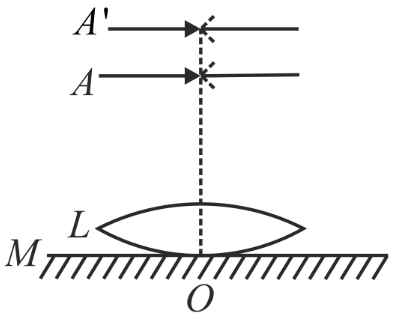
A thin convex lens L (refractive index = 1.5) is placed on a plane mirror M. When a pin is placed at A, such that OA = 18 cm, its real inverted image is formed at A itself, as shown in figure. When liquid of refractive index $$\mu_l$$ is put between the lens and the mirror, the pin has to be moved to A', such that OA' = 27 cm, to get its inverted real image at A' itself. The value of $$\mu_l$$ will be:
Step-by-Step Solution
1. Case 1: Only the Convex Lens is Present (No Liquid)
When the object pin is placed at $$A$$ ($$OA = 18\text{ cm}$$), light rays from the pin pass through the convex lens, reflect normally off the plane mirror, and retrace their path to form an image at $$A$$ itself.
For the rays to reflect normally from the plane mirror and retrace their path, they must emerge parallel from the convex lens. This means the object is located at the focal point of the convex lens ($$L$$).
$$f_1 = OA = 18\text{ cm}$$
Using the lens maker's formula for an equi-convex lens (assuming radii of curvature of both surfaces are equal in magnitude, $$R_1 = R$$ and $$R_2 = -R$$):
$$\frac{1}{f_1} = (\mu_g - 1)\left(\frac{1}{R} - \frac{1}{-R}\right) = (\mu_g - 1)\frac{2}{R}$$
Substitute $$\mu_g = 1.5$$ and $$f_1 = 18\text{ cm}$$:
$$\frac{1}{18} = (1.5 - 1)\frac{2}{R}$$
$$\frac{1}{18} = 0.5 \times \frac{2}{R} = \frac{1}{R} \implies R = 18\text{ cm}$$
2. Case 2: Liquid is Filled Between Lens and Mirror
When a liquid of refractive index $$\mu_l$$ is introduced between the convex lens and the plane mirror, a new plano-concave liquid lens is formed.
The properties of this liquid lens ($$L_2$$) are:
Using the lens maker's formula for the liquid lens:
$$\frac{1}{f_2} = (\mu_l - 1)\left(\frac{1}{-18} - \frac{1}{\infty}\right)$$
$$\frac{1}{f_2} = -\frac{(\mu_l - 1)}{18}$$
3. Equivalent Focal Length of the Combination
The two lenses are in contact, forming a combination. The new position of the pin is at $$A'$$ where $$OA' = 27\text{ cm}$$. Since the image forms at $$A'$$ itself, this new distance represents the equivalent focal length ($$F$$) of the combined lens system:
$$F = 27\text{ cm}$$
The formula for the equivalent focal length of two thin lenses in contact is:
$$\frac{1}{F} = \frac{1}{f_1} + \frac{1}{f_2}$$
Substitute the values of $$F$$, $$f_1$$, and $$f_2$$ into the formula:
$$\frac{1}{27} = \frac{1}{18} - \frac{(\mu_l - 1)}{18}$$
Rearrange the terms to solve for $$\mu_l$$:
$$\frac{\mu_l - 1}{18} = \frac{1}{18} - \frac{1}{27}$$
Take the common denominator on the right side:
$$\frac{\mu_l - 1}{18} = \frac{3 - 2}{54} = \frac{1}{54}$$
Multiply both sides by $$18$$:
$$\mu_l - 1 = \frac{18}{54}$$
$$\mu_l - 1 = \frac{1}{3}$$
$$\mu_l = 1 + \frac{1}{3} = \frac{4}{3}$$
Final Answer
The value of the refractive index of the liquid $$\mu_l$$ is $$\frac{4}{3}$$ (or $$\approx 1.33$$).
Was this solution helpful?
Create a FREE account and get:
_1.webp)

Educational materials for JEE preparation

Ask our AI anything

AI can make mistakes. Please verify important information.
AI can make mistakes. Please verify important information.


