
Join Our JEE Preparation Group
Prep with like-minded aspirants; Get access to free daily tests and study material.
Sign in
Please select an account to continue using cracku.in
↓ →
Join Our JEE Preparation Group
Prep with like-minded aspirants; Get access to free daily tests and study material.
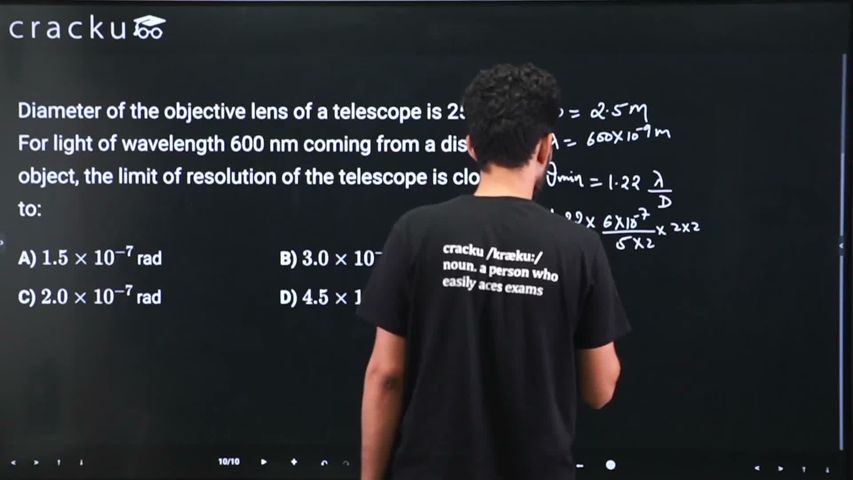
Diameter of the objective lens of a telescope is 250 cm. For light of wavelength 600 nm coming from a distant object, the limit of resolution of the telescope is close to:
We are dealing with the diffraction-limited resolving power of a telescope whose objective is a circular aperture. For such an aperture, the smallest angular separation $$\theta_{\min}$$ that can be resolved is given by the Rayleigh criterion
$$\theta_{\min}=1.22\,\frac{\lambda}{D}$$
where $$\lambda$$ is the wavelength of the light and $$D$$ is the diameter of the objective.
First we convert all quantities to SI units. The diameter is given as 250 cm:
$$D = 250\;\text{cm} = 250 \times 10^{-2}\;\text{m} = 2.5\;\text{m}$$
The wavelength is 600 nm:
$$\lambda = 600\;\text{nm} = 600 \times 10^{-9}\;\text{m}$$
We simplify the wavelength value for easier calculation:
$$600 \times 10^{-9}\;\text{m} = 6.0 \times 10^{2} \times 10^{-9}\;\text{m} = 6.0 \times 10^{-7}\;\text{m}$$
Now we substitute $$\lambda = 6.0 \times 10^{-7}\;\text{m}$$ and $$D = 2.5\;\text{m}$$ into the Rayleigh formula:
$$\theta_{\min}=1.22 \times \frac{6.0 \times 10^{-7}\;\text{m}}{2.5\;\text{m}}$$
We calculate the numerator first:
$$1.22 \times 6.0 \times 10^{-7} = 7.32 \times 10^{-7}$$
Now we divide by 2.5:
$$\theta_{\min} = \frac{7.32 \times 10^{-7}}{2.5}$$
To divide, we handle the coefficients and powers of ten separately:
$$\frac{7.32}{2.5} = 2.928$$
The power of ten remains $$10^{-7}$$, so
$$\theta_{\min} \approx 2.928 \times 10^{-7}\;\text{rad}$$
Rounding to two significant figures to match the precision of the options, we write
$$\theta_{\min} \approx 3.0 \times 10^{-7}\;\text{rad}$$
This value matches Option B.
Hence, the correct answer is Option B.
Was this solution helpful?
Click on the Email ☝️ to Watch the Video Solution
Create a FREE account and get:
_1.webp)

Educational materials for JEE preparation

Ask our AI anything

AI can make mistakes. Please verify important information.
AI can make mistakes. Please verify important information.


