
Join Our JEE Preparation Group
Prep with like-minded aspirants; Get access to free daily tests and study material.
Sign in
Please select an account to continue using cracku.in
↓ →
Join Our JEE Preparation Group
Prep with like-minded aspirants; Get access to free daily tests and study material.
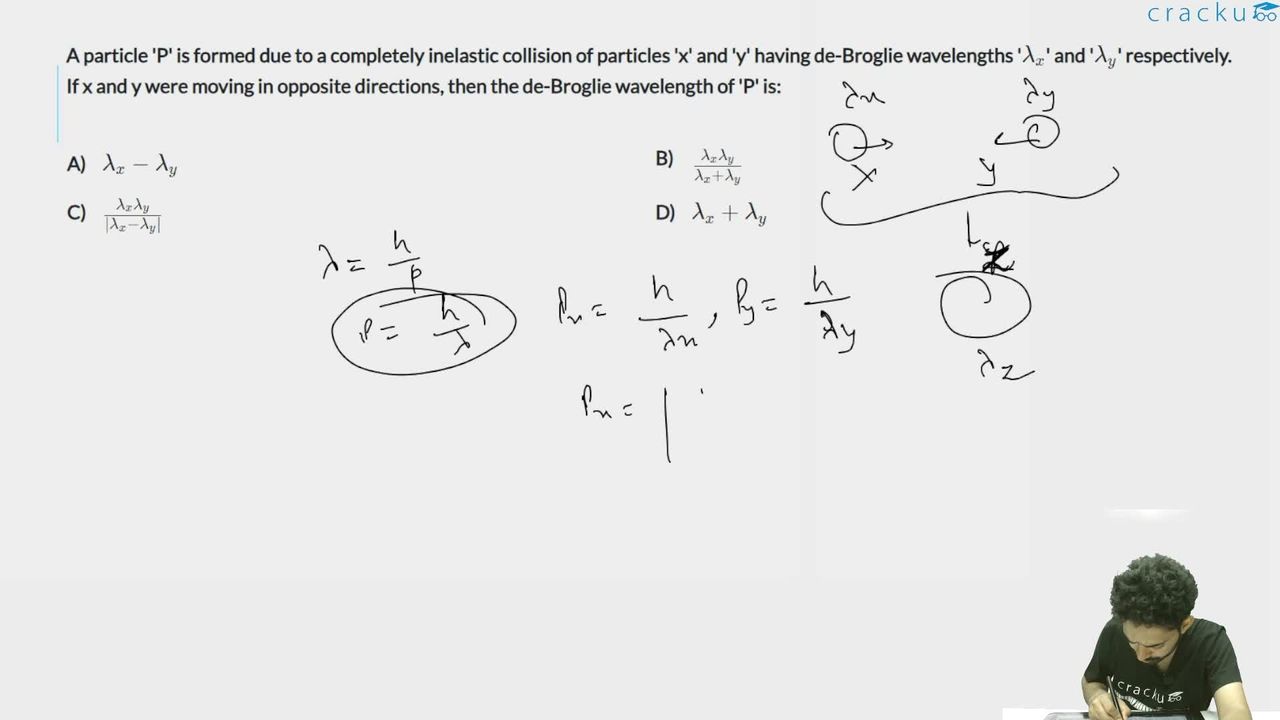
A particle 'P' is formed due to a completely inelastic collision of particles 'x' and 'y' having de-Broglie wavelengths '$$\lambda_x$$' and '$$\lambda_y$$' respectively. If x and y were moving in opposite directions, then the de-Broglie wavelength of 'P' is:
We begin with de Broglie’s relation, which links the magnitude of a particle’s linear momentum $$p$$ to its wavelength $$\lambda$$ by the well-known formula
$$\lambda=\dfrac{h}{p},$$
where $$h$$ is Planck’s constant. Rearranging, we also have
$$p=\dfrac{h}{\lambda}.$$
Let us denote the momenta of the two initial particles by $$\vec p_x$$ and $$\vec p_y$$. Their given de-Broglie wavelengths are $$\lambda_x$$ and $$\lambda_y$$ respectively. Choosing the positive $$x$$-direction as the direction of motion of particle x, we can write
$$\vec p_x = +\,\dfrac{h}{\lambda_x}\,\hat i,$$
because its momentum points along $$+\hat i$$. Since particle y is moving in the opposite direction, its momentum is
$$\vec p_y = -\,\dfrac{h}{\lambda_y}\,\hat i.$$
The collision is completely inelastic, so the two particles stick together and form a single composite particle ‘P’. Linear momentum is always conserved, therefore
$$\vec p_P = \vec p_x + \vec p_y.$$
Substituting the expressions just obtained, we get
$$\vec p_P = \left(+\dfrac{h}{\lambda_x}\right)\hat i + \left(-\dfrac{h}{\lambda_y}\right)\hat i = \left(\dfrac{h}{\lambda_x} - \dfrac{h}{\lambda_y}\right)\hat i = h\left(\dfrac{1}{\lambda_x} - \dfrac{1}{\lambda_y}\right)\hat i.$$
The magnitude of this total momentum is therefore
$$p_P = h\,\Bigl|\,\dfrac{1}{\lambda_x} - \dfrac{1}{\lambda_y}\Bigr|.$$
Now we once again use the de-Broglie relation for the composite particle:
$$\lambda_P=\dfrac{h}{p_P}.$$
Substituting the expression we have just found for $$p_P$$, we obtain
$$\lambda_P=\dfrac{h}{\,h\,\Bigl|\,\dfrac{1}{\lambda_x}-\dfrac{1}{\lambda_y}\Bigr|} =\dfrac{1}{\Bigl|\,\dfrac{1}{\lambda_x}-\dfrac{1}{\lambda_y}\Bigr|}.$$
Combining the fractions in the denominator gives
$$\lambda_P =\dfrac{1}{\Bigl|\dfrac{\lambda_y-\lambda_x}{\lambda_x\lambda_y}\Bigr|} =\dfrac{\lambda_x\lambda_y}{\bigl|\lambda_y-\lambda_x\bigr|}.$$
This matches option C in the list provided.
Hence, the correct answer is Option C.
Was this solution helpful?
Click on the Email ☝️ to Watch the Video Solution
Create a FREE account and get:
_1.webp)

Educational materials for JEE preparation

Ask our AI anything

AI can make mistakes. Please verify important information.
AI can make mistakes. Please verify important information.


