
Join Our JEE Preparation Group
Prep with like-minded aspirants; Get access to free daily tests and study material.
Sign in
Please select an account to continue using cracku.in
↓ →
Join Our JEE Preparation Group
Prep with like-minded aspirants; Get access to free daily tests and study material.
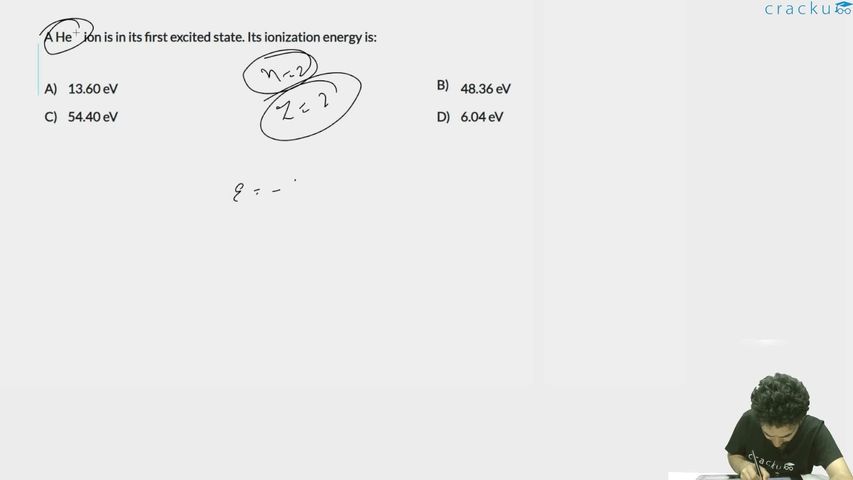
For a hydrogen-like ion, such as $$\text{He}^+$$ whose nucleus has charge number $$Z=2$$, the energy of an electron in the $$n^{\text{th}}$$ Bohr orbit is given by the well-known formula
$$E_n=-\,13.6\,\text{eV}\;\frac{Z^{2}}{n^{2}}.$$
We have an electron in the first excited state, which corresponds to the principal quantum number $$n=2$$ (because the ground state is $$n=1$$ and the next level is $$n=2$$).
Substituting $$Z=2$$ and $$n=2$$ into the formula, we get
$$E_2=-\,13.6\,\text{eV}\;\frac{(2)^{2}}{(2)^{2}}=-\,13.6\,\text{eV}.$$
The negative sign simply indicates that the electron is bound. To remove (ionize) the electron completely, we must supply energy equal in magnitude to this binding energy while taking the electron to $$E=\;0$$ at infinity. Hence, the ionization energy from this state is
$$\text{Ionization energy}=|E_2|=13.6\,\text{eV}.$$
Among the given options, 13.60 eV is listed as option A.
Hence, the correct answer is Option A.
Was this solution helpful?
Click on the Email ☝️ to Watch the Video Solution
Create a FREE account and get:
_1.webp)

Educational materials for JEE preparation

Ask our AI anything

AI can make mistakes. Please verify important information.
AI can make mistakes. Please verify important information.


