
Join Our JEE Preparation Group
Prep with like-minded aspirants; Get access to free daily tests and study material.
Sign in
Please select an account to continue using cracku.in
↓ →
Join Our JEE Preparation Group
Prep with like-minded aspirants; Get access to free daily tests and study material.
One plano-convex and one plano-concave lens of the same radius of curvature R but of different materials are joined side by side as shown in the figure. If the refractive index of the material of 1 is $$\mu_1$$ and that of 2 is $$\mu_2$$, then the focal length of the combination is:
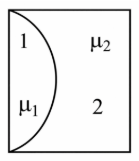
The two lenses are thin and are cemented together by their plane faces. Because the plane faces are in perfect contact, the separation between the lenses is practically zero, so their combination can be treated as a single thin system. For two thin lenses in contact we always use the formula
$$\frac{1}{F} \;=\; \frac{1}{f_1}\;+\;\frac{1}{f_2},$$
where $$F$$ is the focal length of the combination, $$f_1$$ is the focal length of the first lens and $$f_2$$ is the focal length of the second lens.
We now calculate $$f_1$$ and $$f_2$$ one by one with the Lens-maker’s formula. The Lens-maker’s formula for a thin lens surrounded by air (refractive index $$\mu=1$$) is first stated:
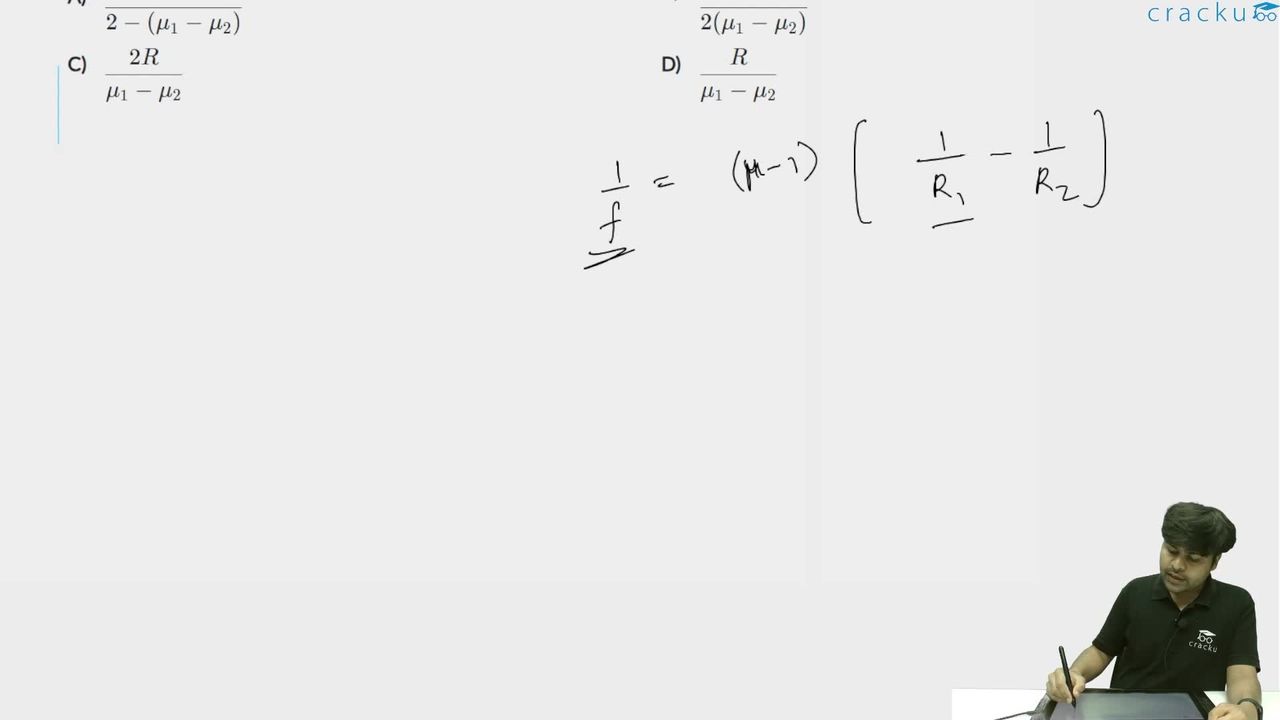
$$\frac{1}{f} \;=\;(\mu - 1)\left(\frac{1}{R_1}-\frac{1}{R_2}\right).$$
Here $$\mu$$ is the refractive index of the lens material, $$R_1$$ is the radius of curvature of the first surface met by the light and $$R_2$$ is that of the second surface. According to the usual sign convention the radius is taken positive when the centre of curvature lies to the right of the surface (in the direction of incident light) and negative otherwise.
Plano-convex lens (material 1)
For the plano-convex lens the first surface is the curved convex surface of radius $$R$$ and the second surface is plane, so $$R_2=\infty$$. Therefore
$$\frac{1}{f_1}= (\mu_1-1)\left(\frac{1}{R}-\frac{1}{\infty}\right) = (\mu_1-1)\left(\frac{1}{R}-0\right) =\frac{\mu_1-1}{R}.$$
So the focal length of the plano-convex lens is
$$f_1=\frac{R}{\mu_1-1}.$$
Plano-concave lens (material 2)
For the plano-concave lens the first surface is plane, so $$R_1=\infty$$, and the second surface is concave with the same magnitude of radius $$R$$.
Because the surface is concave, its centre of curvature lies on the same side as the emergent light and hence (with our sign convention) $$R_2=+R$$.
Substituting into the Lens-maker’s formula:
$$\frac{1}{f_2}= (\mu_2-1)\left(\frac{1}{\infty}-\frac{1}{R}\right) = (\mu_2-1)\left(0-\frac{1}{R}\right) = -\,\frac{\mu_2-1}{R}.$$
Thus
$$f_2 = -\,\frac{R}{\mu_2-1}.$$
(The negative sign correctly shows that the plano-concave lens is diverging.)
Power of the combination
Using the additivity of powers, we substitute $$\frac{1}{f_1}$$ and $$\frac{1}{f_2}$$ into the contact-lens formula:
$$\frac{1}{F}= \frac{1}{f_1}+\frac{1}{f_2} =\frac{\mu_1-1}{R} \;+\;\Bigl(-\frac{\mu_2-1}{R}\Bigr) =\frac{\mu_1-1-\mu_2+1}{R} =\frac{\mu_1-\mu_2}{R}.$$
Finally, inverting this result gives the focal length of the cemented combination:
$$F=\frac{R}{\mu_1-\mu_2}.$$
Hence, the correct answer is Option 4.
Was this solution helpful?
Click on the Email ☝️ to Watch the Video Solution
Create a FREE account and get:
_1.webp)

Educational materials for JEE preparation

Ask our AI anything

AI can make mistakes. Please verify important information.
AI can make mistakes. Please verify important information.
