
Join Our JEE Preparation Group
Prep with like-minded aspirants; Get access to free daily tests and study material.
Sign in
Please select an account to continue using cracku.in
↓ →
Join Our JEE Preparation Group
Prep with like-minded aspirants; Get access to free daily tests and study material.
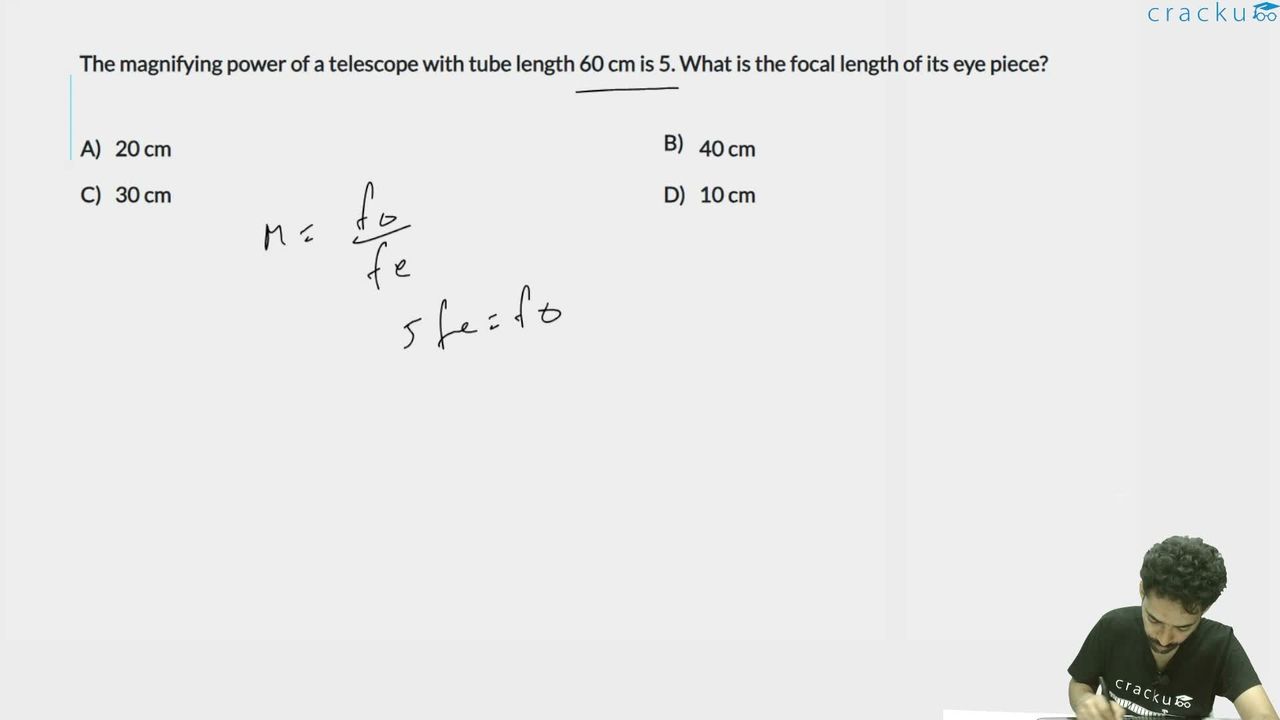
The magnifying power of a telescope with tube length 60 cm is 5. What is the focal length of its eye piece?
For an astronomical telescope adjusted for a final image at infinity, we first recall the two standard relations:
1. The magnifying power (angular magnification) is given by the formula
$$M \;=\;\frac{f_o}{f_e}$$
where $$f_o$$ is the focal length of the objective and $$f_e$$ is the focal length of the eye-piece.
2. The “tube length” of the telescope, that is, the distance between the objective and the eye-piece when the telescope is in normal adjustment, is simply the sum of their focal lengths:
$$L \;=\;f_o \;+\;f_e.$$
Now we substitute the numerical data given in the question. The magnifying power is
$$M \;=\;5,$$
and the tube length is
$$L \;=\;60 \text{ cm}.$$
From the magnification formula we can express the objective’s focal length in terms of the eye-piece’s focal length:
$$f_o \;=\;M\,f_e.$$
So, replacing $$f_o$$ by $$M f_e$$ in the tube-length relation, we have
$$L \;=\;f_o + f_e \;=\;M f_e + f_e.$$
Factorising $$f_e$$ on the right-hand side gives
$$L \;=\;(M + 1)\,f_e.$$
Now we substitute the known values $$L = 60 \text{ cm}$$ and $$M = 5$$:
$$60 \;=\;(5 + 1)\,f_e.$$
That simplifies to
$$60 \;=\;6\,f_e.$$
Dividing both sides by 6 to isolate $$f_e$$, we obtain
$$f_e \;=\;\frac{60}{6} \;=\;10 \text{ cm}.$$
Thus, the focal length of the eye-piece of the telescope is $$10 \text{ cm}$$.
Hence, the correct answer is Option D.
Was this solution helpful?
Click on the Email ☝️ to Watch the Video Solution
Create a FREE account and get:
_1.webp)

Educational materials for JEE preparation

Ask our AI anything

AI can make mistakes. Please verify important information.
AI can make mistakes. Please verify important information.
