
Join Our JEE Preparation Group
Prep with like-minded aspirants; Get access to free daily tests and study material.
Sign in
Please select an account to continue using cracku.in
↓ →
Join Our JEE Preparation Group
Prep with like-minded aspirants; Get access to free daily tests and study material.
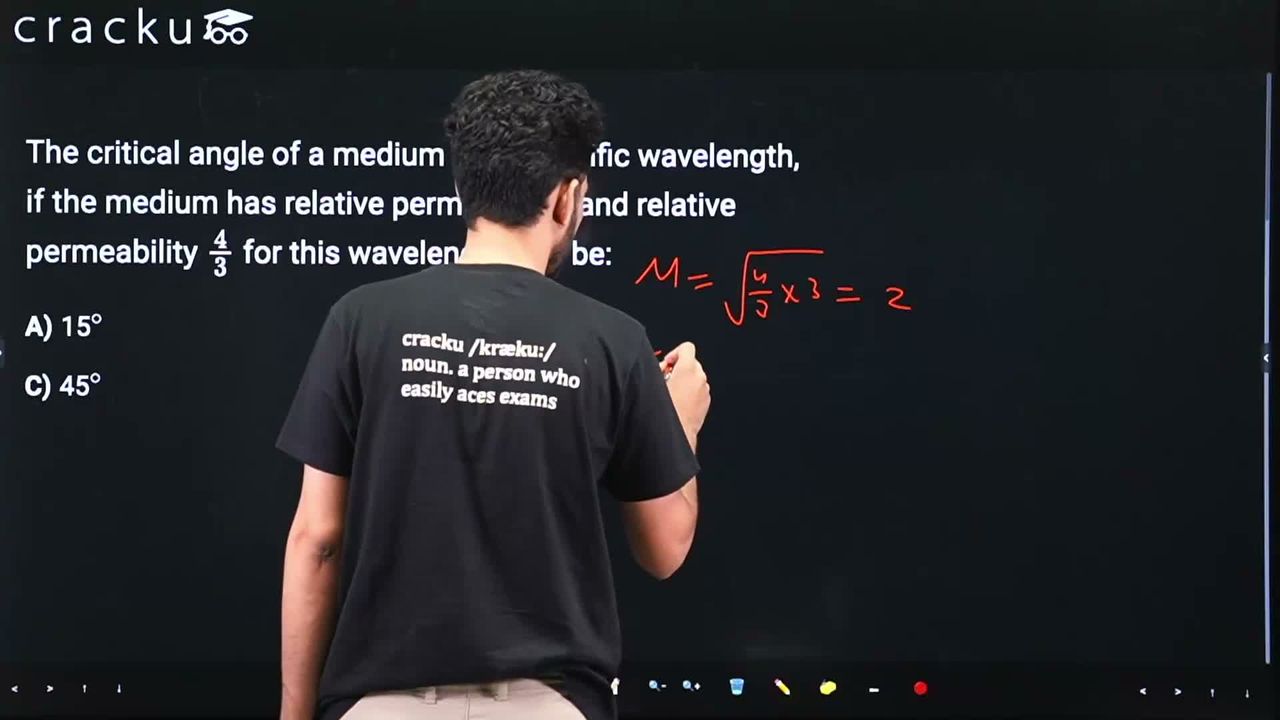
The critical angle of a medium for a specific wavelength, if the medium has relative permittivity 3 and relative permeability $$\frac{4}{3}$$ for this wavelength, will be:
First, we recall the basic connection between the optical refractive index of a non-conducting medium and its electrical properties. The refractive index $$n$$ of a dielectric, when the wavelength is such that absorption is negligible, is given by the relation
$$n=\sqrt{\varepsilon_r\,\mu_r}$$
where $$\varepsilon_r$$ is the relative permittivity (also called the dielectric constant) and $$\mu_r$$ is the relative permeability of the medium.
For the given medium we are told that
$$\varepsilon_r = 3, \qquad\mu_r = \dfrac{4}{3}.$$
We now substitute these numerical values into the formula for $$n$$. We have
$$n = \sqrt{\varepsilon_r \,\mu_r} = \sqrt{ \;3 \times \dfrac{4}{3}\;}.$$
Inside the square root, the factor $$3$$ in the numerator and the factor $$3$$ in the denominator cancel out, leaving
$$n = \sqrt{4}.$$
The square root of $$4$$ is $$2$$, so
$$n = 2.$$
Next, we recall the definition of the critical angle. When light passes from a denser medium (refractive index $$n_1$$) to a rarer medium (refractive index $$n_2$$) and the angle of incidence inside the denser medium is such that the angle of refraction in the rarer medium becomes $$90^\circ$$, that angle of incidence is called the critical angle $$C$$. The mathematical statement of Snell’s law for this limiting case is
$$n_1 \,\sin C = n_2 \,\sin 90^\circ.$$
Because $$\sin 90^\circ = 1$$, we can write
$$n_1 \,\sin C = n_2.$$
If the rarer medium is air (or vacuum) we take $$n_2 \approx 1$$. Here the given medium of refractive index $$n = 2$$ is acting as the denser medium, so $$n_1 = 2$$ and $$n_2 = 1$$. Substituting these values we obtain
$$2 \,\sin C = 1.$$
Dividing both sides by $$2$$ gives
$$\sin C = \dfrac{1}{2}.$$
We know from basic trigonometry that
$$\sin 30^\circ = \dfrac{1}{2}.$$
Therefore
$$C = 30^\circ.$$
Hence, the correct answer is Option B.
Was this solution helpful?
Click on the Email ☝️ to Watch the Video Solution
Create a FREE account and get:
_1.webp)

Educational materials for JEE preparation

Ask our AI anything

AI can make mistakes. Please verify important information.
AI can make mistakes. Please verify important information.
