
Join Our JEE Preparation Group
Prep with like-minded aspirants; Get access to free daily tests and study material.
Sign in
Please select an account to continue using cracku.in
↓ →
Join Our JEE Preparation Group
Prep with like-minded aspirants; Get access to free daily tests and study material.
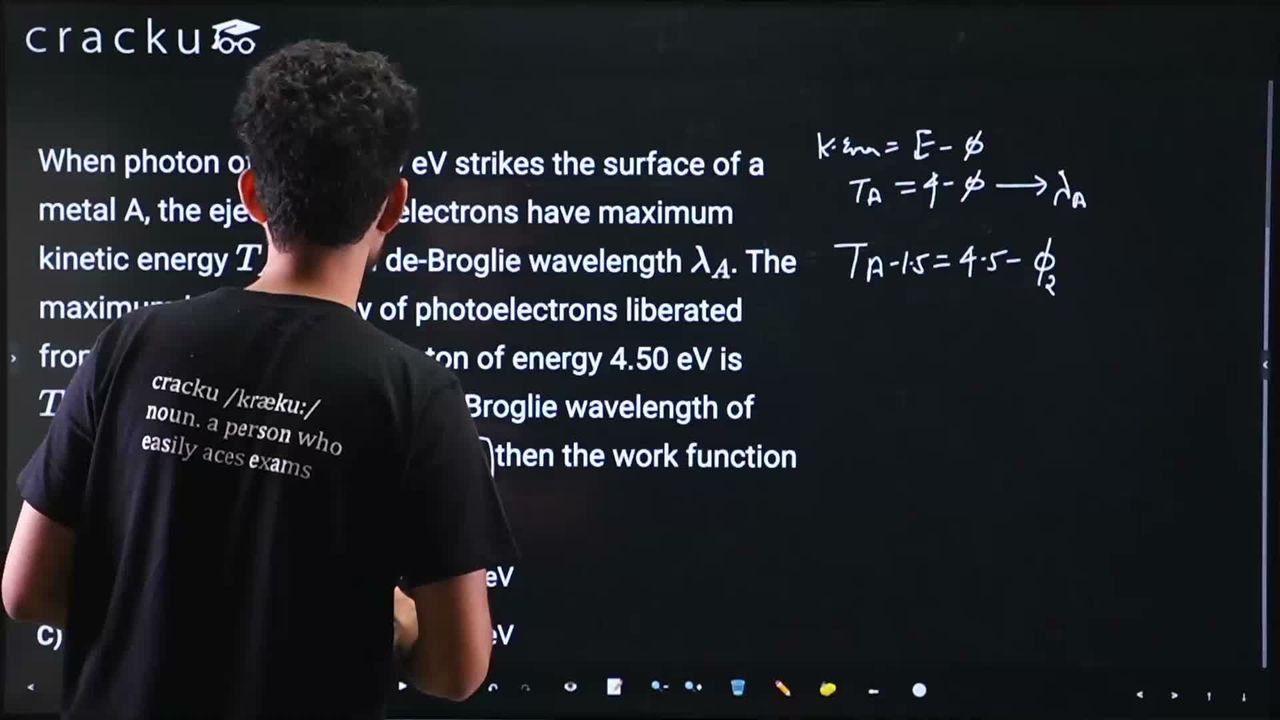
When photon of energy 4.0 eV strikes the surface of a metal A, the ejected photoelectrons have maximum kinetic energy $$T_A$$ eV and de-Broglie wavelength $$\lambda_A$$. The maximum kinetic energy of photoelectrons liberated from another metal B by photon of energy 4.50 eV is $$T_B = (T_A - 1.5)$$ eV. If the de-Broglie wavelength of these photoelectrons $$\lambda_B = 2\lambda_A$$, then the work function of metal B is:
We start by recalling the Einstein photo-electric equation. For any metal surface, the incident photon energy equals the sum of the work function of the metal and the maximum kinetic energy of the emitted photo-electrons. Symbolically, for metal A we write
$$E_A = \phi_A + T_A,$$
where $$E_A$$ is the photon energy, $$\phi_A$$ is the work function of metal A, and $$T_A$$ is the maximum kinetic energy of the photoelectrons from A.
Exactly the same relation applies to metal B:
$$E_B = \phi_B + T_B,$$
with analogous meanings for each symbol.
Next, we need the connection between the kinetic energy of an electron and its de-Broglie wavelength. The de-Broglie relation is
$$\lambda = \frac{h}{p},$$
where $$h$$ is Planck’s constant and $$p$$ is the linear momentum of the electron. For a non-relativistic electron, momentum satisfies
$$p = \sqrt{2mK},$$
where $$m$$ is the electron mass and $$K$$ is its kinetic energy. Substituting this into the de-Broglie formula gives the useful working form
$$\lambda = \frac{h}{\sqrt{2mK}}.$$
This shows that $$\lambda$$ is inversely proportional to the square root of the kinetic energy: $$\lambda \propto \dfrac{1}{\sqrt{K}}.$$
Therefore, for two different electrons, the ratio of their wavelengths equals the square root of the inverse ratio of their kinetic energies:
$$\frac{\lambda_B}{\lambda_A} = \sqrt{\frac{T_A}{T_B}}.$$
Now we substitute the numerical condition given in the problem. We are told that the photo-electrons from metal B have wavelength
$$\lambda_B = 2\lambda_A.$$
Putting this into the proportionality relation gives
$$2 = \sqrt{\frac{T_A}{T_B}}.$$
Squaring both sides yields the direct algebraic link between $$T_A$$ and $$T_B$$:
$$4 = \frac{T_A}{T_B}, \qquad\text{so}\qquad T_A = 4T_B.$$
The statement of the problem also connects the two kinetic energies by
$$T_B = T_A - 1.5 \text{ eV}.$$
We now have two equations:
$$T_A = 4T_B,$$
$$T_B = T_A - 1.5.$$
Substituting the first into the second, we replace $$T_A$$ by $$4T_B$$:
$$T_B = 4T_B - 1.5.$$
Bringing like terms together, we find
$$1.5 = 3T_B \quad\Longrightarrow\quad T_B = \frac{1.5}{3} = 0.5 \text{ eV}.$$
Now we immediately compute $$T_A$$ from $$T_A = 4T_B$$:
$$T_A = 4 \times 0.5 = 2.0 \text{ eV}.$$
Armed with these kinetic energies, we return to the Einstein equation to obtain the work function of metal B. The photon energy striking B is $$E_B = 4.50 \text{ eV}$$, so
$$\phi_B = E_B - T_B = 4.50 \text{ eV} - 0.50 \text{ eV} = 4.00 \text{ eV}.$$
Thus the work function of metal B is $$4 \text{ eV}$$.
Hence, the correct answer is Option A.
Was this solution helpful?
Click on the Email ☝️ to Watch the Video Solution
Create a FREE account and get:
_1.webp)

Educational materials for JEE preparation

Ask our AI anything

AI can make mistakes. Please verify important information.
AI can make mistakes. Please verify important information.
