
Join Our JEE Preparation Group
Prep with like-minded aspirants; Get access to free daily tests and study material.
Sign in
Please select an account to continue using cracku.in
↓ →
Join Our JEE Preparation Group
Prep with like-minded aspirants; Get access to free daily tests and study material.
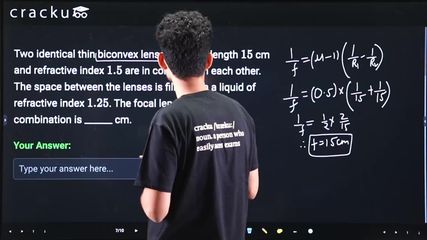
Two identical thin biconvex lenses of focal length $$15$$ cm and refractive index $$1.5$$ are in contact with each other. The space between the lenses is filled with a liquid of refractive index $$1.25$$. The focal length of the combination is ______ cm.
Correct Answer: 10
We have two identical thin biconvex lenses, each with focal length $$f = 15$$ cm and refractive index $$n = 1.5$$, in contact with each other. The space between the lenses is filled with a liquid of refractive index $$n_l = 1.25$$. Using the Lensmaker’s equation for a biconvex lens, $$\frac{1}{f} = (n - 1)\left(\frac{1}{R_1} - \frac{1}{R_2}\right)$$ and noting that for identical biconvex lenses with equal radii of curvature $$R_1 = R$$ and $$R_2 = -R$$, we get:
$$\frac{1}{15} = (1.5 - 1)\left(\frac{1}{R} + \frac{1}{R}\right) = 0.5 \times \frac{2}{R} = \frac{1}{R}$$
$$R = 15 \text{ cm}$$
The liquid filling the space acts as a concave (diverging) lens with surfaces matching the inner surfaces of the biconvex lenses, having radii $$R_1 = -R = -15$$ cm and $$R_2 = R = 15$$ cm. For this liquid lens:
$$\frac{1}{f_l} = (n_l - 1)\left(\frac{1}{R_1} - \frac{1}{R_2}\right) = (1.25 - 1)\left(\frac{1}{-15} - \frac{1}{15}\right)$$
$$\frac{1}{f_l} = 0.25 \times \left(-\frac{2}{15}\right) = -\frac{0.5}{15} = -\frac{1}{30}$$
$$f_l = -30 \text{ cm}$$
Since the two convex lenses and the liquid lens are in contact, the combined focal length is given by
$$\frac{1}{f_{\text{comb}}} = \frac{1}{f_1} + \frac{1}{f_l} + \frac{1}{f_2} = \frac{1}{15} + \left(-\frac{1}{30}\right) + \frac{1}{15}$$
$$\frac{1}{f_{\text{comb}}} = \frac{2}{15} - \frac{1}{30} = \frac{4}{30} - \frac{1}{30} = \frac{3}{30} = \frac{1}{10}$$
$$f_{\text{comb}} = 10 \text{ cm}$$
The answer is 10 cm.
Was this solution helpful?
Click on the Email ☝️ to Watch the Video Solution
Create a FREE account and get:
_1.webp)

Educational materials for JEE preparation

Ask our AI anything

AI can make mistakes. Please verify important information.
AI can make mistakes. Please verify important information.
