
Join Our JEE Preparation Group
Prep with like-minded aspirants; Get access to free daily tests and study material.
Sign in
Please select an account to continue using cracku.in
↓ →
Join Our JEE Preparation Group
Prep with like-minded aspirants; Get access to free daily tests and study material.
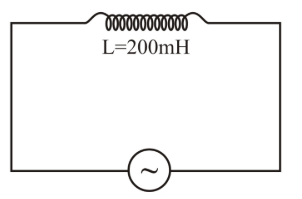
As shown in the figure an inductor of inductance $$200$$ mH is connected to an AC source of emf $$220$$ V and frequency $$50$$ Hz. The instantaneous voltage of the source is $$0$$ V when the peak value of current is $$\frac{\sqrt{a}}{\pi}$$ A. The value of $$a$$ is ______.
Correct Answer: 242
We need to find the value of $$a$$ for a purely inductive AC circuit where an inductor is connected across an alternating electromotive force (emf) source.
1. Identify the Given Data
Note: In a purely inductive circuit, the current lags the voltage by $$90^\circ$$ ($$\frac{\pi}{2}$$ radians). Consequently, when the instantaneous voltage of the source drops to $$0\text{ V}$$, the current reaches its maximum magnitude (peak value $$I_0$$).
2. Calculate the Inductive Reactance ($$X_L$$)
The opposition offered by the inductor to the AC flow is given by:
$$X_L = \omega L = 2\pi f L$$
Substituting the given values:
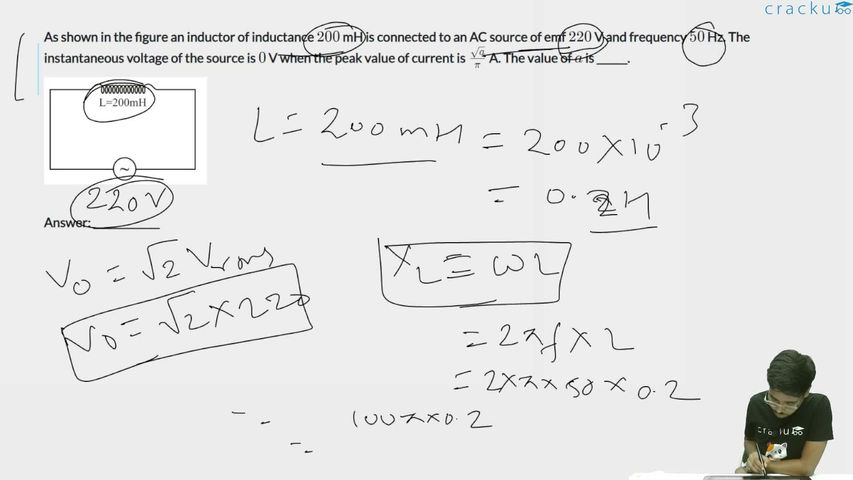
$$X_L = 2 \times \pi \times 50 \times 0.2 = 20\pi\ \Omega$$
3. Calculate the Peak Voltage ($$V_0$$)
The relationship between the alternating source's peak voltage and its RMS value is:
$$V_0 = V_{rms} \times \sqrt{2} = 220\sqrt{2}\text{ V}$$
4. Calculate the Peak Current ($$I_0$$)
Using Ohm's law for an alternating inductive circuit network:
$$I_0 = \frac{V_0}{X_L}$$
Substituting our expressions for $$V_0$$ and $$X_L$$ yields:
$$I_0 = \frac{220\sqrt{2}}{20\pi} = \frac{11\sqrt{2}}{\pi}\text{ A}$$
5. Solve for $$a$$
We equate our derived value of peak current to the given mathematical form:
$$\frac{\sqrt{a}}{\pi} = \frac{11\sqrt{2}}{\pi}$$
Canceling out the common denominator $$\pi$$ from both sides gives:
$$\sqrt{a} = 11\sqrt{2}$$
Squaring both sides of the equation to isolate $$a$$:
$$a = (11\sqrt{2})^2 = 121 \times 2 = 242$$
Therefore, the value of $$a$$ is 242.
Was this solution helpful?
Click on the Email ☝️ to Watch the Video Solution
Create a FREE account and get:
_1.webp)

Educational materials for JEE preparation

Ask our AI anything

AI can make mistakes. Please verify important information.
AI can make mistakes. Please verify important information.
