
Join Our JEE Preparation Group
Prep with like-minded aspirants; Get access to free daily tests and study material.
Sign in
Please select an account to continue using cracku.in
↓ →
Join Our JEE Preparation Group
Prep with like-minded aspirants; Get access to free daily tests and study material.
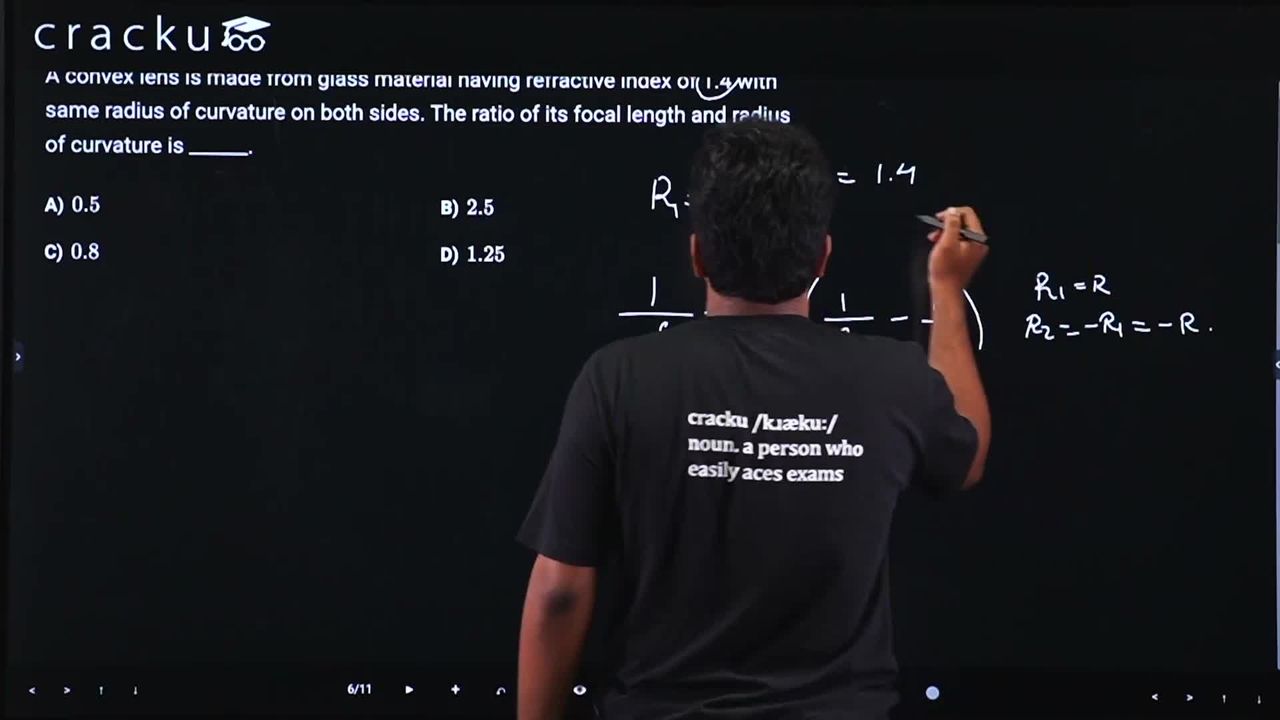
A convex lens is made from glass material having refractive index of 1.4 with same radius of curvature on both sides. The ratio of its focal length and radius of curvature is ______.
The focal length of a thin lens kept in air is obtained from the Lens-Maker’s formula
$$\frac{1}{f}=(n-1)\left(\frac{1}{R_1}-\frac{1}{R_2}\right)$$
where
• $$n$$ is the refractive index of the lens material with respect to air,
• $$R_1$$ is the radius of curvature of the first surface (sign taken according to the Cartesian convention),
• $$R_2$$ is the radius of curvature of the second surface.
The lens is given as a symmetric bi-convex lens, so the magnitudes of the radii are equal: $$|R_1| = |R_2| = R$$.
For light traveling from left to right:
• The centre of curvature of the first surface lies to the right of that surface, hence $$R_1 = +R$$.
• The centre of curvature of the second surface lies to the left of that surface, hence $$R_2 = -R$$.
Substituting these signs:
$$\frac{1}{f}=(n-1)\left(\frac{1}{R}-\frac{1}{-R}\right)=(n-1)\left(\frac{1}{R}+\frac{1}{R}\right)=2(n-1)\frac{1}{R}$$
Rearranging for $$f$$:
$$f=\frac{R}{2(n-1)}$$
The given refractive index is $$n = 1.4$$, so $$n-1 = 0.4$$.
Therefore:
$$f=\frac{R}{2\times 0.4}=\frac{R}{0.8}=1.25\,R$$
Hence
$$\frac{f}{R}=1.25$$
Option D which is: $$1.25$$
Was this solution helpful?
Click on the Email ☝️ to Watch the Video Solution
Create a FREE account and get:
_1.webp)

Educational materials for JEE preparation

Ask our AI anything

AI can make mistakes. Please verify important information.
AI can make mistakes. Please verify important information.


