
Join Our JEE Preparation Group
Prep with like-minded aspirants; Get access to free daily tests and study material.
Sign in
Please select an account to continue using cracku.in
↓ →
Join Our JEE Preparation Group
Prep with like-minded aspirants; Get access to free daily tests and study material.
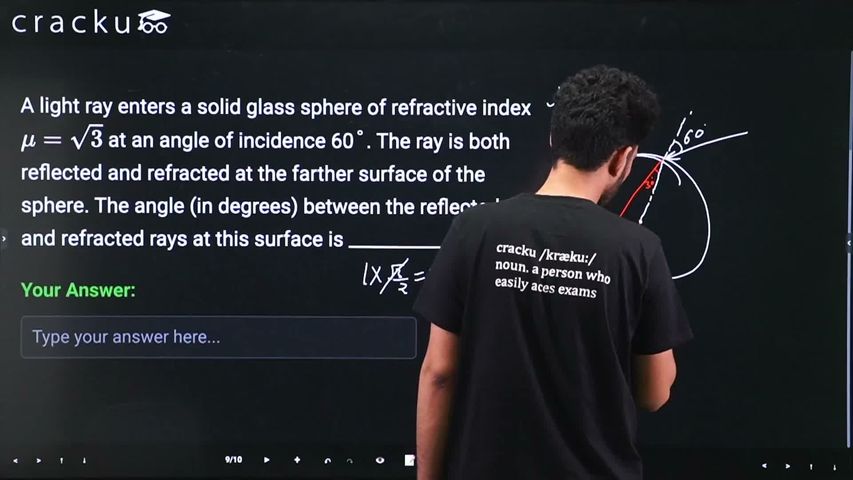
A light ray enters a solid glass sphere of refractive index $$\mu = \sqrt{3}$$ at an angle of incidence 60$$°$$. The ray is both reflected and refracted at the farther surface of the sphere. The angle (in degrees) between the reflected and refracted rays at this surface is ___________.
Correct Answer: 90
We have a solid glass sphere whose refractive index is $$\mu = \sqrt{3}$$. When a light ray from air (refractive index $$1$$) strikes the first surface of the sphere, its angle of incidence is given as $$60^{\circ}$$.
Using Snell’s law, which is stated as $$n_1 \sin i = n_2 \sin r,$$ we substitute $$n_1 = 1,\; i = 60^{\circ},\; n_2 = \sqrt{3}$$ to obtain
$$1 \cdot \sin 60^{\circ} = \sqrt{3}\,\sin r_1.$$
Since $$\sin 60^{\circ} = \dfrac{\sqrt{3}}{2},$$ we get
$$\dfrac{\sqrt{3}}{2} = \sqrt{3}\,\sin r_1.$$
Dividing both sides by $$\sqrt{3}$$,
$$\sin r_1 = \dfrac{1}{2}.$$
This gives $$r_1 = 30^{\circ}.$$ Thus, inside the glass, the ray makes an angle of $$30^{\circ}$$ with the normal at the entry point.
The ray now travels in a straight line to the far surface of the sphere. In the cross-sectional plane through the centre, the entry radius $$OA$$ and the exit radius $$OB$$ form the two equal sides of triangle $$AOB$$ (because both are radii of the same sphere). In this isosceles triangle, the angle between $$OA$$ and the ray $$AB$$ has already been found to be $$30^{\circ}$$, so the angle between $$OB$$ and the same ray must also be $$30^{\circ}$$. Therefore the angle of incidence at the second (far) surface is
$$i_2 = 30^{\circ}.$$
At this second surface the ray is partly reflected back into the glass and partly refracted out into air. For the refracted (emergent) part we again apply Snell’s law, this time with $$n_1 = \sqrt{3},\; i = i_2 = 30^{\circ},\; n_2 = 1$$:
$$\sqrt{3}\,\sin 30^{\circ} = 1 \cdot \sin r_2.$$
Because $$\sin 30^{\circ} = \dfrac{1}{2},$$ we have
$$\sqrt{3}\,\dfrac{1}{2} = \sin r_2 \;\Longrightarrow\; \sin r_2 = \dfrac{\sqrt{3}}{2}.$$
Hence
$$r_2 = 60^{\circ}.$$
For the reflected part, the law of reflection tells us that the angle of reflection equals the angle of incidence, so the reflected ray inside the glass makes an angle
$$\theta_{\text{reflected}} = i_2 = 30^{\circ}$$
with the normal. The refracted (emergent) ray outside the sphere makes an angle
$$\theta_{\text{refracted}} = r_2 = 60^{\circ}$$
with the same normal but lies on the opposite side of that normal. Therefore, the angle between the two rays is the sum of these two angles:
$$\text{Angle between rays} = 30^{\circ} + 60^{\circ} = 90^{\circ}.$$
So, the answer is $$90^{\circ}$$.
Was this solution helpful?
Click on the Email ☝️ to Watch the Video Solution
Create a FREE account and get:
_1.webp)

Educational materials for JEE preparation

Ask our AI anything

AI can make mistakes. Please verify important information.
AI can make mistakes. Please verify important information.


