
Join Our JEE Preparation Group
Prep with like-minded aspirants; Get access to free daily tests and study material.
Sign in
Please select an account to continue using cracku.in
↓ →
Join Our JEE Preparation Group
Prep with like-minded aspirants; Get access to free daily tests and study material.
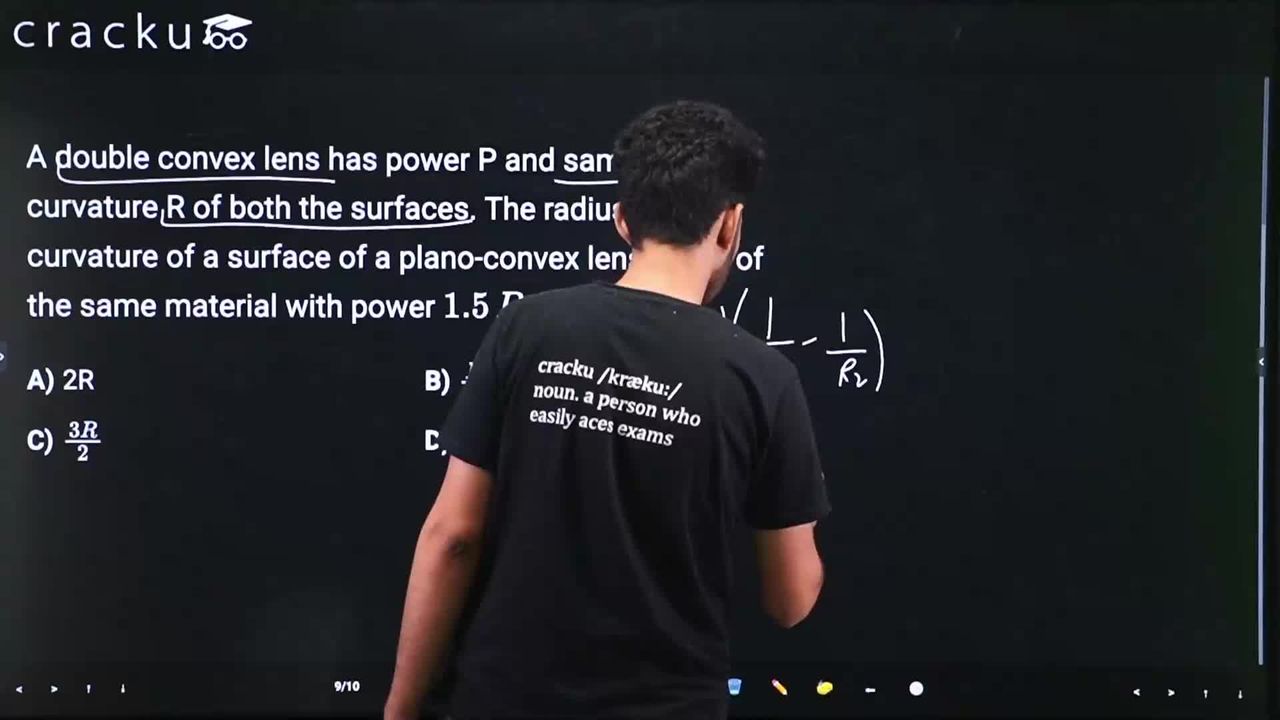
A double convex lens has power P and same radii of curvature R of both the surfaces. The radius of curvature of a surface of a plano-convex lens made of the same material with power $$1.5\,P$$ is:
We start with the thin-lens (Lens-maker’s) formula, which in air is stated as
$$\frac{1}{f} \;=\; (n-1)\left(\frac{1}{R_1}-\frac{1}{R_2}\right),$$
where $$f$$ is the focal length (its reciprocal is the power $$P$$), $$n$$ is the refractive index of the lens material and $$R_1,\,R_2$$ are the radii of curvature of the first and second surfaces, respectively. The sign convention is: a surface is convex toward the incoming light if its radius is positive, and concave toward the incoming light if its radius is negative.
First we treat the given double-convex lens. Both its surfaces are convex and have the same radius $$R$$. Light is taken to enter from the left, so we have
$$R_1 = +R,\qquad R_2 = -R.$$
Substituting these into the formula gives
$$\frac{1}{f} \;=\; (n-1)\!\left(\frac{1}{R} -\frac{1}{-R}\right) = (n-1)\!\left(\frac{1}{R} + \frac{1}{R}\right) = (n-1)\left(\frac{2}{R}\right) = \frac{2(n-1)}{R}.$$
By definition of power, $$P = \dfrac{1}{f},$$ so for the double-convex lens we have
$$P \;=\; \frac{2(n-1)}{R}. \quad -(1)$$
Next we analyse the plano-convex lens made of the same material. Let its curved surface have unknown radius $$r$$, and let the plane face be the second surface. A plane surface has an infinite radius of curvature, so
$$R_1 = +r,\qquad R_2 = \infty.$$ Consequently,
$$\frac{1}{f'} \;=\; (n-1)\left(\frac{1}{r}-\frac{1}{\infty}\right) = (n-1)\left(\frac{1}{r}-0\right) = \frac{(n-1)}{r}.$$
Denote the power of this plano-convex lens by $$P'$$. Then
$$P' = \frac{(n-1)}{r}. \quad -(2)$$
The problem states that this power is one and a half times the power of the original lens, i.e.
$$P' = 1.5\,P.$$ Substituting the expressions (1) and (2) for $$P'$$ and $$P$$ yields
$$\frac{(n-1)}{r} \;=\; 1.5 \left(\frac{2(n-1)}{R}\right).$$
We now cancel the common factor $$(n-1)$$ on both sides:
$$\frac{1}{r} \;=\; 1.5 \left(\frac{2}{R}\right) = \frac{3}{R}.$$
Taking the reciprocal to solve for $$r$$, we get
$$r \;=\; \frac{R}{3}.$$
Hence, the correct answer is Option D.
Was this solution helpful?
Click on the Email ☝️ to Watch the Video Solution
Create a FREE account and get:
_1.webp)

Educational materials for JEE preparation

Ask our AI anything

AI can make mistakes. Please verify important information.
AI can make mistakes. Please verify important information.


