
Join Our JEE Preparation Group
Prep with like-minded aspirants; Get access to free daily tests and study material.
Sign in
Please select an account to continue using cracku.in
↓ →
Join Our JEE Preparation Group
Prep with like-minded aspirants; Get access to free daily tests and study material.
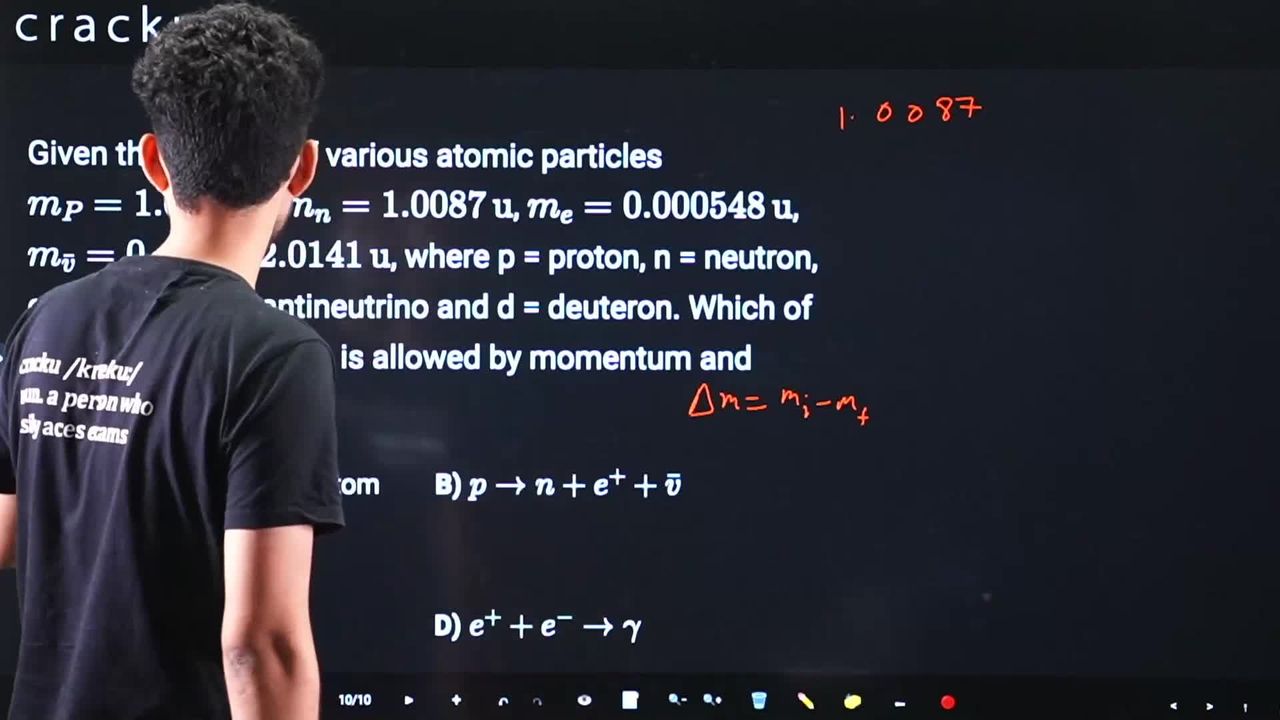
Given the masses of various atomic particles $$m_P = 1.0072\,\text{u}$$, $$m_n = 1.0087\,\text{u}$$, $$m_e = 0.000548\,\text{u}$$, $$m_{\bar{v}} = 0$$, $$m_d = 2.0141\,\text{u}$$, where p = proton, n = neutron, e = electron, $$\bar{v}$$ = antineutrino and d = deuteron. Which of the following process is allowed by momentum and energy conservation:
In order to check whether any nuclear or elementary-particle process can take place without any external supply of energy, we compare the total rest‐mass energy on the two sides of the reaction. The basic statement we shall use is Einstein’s mass-energy relation
$$E = mc^{2},$$
which tells us that a mass difference $$\Delta m = m_{\text{initial}}-m_{\text{final}}$$ corresponds to an energy release (or requirement) of
$$Q = \Delta m\,c^{2} = \Delta m \times 931\;\text{MeV}$$
per atomic-mass-unit. A positive $$Q$$ means that the reaction can proceed spontaneously; a negative $$Q$$ means that at least $$|Q|$$ of kinetic energy must be supplied. We shall study the four given processes one by one.
Option A: $$n+n\;\to\;\hbox{deuterium atom}$$ (nucleus with one bound electron)
Initial mass:
$$m_{\text{initial}} = m_{n}+m_{n}=2\times 1.0087\;\text{u}=2.0174\;\text{u}.$$
Final mass: the phrase “deuterium atom” means one deuteron nucleus plus its single orbital electron. Because the quoted number $$m_{d}=2.0141\;\text{u}$$ is exactly the known atomic mass of deuterium (it already contains the electron of mass $$m_{e}=0.000548\;\text{u}$$), we have
$$m_{\text{final}} = m_{d}=2.0141\;\text{u}.$$
Hence
$$\Delta m = 2.0174-2.0141 = 0.0033\;\text{u},$$
and
$$Q = 0.0033\times 931\;\text{MeV}\approx 3.1\;\text{MeV}.$$
The mass of the products is smaller, so energy is liberated; energy and momentum could be conserved because the electron can recoil. However the electron carries lepton number $$L=+1$$, whereas the initial state has $$L=0$$, so a conserved quantum number is violated. Even though the question only mentions energy and momentum, such a violation rules the process out in practice, so this option is not accepted.
Option B: $$p\;\to\;n+e^{+}+\bar{\nu}$$
Initial mass:
$$m_{\text{initial}} = m_{p}=1.0072\;\text{u}.$$
Final mass:
$$m_{\text{final}} = m_{n}+m_{e}+m_{\bar{\nu}}=1.0087+0.000548+0=1.009248\;\text{u}.$$
The difference is
$$\Delta m = 1.0072-1.009248=-0.002048\;\text{u},$$
giving
$$Q = -0.002048\times 931\;\text{MeV}\approx -1.91\;\text{MeV}.$$
The negative sign means that an isolated proton does not have enough mass energy to produce a heavier neutron together with a positron and an antineutrino. Therefore energy conservation forbids this decay; momentum conservation cannot rescue it. This option is not allowed.
Option C: $$n+p\;\to\;d+\gamma$$
Initial mass:
$$m_{\text{initial}} = m_{n}+m_{p}=1.0087+1.0072=2.0159\;\text{u}.$$
Final mass: the deuterium atom would include an electron, but the symbol $$d$$ is explicitly given as the mass of the deuteron nucleus. In the present reaction only the nucleus is produced, so
$$m_{\text{final}} = m_{d}+m_{\gamma}=2.0141+0=2.0141\;\text{u}.$$
Consequently,
$$\Delta m = 2.0159-2.0141 = 0.0018\;\text{u},$$
and
$$Q = 0.0018\times 931\;\text{MeV}\approx 1.68\;\text{MeV}.$$
This positive $$Q$$ shows that about $$1.68\;\text{MeV}$$ of energy is set free; the single outgoing photon $$\gamma$$ can freely carry away exactly the amount of energy and momentum required. No other conservation law is breached (baryon number, lepton number and charge are all unchanged). Hence this reaction is perfectly allowed.
Option D: $$e^{+}+e^{-}\;\to\;\gamma$$
Initial mass:
$$m_{\text{initial}} = m_{e}+m_{e}=2\times 0.000548\;\text{u}=0.001096\;\text{u}.$$
Final mass: a photon is massless, so
$$m_{\text{final}} = 0.$$
The energy balance is therefore
$$Q = 0.001096\times 931\;\text{MeV}\approx 1.02\;\text{MeV},$$
which is positive. Nevertheless, a single photon cannot simultaneously conserve energy and linear momentum when the initial centre-of-mass momentum is zero (as it is for a positron and an electron that annihilate from rest). At least two photons are required. Thus this one-photon channel is forbidden by momentum conservation.
Putting all the above results together, only process C fulfils both energy and momentum conservation without violating any other fundamental conservation law.
Hence, the correct answer is Option C.
Was this solution helpful?
Click on the Email ☝️ to Watch the Video Solution
Create a FREE account and get:
_1.webp)

Educational materials for JEE preparation

Ask our AI anything

AI can make mistakes. Please verify important information.
AI can make mistakes. Please verify important information.


