
Join Our JEE Preparation Group
Prep with like-minded aspirants; Get access to free daily tests and study material.
Sign in
Please select an account to continue using cracku.in
↓ →
Join Our JEE Preparation Group
Prep with like-minded aspirants; Get access to free daily tests and study material.
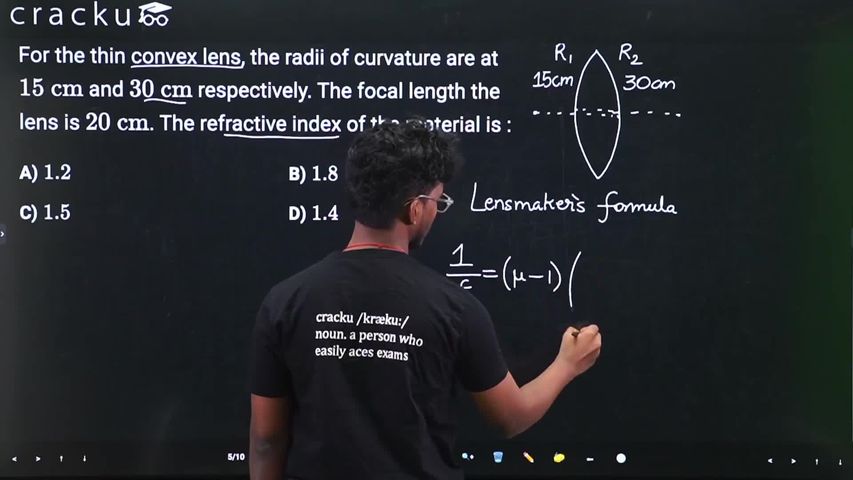
For the thin convex lens, the radii of curvature are at $$15 \text{ cm}$$ and $$30 \text{ cm}$$ respectively. The focal length the lens is $$20 \text{ cm}$$. The refractive index of the material is :
We need to find the refractive index of the lens material given the radii of curvature and focal length.
The Lensmaker's equation relates the focal length of a thin lens to the radii of curvature and the refractive index:
$$\frac{1}{f} = (\mu - 1)\left(\frac{1}{R_1} - \frac{1}{R_2}\right)$$
For a convex lens, $$R_1 = +15$$ cm (first surface is convex, center of curvature on the right), $$R_2 = -30$$ cm (second surface is convex, center of curvature on the left, so negative by sign convention), and $$f = 20$$ cm.
Substituting these values into the Lensmaker's equation gives:
$$\frac{1}{20} = (\mu - 1)\left(\frac{1}{15} - \frac{1}{-30}\right) = (\mu - 1)\left(\frac{1}{15} + \frac{1}{30}\right)$$
The term in parentheses simplifies as follows:
$$\frac{1}{15} + \frac{1}{30} = \frac{2}{30} + \frac{1}{30} = \frac{3}{30} = \frac{1}{10}$$
Substituting this back yields:
$$\frac{1}{20} = (\mu - 1)\times\frac{1}{10}$$
Solving for the refractive index:
$$\mu - 1 = \frac{10}{20} = \frac{1}{2} = 0.5$$
$$\mu = 1.5$$
The correct answer is Option C: 1.5.
Was this solution helpful?
Click on the Email ☝️ to Watch the Video Solution
Create a FREE account and get:
_1.webp)

Educational materials for JEE preparation

Ask our AI anything

AI can make mistakes. Please verify important information.
AI can make mistakes. Please verify important information.
