
Join Our JEE Preparation Group
Prep with like-minded aspirants; Get access to free daily tests and study material.
Sign in
Please select an account to continue using cracku.in
↓ →
Join Our JEE Preparation Group
Prep with like-minded aspirants; Get access to free daily tests and study material.
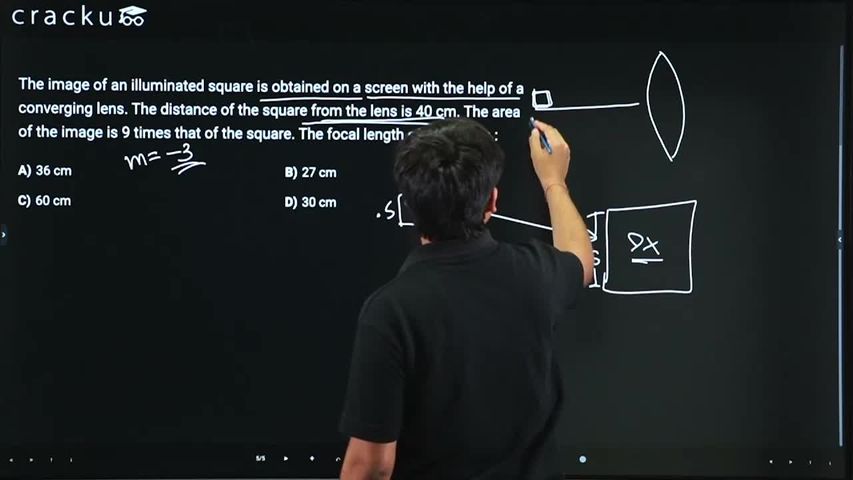
The image of an illuminated square is obtained on a screen with the help of a converging lens. The distance of the square from the lens is 40 cm. The area of the image is 9 times that of the square. The focal length of the lens is :
The problem involves finding the focal length of a converging lens that forms an image of an illuminated square on a screen. The object distance from the lens is given as 40 cm, and the area of the image is 9 times the area of the object. Since the image is formed on a screen, it is real and inverted.
First, recall that for a square object, the area is proportional to the square of its side length. Let the side length of the object be $$ s $$. Then, the area of the object is $$ s^2 $$. The area of the image is given as 9 times the object's area, so it is $$ 9s^2 $$. Therefore, the side length of the image is $$ \sqrt{9s^2} = 3s $$.
The linear magnification $$ m $$ is the ratio of the image size to the object size. Since the image is real and inverted, the magnification is negative. The magnitude of the magnification is the ratio of the side lengths, which is $$ \frac{3s}{s} = 3 $$. Thus, $$ m = -3 $$.
Using the standard sign convention for lenses, the object distance $$ u $$ is negative when measured from the lens in the direction opposite to the incident light. Given the object distance is 40 cm, $$ u = -40 $$ cm.
The magnification $$ m $$ is also given by the ratio of the image distance $$ v $$ to the object distance $$ u $$:
$$ m = \frac{v}{u} $$
Substituting $$ m = -3 $$ and $$ u = -40 $$ cm:
$$ -3 = \frac{v}{-40} $$
Solving for $$ v $$:
$$ v = (-3) \times (-40) = 120 \text{ cm} $$
So, the image distance $$ v = 120 $$ cm.
Now, use the lens formula to find the focal length $$ f $$:
$$ \frac{1}{f} = \frac{1}{v} - \frac{1}{u} $$
Substitute $$ v = 120 $$ cm and $$ u = -40 $$ cm:
$$ \frac{1}{f} = \frac{1}{120} - \frac{1}{-40} = \frac{1}{120} + \frac{1}{40} $$
To add these fractions, find a common denominator. The least common multiple of 120 and 40 is 120:
$$ \frac{1}{120} + \frac{1}{40} = \frac{1}{120} + \frac{3}{120} = \frac{4}{120} $$
Simplify the fraction:
$$ \frac{4}{120} = \frac{1}{30} $$
Therefore:
$$ \frac{1}{f} = \frac{1}{30} $$
Which gives:
$$ f = 30 \text{ cm} $$
Hence, the focal length of the lens is 30 cm.
Now, comparing with the options:
A. 36 cm
B. 27 cm
C. 60 cm
D. 30 cm
So, the correct answer is Option D.
Was this solution helpful?
Click on the Email ☝️ to Watch the Video Solution
Create a FREE account and get:
_1.webp)

Educational materials for JEE preparation

Ask our AI anything

AI can make mistakes. Please verify important information.
AI can make mistakes. Please verify important information.


