
Join Our JEE Preparation Group
Prep with like-minded aspirants; Get access to free daily tests and study material.
Sign in
Please select an account to continue using cracku.in
↓ →
Join Our JEE Preparation Group
Prep with like-minded aspirants; Get access to free daily tests and study material.
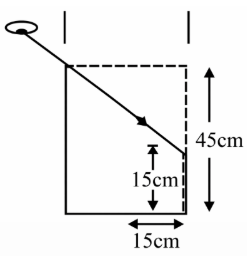
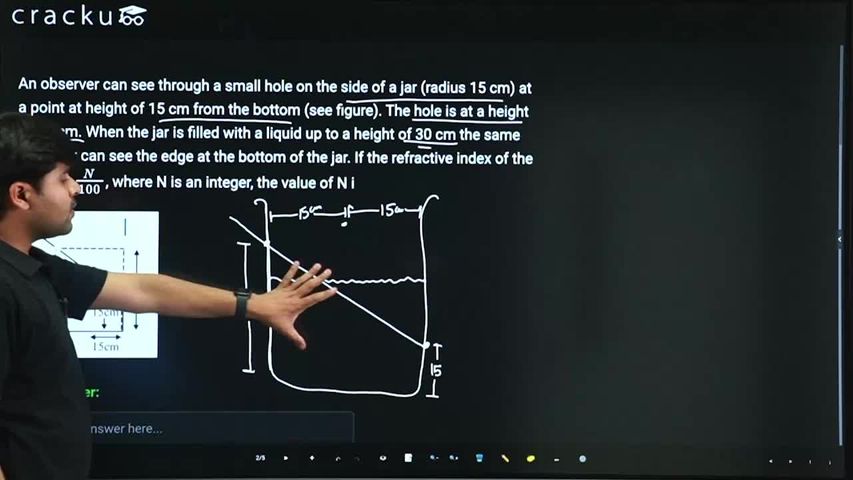
An observer can see through a small hole on the side of a jar (radius 15 cm) at a point at height of 15 cm from the bottom (see figure). The hole is at a height of 45 cm. When the jar is filled with a liquid up to a height of 30 cm the same observer can see the edge at the bottom of the jar. If the refractive index of the liquid is $$\frac{N}{100}$$, where N is an integer, the value of N i
Correct Answer: 158
Let us set up a rectangular coordinate frame whose origin is at the inner surface of the wall that contains the hole. The positive $$x$$-direction is taken horizontally towards the opposite wall and the positive $$y$$-direction is taken vertically upward. In this frame
Hole (point $$H$$): $$x_H = 0\;\text{cm},\;y_H = 45\;\text{cm}$$
Bottom edge that finally becomes visible (point $$B$$): $$x_B = 30\;\text{cm},\;y_B = 0\;\text{cm}$$ (the diameter of the jar is $$2R = 30\;\text{cm}$$).
First, observe the empty jar. A straight ray travelling through air from the hole reaches the far wall at a point that is only $$15\;\text{cm}$$ above the bottom. Call this point $$A$$.
$$x_A = 30\;\text{cm},\;y_A = 15\;\text{cm}$$
The line joining $$H(0,45)$$ to $$A(30,15)$$ therefore represents the extreme ray the observer can follow when the jar is empty. Its equation is obtained in the usual two-point form
$$y - 45 = \frac{15-45}{30-0}\,(x-0)\;.$$
Since the numerator is $$-30$$ and the denominator is $$30$$ we have
$$y - 45 = -1\;x\;,\qquad\Longrightarrow\qquad y = 45 - x\;.$$
We now fill the jar with liquid up to a height of $$30\;\text{cm}$$. Hence the liquid-air interface is the horizontal line
$$y = 30\;\text{cm}\;.$$
Because everything above the liquid is still air, the incident portion of the extreme ray must still run along the same straight line until it meets the interface. Substituting $$y = 30$$ in $$y = 45 - x$$ gives the intersection point $$S$$ of the ray with the surface:
$$30 = 45 - x_S \;\Longrightarrow\; x_S = 15\;\text{cm}\;.$$
Thus
$$S(15,30).$$
The path of the complete ray is therefore
$$H(0,45)\;\longrightarrow\;S(15,30)\;\longrightarrow\;B(30,0).$$
Segment $$HS$$ lies in air (refractive index $$n_1=1$$) and segment $$SB$$ lies in the liquid (refractive index $$n_2=\mu$$, say).
To apply Snell’s law we need the angles the two segments make with the normal to the interface (the normal is vertical). Let the angle of incidence in air be $$i$$ and the angle of refraction in the liquid be $$r$$.
From simple trigonometry, for segment $$HS$$
$$\Delta x_{HS} = x_S - x_H = 15-0 = 15\;\text{cm},$$ $$\Delta y_{HS} = y_S - y_H = 30-45 = -15\;\text{cm}.$$
The horizontal component is $$15\;\text{cm}$$ and the vertical component (magnitude) is $$15\;\text{cm}$$, so
$$\tan i = \frac{|\text{horizontal}|}{|\text{vertical}|} = \frac{15}{15} = 1.$$
We therefore have
$$i = 45^\circ,\qquad \sin i = \frac{1}{\sqrt2}.$$
For segment $$SB$$
$$\Delta x_{SB} = x_B - x_S = 30-15 = 15\;\text{cm},$$ $$\Delta y_{SB} = y_B - y_S = 0-30 = -30\;\text{cm}.$$
Here the horizontal component is $$15\;\text{cm}$$ and the vertical component (magnitude) is $$30\;\text{cm}$$, giving
$$\tan r = \frac{15}{30} = \frac12.$$
Hence the refracted angle satisfies
$$\sin r = \frac{\tan r}{\sqrt{1+\tan^2 r}} = \frac{\tfrac12}{\sqrt{1+\left(\tfrac12\right)^2}} = \frac{\tfrac12}{\sqrt{1+\tfrac14}} = \frac{\tfrac12}{\sqrt{\tfrac54}} = \frac{\tfrac12}{\tfrac{\sqrt5}{2}} = \frac1{\sqrt5}\;.$$
Now we invoke Snell’s law (stated explicitly):
$$n_1\,\sin i = n_2\,\sin r.$$
With $$n_1 = 1$$ and $$n_2 = \mu$$ we write
$$\sin i = \mu\,\sin r.$$
Substituting the values already found, we have
$$\frac{1}{\sqrt2} = \mu\;\frac1{\sqrt5}.$$
Solving for $$\mu$$ gives
$$\mu = \frac{1}{\sqrt2}\;\sqrt5 = \sqrt{\frac52} = \sqrt{2.5} = 1.5811\ldots\;.$$
The refractive index is therefore approximately $$1.58$$. According to the statement of the problem it can be written as $$\dfrac{N}{100}$$, so
$$\frac{N}{100} \approx 1.58 \;\;\Longrightarrow\;\; N = 158.$$
Hence, the correct answer is Option 158.
Was this solution helpful?
Click on the Email ☝️ to Watch the Video Solution
Create a FREE account and get:
_1.webp)

Educational materials for JEE preparation

Ask our AI anything

AI can make mistakes. Please verify important information.
AI can make mistakes. Please verify important information.
