For the following questions answer them individually
Moment of inertia of a cylinder of mass $$m$$, length $$L$$ and radius $$R$$ about an axis passing through its centre and perpendicular to the axis of the cylinder is $$I = M\left(\frac{R^2}{4} + \frac{L^2}{12}\right)$$. If such a cylinder is to be made for a given mass of a material, the ratio $$\frac{L}{R}$$ for it to have minimum possible $$I$$ is:
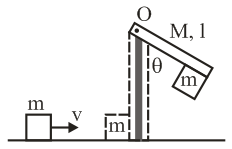
A block of mass $$m = 1$$ kg slides with velocity $$v = 6$$ m s$$^{-1}$$ on a frictionless horizontal surface and collides with a uniform vertical rod and sticks to it as shown. The rod is pivoted about O and swings as a result of the collision making angle $$\theta$$ before momentarily coming to rest. If the rod has mass $$M = 2$$ kg, and length $$\ell = 1$$ m, the value of $$\theta$$ is approximately (take $$g = 10$$ m s$$^{-2}$$)
A satellite is moving in a low nearly circular orbit around the earth. Its radius is roughly equal to that of the earth's radius $$R_e$$. By firing rockets attached to it, its speed is instantaneously increased in the direction of its motion so that it becomes $$\sqrt{\frac{3}{2}}$$ times larger. Due to this the farthest distance from the centre of the earth that the satellite reaches is $$R$$. Value of $$R$$ is:
Pressure inside two soap bubbles are 1.01 and 1.02 atmosphere, respectively. The ratio of their volumes is:
A balloon filled with helium (32°C and 1.7 atm) bursts. Immediately afterwards the expansion of helium can be considered as:
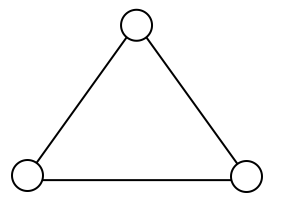
Consider a gas of triatomic molecules. The molecules are assumed to be triangular and made of massless rigid rods whose vertices are occupied by atoms. The internal energy of a mole of the gas at temperature T is:
A uniform thin rope of length 12 m and mass 6 kg hangs vertically from a rigid support and a block of mass 2 kg is attached to its free end. A transverse short wave train of wavelength 6 cm is produced at the lower end of the rope. What is the wavelength of the wave train (in cm) when it reaches the top of the rope?
Two isolated conducting spheres $$S_1$$ and $$S_2$$ of radius $$\frac{2}{3}R$$ and $$\frac{1}{3}R$$ have 12 $$\mu C$$ and $$-3$$ $$\mu C$$ charges, respectively, and are at a large distance from each other. They are now connected by a conducting wire. A long time after this is done the charges on $$S_1$$ and $$S_2$$ are respectively:
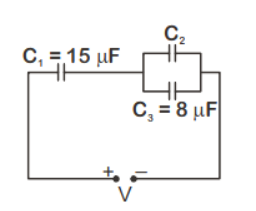
In the circuit shown in the figure, the total charge is 750 $$\mu C$$ and the voltage across capacitor $$C_2$$ is 20 V. Then the charge on capacitor $$C_2$$ is:
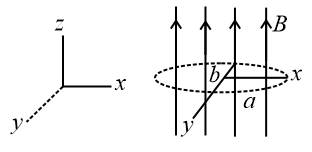
An elliptical loop having resistance $$R$$, of semi major axis $$a$$, and semi minor axis $$b$$ is placed in a magnetic field as shown in the figure. If the loop is rotated about the $$x$$-axis with angular frequency $$\omega$$, the average power loss in the loop due to Joule heating is: