
Join Our JEE Preparation Group
Prep with like-minded aspirants; Get access to free daily tests and study material.
Sign in
Please select an account to continue using cracku.in
↓ →
Join Our JEE Preparation Group
Prep with like-minded aspirants; Get access to free daily tests and study material.
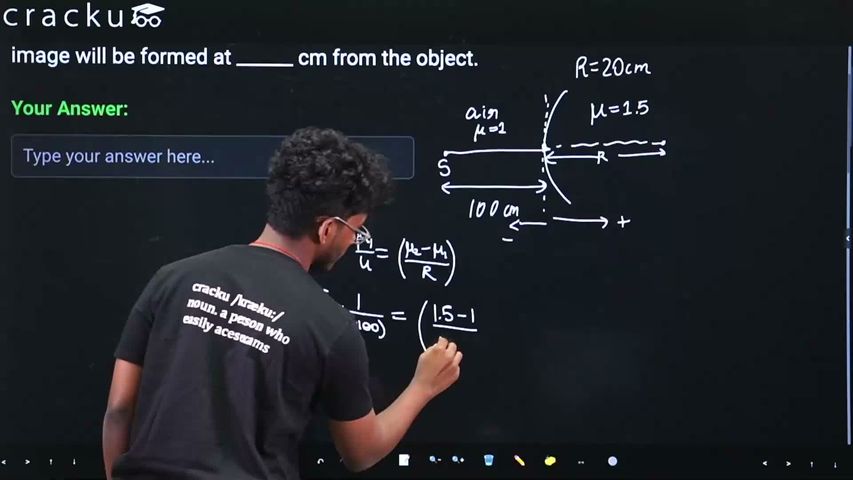
Light from a point source in air falls on a convex curved surface of radius 20 cm and refractive index 1.5. If the source is located at 100 cm from the convex surface, the image will be formed at ______ cm from the object.
Correct Answer: 200
We need to find the image distance from the object when light from a point source in air falls on a convex curved surface of glass.
Refraction at a single spherical surface is governed by the formula $$\frac{\mu_2}{v} - \frac{\mu_1}{u} = \frac{\mu_2 - \mu_1}{R}$$. Here $$\mu_1$$ is the refractive index of the medium containing the object, $$\mu_2$$ is the refractive index of the medium containing the image, $$u$$ is the object distance, $$v$$ is the image distance, and $$R$$ is the radius of curvature.
We know that the refractive index of air is $$\mu_1 = 1$$ and that of glass is $$\mu_2 = 1.5$$.
Since the object lies on the same side as the incident light, the object distance is $$u = -100\ \text{cm}$$. For a convex surface the center of curvature lies on the transmission side, so $$R = +20\ \text{cm}$$.
Substituting these values into the formula gives $$\frac{1.5}{v} - \frac{1}{-100} = \frac{1.5 - 1}{20}$$ which simplifies to $$\frac{1.5}{v} + \frac{1}{100} = \frac{0.5}{20}\,.$$
On the right-hand side we have $$\frac{0.5}{20} = 0.025$$ so that $$\frac{1.5}{v} = 0.025 - \frac{1}{100} = 0.025 - 0.01 = 0.015$$ and therefore $$v = \frac{1.5}{0.015} = 100\ \text{cm}\,.$$
The positive value of $$v$$ indicates the image is formed on the transmission side (inside the glass), 100 cm from the surface.
Hence, the distance from the object to the image is $$|u| + v = 100 + 100 = 200\ \text{cm}$$ since they lie on opposite sides of the refracting surface.
The answer is 200 cm.
Was this solution helpful?
Click on the Email ☝️ to Watch the Video Solution
Create a FREE account and get:
_1.webp)

Educational materials for JEE preparation

Ask our AI anything

AI can make mistakes. Please verify important information.
AI can make mistakes. Please verify important information.
