
Join Our JEE Preparation Group
Prep with like-minded aspirants; Get access to free daily tests and study material.
Sign in
Please select an account to continue using cracku.in
↓ →
Join Our JEE Preparation Group
Prep with like-minded aspirants; Get access to free daily tests and study material.
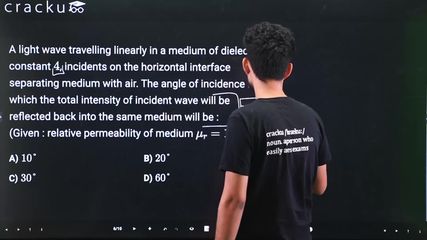
A light wave travelling linearly in a medium of dielectric constant $$4$$, incidents on the horizontal interface separating medium with air. The angle of incidence for which the total intensity of incident wave will be reflected back into the same medium will be :
(Given : relative permeability of medium $$\mu_r = 1$$)
We need to find the angle of incidence for total internal reflection when light travels from a medium with dielectric constant $$\varepsilon_r = 4$$ to air.
The refractive index of the medium is given by $$n = \sqrt{\varepsilon_r \cdot \mu_r} = \sqrt{4 \times 1} = 2$$. At the critical angle $$\theta_c$$, the refracted ray travels along the surface (angle of refraction = $$90°$$), so $$\sin\theta_c = \frac{n_{air}}{n_{medium}} = \frac{1}{2}$$, which gives $$\theta_c = 30°$$.
Total internal reflection occurs when the angle of incidence is greater than or equal to the critical angle. For the entire incident wave to be reflected back, the angle of incidence must exceed $$30°$$. Among the given options ($$10°$$, $$20°$$, $$30°$$, $$60°$$), only $$60°$$ is greater than the critical angle, ensuring total internal reflection.
The correct answer is Option D: $$60°$$.
Was this solution helpful?
Click on the Email ☝️ to Watch the Video Solution
Create a FREE account and get:
_1.webp)

Educational materials for JEE preparation

Ask our AI anything

AI can make mistakes. Please verify important information.
AI can make mistakes. Please verify important information.
