Question 1
The correct order of dipole moments for the given species is
Sign in
Please select an account to continue using cracku.in
↓ →
 JEE WhatsApp Group

Join Our JEE Preparation Group
Prep with like-minded aspirants; Get access to free daily tests and study material.
The correct order of dipole moments for the given species is
The correct order of ONO bond angle in the given species is
Consider the following species:
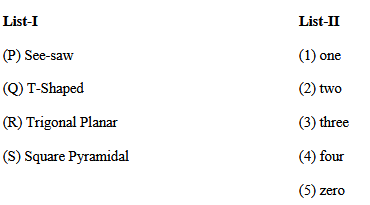
$$SOCl_2$$, $$XeOF_4$$, $$ClF_3$$, $$ClF_5$$, $$XeF_5^{+}$$, $$SO_3^{2-}$$, $$XeF_3^{+}$$, $$SF_4$$
List-I contains different molecular shapes and List-II contains total number of species with the same molecular shapes from the given species. Match each entry in List-I with the appropriate entry in List-II and choose the correct option.
Find out the statements which are not true.
A. Resonating structures with more number of covalent bonds and lesser charge separntion are more stable.
B. In electromeric effect, an unsaturated system shows +E effect with nucleophile and -E effect with electrophile.
C. Inductive effect is responsible for high melting point, boiling point and dipole moment of polar compotmds.
D. The greater the number of alkyl groups attached to the doubly bonded carbon atoms, higher is the heat of hydrogenation.
E. Stability of carbanion increases with the increase in s - character of the carbon carrying the negative charge.
Choose the correct answer from the options given below:
We need to identify which statements are NOT true about organic chemistry concepts.
Statement A: "Resonating structures with more number of covalent bonds and lesser charge separation are more stable."
This is TRUE. More covalent bonds and less charge separation contribute to stability of resonance structures.
Statement B: "In electromeric effect, an unsaturated system shows +E effect with nucleophile and -E effect with electrophile."
This is NOT TRUE. The electromeric effect is the opposite: +E effect occurs with electrophiles (electron shift toward the electrophile) and -E effect occurs with nucleophiles (electron shift away from the nucleophile). The statement has it reversed.
Statement C: "Inductive effect is responsible for high melting point, boiling point and dipole moment of polar compounds."
This is TRUE. Inductive effect contributes to polarity of molecules, affecting physical properties.
Statement D: "The greater the number of alkyl groups attached to the doubly bonded carbon atoms, higher is the heat of hydrogenation."
This is NOT TRUE. More alkyl groups stabilize the double bond (hyperconjugation), resulting in LOWER heat of hydrogenation.
Statement E: "Stability of carbanion increases with the increase in s-character of the carbon carrying the negative charge."
This is TRUE. Greater s-character means the electrons are held closer to the nucleus, stabilizing the carbanion (sp > sp² > sp³).
The statements that are NOT true are B and D only.
Therefore, the answer is Option 4: B & D only.
The formal charges on the atoms marked as (1) to (4) in the Lew is representation
of $$HNO_{3}$$ molecule respectively are
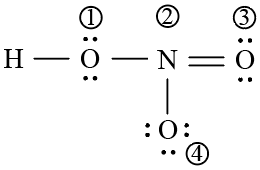
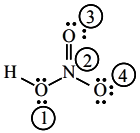
We need to determine the formal charge on each of the atoms marked (1) to (4) in the Lewis structure of the nitric acid ($$HNO_3$$) molecule.
Key Formula: The formal charge of an atom in a Lewis structure is calculated using the following equation:
$$\text{Formal Charge} = \text{Valence electrons} - \text{Non-bonding electrons} - \frac{1}{2}(\text{Bonding electrons})$$
Alternatively, this can be written as:
$$\text{Formal Charge} = \text{Valence electrons} - L - B$$
Where $$L$$ is the number of lone pair electrons (individual dots) and $$B$$ is the number of bonds (lines connected to the atom).
Atom (1) — Oxygen atom bonded to Hydrogen and Nitrogen ($$\text{-OH}$$ group):
Atom (2) — Central Nitrogen atom ($$\text{-N-}$$):
Atom (3) — Oxygen atom double-bonded to Nitrogen ($$\text{=O}$$):
Atom (4) — Oxygen atom single-bonded to Nitrogen ($$\text{-O}^-$$):
Summarizing the calculated values in order from (1) to (4), we get: 0, +1, 0, -1.
Answer: Option A — 0, +1, 0, -1
Bromine trifluoride autoionizes to form $$\text{BrF}_2^+$$ and $$\text{BrF}_4^-$$. The shapes of the cation and anion are respectively __________, and __________.
Reaction
$$2BrF_3\longleftrightarrow\ BF_2^{+\ }+BrF_4^-$$
To determine the molecular geometry, we can calculate the steric number (number of bond pairs + lone pairs) for each ion using Valence Shell Electron Pair Repulsion Theory (VSEPR):
$$BrF_2^+$$
So, steric number $$=4$$→ tetrahedral electron-pair geometry.
With 2 bond pairs and 2 lone pairs, the molecular shape is:
Bent (V-Shaped)
$$BrF^-_4$$
Steric number $$=6$$ → octahedral electron arrangement.
With 4 bond pairs and 2 lone pairs opposite each other, the shape is:
Square Planar
Given below are two statements : **Statement (I) :** The correct sequence of bond lengths in the following species is : $$O_2^+ < O_2 < O_2^- < O_2^{2-}$$ **Statement (II) :** The correct sequence of number of unpaired electrons in the following species is : $$O_2 > O_2^+ > O_2^- > O_2^{2-}$$ In the light of the above statements, choose the correct answer from the options given below :
The four species $$O_2^{2-},\;O_2^{-},\;O_2,\;O_2^{+}$$ all have the same sequence of molecular orbitals because they are homonuclear di-atomic molecules of the second period.
For $$2p$$ orbitals, the energy order is
$$\sigma(2p_z)\lt \pi(2p_x)=\pi(2p_y)\lt \pi^{*}(2p_x)=\pi^{*}(2p_y)\lt \sigma^{*}(2p_z)$$
The inner $$\sigma(2s)$$ and $$\sigma^{*}(2s)$$ levels are completely filled in every case, so only the $$2p$$ block decides bond order and magnetism.
Let us fill the $$2p$$ molecular orbitals for each species and compute the bond order $$\bigl(\text{B.O.}= \tfrac{1}{2}(n_b-n_a)\bigr)$$.
Case 1: $$O_2^{2-}\;(18\;e^-)$$
$$\sigma(2p_z)^2\;\pi(2p_x)^2\;\pi(2p_y)^2\;\pi^{*}(2p_x)^2\;\pi^{*}(2p_y)^2$$
$$n_b=8,\;n_a=4\;\Longrightarrow\;\text{B.O.}= \tfrac{1}{2}(8-4)=1$$
All electrons are paired ⇒ 0 unpaired electrons.
Case 2: $$O_2^{-}\;(17\;e^-)$$
$$\sigma(2p_z)^2\;\pi(2p_x)^2\;\pi(2p_y)^2\;\pi^{*}(2p_x)^2\;\pi^{*}(2p_y)^1$$
$$n_b=8,\;n_a=3\;\Longrightarrow\;\text{B.O.}= \tfrac{1}{2}(8-3)=1.5$$
One electron remains unpaired in the $$\pi^{*}$$ level ⇒ 1 unpaired electron.
Case 3: $$O_2\;(16\;e^-)$$
$$\sigma(2p_z)^2\;\pi(2p_x)^2\;\pi(2p_y)^2\;\pi^{*}(2p_x)^1\;\pi^{*}(2p_y)^1$$
$$n_b=8,\;n_a=2\;\Longrightarrow\;\text{B.O.}= \tfrac{1}{2}(8-2)=2$$
Two electrons singly occupy degenerate $$\pi^{*}$$ orbitals ⇒ 2 unpaired electrons.
Case 4: $$O_2^{+}\;(15\;e^-)$$
$$\sigma(2p_z)^2\;\pi(2p_x)^2\;\pi(2p_y)^2\;\pi^{*}(2p_x)^1\;\pi^{*}(2p_y)^0$$
$$n_b=8,\;n_a=1\;\Longrightarrow\;\text{B.O.}= \tfrac{1}{2}(8-1)=2.5$$
Only one electron is present in the antibonding $$\pi^{*}$$ set ⇒ 1 unpaired electron.
Collecting the results:
Bond orders: $$O_2^{+}(2.5)\; \gt \; O_2(2)\; \gt \; O_2^{-}(1.5)\; \gt \; O_2^{2-}(1)$$
Since bond length is inversely proportional to bond order, the bond-length sequence is
$$O_2^{+} \lt O_2 \lt O_2^{-} \lt O_2^{2-}$$
This is exactly Statement (I) ⇒ Statement (I) is true.
Number of unpaired electrons:
$$O_2\;(2) \gt O_2^{+}\;(1) = O_2^{-}\;(1) \gt O_2^{2-}\;(0)$$
Statement (II) claims the strict order $$O_2 \gt O_2^{+} \gt O_2^{-} \gt O_2^{2-}$$, implying $$O_2^{+}$$ has more unpaired electrons than $$O_2^{-}$$, which is incorrect because both have one.
Hence Statement (II) is false.
Therefore, the correct choice is:
Option C which is: Statement I is true but Statement II is false
Given below are two statements :
Statement I : The number of compounds among SO$$_2$$, SO$$_3$$, SF$$_4$$, SF$$_6$$ and H$$_2$$S in which sulphur does not obey the Octet rule is 3.
Statement II : Among [H$$_2$$O, ClF$$_3$$, SF$$_4$$], [NH$$_3$$, BrF$$_5$$, SF$$_4$$], [BrF$$_5$$, ClF$$_3$$, XeF$$_4$$] and [XeF$$_4$$, ClF$$_3$$, H$$_2$$O], the number of sets in which all the molecules have one lone pair of electrons on the central atom is 1.
In the light of the above statements, choose the correct answer from the options given below :
In the molecules (SO_2), (SO_3), (SF_4), (SF_6), and (H_2S), the number of electrons around the sulphur atom is as follows:
Thus, sulphur does not obey the octet rule in 4 compounds, namely (SO_2), (SO_3), (SF_4), and (SF_6).
Therefore, Statement I is false.
Now consider the number of lone pairs on the central atom:
Checking the given sets:
Only the second set contains molecules in which the central atom has exactly one lone pair.
Therefore, Statement II is true.
Hence, Statement I is false and Statement II is true.
$$SF_4$$ is isostructural with :
A. $$BrF_4^\ominus$$
B. $$CH_4$$
C. $$IF_4^\oplus$$
D. $$XeF_4$$
E. $$XeO_2F_2$$
Choose the correct answer from the options given below :
To determine which species are isostructural with $$SF_4$$, we first analyze the structure of $$SF_4$$ using VSEPR theory.
Sulfur has six valence electrons, and in $$SF_4$$ it forms four $$S-F$$ bonds while retaining one lone pair. Thus, the central atom has a steric number of $$5$$ (four bond pairs and one lone pair), corresponding to $$sp^3d$$ hybridization. The electron pair geometry is trigonal bipyramidal, while the molecular geometry is see-saw due to the presence of one lone pair.
Now, let us examine each species:
Hence, the species that are isostructural with $$SF_4$$ are $$IF_4^+$$ and $$XeO_2F_2$$, corresponding to Option B (C and E Only).
The covalent radii of atoms A and B are $$r_A$$ and $$r_B$$ respectively. The covalent bond length and total length of $$AB$$ molecule are respectively :
To understand the relationship between covalent radii and bond length, we use the fundamental definition of covalent radius in molecular geometry.
The covalent bond length between two atoms $$A$$ and $$B$$ is defined as the sum of their individual covalent radii when they are joined by a single covalent bond. Therefore, the bond length is given by
$$d_{AB}=r_A+r_B.$$
The total length of the diatomic molecule $$AB$$ refers to the distance from the outer edge of atom $$A$$ to the outer edge of atom $$B$$. Since this includes the radii of both atoms on either side of the bond, the total molecular length is
$$L=2(r_A+r_B).$$
Hence, the covalent bond length of the molecule is
$$r_A+r_B,$$
and the total length of the molecule is
$$2(r_A+r_B).$$
Therefore, the correct option is the one corresponding to
$$\boxed{\text{Bond length}=r_A+r_B,\qquad \text{Total length}=2(r_A+r_B).}$$
Which of the following pictorial diagram most correctly represents the $$\pi^*$$ ($$\pi$$ - antibonding) molecular orbital between two atoms if the internuclear axis is taken to be in the z-direction $$(\xrightarrow{z-axis})$$?
The internuclear axis of the diatomic molecule is chosen as the $$z$$-axis.
Recall the shapes of the four common kinds of molecular orbitals :
• $$\sigma$$ - no nodal plane that contains the $$z$$-axis.
• $$\sigma^{*}$$ - one nodal plane that contains the $$z$$-axis (because the two combining $$p_z$$ orbitals overlap out-of-phase).
• $$\pi$$ - one nodal plane that contains the $$z$$-axis (because the lobes lie above and below the axis) but no nodal plane perpendicular to the axis between the nuclei (the overlap is in-phase).
• $$\pi^{*}$$ - two nodal planes: (i) a plane that contains the $$z$$-axis, and (ii) a plane perpendicular to the $$z$$-axis at the bond centre (because the overlap is out-of-phase).
Therefore a correct diagram of a $$\pi^{*}$$ orbital must show:
1. Lobes located above and below the $$z$$-axis - this gives the nodal plane containing the $$z$$-axis (typical for any $$\pi$$ type orbital).
2. Opposite phases (shaded vs unshaded) on the two atoms - this produces a second nodal plane perpendicular to the $$z$$-axis exactly between the nuclei, characteristic of an antibonding orbital.
3. No electron density exactly on the internuclear axis itself (because $$p_x$$ or $$p_y$$ basis functions are used, not $$p_z$$).
Inspecting the four given sketches:
Option (a) - shows in-phase overlap; it represents a bonding $$\pi$$ orbital, not antibonding.
Option (b) - shows lobes above and below the axis with opposite shading on the two atoms; there is a node at the bond centre and a nodal plane containing the $$z$$-axis. This satisfies both conditions for $$\pi^{*}$$.
Option (c) - lobes are along the internuclear axis, so it would be a $$\sigma$$ type, not $$\pi$$.
Option (d) - again shows in-phase overlap (bonding) rather than antibonding.
Thus only Option (b) has the correct orientation and the two required nodal planes of a $$\pi^{*}$$ molecular orbital.
Option B which is: Option (b)
The pairs among
$$A = [SO_3^{2-}, CO_3^{2-}]$$, $$B = [O_2^{2-}, F_2]$$, $$C = [CN^-, CO]$$, $$D = [NH_3, H_3O^+]$$ and $$E = [MnO_4^{2-}, CrO_4^{2-}]$$ that do not have similar Lewis dot structure are:
Species having the same number of atoms and the same total number of valence electrons are isoelectronic and generally possess similar Lewis dot structures.
For the pair ([SO_3^{2-},,CO_3^{2-}]),
$$SO_3^{2-}:6+3(6)+2=26\ \text{valence electrons},$$
$$CO_3^{2-}:4+3(6)+2=24\ \text{valence electrons}.$$
Since the total number of valence electrons is different, their Lewis dot structures are not similar.
For the pair ([O_2^{2-},,F_2]),
$$O_2^{2-}:2(6)+2=14\ \text{valence electrons},$$
$$F_2:2(7)=14\ \text{valence electrons}.$$
Both are isoelectronic and therefore have similar Lewis structures.
For the pair ([CN^-,,CO]),
$$CN^-:4+5+1=10\ \text{valence electrons},$$
$$CO:4+6=10\ \text{valence electrons}.$$
Both are isoelectronic and possess similar Lewis dot structures.
For the pair ([NH_3,,H_3O^+]),
$$NH_3:5+3(1)=8\ \text{valence electrons},$$
$$H_3O^+:6+3(1)-1=8\ \text{valence electrons}.$$
Both have the same electron count and similar trigonal pyramidal Lewis structures.
For the pair ([MnO_4^{2-},,CrO_4^{2-}]), although both contain tetrahedral oxyanions, the central atoms have different electronic configurations. In (MnO_4^{2-}), manganese is in the (+6) oxidation state with a (d^1) configuration, whereas in (CrO_4^{2-}), chromium is in the (+6) oxidation state with a (d^0) configuration. Hence, their Lewis dot structures are not considered similar.
Therefore, the pairs that do not have similar Lewis dot structures are A and E.
Hence, the correct answer is A and E.
Given below are statements about some molecules/ions.
Identify the CORRECT statements.
A The dipole moment value of $$NF_{3}$$ is higher than that of $$NH_{3}$$.
B. The dipole moment value of $$BeH_{2}$$ is zero.
C. The bond order of $$O_{2}^{2-}$$ and $$F_{2}$$ is same.
D. The formal charge on the central oxygen atom of ozone is -1 .
E. In $$NO_{2}$$, all the three atoms satisfy the octet rule, hence it is very stable.
Choose the correct answer from the options given below:
Analyzing each statement:
A. The dipole moment of $$NF_3$$ is higher than that of $$NH_3$$.
False. In $$NH_3$$, the N-H bond dipoles and the lone pair dipole all point in the same direction, giving a large net dipole moment (1.47 D). In $$NF_3$$, the N-F bond dipoles point toward F while the lone pair points in the opposite direction, causing partial cancellation and a small net dipole moment (0.23 D).
B. The dipole moment of $$BeH_2$$ is zero.
True. $$BeH_2$$ is linear ($$sp$$ hybridized), so the two equal Be-H bond dipoles cancel exactly.
C. The bond order of $$O_2^{2-}$$ and $$F_2$$ is the same.
True. Using molecular orbital theory:
$$O_2^{2-}$$: 18 total electrons (8 from each O + 2 extra). MO filling gives 10 bonding and 8 antibonding electrons. Bond order = $$\frac{10-8}{2} = 1$$.
$$F_2$$: 18 total electrons (9 from each F). Same MO filling gives 10 bonding and 8 antibonding electrons. Bond order = $$\frac{10-8}{2} = 1$$.
Both have bond order 1.
D. The formal charge on the central oxygen atom of ozone is -1.
False. In the resonance structures of $$O_3$$, the central oxygen carries a formal charge of +1 (it donates one of its lone pairs to form a coordinate bond), not -1.
E. In $$NO_2$$, all three atoms satisfy the octet rule, hence it is very stable.
False. $$NO_2$$ has 17 valence electrons (odd electron molecule). Nitrogen has an unpaired electron and does not complete its octet, making $$NO_2$$ reactive.
The correct statements are B and C only.
The answer is Option C: B and C Only.
Consider the following molecules/species:
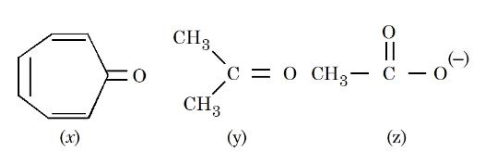
The correct order of carbon-oxygen double bond length is:
The length of a C=O bond depends mainly on its bond order. A higher bond order means stronger overlap, larger electron density between the nuclei and hence a shorter bond. Conversely, a lower bond order leads to a longer bond.
Bond order is reduced whenever the π-electrons of the C=O group are delocalised through resonance or conjugation.
Case (y): acetone
Acetone contains an isolated carbonyl group with no π-conjugation. There is essentially one dominant structure
$$CH_3-CO-CH_3$$
so the C=O bond order is almost exactly 2. Therefore its C=O bond is the shortest of the three molecules considered.
Case (z): acetate ion, $$CH_3COO^-$$
For the carboxylate ion two equivalent resonance forms exist:
$$CH_3-C(=O)O^- \;\;\;\; \leftrightarrow \;\;\;\; CH_3-C(O^-) = O$$
Because both structures contribute equally, each C-O bond has a bond order of $$\frac{1+2}{2}=1.5$$. A bond order of 1.5 is much lower than 2, so the C-O bonds in acetate are considerably longer than the C=O bond in acetone.
Case (x): tropone-like compound
Tropone is $$\text{cyclohepta-2,4,6-trien-1-one}$$. The carbonyl double bond is conjugated with three C=C bonds in the 7-membered ring, producing resonance structures such as
$$\text{O}^--C^+$$ delocalised over the ring.
This delocalisation removes part of the double-bond character from the C=O bond, lowering its bond order to a value between 1.5 (acetate) and 2 (acetone). Consequently its C=O bond length lies between those of acetate and acetone.
Putting the three results together:
• acetate ion (z): bond order 1.5 → longest C-O bond
• tropone-like compound (x): bond order <2 but >1.5 → intermediate length
• acetone (y): bond order ≈2 → shortest C=O bond
Therefore the correct order is
$$\text{z} \; \gt \; \text{x} \; \gt \; \text{y}$$
Option C which is: z > x > y
Given below are two statements:
Statement I: The correct order in terms of bond dissociation enthalpy is $$Cl_{2} > Br_{2} > F_{2} > I_{2}$$.
Statement II : The correct trend in the covalent character of the metal halides is $$[SnCl_{4} > SnCl_{2}]$$, $$[PbCl_{4}> PbCl_{2}]$$, and $$[UF_{4} > UF_{6}]$$.
In The light oh the above statements, choose the correct answer from the options given below:
We need to evaluate two statements about bond dissociation enthalpies and covalent character of metal halides.
First, consider Statement I, which claims that the correct order in terms of bond dissociation enthalpy is $$Cl_2 > Br_2 > F_2 > I_2$$. The bond dissociation enthalpies (in kJ/mol) are: $$Cl\text{-}Cl$$: 242, $$Br\text{-}Br$$: 193, $$F\text{-}F$$: 159, $$I\text{-}I$$: 151.
One might expect $$F_2$$ to have the highest bond dissociation enthalpy since fluorine is the smallest halogen and a shorter bond tends to be stronger; however, $$F_2$$ has an anomalously low bond dissociation enthalpy due to strong lone pair-lone pair repulsion between the two small fluorine atoms. The three lone pairs on each fluorine atom are very close to each other, causing significant interelectronic repulsion that weakens the bond.
Since the experimental enthalpies follow the order $$Cl_2 > Br_2 > F_2 > I_2$$, Statement I is true.
Statement II asserts that the correct trend in covalent character is $$SnCl_4 > SnCl_2$$, $$PbCl_4 > PbCl_2$$, and $$UF_4 > UF_6$$. According to Fajans’ rules, covalent character increases when the cation has a higher charge (more polarizing power), when the cation has a smaller size, and when the anion is larger and more polarizable.
In $$SnCl_4$$, tin is in the +4 oxidation state, giving it greater polarizing power than in $$SnCl_2$$ where tin is in the +2 oxidation state; accordingly, $$SnCl_4$$ is more covalent than $$SnCl_2$$, which agrees with the statement. Similarly, $$PbCl_4$$ (Pb in +4) is more covalent than $$PbCl_2$$ (Pb in +2), so that part of the trend is also correct.
In contrast, for the uranium fluoride pair, $$UF_6$$ contains U6+ (higher charge and more polarizing) while $$UF_4$$ contains U4+ (lower charge), so by Fajans’ rules $$UF_6$$ should have greater covalent character than $$UF_4$$. The statement claims $$UF_4 > UF_6$$, which is incorrect. Therefore, Statement II is false.
The correct answer is Option (3): Statement I is true but Statement II is false.
Pair of species among the following having same bond order as well as paramagnetic character will be-
Among $$H_{2}S$$, $$H_{2}O$$, $$NF_{3}$$, $$NH_{3}$$ and $$CHC1_{3}$$, identify the molecule (X) with lowest dipole moment value. The number of lone pairs of electrons present on the central atom of the molecule (X) is :
We need to identify the molecule with the lowest dipole moment among $$H_2S$$, $$H_2O$$, $$NF_3$$, $$NH_3$$, and $$CHCl_3$$, and then find the number of lone pairs on its central atom.
The approximate dipole moments (in Debye) are:
- $$H_2O$$: 1.85 D (bent geometry, two lone pairs on O)
- $$H_2S$$: 0.97 D (bent geometry, bond angle ~92 degrees)
- $$NH_3$$: 1.47 D (trigonal pyramidal, one lone pair on N)
- $$NF_3$$: 0.23 D (trigonal pyramidal, one lone pair on N)
- $$CHCl_3$$: 1.04 D (tetrahedral-like geometry)
$$NF_3$$ has the lowest dipole moment (0.23 D). This is because in $$NF_3$$, the lone pair on nitrogen points in one direction while the three highly electronegative fluorine atoms pull electron density in the opposite direction. The bond dipoles of the three N-F bonds nearly cancel the lone pair contribution, resulting in a very small net dipole moment.
This contrasts with $$NH_3$$ where both the lone pair and the N-H bond dipoles point in the same direction (toward nitrogen), reinforcing each other.
Nitrogen in $$NF_3$$ has the electronic configuration: 5 valence electrons, 3 used in bonds with F, leaving 1 lone pair on nitrogen.
The correct answer is Option 4: 1.
Consider the transition metal ions $$Mn^{3+}, Cr^{3+}, Fe ^{3+}$$ and $$Co^{3+}$$ and all form low spin octahedral complexes. The correct decreasing order of unpaired electrons in their respective d-orbitals of the complexes is
We need to find the correct decreasing order of unpaired electrons in low-spin octahedral complexes of $$Mn^{3+}$$, $$Cr^{3+}$$, $$Fe^{3+}$$, and $$Co^{3+}$$.
$$Cr^{3+}$$: $$[Ar]3d^3$$, $$Mn^{3+}$$: $$[Ar]3d^4$$, $$Fe^{3+}$$: $$[Ar]3d^5$$, $$Co^{3+}$$: $$[Ar]3d^6$$
In a low-spin (strong field) octahedral complex, electrons fill $$t_{2g}$$ first before going to $$e_g$$:
$$Cr^{3+}$$ ($$d^3$$): $$t_{2g}^3 e_g^0$$ → 3 unpaired electrons
$$Mn^{3+}$$ ($$d^4$$): $$t_{2g}^4 e_g^0$$ → 2 unpaired electrons (one pair in $$t_{2g}$$)
$$Fe^{3+}$$ ($$d^5$$): $$t_{2g}^5 e_g^0$$ → 1 unpaired electron
$$Co^{3+}$$ ($$d^6$$): $$t_{2g}^6 e_g^0$$ → 0 unpaired electrons
$$Cr^{3+}(3) > Mn^{3+}(2) > Fe^{3+}(1) > Co^{3+}(0)$$
This matches Option C: $$Cr^{3+} > Mn^{3+} > Fe^{3+} > Co^{3+}$$.
Therefore, the answer is Option C.
ldentify the molecule (X) with maximum number of lone pairs of electrons (obtained using Lewis dot structure) among $$HNO_{3},H{2}SO_{4},NF_{3}\text{ and }O_{3}$$. Choose the correct bond angle made by the central atom of the molecule (X).
Count lone pairs on all atoms in each molecule using Lewis dot structures:
$$HNO_3$$: Nitrogen forms one N=O double bond, one N-O single bond, and one N-OH bond. N has 0 lone pairs. The =O has 2 lone pairs, the -O- (bridging to H) has 2 lone pairs, and the -OH oxygen has 2 lone pairs. Total = $$0 + 2 + 2 + 2 = 6$$.
$$H_2SO_4$$: Sulfur forms two S=O double bonds and two S-OH bonds. S has 0 lone pairs. Each of the 2 terminal =O atoms has 2 lone pairs, and each of the 2 -OH oxygens has 2 lone pairs. Total = $$0 + 2(2) + 2(2) = 8$$.
$$NF_3$$: Nitrogen has 1 lone pair and forms three N-F bonds. Each F has 3 lone pairs. Total = $$1 + 3(3) = 10$$.
$$O_3$$: Central O has 1 lone pair. The double-bonded terminal O has 2 lone pairs. The single-bonded terminal O (with formal charge -1) has 3 lone pairs. Total = $$1 + 2 + 3 = 6$$.
$$NF_3$$ has the maximum number of lone pairs (10), so molecule X = $$NF_3$$ with central atom nitrogen.
In $$NF_3$$, nitrogen is $$sp^3$$ hybridized with trigonal pyramidal geometry. The highly electronegative F atoms draw bonding electron density away from N, reducing bond pair-bond pair repulsion. Combined with the lone pair compression, the F-N-F bond angle is reduced to approximately $$102°$$.
The answer is Option B: $$102°$$.
Given below are two statements:
Statement I: The number of species among $$BF_{4}^{-},SiF_{4},XeF_{4}\text{ and }SF_{4}$$,that have unequal E-F bond lengths is two. Here, E is the central atom.
Satement II: Among $$O_{2}^{-},O_{2}^{2-},F_{2}\text{ and }O_{2}^{+},O_{2}^{-}$$ has the highest bond order.
In the light of the above statements, choose the correct answer from the options given below
The correct increasing order of C - H(A), C - 0 (B), C = O(C) and C = N (D) bonds in terms of covalent bond length is :
The covalent bond length depends mainly on two factors:
• bond order (greater bond order → shorter bond)
• size of the atoms involved (bond with a smaller atom is shorter).
Typical experimental bond lengths (in Å) are frequently quoted as
$$\begin{aligned} \text{C-H (single)} & : 1.09 \; \text{Å} \\[2pt] \text{C}\equiv\text{N (triple)} & : 1.16 \; \text{Å} \\[2pt] \text{C}=\text{O (double)} & : 1.21 \; \text{Å} \\[2pt] \text{C-O (single)} & : 1.43 \; \text{Å} \end{aligned}$$
Arranging these values from the shortest bond (smallest length) to the longest bond (largest length):
$$\text{C-H} \lt \text{C}\equiv\text{N} \lt \text{C}=\text{O} \lt \text{C-O}$$
Using the labels given in the question:
A = C-H, D = C≡N, C = C=O, B = C-O
The increasing order of covalent bond length is therefore
$$A \lt D \lt C \lt B$$
Hence the correct option is Option A.
Which statements are NOT TRUE about $$XeO_2 F_2$$?
A. It has a see-saw shape.
B. Xe has 5 electron pairs in its valence sheU in XeO 2 F 2.
C. The $$O - Xe- O$$ bond angle is close to $$180^{o}$$.
D. The $$F- Xe -F$$ bond angle is close to $$180^{o}$$.
E. $$Xe$$ has 16 valence electrons in $$XeO_2 F_2$$.
Choose the correct answer from the options given below:
To determine which statements are not true about $$XeO_2F_2$$, we analyze its molecular structure using VSEPR theory and Lewis structure concepts.
First, recall that xenon (Xe) has 8 valence electrons. In $$XeO_2F_2$$, the central Xe atom is bonded to two oxygen (O) atoms and two fluorine (F) atoms. The Lewis structure shows:
Total valence electrons in $$XeO_2F_2$$: Xe contributes 8, each O contributes 6 (total 12 for two O), each F contributes 7 (total 14 for two F), summing to $$8 + 12 + 14 = 34$$ electrons. After accounting for bonding and lone pairs on terminal atoms, Xe has one lone pair.
Now, evaluate each statement:
Statement A: It has a see-saw shape.
Using VSEPR theory, the steric number (SN) is the number of electron domains around Xe. Each bond (single or double) counts as one domain, and the lone pair counts as one domain. Thus, SN = 4 bonding domains (two from Xe-F and two from Xe-O) + 1 lone pair domain = 5. The electron geometry is trigonal bipyramidal. With one lone pair in an equatorial position, the molecular shape is see-saw. Thus, this statement is TRUE.
Statement B: Xe has 5 electron pairs in its valence shell in $$XeO_2F_2$$.
"Electron pairs" refer to both bonding pairs and lone pairs. In the Lewis structure:
- Lone pair on Xe: 1 pair.
- Bonding pairs: Two Xe-F single bonds contribute 2 bonding pairs, and two Xe-O double bonds contribute 4 bonding pairs (since each double bond has two pairs). Total = $$1 + 2 + 4 = 7$$ electron pairs. The statement says 5, which is incorrect. Thus, this statement is NOT TRUE.
Statement C: The $$O - Xe - O$$ bond angle is close to $$180^\circ$$.
In the see-saw shape (trigonal bipyramidal with one lone pair), the lone pair occupies an equatorial position. The two O atoms are typically in equatorial positions (due to bond length and electronegativity considerations). The ideal equatorial bond angle is $$120^\circ$$, but the lone pair repulsion reduces it to less than $$120^\circ$$. It is not close to $$180^\circ$$. Thus, this statement is NOT TRUE.
Statement D: The $$F - Xe - F$$ bond angle is close to $$180^\circ$$.
In the trigonal bipyramidal arrangement, the two F atoms are in axial positions. The axial bond angle is $$180^\circ$$. Thus, this statement is TRUE.
Statement E: Xe has 16 valence electrons in $$XeO_2F_2$$.
The number of valence electrons assigned to Xe in the Lewis structure is calculated as:
- Lone pair electrons: 2 electrons.
- Half the bonding electrons: Each Xe-F bond (2 electrons) contributes 1 electron to Xe, so two bonds give 2 electrons. Each Xe-O double bond (4 electrons) contributes 2 electrons to Xe, so two double bonds give 4 electrons. Total = $$2 + 2 + 4 = 8$$ valence electrons. The statement says 16, which is incorrect. Thus, this statement is NOT TRUE.
The NOT TRUE statements are B, C, and E. The correct option is A. B, C and E Only.
According to Lewis theory, the total number of $$\sigma$$ bond-pairs and lone pair of electrons around the central atom of $$\text{XeO}_6^{4-}$$ ion is _____.
The central atom is xenon. Xenon belongs to group 18, so it possesses $$8$$ valence electrons.
Step 1 - make the σ-bond framework.
$$\text{XeO}_6^{4-}$$ contains six Xe-O bonds.
Formation of one σ-bond consumes one electron from Xe.
Hence electrons of Xe used in σ-bonding = $$6$$.
Step 2 - electrons remaining on Xe.
Electrons initially present on Xe = $$8$$.
Electrons already used in σ-bonds = $$6$$.
Electrons still left on Xe = $$8-6=2$$.
These two electrons stay together as one lone pair.
Step 3 - count σ-bond pairs and lone-pair(s).
Number of σ-bond pairs around Xe = $$6$$.
Number of lone pairs on Xe = $$1$$.
Therefore, the total of “σ bond-pairs + lone pair of electrons’’ around the central xenon atom is $$6 + 1 = 7$$.
Answer: 7
Consider the following species:
$$BrF_5$$, $$XeF_5^-$$, $$BF_4^-$$, $$ICl_4^-$$, $$XeF_4$$, $$SF_4$$, $$NH_4^+$$, $$ClF_3$$, $$XeF_2$$, $$ICl_2^-$$
Number of species having $$sp^3d$$ hybridized central atom is _______.
The hybridization of a central atom can be determined using the Steric Number (SN) formula:
$$(\text{SN}=\frac{1}{2}\left[V+M-C+A\right])$$
Where
$$V = \text{valence electrons of central atom}$$,
$$M = \text{monovalent atoms}$$,
$$C = \text{cationic charge}$$, and
$$A = \text{anionic charge}$$.
A steric number of 5 corresponds to $$(sp^{3}d)$$ hybridization.
1. Species with $$(sp^{3}d)$$ Hybridization $$(\text{SN} = 5)$$:
2. Other Species in the List:
Species having $$sp^3{}d$$ hybridization are:
$$SF_4,\ ClF_3,\ XeF_2,\ ICl_2^-$$
Total number: 4
Regarding the molecular orbital (MO) energy levels for homonuclear diatomic molecules, the INCORRECT statement(s) is(are)
Molecular orbital (MO) theory gives a direct relation between electronic configuration and measurable properties such as bond order, bond energy and bond length.
Bond order $$= \dfrac{n_b - n_a}{2}$$ where $$n_b$$ and $$n_a$$ are the numbers of electrons in bonding and antibonding MOs respectively.
Option A Ne$$_2$$
Each Ne atom has eight valence electrons (2s$$^2$$ 2p$$^6$$); Ne$$_2$$ therefore has 16 valence electrons.
For elements with atomic number $$\gt 7$$ (O, F, Ne) the MO order is
$$\sigma_{2s}\lt\sigma^{*}_{2s}\lt\sigma_{2p_z}\lt\pi_{2p_x}=\pi_{2p_y}\lt
\pi^{*}_{2p_x}=\pi^{*}_{2p_y}\lt\sigma^{*}_{2p_z}$$
Filling 16 electrons gives
bonding electrons $$n_b = 8$$ (σ$$_{2s}$$, σ$$_{2p_z}$$, π$$_{2p_x}$$, π$$_{2p_y}$$)
antibonding electrons $$n_a = 8$$ (σ$$_{2s}^{*}$$, π$$_{2p_x}^{*}$$, π$$_{2p_y}^{*}$$, σ$$_{2p_z}^{*}$$)
Hence $$\text{Bond order} = \dfrac{8-8}{2}=0$$; Ne$$_2$$ is not a stable molecule. Statement A is therefore correct (so it is NOT an incorrect statement).
Option B F$$_2$$
Each F atom contributes seven valence electrons; F$$_2$$ has 14 valence electrons. Using the same MO order as above:
σ$$_{2s}$$ (2) → σ$$_{2s}^{*}$$ (2) → σ$$_{2p_z}$$ (2) → π$$_{2p_x}$$ (2) & π$$_{2p_y}$$ (2) → π$$_{2p_x}^{*}$$ (2) & π$$_{2p_y}^{*}$$ (2)
The highest-energy filled level (HOMO) is the degenerate pair $$\pi^{*}_{2p_x},\;\pi^{*}_{2p_y}$$—both are $$\pi$$-type antibonding orbitals, not σ-type. Hence statement B is incorrect.
Option C Comparison of O$$_2$$ and O$$_2^{+}$$
O$$_2$$ has 12 valence electrons. Configuration: σ$$_{2s}^{2}$$ σ$$_{2s}^{*2}$$ σ$$_{2p_z}^{2}$$ π$$_{2p_x}^{2}$$ π$$_{2p_y}^{2}$$ π$$_{2p_x}^{*1}$$ π$$_{2p_y}^{*1}$$
For O$$_2$$ $$n_b=8,\; n_a=4 \Longrightarrow \text{BO}=\dfrac{8-4}{2}=2$$
O$$_2^{+}$$ has one electron fewer; the electron is removed from a π$$_{2p}^{*}$$ antibonding orbital:
O$$_2^{+}$$ π$$_{2p_x}^{*1}$$, π$$_{2p_y}^{*0}$$
Now $$n_b=8,\; n_a=3 \Longrightarrow \text{BO}=\dfrac{8-3}{2}=2.5$$
Greater bond order implies stronger bond (larger bond energy) and shorter bond length. Therefore O$$_2^{+}$$ has a higher (not smaller) bond energy than O$$_2$$. Statement C is incorrect.
Option D Li$$_2$$ vs. B$$_2$$
Li$$_2$$ (two valence electrons) σ$$_{2s}^{2}$$ ⇒ $$n_b=2,\; n_a=0$$, BO = 1
B$$_2$$ (six valence electrons) σ$$_{2s}^{2}$$ σ$$_{2s}^{*2}$$ π$$_{2p_x}^{1}$$ π$$_{2p_y}^{1}$$ ⇒ $$n_b=4,\; n_a=2$$, BO = 1
Though both have the same bond order, the π(2p)-π(2p) overlap in B$$_2$$ is stronger than the σ(2s)-σ(2s) overlap in Li$$_2$$, producing a shorter bond length for B$$_2$$. Thus Li$$_2$$ indeed has the larger bond length. Statement D is correct (so it is NOT an incorrect statement).
Hence the INCORRECT statements are:
Option B (HOMO of F$$_2$$ is σ-type), Option C (Bond energy of O$$_2^{+}$$ is smaller than that of O$$_2$$).
Option B, Option C
Given below are two statements : Statement (I): Experimentally determined oxygen-oxygen bond lengths in the $$ O_3 $$ are found to be same and the bond length is greater than that of a $$O = O$$ (double bond) but less than that of a single $$(O - O)$$ bond. Statement (II) : The strong lone pair-lone pair repulsion between oxygen atoms is solely responsible for the fact that the bond length in ozone is smaller than that of a double bond $$(O = O)$$ but more than that of a single bond $$(O - O)$$. In the light of the above statements, choose the correct answer from the options given below :
We need to evaluate two statements about bond lengths in ozone ($$O_3$$).
Analysis of Statement I: "The experimentally determined oxygen-oxygen bond lengths in $$O_3$$ are found to be the same, and the bond length is greater than that of $$O=O$$ (double bond) but less than that of a single $$O-O$$ bond."
Ozone has two resonance structures where a double bond alternates between the two terminal oxygen atoms. Due to resonance, both O-O bonds in ozone are equivalent, with a bond order of 1.5 (intermediate between single and double bonds). The bond length in $$O_3$$ is approximately 1.278 angstroms, which is indeed:
- Greater than the $$O=O$$ double bond length (1.21 angstroms in $$O_2$$)
- Less than the $$O-O$$ single bond length (1.48 angstroms in $$H_2O_2$$)
Statement I is TRUE.
Analysis of Statement II: "The strong lone pair-lone pair repulsion between oxygen atoms is solely responsible for the bond length in ozone being smaller than a double bond but more than a single bond."
This statement is incorrect for two reasons. First, the intermediate bond length in ozone is primarily due to resonance, not lone pair-lone pair repulsion. The delocalization of electrons across the two O-O bonds gives each bond a bond order of 1.5. Second, the statement says "solely responsible," which is factually wrong since resonance is the dominant factor.
Statement II is FALSE.
The correct answer is Option 3: Statement I is true but Statement II is false.
Which of the following molecules show/s paramagnetic behavior?
(A) $$O_2$$ (B) $$N_2$$ (C) $$F_2$$ (D) $$S_2$$ (E) $$Cl_2$$
Choose the correct answer:
For a molecule to be paramagnetic, it must contain at least one unpaired electron. The Molecular Orbital (MO) approach is the most reliable way to count unpaired electrons in homonuclear diatomic molecules.
Rule: Fill MOs in the order of increasing energy while obeying Hund’s rule (maximum multiplicity) and the Pauli exclusion principle. In period-2 diatomics the ordering changes after $$N_2$$:
• For $$B_2,\,C_2,\,N_2$$ the sequence is $$\sigma_{2p_z}$$ > $$\pi_{2p_x} = \pi_{2p_y}$$.
• For $$O_2,\,F_2$$ and beyond (including $$S_2,\,Cl_2$$) the sequence is $$\pi_{2p_x} = \pi_{2p_y}$$ > $$\sigma_{2p_z}$$.
Case A: $$O_2$$
Total valence electrons per atom = 6, so molecule has $$12$$.
Filling the energy-correct MO sequence (after $$N_2$$) gives:
$$\sigma_{2s}^2\,\sigma_{2s}^{*2}\,\sigma_{2p_z}^2\,\pi_{2p_x}^2\,\pi_{2p_y}^2\,\pi_{2p_x}^{*1}\,\pi_{2p_y}^{*1}$$
Two electrons remain unpaired in the degenerate $$\pi_{2p}^{*}$$ orbitals, so $$O_2$$ is paramagnetic.
Case B: $$N_2$$
Total valence electrons = $$10$$.
Using the first energy sequence (before $$O_2$$):
$$\sigma_{2s}^2\,\sigma_{2s}^{*2}\,\pi_{2p_x}^2\,\pi_{2p_y}^2\,\sigma_{2p_z}^2$$
All electrons are paired ⇒ $$N_2$$ is diamagnetic.
Case C: $$F_2$$
Total valence electrons = $$14$$.
Filling after $$O_2$$ sequence:
$$\sigma_{2s}^2\,\sigma_{2s}^{*2}\,\sigma_{2p_z}^2\,\pi_{2p_x}^2\,\pi_{2p_y}^2\,\pi_{2p_x}^{*2}\,\pi_{2p_y}^{*2}$$
All electrons are paired ⇒ $$F_2$$ is diamagnetic.
Case D: $$S_2$$
Sulphur is one period below oxygen but forms a similar $$S_2$$ molecule with valence 6 e⁻ per atom ⇒ $$12$$ electrons, and the same MO ordering used for $$O_2$$ applies (the 3p orbitals follow the same pattern).
Hence configuration of $$S_2$$ ends with $$\pi_{3p_x}^{*1}\,\pi_{3p_y}^{*1}$$.
Two unpaired electrons are present, so $$S_2$$ is paramagnetic.
Case E: $$Cl_2$$
Chlorine contributes 7 valence electrons; $$Cl_2$$ has $$14$$. Filling the 3p MO diagram analogous to $$F_2$$ gives all electrons paired ⇒ $$Cl_2$$ is diamagnetic.
Summary: The molecules with unpaired electrons are $$O_2$$ and $$S_2$$ only.
Therefore, the correct option is Option D: A & D only.
Which among the following molecules is (a) involved in $$sp^3d$$ hybridization, (b) has different bond lengths and (c) has lone pair of electrons on the central atom ?
We have to identify the molecule that simultaneously satisfies three conditions:
(a) central atom undergoes $$sp^3d$$ hybridization,
(b) the molecule possesses more than one type of bond length, and
(c) the central atom contains at least one lone pair of electrons.
• Central atom $$P$$: valence electrons = $$5$$, all used for $$5$$ $$P-F$$ bonds.
• Hybridization: $$sp^3d$$ (trigonal-bipyramidal).
• Lone pairs on $$P$$: $$0$$, so condition (c) is not met.
Hence $$PF_5$$ is rejected.
• Central atom $$Xe$$: valence electrons = $$8$$, uses $$4$$ for bonds and retains $$2$$ lone pairs.
• Hybridization: $$sp^3d^2$$ (octahedral arrangement, square-planar shape).
• Geometry is symmetric; all $$Xe-F$$ bonds are equivalent in length.
Condition (a) fails (hybridization not $$sp^3d$$), so $$XeF_4$$ is rejected.
• Central atom $$S$$: valence electrons = $$6$$.
- $$4$$ electrons form $$4$$ $$S-F$$ sigma bonds.
- $$2$$ electrons remain as one lone pair.
• Steric number $$= 5$$ ⇒ hybridization $$sp^3d$$ leading to a trigonal-bipyramidal electron geometry.
• Molecular shape: seesaw (because one equatorial position is occupied by the lone pair).
• In a trigonal-bipyramidal framework, axial bonds (aligned vertically) are longer than equatorial bonds (lying in the trigonal plane) due to greater repulsion along the axial-equatorial angle $$90^{\circ}$$.
Therefore $$SF_4$$ possesses two distinct $$S-F$$ bond lengths.
Conditions (a), (b) and (c) are all satisfied.
• Central atom $$Xe$$: valence electrons = $$8$$.
- $$2$$ electrons pairs form $$2$$ $$Xe-F$$ bonds.
- $$3$$ lone pairs remain.
• Steric number $$= 5$$ ⇒ hybridization $$sp^3d$$.
• All three lone pairs occupy equatorial positions, giving a linear molecule F-Xe-F.
• Both $$Xe-F$$ bonds occupy identical axial positions; thus the two bond lengths are equal.
Condition (b) fails, so $$XeF_2$$ is rejected.
Only $$SF_4$$ fulfils all three requirements.
Hence the correct option is Option C.
Match the LIST-I with LIST-II
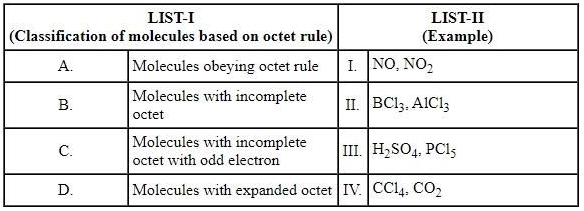
Choose the correct answer from the options given below:
The molecules having square pyramidal geometry are
We need to identify molecules with square pyramidal geometry.
$$BrF_5$$: Br has 7 valence electrons. With 5 F atoms: 5 bond pairs + 1 lone pair = 6 electron pairs. Arrangement: octahedral. With one lone pair, the shape is square pyramidal.
$$PCl_5$$: P has 5 valence electrons. With 5 Cl atoms: 5 bond pairs + 0 lone pairs. Shape is trigonal bipyramidal, not square pyramidal.
$$SbF_5$$: Sb has 5 valence electrons. With 5 F atoms: 5 bond pairs + 0 lone pairs. Shape is trigonal bipyramidal, not square pyramidal.
$$XeOF_4$$: Xe has 8 valence electrons. With 1 O (double bond) + 4 F atoms: 5 bond pairs + 1 lone pair = 6 electron pairs. Arrangement: octahedral. With one lone pair, the shape is square pyramidal.
$$BrF_5$$ and $$XeOF_4$$ both have square pyramidal geometry.
The correct answer is Option D) $$BrF_5$$ and $$XeOF_4$$.
Among $$SO_2$$, $$NF_3$$, $$NH_3$$, $$XeF_2$$, $$ClF_3$$ and $$SF_4$$, the hybridization of the molecule with non-zero dipole moment and highest number of lone pairs of electrons on the central atom is:
We must locate, from the given list, the molecule that satisfies two conditions:
• its dipole moment $$\mu$$ is non-zero,
• its central atom possesses the greatest possible number of lone pairs.
List of species with the data required (use VSEPR rules):
Case 1: $$SO_2$$ - Structure is angular (bent).
Hybridization of S: $$sp^2$$ (AX2E).
Lone pairs on S: 1.
Dipole moment: non-zero (bent shape).
Case 2: $$NF_3$$ - Pyramidal (AX3E).
Hybridization of N: $$sp^3$$.
Lone pairs on N: 1.
Dipole moment: non-zero.
Case 3: $$NH_3$$ - Also pyramidal (AX3E).
Hybridization of N: $$sp^3$$.
Lone pairs on N: 1.
Dipole moment: non-zero.
Case 4: $$XeF_2$$ - Linear (AX2E3).
Hybridization of Xe: $$sp^3d$$.
Lone pairs on Xe: 3 (highest so far).
Dipole moment: $$\mu = 0$$, because the axial $$\mathrm{Xe-F}$$ bonds are colinear and cancel.
Case 5: $$ClF_3$$ - T-shaped (AX3E2).
Hybridization of Cl: $$sp^3d$$.
Lone pairs on Cl: 2.
Dipole moment: non-zero (T-shape is not symmetrical enough for cancellation).
Case 6: $$SF_4$$ - See-saw (AX4E).
Hybridization of S: $$sp^3d$$.
Lone pairs on S: 1.
Dipole moment: non-zero.
Among the systems having non-zero dipole moment, the largest number of lone pairs is 2 (present in $$ClF_3$$). All other dipolar molecules posses only 1 lone pair, while $$XeF_2$$—though it has 3 lone pairs—has $$\mu = 0$$ and therefore does not meet the first criterion.
Therefore the required molecule is $$ClF_3$$.
Hybridization of the central atom in $$ClF_3$$ is $$sp^3d$$.
Hence, the correct option is Option D, $$sp^3d$$.
Given below are two statements:
Statement I: Wet cotton clothes made of cellulose based carbohydrate takes comparatively longer time to get dried than wet nylon polymer based clothes.
Statement II: Intermolecular hydrogen bonding with water molecule is more in nylon-based clothes than in the case of cotton clothes.
In the light of above statements, choose the $$Correct$$ answer from the options given below
Cellulose, the main constituent of cotton fibres, is a polysaccharide chain carrying abundant $$-OH$$ groups on every glucose unit.
Each $$-OH$$ group can act both as a hydrogen-bond donor and acceptor, so a single cellulose chain can form a large number of intermolecular hydrogen bonds with surrounding water molecules.
Nylon is a polyamide. Although each repeat unit contains one $$-CONH$$ group capable of hydrogen bonding, the rest of the chain is a long, non-polar hydrocarbon segment. The total number of hydrogen-bonding sites per unit mass of nylon is therefore much smaller than in cellulose, and the hydrophobic backbone further reduces water affinity.
Because of the extensive hydrogen bonding, cotton absorbs and retains far more water than nylon. Extra heat (or time) is needed to break these numerous hydrogen bonds during drying, so wet cotton garments take a longer time to dry than wet nylon garments.
Thus:
Statement I: Cotton clothes indeed take longer to dry — TRUE.
Statement II: Hydrogen bonding with water is actually stronger and more numerous in cotton, not in nylon — FALSE.
The correct choice is Option B: Statement I is true but Statement II is false.
Total number of sigma ($$\sigma$$) and pi($$\pi$$) bonds respectively present in hex-1-en-4-yne are :
Hex-1-en-4-yne has the structure: $$CH_2=CH-CH_2-C \equiv C-CH_3$$
Let us count the bonds:
Sigma bonds:
- C1=C2: 1 σ bond
- C2-C3: 1 σ bond
- C3-C4: 1 σ bond
- C4≡C5: 1 σ bond
- C5-C6: 1 σ bond
- C1-H bonds: 2 σ bonds
- C2-H bond: 1 σ bond
- C3-H bonds: 2 σ bonds
- C6-H bonds: 3 σ bonds
Total σ bonds = 5 + 8 = 13
Pi bonds:
- C1=C2: 1 π bond
- C4≡C5: 2 π bonds
Total π bonds = 3
The correct answer is Option 3: 13 and 3.
In $$SO_2$$, $$NO_2^-$$ and $$N_3^-$$ the hybridizations at the central atom are respectively :
The hybridization of a given atom can be predicted from its steric number.
Steric number $$=\,$$ (number of $$\sigma$$-bonds around the atom) $$+\,$$ (number of lone pairs on that atom).
• Central atom: $$S$$.
• Lewis structure: $$O = S - O$$ with one lone pair on $$S$$.
• $$\sigma$$-bonds on $$S = 2$$ (one to each $$O$$).
• Lone pairs on $$S = 1$$.
Therefore, steric number $$= 2 + 1 = 3$$.
Steric number 3 corresponds to $$sp^2$$ hybridization, giving a bent (V-shaped) molecule.
Case 2: $$NO_2^-$$• Central atom: $$N$$.
• Lewis structure: $$O = N - O^-$$ (resonance forms) with one lone pair on $$N$$.
• $$\sigma$$-bonds on $$N = 2$$.
• Lone pairs on $$N = 1$$.
Steric number $$= 2 + 1 = 3$$.
Steric number 3 again implies $$sp^2$$ hybridization, giving a bent ion.
Case 3: $$N_3^-$$ (azide ion)• Central atom: the middle $$N$$ of $$N - N - N$$.
• Resonance structures involve $$N \equiv N^+ - N^-$$ and $$N^- - N^+ \equiv N$$, but the central $$N$$ always has:
$$\sigma$$-bonds = 2$$\,$$(to the terminal nitrogens).
Lone pairs = 0 (all its electrons are in bonds or as formal charges on terminals).
Steric number $$= 2 + 0 = 2$$.
Steric number 2 corresponds to $$sp$$ hybridization, giving a linear ion.
Thus, the hybridizations are $$sp^2$$ in $$SO_2$$, $$sp^2$$ in $$NO_2^-$$ and $$sp$$ in $$N_3^-$$.
Matching with the options, we select Option A.
Answer: Option A
Which of the following statement is true with respect to $$H_2O,\ NH_3$$ and $$CH_4?$$ $$A.$$ The central atoms of all the molecules are $$sp^3$$ hybridized. $$B.$$ The $$H-O-H,\ H-N-H$$ and $$H-C-H$$ angles in the above molecules are $$104.5^\circ,\ 107.5^\circ$$ and $$109.5^\circ$$ respectively. $$C.$$ The increasing order of dipole moment is $$CH_4 < NH_3 < H_2O.$$ $$D.$$ Both $$H_2O$$ and $$NH_3$$ are Lewis acids and $$CH_4$$ is a Lewis base. $$E.$$ A solution of $$NH_3$$ in $$H_2O$$ is basic. In this solution $$NH_3$$ and $$H_2O$$ act as Lowry-Bronsted acid and base respectively. Choose the correct answer from the options given below:
We analyze each statement about $$H_2O$$, $$NH_3$$, and $$CH_4$$:
A. Central atoms of all molecules are $$sp^3$$ hybridized.
$$H_2O$$: O has 2 bond pairs + 2 lone pairs = $$sp^3$$. $$NH_3$$: N has 3 bond pairs + 1 lone pair = $$sp^3$$. $$CH_4$$: C has 4 bond pairs = $$sp^3$$. Correct.
B. Bond angles are $$104.5°$$, $$107.5°$$, and $$109.5°$$ respectively.
H-O-H = $$104.5°$$, H-N-H = $$107°$$ (approximately $$107.5°$$), H-C-H = $$109.5°$$. Correct.
C. Increasing order of dipole moment: $$CH_4 < NH_3 < H_2O$$.
$$CH_4$$ has zero dipole moment (symmetric). $$NH_3$$ has $$\mu = 1.47$$ D. $$H_2O$$ has $$\mu = 1.85$$ D. So $$CH_4 < NH_3 < H_2O$$. Correct.
D. Both $$H_2O$$ and $$NH_3$$ are Lewis acids and $$CH_4$$ is a Lewis base.
$$H_2O$$ and $$NH_3$$ have lone pairs and act as Lewis BASES (not acids). $$CH_4$$ is neither a good Lewis acid nor base. Incorrect.
E. A solution of $$NH_3$$ in $$H_2O$$ is basic. $$NH_3$$ and $$H_2O$$ act as Lowry-Bronsted acid and base respectively.
In the reaction $$NH_3 + H_2O \rightleftharpoons NH_4^+ + OH^-$$, $$NH_3$$ acts as a Bronsted BASE (accepts $$H^+$$) and $$H_2O$$ acts as a Bronsted ACID (donates $$H^+$$). The statement says $$NH_3$$ is the acid and $$H_2O$$ is the base, which is reversed. Incorrect.
Correct statements: A, B, and C only.
The correct answer is Option A: A, B and C only.
Given below are two statements :
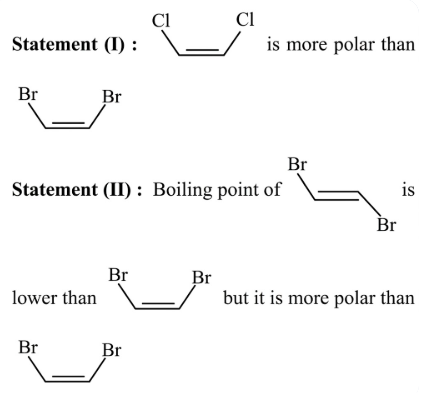
In the light of the above statements, choose the most appropriate answer from the options given below :
To determine the correct option, we need to evaluate the physical properties, specifically polarity and boiling point, of the molecules given in the two statements.
The first statement says that cis-1,2-dichloroethene is more polar than cis-1,2-dibromoethene.
The polarity of a molecule depends on its net dipole moment, which is the vector sum of all the individual bond dipoles.
Chlorine is more electronegative than bromine. Therefore, the carbon-chlorine $$\left(C-Cl\right)$$ bond has a larger bond dipole than the carbon-bromine $$\left(C-Br\right)$$ bond.
In both cis isomers, the two halogen atoms are present on the same side of the double bond. As a result, the individual bond dipoles reinforce each other instead of cancelling.
Since the $$C-Cl$$ bond dipoles are stronger than the $$C-Br$$ bond dipoles, cis-1,2-dichloroethene has a larger net dipole moment and is therefore more polar than cis-1,2-dibromoethene.
Hence, Statement (I) is correct.
The second statement says that the boiling point of trans-1,2-dibromoethene is lower than cis-1,2-dibromoethene, but it is more polar than cis-1,2-dibromoethene.
The first part of the statement is correct. The cis isomer is polar and experiences dipole-dipole interactions in addition to London dispersion forces. The trans isomer is non-polar and experiences only London dispersion forces. Therefore, the cis isomer has a higher boiling point, and the boiling point of the trans isomer is lower.
The second part of the statement is incorrect. In trans-1,2-dibromoethene, the two bromine atoms are present on opposite sides of the double bond. Their bond dipoles act in opposite directions and cancel each other completely, giving a net dipole moment $$\mu = 0$$.
Therefore, the trans isomer is non-polar, while the cis isomer is polar.
Hence, Statement (II) is incorrect.
Therefore,
The correct answer is
$$\boxed{\text{Statement I is correct but Statement II is incorrect.}}$$
Match the LIST-I with LIST-II.
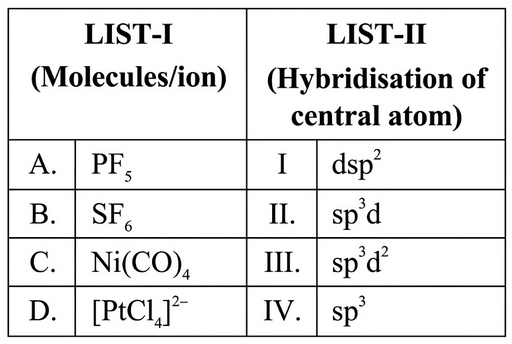
Choose the correct answer from the options given below :
The hybridisation of a central atom is obtained from its steric number (total number of $$\sigma$$-bonds + lone pairs).
For transition-metal complexes we also look at the observed geometry.
Case A: $$PF_5$$
Phosphorus forms five $$\sigma$$-bonds with fluorine and has no lone pair.
Hence steric number $$=5$$ $$\Rightarrow$$ hybridisation $$= sp^3d$$ (trigonal bipyramidal).
Therefore $$PF_5$$ matches List-II entry II.
Case B: $$SF_6$$
Sulphur forms six $$\sigma$$-bonds with fluorine and has no lone pair.
Steric number $$=6$$ $$\Rightarrow$$ hybridisation $$= sp^3d^2$$ (octahedral).
Therefore $$SF_6$$ matches List-II entry III.
Case C: $$Ni(CO)_4$$
Nickel in $$Ni(CO)_4$$ is in the zero oxidation state and the complex is tetrahedral.
A tetrahedral arrangement uses four equivalent hybrid orbitals: $$sp^3$$.
Therefore $$Ni(CO)_4$$ matches List-II entry IV.
Case D: $$[PtCl_4]^{2-}$$
The ion is square-planar; Pt(II) uses one $$d$$, one $$s$$ and two $$p$$ orbitals forming $$dsp^2$$ hybrids.
Therefore $$[PtCl_4]^{2-}$$ matches List-II entry I.
Collecting all results:
A → II, B → III, C → IV, D → I.
The correct option is Option A.
Arrange the following compounds in increasing order of their dipole moment : $$HBr,H_{2}S,NF_{3}\text{ and }CHCl_{3}$$
Given below are two statements:
Statement (I) : for
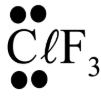
, all three possible structures may be drawn.
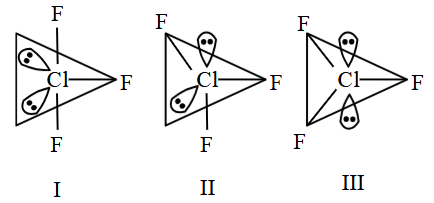
Statement (II) : Structure III is most stable, as the orbitals having the lone pairs are axial, where the $$lp-bp$$ repulsion is minimum.
In the light of the above statements, choose the most appropriate answer from the options given below:
The central atom $$Cl$$ in $$ClF_3$$ has $$7$$ valence electrons. Three of them are used to form $$\sigma$$-bonds with three $$F$$ atoms and the remaining $$4$$ electrons constitute two lone pairs. Hence the steric number is $$5$$ ( $$= 3\; \text{bond pairs} + 2\; \text{lone pairs}$$ ).
For steric number $$5$$, the electron-pair geometry is $$\text{trigonal bipyramidal}$$. The five positions are
• two axial (directly opposite, $$180^{\circ}$$ apart)
• three equatorial (coplanar, $$120^{\circ}$$ apart)
Placing two lone pairs and three bond pairs in these five positions can, in principle, give the following three arrangements:
Case I: both lone pairs axial $$\rightarrow$$ all three $$F$$ atoms equatorial.
Case II: one lone pair axial, one lone pair equatorial $$\rightarrow$$ two $$F$$ atoms equatorial, one axial.
Case III: both lone pairs equatorial $$\rightarrow$$ one $$F$$ atom equatorial, two $$F$$ atoms axial (T-shaped).
Thus, as statement (I) says, all three structures can indeed be drawn; so Statement I is correct.
According to VSEPR theory the order of repulsions is $$lp\!-\!lp \; \gt \; lp\!-\!bp \; \gt \; bp\!-\!bp$$. An axial position is at $$90^{\circ}$$ to three other positions, whereas an equatorial position is at $$90^{\circ}$$ to only two. Therefore a lone pair experiences less repulsion when it occupies an equatorial site.
Hence Case III, in which both lone pairs occupy the equatorial positions, has the minimum total repulsion and is the most stable. Statement (II) claims the most stable structure has lone pairs in axial orbitals, which is opposite to the VSEPR prediction. Therefore Statement II is incorrect.
So, Statement I is correct while Statement II is incorrect. Hence the correct option is Option B.
Consider $$'n'$$ is the number of lone pair of electrons present in the equatorial position of the most stable structure of $$ClF_{3}$$. The ions from the following with $$'n'$$ number of unpaired electrons are $$A. V^{3+} B.Ti^{3+} C.Cu^{2+} D.Ni^{2+} E.Ti^{2+}$$ Choose the correct answer from the options given below :
We need to find the ions with $$n$$ unpaired electrons, where $$n$$ is the number of lone pairs in the equatorial position of the most stable structure of $$ClF_3$$.
In $$ClF_3$$, the central atom Cl has 7 valence electrons, three of which form bonds with F atoms, leaving two lone pairs (4 electrons). The resulting geometry is trigonal bipyramidal (sp$$^3$$d hybridization) with three F atoms and two lone pairs. Since lone pairs repel more strongly and occupy equatorial positions to minimize repulsion, the most stable T-shaped structure has both lone pairs equatorial. Hence $$n = 2$$.
Examining the given ions for two unpaired electrons: $$V^{3+}$$ has the configuration [Ar] 3d$$^2$$ and thus 2 unpaired electrons; $$Ti^{3+}$$ is [Ar] 3d$$^1$$ with 1 unpaired electron; $$Cu^{2+}$$ is [Ar] 3d$$^9$$ with 1 unpaired electron; $$Ni^{2+}$$ is [Ar] 3d$$^8$$ with 2 unpaired electrons (high‐spin); and $$Ti^{2+}$$ is [Ar] 3d$$^2$$ with 2 unpaired electrons.
Therefore, the ions with 2 unpaired electrons are $$V^{3+}$$, $$Ni^{2+}$$, and $$Ti^{2+}$$, corresponding to options A, D, and E. The correct answer is Option 2: A, D and E Only.
The maximum covalency of a non-metallic group 15 element ' E ' with weakest E-E bond is:
We need to find the maximum covalency of a non-metallic Group 15 element 'E' with the weakest E-E bond.
Non-metallic Group 15 elements are: N, P, As.
Among these, the weakest E-E single bond is the N-N bond (bond energy ≈ 160 kJ/mol). This is because nitrogen atoms are small, and the lone pairs on adjacent nitrogen atoms experience strong repulsion, weakening the single bond.
For comparison, P-P bond energy ≈ 200 kJ/mol.
Nitrogen has the electronic configuration $$1s^2 2s^2 2p^3$$.
Since nitrogen is in the 2nd period, it has no d-orbitals available for bonding and cannot expand its octet.
Maximum number of bonds nitrogen can form = 3 covalent bonds + 1 coordinate bond (using the lone pair) = 4.
Example: $$NH_4^+$$ where nitrogen forms 4 covalent bonds.
The answer is Option A: 4.
Which of the following linear combination of atomic orbitals will lead to formation of molecular orbitals in homonuclear diatomic molecules [internuclear axis in $$z$$-direction] ? A. $$2p_z$$ and $$2p_x$$ B. 2 s and $$2p_x$$ C. 3 $$d_{xy}$$ and 3 $$d_{x^{2} - y^{2}}$$ D. 2 s and $$2p_z$$ E. $$2p_z$$ and $$3d_{x}^{2}- y^{2}$$ Choose the correct answer from the options given below:
For the formation of molecular orbitals in homonuclear diatomic molecules (with the internuclear axis along the $$z$$-direction), the combining atomic orbitals must have the same symmetry with respect to the internuclear axis.
The rule is: Orbitals combine only if they have the same symmetry about the molecular axis. Specifically, they must have the same value of $$m_l$$ along the z-axis ($$\sigma$$ for $$m_l = 0$$, $$\pi$$ for $$|m_l| = 1$$, $$\delta$$ for $$|m_l| = 2$$).
A. $$2p_z$$ and $$2p_x$$: $$2p_z$$ has $$m_l = 0$$, $$2p_x$$ has $$|m_l| = 1$$. Different symmetry. Cannot combine. No.
B. $$2s$$ and $$2p_x$$: $$2s$$ has $$m_l = 0$$ ($$\sigma$$), $$2p_x$$ has $$|m_l| = 1$$ ($$\pi$$). Different symmetry. Cannot combine. No.
C. $$3d_{xy}$$ and $$3d_{x^2-y^2}$$: $$3d_{xy}$$ has $$|m_l| = 2$$ ($$\delta$$), $$3d_{x^2-y^2}$$ also has $$|m_l| = 2$$ ($$\delta$$). Same symmetry, but these are on the same atom. For a homonuclear diatomic, the $$3d_{xy}$$ on one atom combines with $$3d_{xy}$$ on the other. The statement says combining $$3d_{xy}$$ with $$3d_{x^2-y^2}$$, which are different orbitals on different atoms with the same $$|m_l|$$ but different orientations. They do not form bonding/antibonding pairs with each other. No.
D. $$2s$$ and $$2p_z$$: Both have $$m_l = 0$$ ($$\sigma$$ symmetry). They can combine to form molecular orbitals. Yes.
E. $$2p_z$$ and $$3d_{x^2-y^2}$$: $$2p_z$$ has $$m_l = 0$$, $$3d_{x^2-y^2}$$ has $$|m_l| = 2$$. Different symmetry. Cannot combine. No.
Only D leads to formation of molecular orbitals.
The correct answer is Option B: D Only.
Resonance in $$X_2Y$$ can be represented as
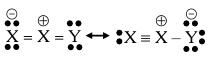
The enthalpy of formation of X_2Y\left( X\equiv X(g)+\frac{1}{2}Y=Y(g)\rightarrow X_2 Y(g)\right) is 80 kJ mol$$^{-1}$$. The magnitude of resonance energy of $$X_2Y$$ is _____ kJ mol$$^{-1}$$ (nearest integer value). Given: Bond energies of $$X \equiv X$$, $$X = X$$, $$Y = Y$$ and $$X = Y$$ are 940, 410, 500 and 602 kJ mol$$^{-1}$$ respectively.
valence X : 3, Y : 2
The resonance energy of a molecule is the extra stabilisation it enjoys due to resonance.
Mathematically,
$$\text{Resonance energy}= \left( \Delta H_f^{\,\text{calculated (one structure)}} \right) - \left( \Delta H_f^{\,\text{experimental}} \right)$$
The question gives the experimental enthalpy of formation of $$X_2Y$$ as
$$\Delta H_f^{\,\text{exp}} = 80\ \text{kJ mol}^{-1}$$
To obtain $$\Delta H_f^{\,\text{calculated}}$$ we choose any one canonical (non-resonating) structure.
A convenient choice for $$X_2Y$$ is
$$X=X - Y\;,$$
i.e. one $$X=X$$ double bond and one $$X=Y$$ double bond.
The enthalpy of formation is obtained from the usual bond-energy relation
$$\Delta H_f = \sum \text{(bond energies of bonds broken)} \;-\; \sum \text{(bond energies of bonds formed)}$$
Step 1: Bonds broken (to obtain free atoms)
We start from the elemental forms:
• 1 mol $$X_2$$ contains one $$X\equiv X$$ triple bond
Energy to break it = $$E_{X\equiv X}=940\ \text{kJ}$$
• ½ mol $$Y_2$$ contains half a $$Y=Y$$ double bond
Energy to break it = $$\tfrac12\,E_{Y=Y}
=\tfrac12 \times 500
=250\ \text{kJ}$$
Total energy required to break reactant bonds:
$$E_{\text{broken}} = 940 + 250 = 1190\ \text{kJ}$$
Step 2: Bonds formed in the chosen structure of $$X_2Y$$
• One $$X=X$$ double bond energy released = $$E_{X=X}=410\ \text{kJ}$$
• One $$X=Y$$ double bond energy released = $$E_{X=Y}=602\ \text{kJ}$$
Total energy released on forming product bonds:
$$E_{\text{formed}} = 410 + 602 = 1012\ \text{kJ}$$
Step 3: Calculated enthalpy of formation (one structure)
$$\Delta H_f^{\,\text{calc}} = E_{\text{broken}} - E_{\text{formed}} = 1190 - 1012 = 178\ \text{kJ mol}^{-1}$$
Step 4: Resonance energy
$$\text{Resonance energy} = \Delta H_f^{\,\text{calc}} - \Delta H_f^{\,\text{exp}} = 178 - 80 = 98\ \text{kJ mol}^{-1}$$
Hence, the magnitude of the resonance energy of $$X_2Y$$ is 98 kJ mol$$^{-1}$$.
The number of molecules/ions that show linear geometry among the following is ______
$$\mathrm{SO_2}$$, $$\ \mathrm{BeCl_2}$$, $$\ \mathrm{CO_2}$$, $$\ \mathrm{N_3^-}$$, $$\ \mathrm{NO_2}$$, $$\ \mathrm{F_2O}$$, $$\ \mathrm{XeF_2}$$, $$\ \mathrm{NO_2^+}$$, $$\ \mathrm{I_3^-}$$, $$\ \mathrm{O_3}$$
We need to count the number of molecules/ions with linear geometry from the given list.
$$SO_2, BeCl_2, CO_2, N_3^-, NO_2, F_2O, XeF_2, NO_2^+, I_3^-, O_3$$
Analyzing each:
1. $$SO_2$$: S has 2 bonding pairs + 1 lone pair = bent geometry. NOT linear.
2. $$BeCl_2$$: Be has 2 bonding pairs, no lone pairs. sp hybridized. LINEAR.
3. $$CO_2$$: C has 2 double bonds, no lone pairs. sp hybridized. LINEAR.
4. $$N_3^-$$: Azide ion. Central N has 2 bonding regions, no lone pairs. sp hybridized. LINEAR.
5. $$NO_2$$: N has 2 bonding pairs + 1 unpaired electron = bent geometry. NOT linear.
6. $$F_2O$$: O has 2 bonding pairs + 2 lone pairs = bent geometry. NOT linear.
7. $$XeF_2$$: Xe has 2 bonding pairs + 3 lone pairs = LINEAR (sp³d hybridization, trigonal bipyramidal with F atoms in axial positions).
8. $$NO_2^+$$: Nitronium ion. N has 2 double bonds, no lone pairs. sp hybridized. LINEAR.
9. $$I_3^-$$: Central I has 2 bonding pairs + 3 lone pairs = LINEAR (similar to XeF₂).
10. $$O_3$$: Central O has 2 bonding regions + 1 lone pair = bent geometry. NOT linear.
Linear molecules/ions: $$BeCl_2, CO_2, N_3^-, XeF_2, NO_2^+, I_3^-$$ = 6
The answer is 6.
Total number of molecules/species from following which will be paramagnetic is ______
$$O_{2}$$, $$O_2^+$$, $$O_2^-$$, $$NO$$, $$NO_{2}$$, $$CO$$, $$K_{2}[NiCl_{4}]$$, $$[Co(NH_{3})_{6}]Cl_{3}$$, $$K_{2}[Ni(CN)_{4}]$$
We need to find the total number of paramagnetic species from the given list.
A species is paramagnetic if it has one or more unpaired electrons.
1. $$O_2$$ (Oxygen molecule):
MO configuration: $$(\sigma_{2s})^2(\sigma_{2s}^*)^2(\sigma_{2p})^2(\pi_{2p})^4(\pi_{2p}^*)^2$$. The two electrons in $$\pi_{2p}^*$$ are unpaired (one in each degenerate orbital, by Hund's rule). Paramagnetic (2 unpaired electrons).
2. $$O_2^+$$: Remove one electron from $$\pi_{2p}^*$$: 1 unpaired electron. Paramagnetic.
3. $$O_2^-$$: Add one electron to $$\pi_{2p}^*$$: 3 electrons in two degenerate orbitals gives 1 unpaired. Paramagnetic.
4. NO (Nitric oxide): Total 15 electrons. MO config has one unpaired electron in $$\pi_{2p}^*$$. Paramagnetic.
5. $$NO_2$$: Nitrogen dioxide has 23 electrons (odd number), so at least 1 unpaired electron. Paramagnetic.
6. CO: 14 electrons, all paired in MO configuration. Diamagnetic.
7. $$K_2[NiCl_4]$$: Contains $$[NiCl_4]^{2-}$$. $$Ni^{2+}$$ has $$d^8$$ configuration. $$Cl^-$$ is a weak-field ligand, so tetrahedral geometry. In tetrahedral field, $$d^8$$ has 2 unpaired electrons. Paramagnetic.
8. $$[Co(NH_3)_6]Cl_3$$: Contains $$[Co(NH_3)_6]^{3+}$$. $$Co^{3+}$$ has $$d^6$$. $$NH_3$$ is a strong-field ligand (octahedral), so low-spin: all 6 electrons fill $$t_{2g}$$ with 0 unpaired electrons. Diamagnetic.
9. $$K_2[Ni(CN)_4]$$: Contains $$[Ni(CN)_4]^{2-}$$. $$Ni^{2+}$$ has $$d^8$$. $$CN^-$$ is a strong-field ligand, forming square planar geometry. In square planar, $$d^8$$ has 0 unpaired electrons. Diamagnetic.
Count of paramagnetic species: $$O_2, O_2^+, O_2^-, NO, NO_2, K_2[NiCl_4]$$ = 6.
The answer is 6.
Total number of non bonded electrons present in $$NO_{2}$$ -ion based on Lewis theory is
The Lewis structure of $$NO_2^-$$ (nitrite ion):
Nitrogen has 5 valence electrons, each oxygen has 6, plus 1 for the negative charge: Total = 5 + 2(6) + 1 = 18 electrons.
Structure: $$[:O-N=O:]^-$$ with a lone pair on N.
Non-bonded electrons (lone pairs):
- Nitrogen: 1 lone pair = 2 electrons
- Oxygen (single bond): 3 lone pairs = 6 electrons
- Oxygen (double bond): 2 lone pairs = 4 electrons
Total non-bonded electrons = 2 + 6 + 4 = 12
The answer is 12.
Given below are two statements:
Statement-I: Since fluorine is more electronegative than nitrogen, the net dipole moment of $$NF_3$$ is greater than $$NH_3$$.
Statement-II: In $$NH_3$$, the orbital dipole due to lone pair and the dipole moment of NH bonds are in opposite direction, but in $$NF_3$$ the orbital dipole due to lone pair and dipole moments of N-F bonds are in same direction.
In the light of the above statements, choose the most appropriate from the options given below.
Statement I claims that since fluorine is more electronegative than nitrogen, the net dipole moment of $$NF_3$$ is greater than $$NH_3$$. However, experimental dipole moments are $$\mu(NH_3) = 1.47$$ D and $$\mu(NF_3) = 0.23$$ D, so $$NF_3$$ has a much lower dipole moment than $$NH_3$$. This is because in $$NH_3$$, the lone pair dipole and the bond dipoles reinforce each other, while in $$NF_3$$ they oppose each other (partially cancelling). Statement I is false.
Statement II asserts that in $$NH_3$$ the orbital dipole due to lone pair and the dipole moments of N-H bonds are in opposite direction, but in $$NF_3$$ they are in the same direction. In reality, the situation is reversed: in $$NH_3$$ the N-H bond dipoles point from H towards N (since N is more electronegative) and the lone pair on nitrogen also contributes a dipole in the same direction (away from nitrogen, towards the lone pair region), so they reinforce each other. In $$NF_3$$ the N-F bond dipoles point from N towards F (since F is more electronegative than N), i.e., away from nitrogen, while the lone pair dipole still points in the direction from the base towards the apex (away from the lone pair), so they oppose each other, causing partial cancellation and a low dipole moment. Statement II is false.
Since both statements are false, the correct answer is Option (2): Both Statement I and Statement II are false.
The linear combination of atomic orbitals to form molecular orbitals takes place only when the combining atomic orbitals A. have the same energy B. have the minimum overlap C. have same symmetry about the molecular axis D. have different symmetry about the molecular axis. Choose the most appropriate from the options given below:
We need to identify the correct conditions for linear combination of atomic orbitals (LCAO) to form molecular orbitals.
The three essential conditions for LCAO are:
Condition A: Same energy. The combining atomic orbitals must have comparable (similar or same) energies. For example, the 1s orbital of one atom can effectively combine with the 1s orbital of the other atom, but not with a 2s orbital (which has very different energy). This condition ensures effective orbital mixing. This is CORRECT.
Condition B: Minimum overlap. This is INCORRECT. The correct condition is that the atomic orbitals must have maximum overlap. Greater overlap between atomic orbitals leads to stronger bonding (or antibonding) molecular orbitals. Minimum overlap would result in negligible interaction and no effective molecular orbital formation.
Condition C: Same symmetry about the molecular axis. The combining atomic orbitals must have the same symmetry with respect to the molecular (internuclear) axis. For example, a $$2p_z$$ orbital (symmetric about the bond axis) combines with another $$2p_z$$ orbital to form $$\sigma$$ molecular orbitals, and $$2p_x$$ orbitals combine with $$2p_x$$ orbitals to form $$\pi$$ molecular orbitals. A $$2p_z$$ orbital cannot effectively combine with a $$2p_x$$ orbital because they have different symmetries. This is CORRECT.
Condition D: Different symmetry about the molecular axis. This is INCORRECT — it is the opposite of the correct condition (Condition C).
The correct conditions are A and C.
The correct answer is Option (2): A and C only.
The shape of carbocation is :
We need to determine the shape of a carbocation.
Understand the electronic structure of a carbocation
A carbocation is a positively charged carbon species, such as $$CH_3^+$$. The carbon atom in a carbocation has only 6 electrons (3 bonding pairs) instead of the usual 8. It has:
- 3 bond pairs (from three bonds to hydrogen or other groups)
- 0 lone pairs
- 1 empty (vacant) p-orbital
Determine the hybridisation
With only 3 regions of electron density (3 bond pairs and no lone pairs), the carbon in a carbocation undergoes sp$$^2$$ hybridisation. The three sp$$^2$$ hybrid orbitals form bonds, while the unhybridised p-orbital remains empty and is perpendicular to the plane of the three bonds.
Determine the geometry
According to VSEPR theory and the sp$$^2$$ hybridisation, three bond pairs with no lone pairs arrange themselves at $$120°$$ angles in a plane to minimise repulsion. This gives a trigonal planar geometry.
The bond angles are all $$120°$$, and all three bonds lie in the same plane with the carbon atom at the centre.
The correct answer is Option (2): trigonal planar.
Arrange the bonds in order of increasing ionic character in the molecules: $$LiF$$, $$K_2O$$, $$N_2$$, $$SO_2$$ and $$ClF_3$$.
To compare the ionic character of different bonds we use the Pauling concept:
• Ionic character increases with the electronegativity difference $$\Delta\chi = \chi_{\text{more}} - \chi_{\text{less}}$$ between the two bonded atoms.
• A convenient estimate of percentage ionic character is
$$\%\,\text{ionic} = \left(1 - e^{-\frac{(\Delta\chi)^2}{4}}\right)\times100$$
Although we do not need the exact percentages, the formula shows that a larger $$\Delta\chi$$ means a more ionic bond.
The Pauling electronegativity (EN) values needed are
$$\chi_{Li}=1.0,\; \chi_{K}=0.8,\; \chi_{N}=3.0,\; \chi_{S}=2.5,\; \chi_{Cl}=3.0,\; \chi_{O}=3.5,\; \chi_{F}=4.0$$
Now calculate $$\Delta\chi$$ for the representative bond in each molecule:
$$\begin{aligned} N_2: &\; \Delta\chi = 3.0-3.0 = 0 \\[2pt] SO_2\;(S{-}O): &\; \Delta\chi = 3.5-2.5 = 1.0 \\[2pt] ClF_3\;(Cl{-}F): &\; \Delta\chi = 4.0-3.0 = 1.0 \\[2pt] K_2O\;(K{-}O): &\; \Delta\chi = 3.5-0.8 = 2.7 \\[2pt] LiF\;(Li{-}F): &\; \Delta\chi = 4.0-1.0 = 3.0 \end{aligned}$$
Interpretation:
• $$N_2$$ has $$\Delta\chi = 0$$, so it is perfectly covalent.
• $$K_2O$$ and $$LiF$$ have the largest $$\Delta\chi$$ values; their bonds are highly ionic.
• $$SO_2$$ and $$ClF_3$$ tie at $$\Delta\chi = 1.0$$. However, the S-O bonds in $$SO_2$$ possess significant multiple-bond (π-bond) character because of $$p\pi\!-\!d\pi$$ back-bonding and resonance. Multiple bonding increases covalent character and therefore decreases ionic character when compared with a single S-O bond of the same $$\Delta\chi$$. The Cl-F bonds in $$ClF_3$$ are simple single bonds, so their ionic character is slightly higher than that of the S-O bonds.
Combining all the points, the bonds arranged in order of increasing ionic character are
$$N_2 \lt SO_2 \lt ClF_3 \lt K_2O \lt LiF$$
This corresponds to Option C.
Choose the polar molecule from the following :
Let us analyze each molecule for polarity:
- $$CCl_4$$: Tetrahedral, symmetric, dipole moments cancel. Non-polar.
- $$CO_2$$: Linear, symmetric, dipole moments cancel. Non-polar.
- $$CH_2=CH_2$$: Planar, symmetric. Non-polar.
- $$CHCl_3$$: Tetrahedral but asymmetric (one H, three Cl). Net dipole moment exists. Polar.
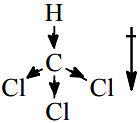
The answer is $$CHCl_3$$, which corresponds to Option (4).
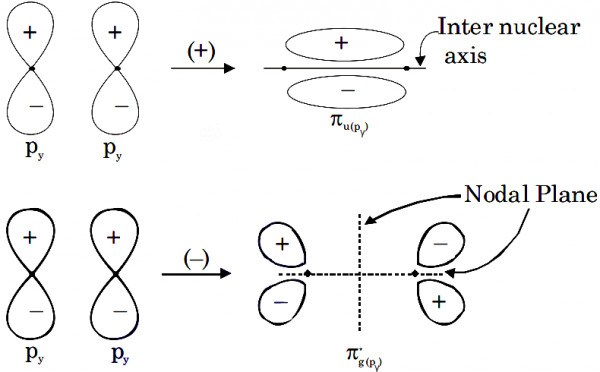
Given below are two statements:
Statement (I): A $$\pi$$ bonding MO has lower electron density above and below the inter-nuclear axis.
Statement (II): The $$\pi^*$$ antibonding MO has a node between the nuclei.
In light of the above statements, choose the most appropriate answer from the options given below:
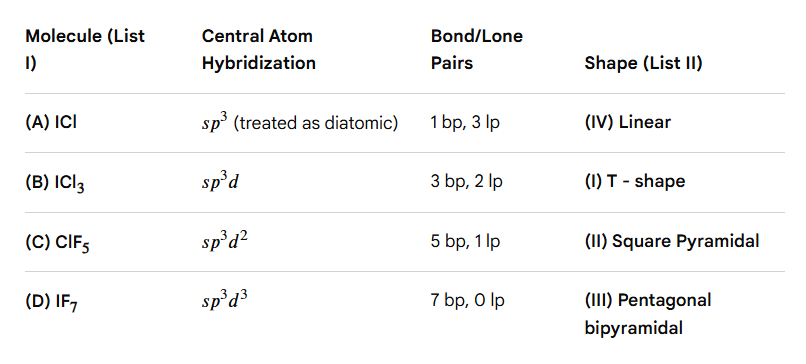
Match List I with List II :
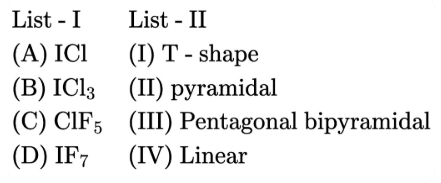
Choose the correct answer from the options given below :
Which one of the following molecules has maximum dipole moment?
Given below are two statements: one is labelled as Assertion A and the other is labelled as Reason R. Assertion A: $$PH_3$$ has lower boiling point than $$NH_3$$. Reason R: In liquid state $$NH_3$$ molecules are associated through Vander Waal's forces, but $$PH_3$$ molecules are associated through hydrogen bonding. In the light of the above statements, choose the most appropriate answer from the options given below:
The Assertion A states that $$PH_3$$ has a lower boiling point than $$NH_3$$. This statement is correct because boiling point depends on the strength of intermolecular forces. Ammonia ( $$NH_3$$ ) molecules exhibit hydrogen bonding, which is a stronger intermolecular force compared to the van der Waals forces present in phosphine ( $$PH_3$$ ).
The Reason R states that in the liquid state $$NH_3$$ molecules are associated through van der Waals forces, but $$PH_3$$ molecules are associated through hydrogen bonding. This statement is incorrect. In fact, $$NH_3$$ molecules form hydrogen bonds due to the high electronegativity of nitrogen and the presence of lone pair on nitrogen. On the other hand, $$PH_3$$ molecules cannot form hydrogen bonds because phosphorus is less electronegative and its lone pair is less available for hydrogen bonding; thus, $$PH_3$$ molecules are held together primarily by weaker van der Waals forces.
Since Assertion A is correct and Reason R is not correct, the correct choice is Option D: A is correct but R is not correct.
Given below are two statements : one is labelled as Assertion (A) and the other is labelled as Reason (R). Assertion (A) : $$NH_3$$ and $$NF_3$$ molecule have pyramidal shape with a lone pair of electrons on nitrogen atom. The resultant dipole moment of $$NH_3$$ is greater than that of $$NF_3$$. Reason (R) : In $$NH_3$$, the orbital dipole due to lone pair is in the same direction as the resultant dipole moment of the $$N-H$$ bonds. $$F$$ is the most electronegative element. In the light of the above statements, choose the correct answer from the options given below :
Assertion (A): $$NH_3$$ and $$NF_3$$ both have pyramidal shapes with a lone pair on nitrogen. The dipole moment of $$NH_3$$ is greater than that of $$NF_3$$.
Reason (R): In $$NH_3$$, the orbital dipole due to the lone pair is in the same direction as the resultant dipole moment of the N-H bonds. F is the most electronegative element.
Evaluate Assertion (A)
Both $$NH_3$$ ($$\mu = 1.47$$ D) and $$NF_3$$ ($$\mu = 0.23$$ D) are pyramidal. Indeed, $$\mu_{NH_3} > \mu_{NF_3}$$. Assertion A is true.
Evaluate Reason (R)
In $$NH_3$$: The bond dipoles of N-H point from H to N (since N is more electronegative). The lone pair on N also creates a dipole pointing away from N in the same direction. Both contributions add up, resulting in a large net dipole moment.
In $$NF_3$$: The bond dipoles of N-F point from N to F (since F is more electronegative), which is opposite to the direction of the lone pair dipole. The two effects partially cancel, resulting in a much smaller net dipole moment.
F is indeed the most electronegative element. Reason R is true and correctly explains why $$\mu_{NH_3} > \mu_{NF_3}$$.
Both (A) and (R) are true and (R) is the correct explanation of (A). The answer is Option 1.
Match List I with List II:
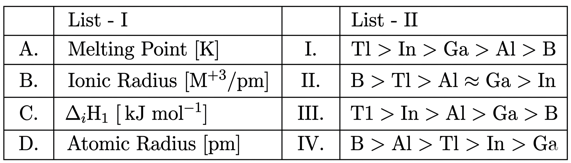
Choose the correct answer from the options given below:
The melting point trend in Group 13 is highly irregular.
Unlike atomic radii, the ionic radii of M+3 ions follow a regular trend. As you move down the group, more shells are added, and the effective nuclear charge felt by the outermost electrons (in an ionic state) allows for a consistent increase in size.
The First Ionization Enthalpy is irregular due to poor shielding by d and f electrons.
Normally, atomic radius increases down a group. However, there is a anomaly between Aluminium and Gallium.
Number of molecules/ions from the following in which the central atom is involved in sp³ hybridization is: $$NO_3^-,\ BCl_3,\ ClO_2^-,\ ClO_3$$
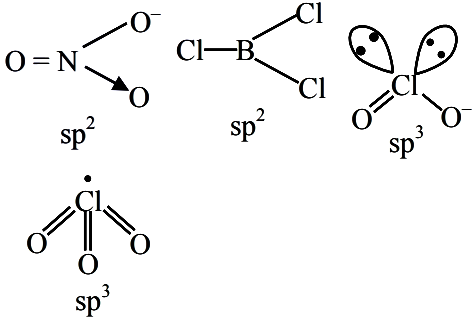
Select the compound from the following that will show intramolecular hydrogen bonding.
Intramolecular hydrogen bonding occurs within the same molecule and requires a hydrogen bond donor and acceptor to be positioned close to each other. Intermolecular hydrogen bonding occurs between different molecules.
$$H_2O$$, $$NH_3$$, and $$C_2H_5OH$$ contain hydrogen-bonding groups, but they do not have suitably positioned donor and acceptor sites within the same molecule. Therefore, they exhibit intermolecular hydrogen bonding.
In $$o$$-nitrophenol, the $$-OH$$ group and $$-NO_2$$ group are present at adjacent (ortho) positions on the benzene ring. The hydrogen atom of the $$-OH$$ group forms a hydrogen bond with an oxygen atom of the $$-NO_2$$ group within the same molecule.
This interaction results in the formation of a stable six-membered pseudo-ring through intramolecular hydrogen bonding.
Therefore, $$o$$-nitrophenol is the only compound among the given options that exhibits intramolecular hydrogen bonding.
Hence, the correct answer is:
$$o\text{-nitrophenol}$$
The correct statement/s about Hydrogen bonding is/are: A. Hydrogen bonding exists when H is covalently bonded to the highly electronegative atom. B. Intermolecular H bonding is present in o-nitrophenol. C. Intramolecular H bonding is present in HF. D. The magnitude of H bonding depends on the physical state of the compound. E. H-bonding has powerful effect on the structure and properties of compounds. Choose the correct answer from the options given below:
We evaluate each statement about hydrogen bonding.
A: "H bonding exists when H is covalently bonded to a highly electronegative atom."
TRUE. Hydrogen bonds form when H is bonded to F, O, or N (highly electronegative atoms).
B: "Intermolecular H bonding is present in o-nitrophenol."
FALSE. In o-nitrophenol, intramolecular H bonding occurs between the -OH and the -NO₂ group in the ortho position, forming a six-membered chelate ring. It is the para-isomer that shows intermolecular H bonding.
C: "Intramolecular H bonding is present in HF."
FALSE. HF shows strong intermolecular hydrogen bonding (not intramolecular). Intramolecular H bonding requires two functional groups within the same molecule.
D: "The magnitude of H bonding depends on the physical state of the compound."
TRUE. In the solid state, molecules are closer and more ordered, allowing stronger H bonding. In the gas phase, molecules are far apart and H bonding is minimal.
E: "H bonding has powerful effect on the structure and properties of compounds."
TRUE. H bonding significantly affects boiling points, solubility, viscosity, and molecular structure (e.g., DNA double helix, protein folding).
Correct statements: A, D, E.
The correct answer is Option (2): A, D, E only.
Which of the following is least ionic?
We need to determine which of the given compounds is the least ionic.
We know from Fajans’ rules that ionic character decreases (and covalent character increases) when the cation is small with high charge (high charge density equals high polarizing power), the anion is large and easily polarizable, and the cation adopts a pseudo-noble gas configuration (such as an 18-electron outer shell) instead of a noble gas configuration (8-electron outer shell), since cations with (n-1)d$$^{10}$$ configurations exhibit higher polarizing power.
With these considerations in mind, we examine each compound in turn.
In BaCl$$_2$$ the Ba$$^{2+}$$ ion is large and has the noble gas configuration [Xe], which results in low polarizing power; consequently, BaCl$$_2$$ is highly ionic.
In AgCl, the Ag$$^{+}$$ ion has the electronic configuration [Kr]4d$$^{10}$$, and despite its +1 charge, its filled d-shell provides strong polarizing power; this causes AgCl to exhibit significant covalent character.
In KCl, the K$$^{+}$$ ion has the noble gas configuration [Ar] and a relatively large radius, leading to low charge density and making KCl one of the most ionic compounds.
In CoCl$$_2$$ the Co$$^{2+}$$ ion has the configuration [Ar]3d$$^7$$ and thus some polarizing power due to its +2 charge and incomplete d-shell, but it is not as strongly polarizing as Ag$$^{+}$$; therefore, CoCl$$_2$$ is more ionic than AgCl yet less so than BaCl$$_2$$ and KCl.
Ranking these compounds by ionic character from most to least ionic gives KCl > BaCl$$_2$$ > CoCl$$_2$$ > AgCl.
AgCl is the least ionic compound because Ag$$^{+}$$ has exceptionally high polarizing power according to Fajans’ rules.
The correct answer is Option (2): AgCl.
The correct increasing order for bond angles among $$BF_3$$, $$PF_3$$ and $$ClF_3$$ is :
The bond angle in a molecule depends mainly on two factors, (i) the total number of electron pairs around the central atom (bond pairs + lone pairs) and (ii) the number of lone pairs, because lone-pair-lone-pair repulsion $$\gt$$ lone-pair-bond-pair $$\gt$$ bond-pair-bond-pair repulsion (VSEPR theory).
Case 1: $$BF_3$$
• Central atom B has 3 valence electrons.
• It forms three $$\sigma$$ bonds with F and has no lone pair $$\Rightarrow$$ steric number = 3 (AX$$_3$$ type).
• Geometry: trigonal planar.
• Ideal bond angle for trigonal planar = $$120^{\circ}$$, and with no lone pair the actual angle remains $$\approx 120^{\circ}$$.
Case 2: $$PF_3$$
• Central atom P has 5 valence electrons.
• It forms three $$\sigma$$ bonds with F and retains one lone pair $$\Rightarrow$$ steric number = 4 (AX$$_3$$E type).
• Electron-pair geometry: tetrahedral; molecular shape: trigonal pyramidal.
• Presence of one lone pair compresses the bond angle below the ideal $$109.5^{\circ}$$. Furthermore, highly electronegative F pulls electron density away from the P-F bond pairs, so bond-pair-bond-pair repulsion decreases and the angle contracts further.
• Observed P-F-P angle $$\approx 97^{\circ}$$.
Case 3: $$ClF_3$$
• Central atom Cl has 7 valence electrons.
• It forms three $$\sigma$$ bonds with F and retains two lone pairs $$\Rightarrow$$ steric number = 5 (AX$$_3$$E$$_2$$ type).
• Electron-pair geometry: trigonal bipyramidal; molecular shape: T-shaped (the two lone pairs occupy two equatorial positions).
• Two lone pairs produce strong repulsions, squeezing the F-Cl-F bond angle well below the ideal $$90^{\circ}$$ of a T shape; experimental value $$\approx 87^{\circ}$$.
Comparing the three angles:
$$\angle F\!-\!Cl\!-\!F \ (\text{in } ClF_3) \approx 87^{\circ} \lt$$
$$\angle F\!-\!P\!-\!F \ (\text{in } PF_3) \approx 97^{\circ} \lt$$
$$\angle F\!-\!B\!-\!F \ (\text{in } BF_3) \approx 120^{\circ}$$
Therefore, the correct increasing order of bond angles is
$$ClF_3 \lt PF_3 \lt BF_3$$.
The order matches Option B.
The number of species from the following that have pyramidal geometry around the central atom is _______. $$S_2O_3^{2-}$$, $$SO_4^{2-}$$, $$SO_3^{2-}$$, $$S_2O_7^{2-}$$
Count species with pyramidal geometry around the central atom from: $$S_2O_3^{2-}$$, $$SO_4^{2-}$$, $$SO_3^{2-}$$, $$S_2O_7^{2-}$$.
$$S_2O_3^{2-}$$ (thiosulphate):
The central sulfur atom is bonded to 3 oxygen atoms and 1 sulfur atom in a tetrahedral arrangement (similar to $$SO_4^{2-}$$). Not pyramidal.
$$SO_4^{2-}$$ (sulphate):
S is surrounded by 4 oxygen atoms. Geometry: tetrahedral. Not pyramidal.
$$SO_3^{2-}$$ (sulphite):
S has 3 bond pairs (to O atoms) + 1 lone pair. Electron geometry is tetrahedral, but molecular geometry is pyramidal (trigonal pyramidal). This is pyramidal.
$$S_2O_7^{2-}$$ (disulphate / pyrosulphate):
Two $$SO_4$$ tetrahedra share one oxygen. Each S is in a tetrahedral environment. Not pyramidal.
Only 1 species ($$SO_3^{2-}$$) has pyramidal geometry.
The correct answer is Option (4): 1.
The incorrect statement regarding the geometrical isomers of 2-butene is :
We need to identify the incorrect statement about geometrical isomers of 2-butene.
2-Butene (CH$$_3$$CH=CHCH$$_3$$) exists as two geometrical isomers due to restricted rotation around the C=C bond:
(i) cis-2-butene: Both methyl groups are on the same side of the double bond.
(ii) trans-2-butene: The methyl groups are on opposite sides of the double bond.
Evaluate each statement:
(1) "cis- and trans-2-butene are not interconvertible at room temperature": This is CORRECT. The energy barrier for rotation around a C=C bond is very high (~250 kJ/mol), preventing interconversion at room temperature.
(2) "cis- and trans-2-butene are stereoisomers": This is CORRECT. They have the same molecular formula and connectivity but differ in the spatial arrangement of atoms. Geometrical isomers are a type of stereoisomers.
(3) "cis-2-butene has less dipole moment than trans-2-butene": This is INCORRECT. In cis-2-butene, the two methyl groups are on the same side, so their bond dipoles add up, resulting in a net dipole moment. In trans-2-butene, the methyl groups are on opposite sides, and their dipoles cancel out, giving a dipole moment of approximately zero. Therefore, cis-2-butene has a HIGHER dipole moment than trans-2-butene.
(4) "trans-2-butene is more stable than cis-2-butene": This is CORRECT. trans-2-butene is more stable because the methyl groups are farther apart, reducing steric strain.
The correct answer is Option (3).
Functional group present in sulphonic acids is :
Relative stability of the contributing structures is

A general rule for stability is such that: the compound having no charge at all would be the most stable, then an electronegative atom like Oxygen getting a negative charge would be preferrable and an electronegative atom having a positive charge would be least preferrable. Hence, I>II>III
The species formed on fluorination of phosphorus pentachloride in a polar organic solvent are
Phosphorus pentachloride is a trigonal-bipyramidal molecule. In a highly polar organic solvent it undergoes auto-ionisation (self-dissociation) according to
$$PCl_5 \;\longrightarrow\; [PCl_4]^+ + [PCl_6]^- \quad -(1)$$
When the solution is treated with a fluoride ion source (for example $$HF$$, $$SbF_5$$, or any fluorinating agent), the incoming fluoride ions attack the halophosphate anion first because the anion already carries an excess negative charge and can accept further halide substitution more easily than the cation.
Step 1 - Replacement of two equatorial chlorides
Fluoride ions substitute two of the equatorial chlorides of $$[PCl_6]^-$$ to give the mixed-halide anion $$[PCl_4F_2]^-$$:
$$[PCl_6]^- + 2\,F^- \;\longrightarrow\; [PCl_4F_2]^- + 2\,Cl^- \quad -(2)$$
The cation produced in reaction $$(1)$$ remains unchanged, so the ionic species present after this first fluorination are
$$[PCl_4]^+[PCl_4F_2]^-$$
Step 2 - Complete fluorination
If further fluoride ions are supplied, all six positions around phosphorus in the anion can be occupied by fluorides, converting $$[PCl_4F_2]^-$$ into the hexafluorophosphate anion $$[PF_6]^-$$:
$$[PCl_4F_2]^- + 4\,F^- \;\longrightarrow\; [PF_6]^- + 4\,Cl^- \quad -(3)$$
The cation is still $$[PCl_4]^+$$, so a second ionic pair appears:
$$[PCl_4]^+[PF_6]^-$$
Thus, on fluorination of $$PCl_5$$ in a polar organic solvent, two distinct ion pairs can be isolated depending on how many fluorides replace chlorides in the anion:
$$[PCl_4]^+[PCl_4F_2]^- \quad\text{and}\quad [PCl_4]^+[PF_6]^-$$
None of the other suggested combinations can be obtained under these conditions because the cationic part remains $$[PCl_4]^+$$ and the neutral covalent molecules $$PF_5$$, $$PF_3$$ or $$PCl_3$$ are not formed in appreciable amounts in a polar medium.
Therefore, the correct choice is:
Option B which is: $$[PCl_4]^+[PCl_4F_2]^-$$ and $$[PCl_4]^+[PF_6]^-$$
Given below are two statements : one is labelled as Assertion (A) and the other is labelled as Reason (R). Assertion (A) : Cis form of alkene is found to be more polar than the trans form. Reason (R) : Dipole moment of trans isomer of 2-butene is zero. In the light of the above statements, choose the correct answer from the options given below :
Assertion (A): Cis form of alkene is more polar than the trans form.
In the cis form, similar groups are on the same side, so bond dipoles add up, resulting in a net dipole moment. In the trans form, similar groups are on opposite sides, so dipoles cancel. Thus cis is more polar. True.
Reason (R): Dipole moment of trans isomer of 2-butene is zero.
In trans-2-butene, the two methyl groups and two H atoms are on opposite sides of the double bond, causing the dipole moments to cancel. Dipole moment is zero (or nearly zero). True.
The reason correctly explains the assertion — because trans forms have zero (or very low) dipole moment due to cancellation, cis forms are comparatively more polar.
The correct answer is Option (2): Both (A) and (R) are true and (R) is the correct explanation of (A).
For the Compounds : (A) $$H_3C-CH_2-O-CH_2-CH_2-CH_3$$
(B) $$H_3C-CH_2-CH_2-CH_2-CH_2-CH_3$$ (
C)
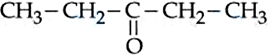
(D)
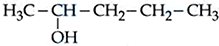
The increasing order of boiling point is :
Which of the following are aromatic?
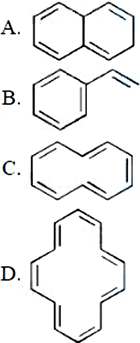
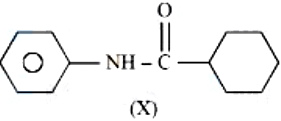
Which of the following is metamer of the given compound (X)?
Given below are two statements:
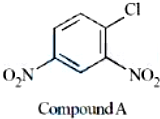
Statement I: IUPAC name of Compound A is 4-chloro-1,3-dinitrobenzene.
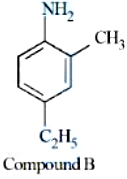
Statement II: IUPAC name of Compound B is 4-ethyl-2-methylaniline. In the light of the above statements, choose the most appropriate answer from the options given below:
The compound(s) having peroxide linkage is(are)
Peroxide (peroxo) linkage means the presence of an $$\mathrm{O\!-\!O}$$ single bond inside the molecule.
Therefore, we must write the accepted structures of the given oxo-acids of sulphur and look for an $$\mathrm{O\!-\!O}$$ bond.
Option A : $$H_2S_2O_7$$ (pyrosulphuric acid, oleum)
$$H_2S_2O_7 : \; HO\!-\!S(=O)_2\!-\!O\!-\!S(=O)_2\!-\!OH$$
The two sulphur atoms are bridged by a single oxygen $$\,(S\!-\!O\!-\!S)$$, but there is no $$\mathrm{O\!-\!O}$$ bond.
Hence, it does not contain a peroxide linkage.
Option B : $$H_2S_2O_8$$ (peroxodisulphuric acid, Marshall’s acid)
$$H_2S_2O_8 : \; HO\!-\!S(=O)_2\!-\!O\!-\!\mathbf{O}\!-\!S(=O)_2\!-\!OH$$
A peroxide bridge $$\mathbf{(O\!-\!O)}$$ joins the two $$SO_3$$ groups, so the molecule definitely contains a peroxide linkage.
Option C : $$H_2S_2O_5$$ (disulphurous acid)
An accepted structure is $$HO\!-\!S(=O)\!-\!O\!-\!S(=O)\!-\!OH$$ (or an $$S\!-\!S$$ bonded form in equilibrium).
Neither form possesses an $$\mathrm{O\!-\!O}$$ bond, so no peroxide linkage is present.
Option D : $$H_2SO_5$$ (peroxomonosulphuric acid, Caro’s acid)
$$H_2SO_5 : \; HO\!-\!\mathbf{O}\!-\!S(=O)_2\!-\!OH$$
One hydroxyl oxygen is linked to the sulphur through an $$\mathbf{O\!-\!O}$$ bond; hence a peroxide linkage is present.
Thus, the compounds that contain a peroxide linkage are:
Option B which is: $$H_2S_2O_8$$, Option D which is: $$H_2SO_5$$
The option(s) in which at least three molecules follow Octet Rule is(are)
For a molecule to obey the octet rule, every atom (especially the central atom) must possess exactly $$8$$ valence electrons (4 electron pairs) after the Lewis structure is drawn.
Two types of violation are common:
(i) Incomplete octet - the central atom has <8 electrons, e.g. $$BF_3$$, $$BCl_3$$.
(ii) Expanded octet - the central atom has >8 electrons, e.g. $$PF_5$$, $$H_2SO_4$$.
(iii) Odd-electron (free-radical) structures automatically break the octet rule because one atom necessarily has 7 electrons; e.g. $$NO$$, $$NO_2$$.
We now examine the four options, molecule by molecule.
Case A: $$CO_2$$, $$C_2H_4$$, $$NO$$, $$HCl$$• $$CO_2$$ - each O has 8 electrons, the central C has 8 electrons ⇒ obeys.
• $$C_2H_4$$ (ethene) - both C atoms achieve an octet through a double bond and two C-H σ-bonds ⇒ obeys.
• $$NO$$ - 11 valence electrons, one electron remains unpaired; N has only 7 electrons ⇒ violates.
• $$HCl$$ - Cl has 8 electrons, H needs only 2 ⇒ obeys.
Total obeying = 3 out of 4 ⇒ Option A satisfies the condition.
Case B: $$NO_2$$, $$O_3$$, $$HCl$$, $$H_2SO_4$$• $$NO_2$$ - odd number (17) of valence electrons; one O has 7 electrons ⇒ violates.
• $$O_3$$ - 18 electrons; every O ends with 8 electrons ⇒ obeys.
• $$HCl$$ - obeys (see above).
• $$H_2SO_4$$ - S forms six σ-bonds (4 S-O + 2 S-O(H)); S gets 12 electrons ⇒ expanded octet ⇒ violates.
Total obeying = 2 ⇒ Option B does not qualify.
Case C: $$BCl_3$$, $$NO$$, $$NO_2$$, $$H_2SO_4$$• $$BCl_3$$ - B ends with only 6 electrons ⇒ violates.
• $$NO$$ - violates (see above).
• $$NO_2$$ - violates (see above).
• $$H_2SO_4$$ - violates (expanded octet).
Total obeying = 0 ⇒ Option C does not qualify.
Case D: $$CO_2$$, $$BCl_3$$, $$O_3$$, $$C_2H_4$$• $$CO_2$$ - obeys (see Case A).
• $$BCl_3$$ - B has 6 electrons ⇒ violates.
• $$O_3$$ - obeys (see Case B).
• $$C_2H_4$$ - obeys (see Case A).
Total obeying = 3 ⇒ Option D satisfies the condition.
Hence, the options containing at least three molecules that follow the octet rule are:
Option A and Option D.
Final Answer: Option A (CO₂, C₂H₄, NO, HCl) and Option D (CO₂, BCl₃, O₃, C₂H₄).
The molecule/ion with square pyramidal shape is:
We need to identify which molecule or ion has a square pyramidal shape. To determine the shape, we use VSEPR theory: first count the total electron pairs (bond pairs + lone pairs) around the central atom, then determine the geometry.
Recall: The shape of a molecule depends on the number of bond pairs (BP) and lone pairs (LP) around the central atom. A square pyramidal shape arises when there are 6 electron pairs total: 5 bond pairs and 1 lone pair (derived from octahedral electron geometry).
Option 1: $$[Ni(CN)_4]^{2-}$$
Nickel in this complex is Ni$$^{2+}$$ with electronic configuration $$[Ar] 3d^8$$. CN$$^-$$ is a strong field ligand, so it causes pairing of d-electrons. With 4 ligands and a $$d^8$$ configuration in a strong field, the complex adopts a square planar geometry ($$dsp^2$$ hybridization). This is NOT square pyramidal.
Option 2: $$PCl_5$$
Phosphorus has 5 valence electrons. Each Cl contributes 1 bond pair, giving 5 BP and 0 LP around P. With 5 bond pairs and no lone pairs, the geometry is trigonal bipyramidal ($$sp^3d$$ hybridization). This is NOT square pyramidal.
Option 3: $$BrF_5$$
Bromine has 7 valence electrons. Each F contributes 1 bond pair, giving 5 BP. The remaining electrons on Br: $$7 - 5 = 2$$ electrons = 1 lone pair (LP). So there are 5 BP + 1 LP = 6 total electron pairs around Br.
With 6 electron pairs, the electron geometry is octahedral ($$sp^3d^2$$ hybridization). When one position of the octahedron is occupied by a lone pair, the molecular shape becomes square pyramidal.
Option 4: $$PF_5$$
Phosphorus has 5 valence electrons, and each F contributes 1 bond pair, giving 5 BP and 0 LP. The geometry is trigonal bipyramidal (same as $$PCl_5$$). This is NOT square pyramidal.
Conclusion: Only $$BrF_5$$ has 5 bond pairs and 1 lone pair arranged in an octahedral electron geometry, resulting in a square pyramidal molecular shape.
The correct answer is Option (3): $$BrF_5$$.
Based on VSEPR model, match the xenon compounds given in List-I with the corresponding geometries and the number of lone pairs on xenon given in List-II and choose the correct option.
| List-I | List-II | ||
|---|---|---|---|
| (P) | $$XeF_2$$ | (1) | Trigonal bipyramidal and two lone pair of electrons |
| (Q) | $$XeF_4$$ | (2) | Tetrahedral and one lone pair of electrons |
| (R) | $$XeO_3$$ | (3) | Octahedral and two lone pair of electrons |
| (S) | $$XeO_3F_2$$ | (4) | Trigonal bipyramidal and no lone pair of electrons |
| (5) | Trigonal bipyramidal and three lone pair of electrons | ||
Match List - I with List - II.
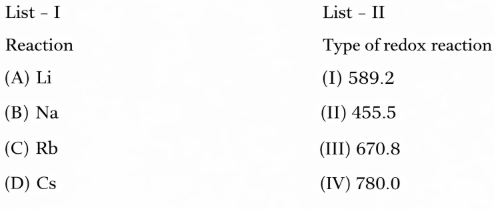
Choose the correct answer from the options given below :
Number of compounds with one lone pair of electrons on central atom amongst following is _______
$$O_3, H_2O, SF_4, ClF_3, NH_3, BrF_5, XeF_4$$
The number of lone pairs on the central atom can be determined using
$$\text{Lone Pairs}=\frac{\text{Valence Electrons of Central Atom}-\text{Electrons Used in Bonding}}{2}$$
For $$O_3$$, the central oxygen has 6 valence electrons and uses 4 electrons in bonding. The remaining 2 electrons constitute 1 lone pair.
For $$H_2O$$, the central oxygen has 6 valence electrons and uses 2 electrons in bonding. The remaining 4 electrons constitute 2 lone pairs.
For $$SF_4$$, sulfur has 6 valence electrons and uses 4 electrons in bonding. The remaining 2 electrons constitute 1 lone pair.
For $$ClF_3$$, chlorine has 7 valence electrons and uses 3 electrons in bonding. The remaining 4 electrons constitute 2 lone pairs.
For $$NH_3$$, nitrogen has 5 valence electrons and uses 3 electrons in bonding. The remaining 2 electrons constitute 1 lone pair.
For $$BrF_5$$, bromine has 7 valence electrons and uses 5 electrons in bonding. The remaining 2 electrons constitute 1 lone pair.
For $$XeF_4$$, xenon has 8 valence electrons and uses 4 electrons in bonding. The remaining 4 electrons constitute 2 lone pairs.
Thus, the compounds containing exactly one lone pair on the central atom are $$O_3$$, $$SF_4$$, $$NH_3$$, and $$BrF_5$$.
Therefore, the total number of such compounds is, $$4$$
The total number of molecules with zero dipole moment among $$CH_4, BF_3, H_2O, HF, NH_3, CO_2$$ and $$SO_2$$ is ______.
We need to find the number of molecules with zero dipole moment among: $$CH_4, BF_3, H_2O, HF, NH_3, CO_2,$$ and $$SO_2$$.
A molecule has zero dipole moment when the individual bond dipoles cancel each other out due to symmetry.
Analysing each molecule:
1. $$CH_4$$ (Methane): Tetrahedral geometry. All four $$C-H$$ bonds are identical and symmetrically arranged. The bond dipoles cancel out completely.
Dipole moment = Zero
2. $$BF_3$$ (Boron trifluoride): Trigonal planar geometry. The three $$B-F$$ bonds are symmetrically placed at $$120°$$ angles. The bond dipoles cancel out.
Dipole moment = Zero
3. $$H_2O$$ (Water): Bent geometry with a bond angle of about $$104.5°$$. The two $$O-H$$ bond dipoles do not cancel due to the bent shape, and there are two lone pairs on oxygen.
Dipole moment = Non-zero
4. $$HF$$ (Hydrogen fluoride): Linear diatomic molecule with a highly polar $$H-F$$ bond. Since there is only one bond, there is nothing to cancel it.
Dipole moment = Non-zero
5. $$NH_3$$ (Ammonia): Trigonal pyramidal geometry with one lone pair on nitrogen. The bond dipoles and the lone pair contribution do not cancel.
Dipole moment = Non-zero
6. $$CO_2$$ (Carbon dioxide): Linear geometry. The two $$C=O$$ bonds are equal and opposite in direction. The bond dipoles cancel perfectly.
Dipole moment = Zero
7. $$SO_2$$ (Sulfur dioxide): Bent geometry with a bond angle of about $$119°$$. The two $$S=O$$ bond dipoles do not cancel due to the bent shape, and there is a lone pair on sulfur.
Dipole moment = Non-zero
The molecules with zero dipole moment are: $$CH_4$$, $$BF_3$$, and $$CO_2$$.
Therefore, the total number of molecules with zero dipole moment = 3.
A diatomic molecule has a dipole moment of 1.2 D. If the bond distance is 1 $$\mathring{A}$$, then fractional charge on each atom is ______ $$\times 10^{-1}$$ esu. (Given 1D = $$10^{-18}$$ esu cm)
Number of compounds from the following with zero dipole moment is ______ $$HF$$, $$H_2$$, $$H_2S$$, $$CO_2$$, $$NH_3$$, $$BF_3$$, $$CH_4$$, $$CHCl_3$$, $$SiF_4$$, $$H_2O$$, $$BeF_2$$
We need to count the number of compounds with zero dipole moment from the given list.
Key concept: A molecule has zero dipole moment if it is either nonpolar (same atoms bonded) or if its geometry causes the individual bond dipoles to cancel out due to symmetry.
Let us check each compound:
1. HF — Linear, polar bond. Dipole moment $$\neq 0$$.
2. $$H_2$$ — Homonuclear diatomic, nonpolar. Dipole moment = 0.
3. $$H_2S$$ — Bent shape (like water). Dipole moment $$\neq 0$$.
4. $$CO_2$$ — Linear, $$O=C=O$$. Bond dipoles cancel. Dipole moment = 0.
5. $$NH_3$$ — Trigonal pyramidal with lone pair. Dipole moment $$\neq 0$$.
6. $$BF_3$$ — Trigonal planar, symmetric. Bond dipoles cancel. Dipole moment = 0.
7. $$CH_4$$ — Tetrahedral, symmetric. Bond dipoles cancel. Dipole moment = 0.
8. $$CHCl_3$$ — Tetrahedral but asymmetric (one H, three Cl). Dipole moment $$\neq 0$$.
9. $$SiF_4$$ — Tetrahedral, symmetric. Bond dipoles cancel. Dipole moment = 0.
10. $$H_2O$$ — Bent shape. Dipole moment $$\neq 0$$.
11. $$BeF_2$$ — Linear, $$F-Be-F$$. Bond dipoles cancel. Dipole moment = 0.
Compounds with zero dipole moment: $$H_2$$, $$CO_2$$, $$BF_3$$, $$CH_4$$, $$SiF_4$$, $$BeF_2$$ = 6 compounds.
The answer is 6.
Number of compounds/species from the following with non-zero dipole moment is ______. $$BeCl_2$$, $$BCl_3$$, $$NF_3$$, $$XeF_4$$, $$CCl_4$$, $$H_2O$$, $$H_2S$$, $$HBr$$, $$CO_2$$, $$H_2$$, $$HCl$$
Count compounds/species with non-zero dipole moment from the given list.
Analysis of each:
- $$BeCl_2$$: Linear, symmetric → $$\mu = 0$$
- $$BCl_3$$: Trigonal planar, symmetric → $$\mu = 0$$
- $$NF_3$$: Trigonal pyramidal (lone pair on N) → $$\mu \neq 0$$
- $$XeF_4$$: Square planar, symmetric → $$\mu = 0$$
- $$CCl_4$$: Tetrahedral, symmetric → $$\mu = 0$$
- $$H_2O$$: Bent → $$\mu \neq 0$$
- $$H_2S$$: Bent → $$\mu \neq 0$$
- $$HBr$$: Diatomic, polar → $$\mu \neq 0$$
- $$CO_2$$: Linear, symmetric → $$\mu = 0$$
- $$H_2$$: Homonuclear diatomic → $$\mu = 0$$
- $$HCl$$: Diatomic, polar → $$\mu \neq 0$$
Non-zero dipole moment: $$NF_3, H_2O, H_2S, HBr, HCl$$ → 5.
The correct answer is 5.
Number of molecules/species from the following having one unpaired electron is ______. $$O_2,\ O_2^{-1},\ NO,\ CN^{-1},\ O_2^{2-}$$
We need to count how many of the given species have exactly one unpaired electron, using Molecular Orbital Theory (MOT).
Key Concept: In MOT, electrons fill molecular orbitals in order of increasing energy. For diatomic molecules of second-period elements, the filling order depends on whether the species has 14 or fewer electrons (where $$\sigma_{2p}$$ is higher than $$\pi_{2p}$$) or more than 14 electrons (where $$\sigma_{2p}$$ is lower than $$\pi_{2p}$$).
1. $$O_2$$ (16 electrons):
Electronic configuration: $$(\sigma_{1s})^2 (\sigma^*_{1s})^2 (\sigma_{2s})^2 (\sigma^*_{2s})^2 (\sigma_{2p})^2 (\pi_{2p})^4 (\pi^*_{2p})^2$$
The last two electrons go into the two degenerate $$\pi^*_{2p}$$ orbitals. By Hund's rule, they occupy different orbitals with parallel spins. This gives 2 unpaired electrons.
Since we need exactly 1 unpaired electron, $$O_2$$ does not qualify.
2. $$O_2^-$$ (17 electrons):
Compared to $$O_2$$, this has one additional electron: $$(\pi^*_{2p})^3$$
The two degenerate $$\pi^*_{2p}$$ orbitals now hold 3 electrons: one orbital has 2 (paired), the other has 1 (unpaired). This gives 1 unpaired electron. This qualifies.
3. $$NO$$ (15 electrons):
Electronic configuration: $$(\sigma_{1s})^2 (\sigma^*_{1s})^2 (\sigma_{2s})^2 (\sigma^*_{2s})^2 (\sigma_{2p})^2 (\pi_{2p})^4 (\pi^*_{2p})^1$$
The 15th electron enters one of the $$\pi^*_{2p}$$ orbitals, giving 1 unpaired electron. This qualifies.
4. $$CN^-$$ (14 electrons):
$$CN^-$$ is isoelectronic with $$N_2$$ and $$CO$$ (all have 14 electrons). For species with 14 or fewer electrons, the MO ordering has $$\pi_{2p}$$ below $$\sigma_{2p}$$:
$$(\sigma_{1s})^2 (\sigma^*_{1s})^2 (\sigma_{2s})^2 (\sigma^*_{2s})^2 (\pi_{2p})^4 (\sigma_{2p})^2$$
All electrons are paired, giving 0 unpaired electrons. Does not qualify.
5. $$O_2^{2-}$$ (18 electrons):
Compared to $$O_2$$, this has two additional electrons: $$(\pi^*_{2p})^4$$
Both $$\pi^*_{2p}$$ orbitals are now completely filled (2 electrons each), so all electrons are paired. This gives 0 unpaired electrons. Does not qualify.
Counting the species with exactly one unpaired electron:
$$O_2^-$$ and $$NO$$ — that is 2 species.
The answer is 2.
The number of species from the following which are paramagnetic and with bond order equal to one is _______
$$H_2, He_2^+, O_2^+, N_2^{2-}, O_2^{2-}, F_2, Ne_2^+, B_2$$
We need to find the number of species that are paramagnetic AND have bond order = 1 from: $$H_2, He_2^+, O_2^+, N_2^{2-}, O_2^{2-}, F_2, Ne_2^+, B_2$$.
Analyze each species.
$$H_2$$: $$\sigma_{1s}^2$$. Bond order = 1. Diamagnetic (all paired). No.
$$He_2^+$$: $$\sigma_{1s}^2 {\sigma^*_{1s}}^{1}$$. Bond order = 0.5. No (BO ≠ 1).
$$O_2^+$$: Bond order = 2.5. No.
$$N_2^{2-}$$: 16 electrons. Same as $$O_2$$. Bond order = 2. No.
$$O_2^{2-}$$: 18 electrons. $$\sigma_{1s}^2{\sigma^*_{1s}}^{2}\sigma_{2s}^2{\sigma^*_{2s}}^{2}\sigma_{2p}^2\pi_{2p}^4{\pi^*_{2p}}^{4}$$. Bond order = (10-8)/2 = 1. All electrons paired. Diamagnetic. No.
$$F_2$$: 18 electrons. Bond order = 1. Diamagnetic. No.
$$Ne_2^+$$: 19 electrons. Bond order = (10-9)/2 = 0.5. No.
$$B_2$$: 10 electrons. $$\sigma_{1s}^2{\sigma^*_{1s}}^{2}\sigma_{2s}^2{\sigma^*_{2s}}^{2}\pi_{2p}^1\pi_{2p}^1$$. Bond order = (6-4)/2 = 1. Two unpaired electrons in $$\pi_{2p}$$. Paramagnetic with bond order 1. Yes!
Count.
Only $$B_2$$ satisfies both conditions = 1 species.
Conclusion.
The number is 1.
Therefore, the answer is 1.
Total number of electrons present in $$(\pi^*)$$ molecular orbitals of $$O_2$$, $$O_2^+$$ and $$O_2^-$$ is ______.
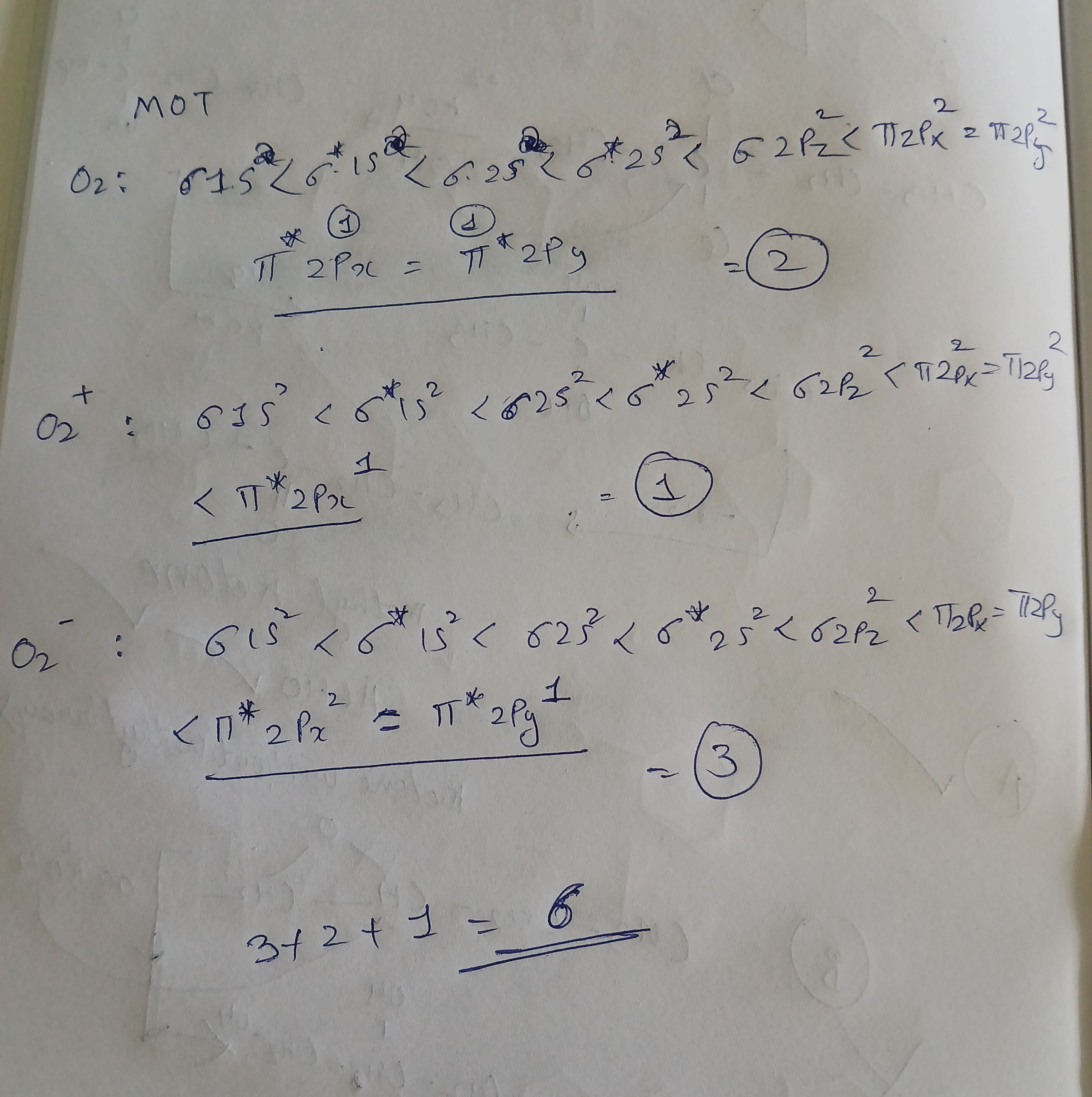
Sum of bond order of CO and $$NO^+$$ is _______.
We need to find the sum of bond orders of CO and $$NO^+$$.
We first determine the bond order of CO using Molecular Orbital Theory (MOT). The formula for bond order is:
$$ \text{Bond Order} = \frac{N_b - N_a}{2} $$
where $$N_b$$ = number of electrons in bonding molecular orbitals, and $$N_a$$ = number of electrons in antibonding molecular orbitals.
CO has a total of $$6 + 8 = 14$$ electrons. The molecular orbital configuration for CO (following the order for molecules with atomic number $$\leq 7$$ for the lighter atom) is:
$$ \begin{aligned} &(\sigma 1s)^2 (\sigma^* 1s)^2 (\sigma 2s)^2 (\sigma^* 2s)^2\\ &(\pi 2p_x)^2 (\pi 2p_y)^2 (\sigma 2p_z)^2 \end{aligned} $$
Counting electrons gives bonding electrons $$N_b = 2 + 2 + 2 + 2 + 2 = 10$$ (from $$\sigma 1s, \sigma 2s, \pi 2p_x, \pi 2p_y, \sigma 2p_z$$) and antibonding electrons $$N_a = 2 + 2 = 4$$ (from $$\sigma^* 1s, \sigma^* 2s$$). Thus,
$$ \text{Bond Order of CO} = \frac{10 - 4}{2} = \frac{6}{2} = 3 $$
Next, we determine the bond order of $$NO^+$$. This species has $$7 + 8 - 1 = 14$$ electrons (nitrogen has 7, oxygen has 8, minus 1 for the positive charge). Since $$NO^+$$ is isoelectronic with CO, it has the same MO configuration:
$$ \begin{aligned} &(\sigma 1s)^2 (\sigma^* 1s)^2 (\sigma 2s)^2 (\sigma^* 2s)^2\\ &(\pi 2p_x)^2 (\pi 2p_y)^2 (\sigma 2p_z)^2 \end{aligned} $$
Therefore,
$$ \text{Bond Order of } NO^+ = \frac{10 - 4}{2} = \frac{6}{2} = 3 $$
Finally, the sum of bond orders is
$$ \text{Sum of bond orders} = 3 + 3 = 6 $$
The answer is $$\boxed{6}$$.
The number of molecules/ion/s having trigonal bipyramidal shape is: $$PF_5$$, $$BrF_5$$, $$PCl_5$$, $$[PtCl_4]^{2-}$$, $$BF_3$$, $$Fe(CO)_5$$
Find how many of the given species have trigonal bipyramidal (TBP) shape: $$PF_5, BrF_5, PCl_5, [PtCl_4]^{2-}, BF_3, Fe(CO)_5$$.
Method: For each species, count electron domains around the central atom and determine the geometry using VSEPR theory.
1. $$PF_5$$: P has 5 valence electrons, each F contributes 1 bond = 5 bond pairs, 0 lone pairs. Electron geometry: TBP. Molecular shape: Trigonal bipyramidal.
2. $$BrF_5$$: Br has 7 valence electrons, 5 bonds to F uses 5 electrons, leaving 2 electrons = 1 lone pair. Total electron domains = 6 (octahedral electron geometry). Shape: Square pyramidal (not TBP).
3. $$PCl_5$$: Same as $$PF_5$$. P has 5 bond pairs, 0 lone pairs. Shape: Trigonal bipyramidal.
4. $$[PtCl_4]^{2-}$$: Pt is a transition metal with d$$^8$$ configuration ($$Pt^{2+}$$). With 4 $$Cl^-$$ ligands, it adopts square planar geometry (not TBP).
5. $$BF_3$$: B has 3 valence electrons, 3 bonds = 3 bond pairs, 0 lone pairs. Shape: Trigonal planar (not TBP).
6. $$Fe(CO)_5$$: Fe has 8 valence electrons. In $$Fe(CO)_5$$, iron is $$Fe(0)$$ with 5 CO ligands forming 5 bond pairs. This follows the 18-electron rule (8 + 5×2 = 18). The geometry is Trigonal bipyramidal.
Count of TBP species: $$PF_5$$, $$PCl_5$$, $$Fe(CO)_5$$ = 3.
The answer is 3.
The number of species from the following in which the central atom uses $$sp^3$$ hybrid orbitals in its bonding is _________. $$NH_3, SO_2, SiO_2, BeCl_2, CO_2, H_2O, CH_4, BF_3$$
The hybridization of the central atom can be determined using the steric number.
$$\text{Steric Number}=\text{Number of bonded atoms}+\text{Number of lone pairs}$$
A steric number of $$4$$ corresponds to $$sp^3$$ hybridization.
For $$NH_3$$, nitrogen is bonded to three hydrogen atoms and possesses one lone pair.
$$SN=3+1=4$$
Therefore, nitrogen is $$sp^3$$ hybridized.
For $$SO_2$$, sulfur is bonded to two oxygen atoms and possesses one lone pair.
$$SN=2+1=3$$
Therefore, sulfur is $$sp^2$$ hybridized.
For $$SiO_2$$, each silicon atom in the three-dimensional covalent network is bonded to four oxygen atoms.
$$SN=4+0=4$$
Therefore, silicon is $$sp^3$$ hybridized.
For $$BeCl_2$$, beryllium is bonded to two chlorine atoms.
$$SN=2+0=2$$
Therefore, beryllium is $$sp$$ hybridized.
For $$CO_2$$, carbon is bonded to two oxygen atoms.
$$SN=2+0=2$$
Therefore, carbon is $$sp$$ hybridized.
For $$H_2O$$, oxygen is bonded to two hydrogen atoms and possesses two lone pairs.
$$SN=2+2=4$$
Therefore, oxygen is $$sp^3$$ hybridized.
For $$CH_4$$, carbon is bonded to four hydrogen atoms.
$$SN=4+0=4$$
Therefore, carbon is $$sp^3$$ hybridized.
For $$BF_3$$, boron is bonded to three fluorine atoms.
$$SN=3+0=3$$
Therefore, boron is $$sp^2$$ hybridized.
Thus, the species containing a central atom with $$sp^3$$ hybridization are $$NH_3$$, $$SiO_2$$, $$H_2O$$, and $$CH_4$$.
Hence, the total number of $$sp^3$$ hybridized species is
$$4$$
The total number of anti bonding molecular orbitals, formed from $$2s$$ and $$2p$$ atomic orbitals in a diatomic molecule is ______.
We need to find the total number of antibonding molecular orbitals formed from $$2s$$ and $$2p$$ atomic orbitals in a diatomic molecule.
Molecular Orbital Theory: When atomic orbitals combine to form molecular orbitals, each pair of atomic orbitals produces one bonding and one antibonding molecular orbital.
From $$2s$$ atomic orbitals:
Each atom contributes one $$2s$$ orbital. The two $$2s$$ orbitals combine to form:
From $$2p$$ atomic orbitals:
Each atom contributes three $$2p$$ orbitals ($$2p_x, 2p_y, 2p_z$$). The six $$2p$$ orbitals (3 from each atom) combine to form:
Total antibonding MOs from $$2p$$ orbitals = 3
Total antibonding molecular orbitals = 1 (from 2s) + 3 (from 2p) = 4
Therefore, the answer is 4.
The total number of molecular orbitals formed from $$2s$$ and $$2p$$ atomic orbitals of a diatomic molecule is _______.
In a diatomic molecule, molecular orbitals are formed by the linear combination of atomic orbitals (LCAO). Each pair of atomic orbitals (one from each atom) combines to form two molecular orbitals — one bonding and one antibonding.
From the 2s atomic orbitals:
Each atom contributes one 2s orbital. These two 2s orbitals combine to form:
1. $$\sigma_{2s}$$ (bonding)
2. $$\sigma^*_{2s}$$ (antibonding)
That gives 2 molecular orbitals.
From the 2p atomic orbitals:
Each atom contributes three 2p orbitals ($$2p_x$$, $$2p_y$$, $$2p_z$$). These six atomic orbitals (3 from each atom) combine to form:
1. $$\sigma_{2p_z}$$ (bonding)
2. $$\sigma^*_{2p_z}$$ (antibonding)
3. $$\pi_{2p_x}$$ (bonding)
4. $$\pi^*_{2p_x}$$ (antibonding)
5. $$\pi_{2p_y}$$ (bonding)
6. $$\pi^*_{2p_y}$$ (antibonding)
That gives 6 molecular orbitals.
Total molecular orbitals = 2 + 6 = 8.
The answer is 8.
The number of optical isomers in following compound is: ________
Total number of optically active compounds from the following is ____
CH3-CH(OH)-CH(OH)-CH3: This Fischer projection shows chiral centers at C2 and C3. However, there is a horizontal plane of symmetry passing directly between C2 and C3, dividing the molecule into two identical halves. This makes it a meso compound, optically inactive.
Heptane-3,4,5-triol: The molecule has chiral centers at C3 and C5, and a pseudoasymmetric center at C4. As drawn, there is a vertical plane of symmetry passing straight through C4 and its attached -OH group. The left side (ethyl group and -OH group) perfectly mirrors the right side. Thus, it is a meso compound.
Butanol: There are no chiral carbons (no carbon is attached to four different groups). Hence optically inactive.
1-chlorobutane: There are no chiral carbons. Hence Optically inactive.
1-chloro-3-methylbutane: There are no chiral carbons. Carbon-3 is attached to two identical methyl groups. Hence, optically inactive.
2-chlorobutane: Carbon-2 is bonded to four distinct groups. This makes C2 a chiral center. There is no plane or center of symmetry in the molecule. Hence optically active compound.
Total Optically active compounds = 0+0+0+0+0+1 = 1
How many compounds among the following compounds show inductive, mesomeric as well as hyperconjugation effects?
The number of non-polar molecules from the following is
$$HF$$, $$H_2O$$, $$SO_2$$, $$H_2$$, $$CO_2$$, $$CH_4$$, $$NH_3$$, $$HCl$$, $$CHCl_3$$, $$BF_3$$
We need to count the non-polar molecules from the given list: HF, H$$_2$$O, SO$$_2$$, H$$_2$$, CO$$_2$$, CH$$_4$$, NH$$_3$$, HCl, CHCl$$_3$$, BF$$_3$$.
A molecule is non-polar if either (a) it has no polar bonds, or (b) it has polar bonds but they are arranged symmetrically so that the dipole moments cancel out.
Analyze each molecule:
(i) HF: Polar bond, asymmetric → Polar
(ii) H$$_2$$O: Polar O-H bonds, bent geometry → dipoles don't cancel → Polar
(iii) SO$$_2$$: Polar S=O bonds, bent geometry → Polar
(iv) H$$_2$$: Same atoms, no dipole → Non-polar ✓
(v) CO$$_2$$: Polar C=O bonds, but linear and symmetric → dipoles cancel → Non-polar ✓
(vi) CH$$_4$$: Polar C-H bonds, but tetrahedral symmetry → dipoles cancel → Non-polar ✓
(vii) NH$$_3$$: Polar N-H bonds, pyramidal geometry → Polar
(viii) HCl: Polar bond, asymmetric → Polar
(ix) CHCl$$_3$$: Asymmetric substitution → dipoles don't cancel → Polar
(x) BF$$_3$$: Polar B-F bonds, but trigonal planar symmetry → dipoles cancel → Non-polar ✓
Count non-polar molecules: H$$_2$$, CO$$_2$$, CH$$_4$$, BF$$_3$$ = 4.
The answer is 4.
Total number of aromatic compounds among the following compounds is _____
To determine if a molecule is aromatic, it must satisfy Hückel's Rule. A compound is aromatic if it is:
Non-aromatic.
Number of carbocations from the following that are not stabilized by hyperconjugation is __________
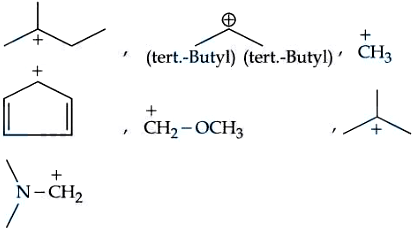
_
Statement I: Dipole moment is a vector quantity and by convention it is depicted by a small arrow with tail on the negative centre and head pointing towards the positive centre.
Statement II: The crossed arrow of the dipole moment symbolizes the direction of the shift of charges in the molecules.
In the light of the above statements, choose the most appropriate answer:
Statement I states that dipole moment is a vector quantity and is represented by a small arrow with its tail on the negative centre and head pointing towards the positive centre.
Although dipole moment is indeed a vector quantity, the direction of the dipole moment vector is stated incorrectly.
By convention, the dipole moment vector points from the positive centre to the negative centre, i.e., the tail is at the positive end and the head points towards the negative end.
Hence, Statement I is incorrect.
Statement II states that the crossed arrow of the dipole moment symbolizes the direction of the shift of charges in the molecule.
This is correct. The crossed arrow represents the direction of electron density shift, pointing from the partial positive charge $$\delta^+$$ towards the partial negative charge $$\delta^-$$.
Hence, Statement II is correct.
Therefore, the correct answer is
$$\boxed{\text{Option B: Statement I is incorrect but Statement II is correct.}}$$
What is the number of unpaired electron(s) in the highest occupied molecular orbital of the following species: N$$_2$$, N$$_2^+$$, O$$_2$$, O$$_2^+$$?
Explanation
For molecules up to $$N_2$$, the molecular orbital energy order is
$$\sigma_{2s}<\sigma_{2s}^{}<\pi_{2p_x}=\pi_{2p_y}<\sigma_{2p_z}<\pi_{2p}^{}$$
For $$O_2$$ and beyond, the order is
$$\sigma_{2s}<\sigma_{2s}^{}<\sigma_{2p_z}<\pi_{2p_x}=\pi_{2p_y}<\pi_{2p}^{}$$
For $$N_2$$,
$$N_2=(\sigma_{1s})^2(\sigma_{1s}^{})^2(\sigma_{2s})^2(\sigma_{2s}^{})^2(\pi_{2p_x})^2(\pi_{2p_y})^2(\sigma_{2p_z})^2$$
The HOMO is $$\sigma_{2p_z}$$ and it contains two paired electrons.
Therefore, the number of unpaired electrons in the HOMO is
$$0$$
For $$N_2^+$$, one electron is removed from the HOMO.
$$N_2^+=(\sigma_{2p_z})^1$$
The HOMO contains one unpaired electron.
Therefore,
$$1$$
unpaired electron is present in the HOMO.
For $$O_2$$,
$$(\pi_{2p_x}^{})^1(\pi_{2p_y}^{})^1$$
The HOMO consists of the degenerate $$\pi^{*}$$ orbitals. According to Hund's rule, the two electrons occupy separate orbitals.
Therefore, the number of unpaired electrons in the HOMO is
$$2$$
For $$O_2^+$$, one electron is removed from the $$\pi^{*}$$ level.
Only one unpaired electron remains in the HOMO.
Therefore, the number of unpaired electrons is
$$1$$
Hence, for
$$N_2,\ N_2^+,\ O_2,\ O_2^+$$
the numbers of unpaired electrons in the HOMO are
$$0,\ 1,\ 2,\ 1$$
Hence, the correct answer is
$$0,\ 1,\ 2,\ 1$$
According to MO theory the bond orders for O$$_2^{2-}$$, CO and NO$$^+$$ respectively, are
The bond order is calculated by:
$$Bond\ Order\ =\ \frac{N_b-N_a}{2}$$
where,
$$N_b$$ is number of bonding electrons
$$N_a$$ is number of antibonding electrons
For, $$O_2^{2-}$$
Total electrons = 8+8+2 = 18 electrons
MO Configuration:
$$\sigma_{1s}^2 \ \sigma_{1s}^{*2} \ \sigma_{2s}^2 \ \sigma_{2s}^{*2} \ \sigma_{2p_z}^2 \ (\pi_{2p_x}^2 = \pi_{2p_y}^2) \ (\pi_{2p_x}^{*2} = \pi_{2p_y}^{*2})$$
$$N_{b} = 10$$, $$N_{a} = 8$$
$$\text{Bond Order} = \frac{10 - 8}{2} = 1$$
For, $$CO$$
Total Electrons: $6 + 8 = 14\text{ electrons}$
MO Configuration: $$\sigma_{1s}^2 \ \sigma_{1s}^{*2} \ \sigma_{2s}^2 \ \sigma_{2s}^{*2} \ (\pi_{2p_x}^2 = \pi_{2p_y}^2) \ \sigma_{2p_z}^2$$
$$N_b = 10$$, $$N_a = 4$$
$$\text{Bond Order} = \frac{10 - 4}{2} = 3$$
For, $$\text{NO}^+$$
Total Electrons: $7 + 8 - 1 = 14\text{ electrons}$
MO Configuration: Since it is isoelectronic with $\text{CO}$, it shares the same molecular orbital distribution.
$$N_b = 10$$, $$N_a = 4$$
$$\text{Bond Order} = \frac{10 - 4}{2} = 3$$
Hence, Option A is correct.
Consider the following statement
(A) NF$$_3$$ molecules has a trigonal planar structure.
(B) Bond Length of N$$_2$$ is shorter than O$$_2$$.
(C) Isoelectronic molecules or ions have identical bond order.
(D) Dipole moment of H$$_2$$S is higher than that of water molecule.
Choose the correct answer from the options given below:
Analyzing each statement:
(A) NF₃ has trigonal planar structure: NF₃ has 3 bond pairs + 1 lone pair on N → pyramidal (like NH₃), NOT trigonal planar. Incorrect.
(B) Bond length of N₂ is shorter than O₂: N₂ has bond order 3 (triple bond, length ~1.10 Å). O₂ has bond order 2 (double bond, length ~1.21 Å). So N₂ is shorter. Correct.
(C) Isoelectronic molecules or ions have identical bond order: Isoelectronic species have the same number of electrons and similar electronic configuration, so they have the same bond order. For example, CO, N₂, NO⁺ are isoelectronic with bond order 3. Correct.
(D) Dipole moment of H₂S is higher than H₂O: H₂O has a dipole moment of 1.85 D while H₂S has 0.97 D. H₂O has a higher dipole moment due to the greater electronegativity of O and the bond angle. Incorrect.
Correct statements: B and C.
This matches option 4: (B) and (C) are correct.
Decreasing order of the hydrogen bonding in following forms of water is correctly represented by
A. Liquid water
B. Ice
C. Impure water
Hydrogen bonding depends on the structural arrangement and purity of water. In ice, every water molecule is hydrogen-bonded to exactly four neighbouring water molecules in a rigid, three-dimensional tetrahedral lattice. This maximises the number of hydrogen bonds per molecule.
In liquid water, thermal energy partially disrupts this ordered network. While extensive hydrogen bonding still exists, some bonds are continuously broken and reformed, so the average number of hydrogen bonds per molecule is fewer than in ice.
In impure water, dissolved solutes (ions, molecules, or other impurities) interfere with the hydrogen-bonding network. The impurity particles occupy space and interact with water molecules differently, further reducing the extent of hydrogen bonding compared to pure liquid water.
Therefore, the decreasing order of hydrogen bonding is $$\text{Ice (B)} > \text{Liquid Water (A)} > \text{Impure Water (C)}$$, i.e., $$B > A > C$$.
Hence, the correct answer is Option 2.
For OF$$_2$$ molecule consider the following:
(A) Number of lone pairs on oxygen is 2.
(B) FOF angle is less than 104.5°.
(C) Oxidation state of O is -2.
(D) Molecule is bent 'V' shaped.
(E) Molecular geometry is linear.
Correct options are:
We need to identify the correct statements about OF$$_2$$.
(A) Number of lone pairs on oxygen is 2.
Oxygen has 6 valence electrons. In OF$$_2$$, it forms 2 bonds with F, leaving 2 lone pairs. CORRECT. ✓
(B) FOF angle is less than 104.5°.
OF$$_2$$ has 2 bond pairs and 2 lone pairs around O (similar to water). The lone pair-lone pair repulsion reduces the bond angle. The actual FOF angle is about 103°, which is less than 104.5°. CORRECT. ✓
(C) Oxidation state of O is -2.
In OF$$_2$$, fluorine is more electronegative than oxygen, so F has -1 oxidation state. Therefore, O has +2 oxidation state, not -2. INCORRECT.
(D) Molecule is bent V-shaped.
With 2 bond pairs and 2 lone pairs, the molecular geometry is bent (V-shaped). CORRECT. ✓
(E) Molecular geometry is linear.
The molecule is bent, not linear. INCORRECT.
Correct statements: A, B, D.
The correct answer is Option 4: A, B, D only.
Given below are two statements: One is labelled as Assertion A and the other is labelled as Reason R.
Assertion A: Butan-1-ol has higher boiling point than ethoxyethane.
Reason R: Extensive hydrogen bonding leads to stronger association of molecules.
In the light of the above statements, choose the correct answer from the options given below :
Assertion A: Butan-1-ol has higher boiling point than ethoxyethane (diethyl ether).
Reason R: Extensive hydrogen bonding leads to stronger association of molecules.
Analysis of Assertion A:
Butan-1-ol (CH₃CH₂CH₂CH₂OH) has a boiling point of approximately 117.7°C.
Ethoxyethane (CH₃CH₂OCH₂CH₃, diethyl ether) has a boiling point of approximately 34.6°C.
Both have the same molecular formula C₄H₁₀O, but butan-1-ol has a significantly higher boiling point.
Assertion A is True.
Analysis of Reason R:
Butan-1-ol has an -OH group capable of forming extensive intermolecular hydrogen bonds, leading to stronger molecular association and higher boiling point. Ethoxyethane cannot form H-bonds with itself (no O-H or N-H groups).
Reason R is True and correctly explains Assertion A.
The correct answer is Option B: Both A and R are true and R is the correct explanation of A.
The bond dissociation energy is highest for
We need to determine which diatomic halogen molecule has the highest bond dissociation energy.
Bond dissociation energies of halogens:
The bond dissociation energies follow the general trend:
$$\text{Cl}_2 (242 \text{ kJ/mol}) > \text{Br}_2 (193 \text{ kJ/mol}) > \text{F}_2 (159 \text{ kJ/mol}) > \text{I}_2 (151 \text{ kJ/mol})$$
Explanation:
Generally, bond dissociation energy decreases as we go down the group due to increasing atomic size and decreasing orbital overlap. However, $$\text{F}_2$$ is an exception — it has an anomalously low bond dissociation energy because the small size of fluorine atoms leads to strong lone pair-lone pair repulsion between the closely placed non-bonding electrons.
Therefore, $$\text{Cl}_2$$ has the highest bond dissociation energy among the halogens.
The correct answer is Option 1: Cl$$_2$$.
The pair from the following pairs having both compounds with net non-zero dipole moment is
We need to find the pair where both compounds have a net non-zero dipole moment.
We start by noting that
A molecule has a non-zero dipole moment when the bond dipoles do not cancel due to molecular asymmetry. Symmetric molecules (like linear CO$$_2$$, benzene, para-dichlorobenzene, trans-butene) have zero dipole moments.
Next,
Option 1: 1,4-Dichlorobenzene and 1,3-Dichlorobenzene
1,4-Dichlorobenzene (para): The two C-Cl bond dipoles are equal and opposite, cancelling exactly. Dipole moment = 0.
1,3-Dichlorobenzene (meta): The bond dipoles do not cancel. Dipole moment is non-zero.
Not both non-zero.
Option 2: cis-butene and trans-butene
cis-2-butene: The two CH$$_3$$ groups are on the same side, creating asymmetry. Has a small but non-zero dipole moment.
trans-2-butene: The CH$$_3$$ groups are on opposite sides, and the molecule has a centre of symmetry. Dipole moment = 0.
Not both non-zero.
Option 3: CH$$_2$$Cl$$_2$$ and CHCl$$_3$$
CH$$_2$$Cl$$_2$$ (dichloromethane): Tetrahedral with 2 H and 2 Cl -- asymmetric arrangement. Has a dipole moment of 1.60 D. Non-zero.
CHCl$$_3$$ (chloroform): Tetrahedral with 1 H and 3 Cl -- asymmetric. Has a dipole moment of 1.04 D. Non-zero.
Both have non-zero dipole moments.
Option 4: Benzene and anisidine
Benzene is perfectly symmetric with zero dipole moment.
Not both non-zero.
The correct answer is Option 3: CH$$_2$$Cl$$_2$$, CHCl$$_3$$.
Which one of the following pairs is an example of polar molecular solids?
We need to identify the pair where both compounds form polar molecular solids.
We start by noting that
Polar molecular solids are composed of polar molecules held together by dipole-dipole interactions (and possibly hydrogen bonds). The key requirement is that each molecule must have a net non-zero dipole moment.
Next,
Option 1: SO$$_2$$(s), CO$$_2$$(s)
SO$$_2$$ is bent (bond angle ~119 degrees) with a net dipole moment -- it is polar. However, CO$$_2$$ is linear and symmetric, so its two C=O bond dipoles cancel, giving zero net dipole moment. CO$$_2$$ forms a non-polar molecular solid. This pair does not work.
Option 2: SO$$_2$$(s), NH$$_3$$(s)
SO$$_2$$ is polar (bent structure, as explained above). NH$$_3$$ has a pyramidal geometry with a lone pair on nitrogen, giving a net dipole moment of 1.47 D. Both are polar molecules, and both form polar molecular solids. This is the correct pair.
Option 3: MgO(s), SO$$_2$$(s)
MgO is an ionic solid (Mg$$^{2+}$$ and O$$^{2-}$$ ions), not a molecular solid. This pair does not work.
Option 4: HCl(s), AlN(s)
HCl is a polar molecule, but AlN is a covalent network solid (similar to diamond/BN structure), not a molecular solid. This pair does not work.
The correct answer is Option 2: SO$$_2$$(s), NH$$_3$$(s).
For compound having the formula GaAlCl$$_4$$, the correct option from the following is
We need to identify the correct statement about the compound GaAlCl$$_4$$.
The compound GaAlCl$$_4$$ is an ionic salt with the formula Ga$$^+$$[AlCl$$_4$$]$$^-$$. Aluminum readily forms the stable tetrachloroaluminate anion [AlCl$$_4$$]$$^-$$, in which Al is tetrahedrally coordinated with four Cl atoms using $$sp^3$$ hybridization. Gallium exists as the monovalent cation Ga$$^+$$ due to the inert pair effect, where the 4s$$^2$$ electrons resist participation in bonding.
Now, the oxidation states are: Ga has +1 (not +3), and Al has +3 (since $$x + 4(-1) = -1$$, so $$x = +3$$). On the Pauling electronegativity scale, Ga (1.81) is more electronegative than Al (1.61). Despite being more electronegative, Ga forms the cation because Al has a very strong tendency to form the [AlCl$$_4$$]$$^-$$ complex anion.
Evaluating each option: Option 1 says Ga is coordinated with Cl, which is incorrect since Ga exists as a free cation. Option 2 says Ga is more electronegative than Al and forms the cationic part, which is correct. Option 3 says Cl bonds with both Al and Ga, which is incorrect. Option 4 says Ga has oxidation state +3, which is also incorrect.
Hence, the correct answer is Option 2.
Match List I with List II
List I List II
A. XeF$$_4$$ I. See-saw
B. SF$$_4$$ II. Square planar
C. NH$$_4^+$$ III. Bent T-shaped
D. BrF$$_3$$ IV. Tetrahedral
Choose the correct answer from the options given below:
We determine the molecular geometry using VSEPR theory:
A. XeF$$_4$$: Xe has 8 valence electrons. With 4 F atoms, there are 4 bond pairs and 2 lone pairs (6 electron pairs total). Geometry: Square planar → II
B. SF$$_4$$: S has 6 valence electrons. With 4 F atoms, there are 4 bond pairs and 1 lone pair (5 electron pairs total). Geometry: See-saw → I
C. NH$$_4^+$$: N has 5 valence electrons, minus 1 for positive charge = 4 electrons shared with 4 H atoms. 4 bond pairs, 0 lone pairs. Geometry: Tetrahedral → IV
D. BrF$$_3$$: Br has 7 valence electrons. With 3 F atoms, there are 3 bond pairs and 2 lone pairs (5 electron pairs total). Geometry: Bent T-shaped → III
Matching: A-II, B-I, C-IV, D-III
Match List I with List II
| List I (molecules/ions) | List II (No. of lone pairs of e$$^-$$ on central atom) |
|---|---|
| (A) IF$$_7$$ | I. Three |
| (B) ICl$$_4^-$$ | II. One |
| (C) XeF$$_6$$ | III. Two |
| (D) XeF$$_2$$ | IV. Zero |
We need to match each molecule/ion with the number of lone pairs on its central atom.
(A) IF$$_7$$:
Iodine has 7 valence electrons. It forms 7 bonds with 7 fluorine atoms, using all its valence electrons for bonding. The hybridization is $$sp^3d^3$$.
Lone pairs on I = $$\frac{7 - 7}{2} = 0$$ (Zero) --> matches IV
(B) ICl$$_4^-$$:
Iodine has 7 valence electrons, plus 1 from the negative charge = 8 electrons available. It forms 4 bonds with Cl atoms, leaving 4 non-bonding electrons.
Lone pairs on I = $$\frac{8 - 4}{2} = 2$$ (Two) --> matches III
The geometry is square planar ($$sp^3d^2$$, with 2 lone pairs in axial positions of the octahedron).
(C) XeF$$_6$$:
Xenon has 8 valence electrons. It forms 6 bonds with F atoms, leaving 2 non-bonding electrons.
Lone pairs on Xe = $$\frac{8 - 6}{2} = 1$$ (One) --> matches II
The geometry is distorted octahedral ($$sp^3d^3$$ hybridization with 1 lone pair).
(D) XeF$$_2$$:
Xenon has 8 valence electrons. It forms 2 bonds with F atoms, leaving 6 non-bonding electrons.
Lone pairs on Xe = $$\frac{8 - 2}{2} = 3$$ (Three) --> matches I
The geometry is linear ($$sp^3d$$ hybridization with 3 lone pairs in equatorial positions of a trigonal bipyramid).
The correct matching is: A-IV, B-III, C-II, D-I.
The correct answer is Option 2.
Order of Covalent bond;
A.$$KF > KI; LiF > KF$$
B. $$KF < KI; LiF > KF$$
C. $$SnCl_4 > SnCl_2$$; CuCl > NaCl
D. $$LiF > KF; CuCl > NaCl$$
E. $$KF < KI; CuCl > NaCl$$
Covalent character in an ionic compound is assessed using Fajans' rules. Covalent character increases when (i) the cation is small and highly charged, (ii) the anion is large and easily polarisable, and (iii) the cation has a pseudo-noble-gas configuration (e.g., $$Cu^{+}$$ with $$18$$ electrons in the outermost shell) rather than a noble-gas configuration.
Statement A: $$KF > KI;\; LiF > KF$$. Since $$I^{-}$$ is larger and more polarisable than $$F^{-}$$, we have $$KI > KF$$, not $$KF > KI$$. The first part is wrong, so A is incorrect.
Statement B: $$KF < KI;\; LiF > KF$$. As argued above, $$KI > KF$$ because $$I^{-}$$ is more polarisable. Also, $$Li^{+}$$ is much smaller than $$K^{+}$$ and therefore more polarising, so $$LiF > KF$$. Both parts are correct, so B is correct.
Statement C: $$SnCl_{4} > SnCl_{2};\; CuCl > NaCl$$. In $$SnCl_{4}$$, tin is in the $$+4$$ oxidation state, which is smaller and more highly charged than $$Sn^{2+}$$, so $$SnCl_{4}$$ has greater covalent character than $$SnCl_{2}$$. For $$CuCl$$ vs $$NaCl$$, $$Cu^{+}$$ has a pseudo-noble-gas configuration $$(3d^{10})$$ and is smaller than $$Na^{+}$$, giving $$CuCl$$ much greater covalent character. Both parts are correct, so C is correct.
Statement D: $$LiF > KF;\; CuCl < NaCl$$. While $$LiF > KF$$ is correct, $$CuCl < NaCl$$ is wrong (it should be $$CuCl > NaCl$$). So D is incorrect.
Statement E: $$KF < KI;\; CuCl > NaCl$$. Both parts follow directly from the reasoning above and are correct. So E is correct.
The correct statements are B, C, and E.
Hence, the correct answer is Option 3.
The bond order and magnetic property of acetylide ion are same as that of
The acetylide ion $$C_2^{2-}$$ contains $$2(6) + 2 = 14$$ electrons. Using the MO diagram for homonuclear diatomic molecules without 2s-2p mixing, its electron configuration is $$\sigma_{1s}^2{\sigma^*_{1s}}^{2}\sigma_{2s}^2{\sigma^*_{2s}}^{2}\pi_{2p}^4\sigma_{2p}^2$$, which gives a bond order of $$\frac{10 - 4}{2} = 3$$. All electrons are paired, so $$C_2^{2-}$$ is diamagnetic.
In $$NO^+$$, nitrogen contributes 7 electrons and oxygen contributes 8, with the positive charge removing one electron, for a total of $$7 + 8 - 1 = 14$$ electrons. This makes $$NO^+$$ isoelectronic with $$C_2^{2-}$$. Its bond order is also $$3$$ and it is diamagnetic, matching the properties of the acetylide ion.
The species $$O_2^+$$ (15 electrons, bond order $$2.5$$, paramagnetic), $$N_2^+$$ (13 electrons, bond order $$2.5$$, paramagnetic), and $$O_2^-$$ (17 electrons, bond order $$1.5$$, paramagnetic) do not share the same bond order and magnetic behavior as $$C_2^{2-}$$.
Therefore, the species that matches both the bond order and magnetic property of the acetylide ion is $$NO^+$$. The correct answer is Option 3: $$NO^+$$.
Match Column I with Column II
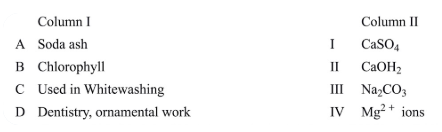
Resonance in carbonate ion CO$$_3^{2-}$$ is
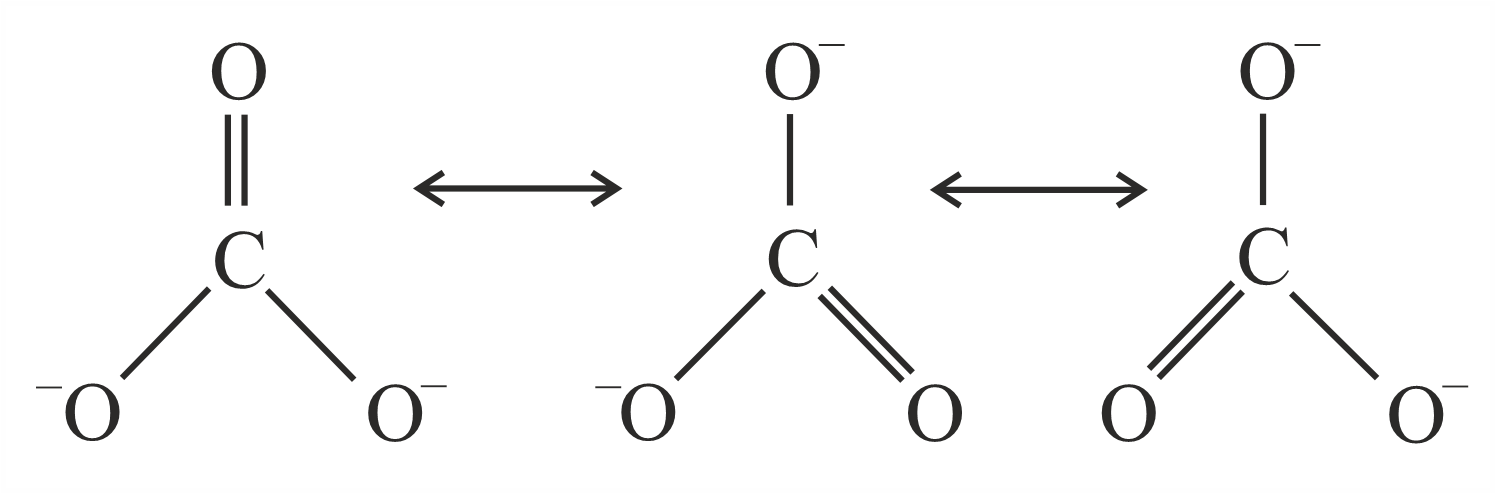
Which of the following is true?
The carbonate ion $$CO_3^{2-}$$ can be represented by three resonance structures, each showing one C=O double bond and two C-O single bonds with different oxygen atoms.
Key points about resonance:
1. Resonance structures are not real, individual structures. They are merely convenient representations used to describe the actual structure.
2. The actual molecule does not switch between these structures. There is no dynamic equilibrium between resonance structures.
3. The resonance structures do not exist for any amount of time individually.
4. The actual structure of $$CO_3^{2-}$$ is a single structure called the resonance hybrid, which is a weighted average of all three resonance structures. In this hybrid, all three C-O bonds are equivalent with a bond order of $$\frac{4}{3}$$, and all bond lengths are equal.
Therefore, the correct statement is: $$CO_3^{2-}$$ has a single structure i.e., resonance hybrid of the above three structures.
The number of species from the following carrying a single lone pair on central atom Xenon is
$$XeF_5^+$$, $$XeO_3$$, $$XeO_2F_2$$, $$XeF_5^-$$, $$XeO_3F_2$$, $$XeOF_4$$, $$XeF_4$$
We need to find how many species from the given list carry a single lone pair on the central atom Xenon. Xenon has 8 valence electrons, and we count lone pairs by subtracting electrons used in bonding.
For $$XeF_5^+$$: Effective electrons from Xe = $$8 - 1 = 7$$ (charge adjusts by $$-1$$). Five Xe-F bonds use 5 electrons, leaving $$7 - 5 = 2$$ electrons = 1 lone pair. Geometry is square pyramidal with $$sp^3d^2$$ hybridization.
For $$XeO_3$$: Three double bonds use $$3 \times 2 = 6$$ electrons, leaving $$8 - 6 = 2$$ electrons = 1 lone pair. Geometry is trigonal pyramidal with $$sp^3$$ hybridization.
For $$XeO_2F_2$$: Two double bonds with O use 4 electrons and two single bonds with F use 2 electrons, totalling 6. That leaves $$8 - 6 = 2$$ electrons = 1 lone pair. Geometry is see-saw with $$sp^3d$$ hybridization.
For $$XeF_5^-$$: Effective electrons = $$8 + 1 = 9$$. Five bonds use 5, leaving 4 electrons = 2 lone pairs. This does not qualify.
For $$XeO_3F_2$$: Three double bonds use 6 and two single bonds use 2, totalling 8. That leaves $$8 - 8 = 0$$ lone pairs. This does not qualify.
For $$XeOF_4$$: One double bond uses 2 and four single bonds use 4, totalling 6. That leaves $$8 - 6 = 2$$ electrons = 1 lone pair. Geometry is square pyramidal with $$sp^3d^2$$ hybridization.
For $$XeF_4$$: Four single bonds use 4 electrons, leaving $$8 - 4 = 4$$ electrons = 2 lone pairs. This does not qualify.
The species with a single lone pair are $$XeF_5^+$$, $$XeO_3$$, $$XeO_2F_2$$, and $$XeOF_4$$. Hence, the answer is $$4$$.
Arrange the following gases in increasing order of van der Waals constant 'a'
(A) Ar
(B) CH$$_4$$
(C) H$$_2$$O
(D) C$$_6$$H$$_6$$
Choose the correct option from the following.
The van der Waals constant $$a$$ measures the magnitude of intermolecular attractive forces.
Stronger intermolecular forces $$\Rightarrow$$ larger value of $$a$$.
Given gases:
$$Ar,\ CH_4,\ H_2O,\ C_6H_6$$
Analysis:
For argon: $$Ar$$
Being a noble gas, it has very weak intermolecular forces.
Hence it has the smallest value of $$a$$.
For methane: $$CH_4$$
Non-polar molecule with weak van der Waals forces, but stronger than Ar.
For water: $$H_2O$$
Strong hydrogen bonding is present, so intermolecular attraction is much larger.
For benzene: $$C_6H_6$$
Large molecular size and highly polarizable electron cloud produce very strong intermolecular attractions.
Hence benzene has the largest value of $$a$$.
Therefore the increasing order of van der Waals constant $$a$$ is:
$${Ar < CH_4 < H_2O < C_6H_6}$$
Hence, Option D is correct
Match List-I with List-II:
| List-I Species | List-II Geometry/Shape | ||
|---|---|---|---|
| A. | H$$_3$$O$$^+$$ | I. | Tetrahedral |
| B. | Acetylide anion | II. | Linear |
| C. | NH$$_4^+$$ | III. | Pyramidal |
| D. | ClO$$_2^-$$ | IV. | Bent |
We need to determine the geometry/shape of each species using VSEPR theory.
A. H$$_3$$O$$^+$$:
Central atom O has 3 bond pairs + 1 lone pair = 4 electron pairs (sp$$^3$$ hybridized).
Shape: Pyramidal (III)
B. Acetylide anion (C$$_2^{2-}$$):
The acetylide anion has a triple bond between two carbon atoms: $$[:C \equiv C:]^{2-}$$
Shape: Linear (II)
C. NH$$_4^+$$:
Central atom N has 4 bond pairs + 0 lone pairs = 4 electron pairs (sp$$^3$$ hybridized).
Shape: Tetrahedral (I)
D. ClO$$_2^-$$:
Central atom Cl has 2 bond pairs + 2 lone pairs = 4 electron pairs (sp$$^3$$ hybridized).
Shape: Bent (IV)
Therefore: A → III, B → II, C → I, D → IV
Match List I with List II
| List I Type of Hydride | List II Example | ||
|---|---|---|---|
| A | Electron deficient hydride | I | MgH$$_2$$ |
| B | Electron rich hydride | II | HF |
| C | Electron precise hydride | III | B$$_2$$H$$_6$$ |
| D | Saline hydride | IV | CH$$_4$$ |
Choose the correct answer from the options given below :
Molecular (covalent) hydrides are classified into three categories based on the availability of valence electrons relative to the total number required for drawing their standard Lewis structures, whereas ionic hydrides form distinct crystal lattices.
Matching Analysis:
Reason: Group 13 elements form electron-deficient hydrides. Diborane ($$B_{2}H_6$$) lacks sufficient valence electrons to satisfy a conventional octet network via normal 2-electron covalent bonds, necessitating unique 3-center-2-electron bridge bonds.
$$\text{}$$
Reason: Group 15, 16, and 17 elements form electron-rich compounds because they hold extra lone pairs of electrons not involved in bonding. Hydrogen fluoride ($$HF$$) features three lone pairs on its fluorine atom.
$$\text{}$$
Reason: Group 14 elements form electron-precise systems. Methane ($$CH_4$$) possesses exactly the right number of valence electrons (8 electrons) needed to form its 4 symmetric covalent bonds without remaining lone pairs.
$$\text{}$$
Reason: Saline (or ionic) hydrides are formed when hydrogen bonds with highly electropositive s-block elements (alkali and alkaline earth metals). Magnesium hydride ($$MgH_2$$) belongs cleanly to this ionic chemical class.
O $$-$$ O bond length in H$$_2$$O$$_2$$ is X than the O $$-$$ O bond length in F$$_2$$O$$_2$$. The O $$-$$ H bond length in H$$_2$$O$$_2$$ is Y than that of the O $$-$$ F bond in F$$_2$$O$$_2$$. Choose the correct option for X and Y from the given below.
We compare bond lengths in $$H_2O_2$$ and $$F_2O_2$$ (dioxygen difluoride, FOOF).
For X (O-O bond comparison): In $$H_2O_2$$, the O-O single bond has a length of about 1.47 Angstrom. In $$F_2O_2$$, the highly electronegative fluorine atoms draw electron density away from the O-O bond region, weakening it and increasing it to about 1.58 Angstrom. Since the O-O bond in $$H_2O_2$$ (1.47 Angstrom) is less than in $$F_2O_2$$ (1.58 Angstrom), X = shorter.
For Y (O-H vs O-F bond comparison): The O-H bond length in $$H_2O_2$$ is about 0.97 Angstrom. The O-F bond length in $$F_2O_2$$ is about 1.41 Angstrom. Since 0.97 Angstrom is less than 1.41 Angstrom, the O-H bond is shorter than the O-F bond. Thus Y = shorter.
The correct answer is Option A: X-shorter, Y-shorter.
The setting time of Cement is increased by adding
The setting of cement involves the hydration of calcium aluminates and silicates, which is an exothermic process that occurs rapidly.
Gypsum (CaSO₄·2H₂O) is added to cement to increase the setting time (slow down the setting process). It reacts with tricalcium aluminate (C₃A) to form calcium sulfoaluminate (ettringite), which coats the C₃A particles and prevents their rapid hydration, thereby increasing the setting time.
Without gypsum, cement would set too quickly (flash setting), making it difficult to work with.
The correct answer is Gypsum.
What is the purpose of adding gypsum to cement?
Gypsum (CaSO₄·2H₂O) is added to cement to slow down the process of setting.
Without gypsum, cement would set too rapidly (flash setting) when water is added, making it difficult to work with. Gypsum reacts with tricalcium aluminate (C₃A) in cement to form calcium sulfoaluminate (ettringite), which coats the C₃A particles and delays their rapid hydration.
This gives workers sufficient time to mix, transport, and place the concrete before it hardens.
The correct answer is To slow down the process of setting.
Structures of BeCl$$_2$$ in solid state, vapour phase and at very high temperature respectively are:
We need to determine the structures of $$\text{BeCl}_2$$ in the solid state, vapour phase, and at very high temperature.
In the solid state, $$\text{BeCl}_2$$ exists as a polymeric chain structure. Each Be atom is tetrahedrally coordinated, bonded to four Cl atoms through bridging chlorine atoms forming a chain polymer.
When $$\text{BeCl}_2$$ is vaporised at moderate temperatures, the polymeric chain breaks down into dimeric units. In the dimer, two BeCl$$_2$$ units are connected through two bridging Cl atoms, with each Be atom having a coordination number of 3 (trigonal planar geometry with two terminal and one bridging Cl).
At very high temperatures, the dimer dissociates completely into monomeric BeCl$$_2$$ molecules. The monomer is a linear molecule (sp hybridisation) with Be bonded to two Cl atoms at 180°.
Solid state → Polymeric, Vapour phase → Dimeric, Very high temperature → Monomeric. The correct answer is Option D: Polymeric, Dimeric, Monomeric.
Which of the following represents the lattice structure of A$$_{0.95}$$O containing A$$^{2+}$$, A$$^{3+}$$ and O$$^{2-}$$ ions?

The formula $$A_{0.95}O$$ indicates a metal deficiency defect. For every oxygen ion present in the crystal, the number of metal ions is only $$0.95$$ times the number expected in a perfectly stoichiometric lattice.
The lattice shown contains 20 oxide ions $$O^{2-}$$.
Therefore, the expected number of metal ions is
$$20\times 0.95=19$$
Since there are 20 cation lattice sites but only 19 cations, the structure must contain one cation vacancy.
The total negative charge contributed by the oxide ions is
$$20\times (-2)=-40$$
For electrical neutrality, the total positive charge must be
$$+40$$
Let the number of $$A^{3+}$$ ions be $$x$$ and the number of $$A^{2+}$$ ions be $$y$$.
Since the total number of cations is 19,
$$x+y=19$$
Since the total positive charge must be 40,
$$3x+2y=40$$
Substituting
$$y=19-x$$
into the charge balance equation,
$$3x+2(19-x)=40$$
$$3x+38-2x=40$$
$$x=2$$
Therefore,
$$y=19-2=17$$
Thus, the lattice must contain
$$2\ A^{3+}\ ions$$
and
$$17\ A^{2+}\ ions$$
along with
$$1$$
cation vacancy.
The given diagram shows exactly one vacant cation site, seventeen cations of one type, and two cations of the higher oxidation state. Hence, it satisfies both the stoichiometric requirement
$$A_{0.95}O$$
and the condition of electrical neutrality.
Hence, the given diagram correctly represents the $$A_{0.95}O$$ lattice.
A compound is formed by two elements X and Y. The element Y forms cubic close packed arrangement and those of element X occupy one third of the tetrahedral voids. What is the formula of the compound?
Element Y forms a cubic close packed (CCP/FCC) arrangement. In a CCP structure, the number of atoms of Y per unit cell is 4, and the number of tetrahedral voids is $$2 \times 4 = 8$$.
Now, element X occupies one-third of the tetrahedral voids:
$$\text{Number of X atoms} = \frac{1}{3} \times 8 = \frac{8}{3}$$
The ratio of X to Y atoms is:
$$X : Y = \frac{8}{3} : 4 = \frac{8}{3} : \frac{12}{3} = 8 : 12 = 2 : 3$$
Hence, the correct answer is X$$_2$$Y$$_3$$.
A cubic solid is made up of two elements X and Y. Atoms of X are present on every alternate corner and one at the center of cube. Y is at $$\frac{1}{3}$$rd of the total faces. The empirical formula of the compound is
A cubic solid is made up of two elements X and Y. We need to find the empirical formula.
X is present on every alternate corner and one at the center of the cube.
A cube has 8 corners. Every alternate corner means 4 corners are occupied by X.
Contribution from corners = $$4 \times \dfrac{1}{8} = \dfrac{1}{2}$$
Contribution from body center = $$1$$
Total X per unit cell = $$\dfrac{1}{2} + 1 = \dfrac{3}{2} = 1.5$$
Y is at $$\dfrac{1}{3}$$rd of the total faces.
A cube has 6 faces. $$\dfrac{1}{3} \times 6 = 2$$ face-centered positions are occupied by Y.
Contribution from face centers = $$2 \times \dfrac{1}{2} = 1$$
Total Y per unit cell = $$1$$
X : Y = 1.5 : 1 = 3 : 2
The empirical formula is $$\text{X}_3\text{Y}_2$$ or equivalently $$\text{X}_{1.5}\text{Y}$$.
The correct answer is Option B: $$\text{X}_{1.5}\text{Y}$$.
Which of the following expressions is correct in case of a CsCl unit cell (edge length 'a')?
In a CsCl unit cell, Cs⁺ occupies the body center and Cl⁻ occupies the corners (or vice versa). The ions touch along the body diagonal.
Body diagonal of a cube with edge length $$a$$: $$d = \sqrt{3}a$$
The body diagonal connects opposite corners passing through the center. Along this diagonal:
$$2(r_{Cs^+} + r_{Cl^-}) = \sqrt{3}a$$
$$r_{Cs^+} + r_{Cl^-} = \frac{\sqrt{3}}{2}a$$
This matches option 2.
Match List I with List II
List I (Oxide) List II (Type of bond)
A. N$$_2$$O$$_4$$ I. 1 N=O bond
B. NO$$_2$$ II. 1 N-O-N bond
C. N$$_2$$O$$_5$$ III. 1 N-N bond
D. N$$_2$$O IV. 1 N=N/N$$\equiv$$N bond
Let us analyze the structure of each oxide:
A. N₂O₄: The structure is O₂N-NO₂, where two NO₂ groups are joined by a N-N bond → Match with III
B. NO₂: The structure of NO₂ has one $$N=O$$ double bond and one N-O bond with a lone electron on nitrogen → Match with I (1 N=O bond)
C. N₂O₅: The structure is O₂N-O-NO₂, where two NO₂ groups are connected through an oxygen atom, forming a N-O-N bond → Match with II
D. N₂O: The structure is N=N=O (or N≡N→O), which contains a N=N or N≡N bond → Match with IV
The correct matching is: A-III, B-I, C-II, D-IV.
The correct relationships between unit cell edge length 'a' and radius of sphere 'r' for face-centred and body-centred cubic structures respectively are:
We need to find the correct relationships between the unit cell edge length $$a$$ and the radius of the sphere $$r$$ for face-centred cubic (FCC) and body-centred cubic (BCC) structures.
Face-Centred Cubic (FCC) Structure:
In an FCC unit cell, atoms touch along the face diagonal. Consider one face of the cube:
- The face diagonal passes through the center of the face atom and connects two corner atoms.
- Along this diagonal, we have: half of corner atom + full face atom + half of corner atom = $$r + 2r + r = 4r$$.
- The face diagonal of a cube with edge length $$a$$ has length $$a\sqrt{2}$$ (by the Pythagorean theorem: $$\sqrt{a^2 + a^2} = a\sqrt{2}$$).
Therefore:
$$a\sqrt{2} = 4r$$ $$a = \frac{4r}{\sqrt{2}} = \frac{4r\sqrt{2}}{2} = 2\sqrt{2}r$$This gives us: $$2\sqrt{2}r = a$$.
Body-Centred Cubic (BCC) Structure:
In a BCC unit cell, atoms touch along the body diagonal. The body diagonal connects two opposite corners and passes through the center atom.
- Along the body diagonal: half of corner atom + full center atom + half of corner atom = $$r + 2r + r = 4r$$.
- The body diagonal of a cube with edge length $$a$$ has length $$a\sqrt{3}$$ (by the 3D Pythagorean theorem: $$\sqrt{a^2 + a^2 + a^2} = a\sqrt{3}$$).
Therefore:
$$a\sqrt{3} = 4r$$ $$4r = \sqrt{3}a$$FCC: $$2\sqrt{2}r = a$$
BCC: $$4r = \sqrt{3}a$$
The correct answer is Option 4: $$2\sqrt{2}r = a$$ and $$4r = \sqrt{3}a$$.
The stoichiometric reaction of 516 g of dimethyldichlorosilane with water results in a tetrameric cyclic product X in 75% yield. The weight (in g) of X obtained is ____.
[Use, molar mass (g mol$$^{-1}$$): H = 1, C = 12, O = 16, Si = 28, Cl = 35.5]
Molecular formula of dimethyldichlorosilane: $$(CH_3)_2SiCl_2$$.
Molar mass of $$(CH_3)_2SiCl_2$$:
C: $$2 \times 12 = 24 \text{ g}$$
H: $$6 \times 1 = 6 \text{ g}$$
Si: $$1 \times 28 = 28 \text{ g}$$
Cl: $$2 \times 35.5 = 71 \text{ g}$$
Total $$= 24 + 6 + 28 + 71 = 129 \text{ g mol}^{-1}$$.
Moles of dimethyldichlorosilane taken:
$$n = \frac{516 \text{ g}}{129 \text{ g mol}^{-1}} = 4.0 \text{ mol}$$.
Hydrolysis-condensation stoichiometry to give the cyclic tetramer $$X$$ (octamethylcyclotetrasiloxane):
$$4\,(CH_3)_2SiCl_2 + 4\,H_2O \rightarrow [(CH_3)_2SiO]_4 + 8\,HCl$$.
Thus $$4$$ moles of starting material produce $$1$$ mole of $$X$$.
Therefore, theoretical moles of $$X$$ formed = $$\frac{4.0}{4} = 1.0 \text{ mol}$$.
Molar mass of $$X = [(CH_3)_2SiO]_4$$:
One $$(CH_3)_2SiO$$ unit: C$$_2$$H$$_6$$SiO $$= 30 + 28 + 16 = 74 \text{ g mol}^{-1}$$.
Tetramer (4 units): $$4 \times 74 = 296 \text{ g mol}^{-1}$$.
Theoretical mass of $$X$$ = $$1.0 \text{ mol} \times 296 \text{ g mol}^{-1} = 296 \text{ g}$$.
Given yield = $$75\%$$, actual mass obtained:
$$m = 0.75 \times 296 \text{ g} = 222 \text{ g}$$.
Hence, the weight of the tetrameric cyclic product $$X$$ obtained is 222 g.
Sum of $$\pi$$-bonds present in peroxodisulphuric acid and pyrosulphuric acid is
Explanation
To determine the total number of $$\pi$$-bonds, first draw the structures of the given oxoacids of sulphur.
Each $$S=O$$ double bond contains one $$\pi$$-bond.
Therefore, the total number of $$\pi$$-bonds is equal to the total number of $$S=O$$ double bonds present in the molecules.
For peroxodisulphuric acid, $$H_2S_2O_8$$
The structure contains:
Hence, the number of $$\pi$$-bonds in $$H_2S_2O_8$$ is
$$4$$
For pyrosulphuric acid, $$H_2S_2O_7$$
The structure contains:
Hence, the number of $$\pi$$-bonds in $$H_2S_2O_7$$ is
$$4$$
Therefore, the total number of $$\pi$$-bonds present in both molecules is
$$4+4=8$$
Hence, the correct answer is
$$8$$
The number of bent-shaped molecule/s from the following is _______ N$$_3^-$$, NO$$_2$$, I$$_3^-$$, O$$_3$$, SO$$_2$$
Find the number of bent-shaped molecules from: N$$_3^-$$, NO$$_2$$, I$$_3^-$$, O$$_3$$, SO$$_2$$.
N$$_3^-$$ (Azide ion): Central N has 2 bond pairs, 0 lone pairs. Geometry: linear. Not bent.
NO$$_2$$ (Nitrogen dioxide): Central N has 2 bond pairs + 1 unpaired electron. Geometry: bent (bond angle ~134°). $$\checkmark$$
I$$_3^-$$ (Triiodide ion): Central I has 2 bond pairs + 3 lone pairs. Geometry: linear. Not bent.
O$$_3$$ (Ozone): Central O has 2 bond pairs + 1 lone pair. Geometry: bent (bond angle ~117°). $$\checkmark$$
SO$$_2$$ (Sulfur dioxide): Central S has 2 bond pairs + 1 lone pair. Geometry: bent (bond angle ~119°). $$\checkmark$$
Bent-shaped molecules: NO$$_2$$, O$$_3$$, SO$$_2$$ = 3 molecules.
The correct answer is 3.
The number of species having a square planar shape from the following is
XeF$$_4$$, SF$$_4$$, SiF$$_4$$, BF$$_4^-$$, BrF$$_4^-$$, [Cu(NH$$_3$$)$$_4$$]$$^{2+}$$, [FeCl$$_4$$]$$^{2-}$$, [PtCl$$_4$$]$$^{2-}$$
We need to count the number of species with square planar geometry from the given list.
1. XeF$$_4$$: Xe has 4 bond pairs and 2 lone pairs (sp$$^3$$d$$^2$$). The geometry is square planar. ✔
2. SF$$_4$$: S has 4 bond pairs and 1 lone pair (sp$$^3$$d). The geometry is see-saw (trigonal bipyramidal with one equatorial lone pair). ✘
3. SiF$$_4$$: Si has 4 bond pairs and 0 lone pairs (sp$$^3$$). The geometry is tetrahedral. ✘
4. BF$$_4^-$$: B has 4 bond pairs and 0 lone pairs (sp$$^3$$). The geometry is tetrahedral. ✘
5. BrF$$_4^-$$: Br has 4 bond pairs and 2 lone pairs (sp$$^3$$d$$^2$$). The geometry is square planar. ✔
6. [Cu(NH$$_3$$)$$_4$$]$$^{2+}$$: Cu$$^{2+}$$ is a d$$^9$$ ion. With NH$$_3$$ as a strong field ligand, it adopts a square planar geometry (due to Jahn-Teller distortion). ✔
7. [FeCl$$_4$$]$$^{2-}$$: Fe$$^{2+}$$ is d$$^6$$ with Cl$$^-$$ (weak field). This is a tetrahedral complex. ✘
8. [PtCl$$_4$$]$$^{2-}$$: Pt$$^{2+}$$ is a d$$^8$$ ion. All d$$^8$$ complexes of heavy transition metals are square planar. ✔
Count: XeF$$_4$$, BrF$$_4^-$$, [Cu(NH$$_3$$)$$_4$$]$$^{2+}$$, [PtCl$$_4$$]$$^{2-}$$ = 4 species.
The correct answer is 4.
The total number of lone pairs of electrons on oxygen atoms of ozone is
Ozone $$(O_3)$$ contains three oxygen atoms. Since oxygen belongs to Group 16, each oxygen atom contributes 6 valence electrons.
Total valence electrons in ozone:
$$3 \times 6 = 18 \text{ electrons}$$
The Lewis structure of ozone contains one double bond and one single bond between the oxygen atoms:
$$O = O - O \leftrightarrow O - O = O$$
The bonding electrons account for:
$$1 \text{ double bond} + 1 \text{ single bond} = 4 + 2 = 6 \text{ electrons}$$
Therefore, the remaining non-bonding electrons are:
$$18 - 6 = 12 \text{ electrons}$$
These 12 electrons are present as lone pairs.
For the double-bonded terminal oxygen:
$$4 \text{ non-bonding electrons} = 2 \text{ lone pairs}$$
For the central oxygen:
$$2 \text{ non-bonding electrons} = 1 \text{ lone pair}$$
For the single-bonded terminal oxygen:
$$6 \text{ non-bonding electrons} = 3 \text{ lone pairs}$$
Hence, total lone pairs in ozone are:
$$2 + 1 + 3 = 6$$
Therefore, the total number of lone pairs present in $$O_3$$ is
$$\boxed{6}$$
In an ice crystal, each water molecule is hydrogen bonded to ______ neighbouring molecules.
Determine the number of neighbouring water molecules hydrogen-bonded to each water molecule in an ice crystal.
Structure of ice.
In ice, water molecules arrange in a tetrahedral crystal structure. Each oxygen atom is at the centre of a tetrahedron.
Hydrogen bonding in ice.
Each water molecule forms four hydrogen bonds with its neighbours:
Two hydrogen bonds where the molecule acts as a donor (through its two O-H bonds).
Two hydrogen bonds where the molecule acts as an acceptor (through its two lone pairs on oxygen).
This gives each water molecule exactly 4 hydrogen-bonded neighbours, consistent with the tetrahedral arrangement in the ice crystal.
The correct answer is 4.
The number of molecules or ions from the following, which do not have odd number of electrons are ______.
(A) NO$$_2$$
(B) ICl$$_4^-$$
(C) BrF$$_3$$
(D) ClO$$_2$$
(E) NO$$_2^+$$
(F) NO
We need to find the number of molecules or ions that do not have an odd number of electrons.
We count the total electrons in each species:
(A) NO$$_2$$: N has 7 electrons, each O has 8 electrons. Total = 7 + 2(8) = 23 (odd).
(B) ICl$$_4^-$$: I has 53 electrons, each Cl has 17 electrons, plus 1 for the negative charge. Total = 53 + 4(17) + 1 = 122 (even). Not odd.
(C) BrF$$_3$$: Br has 35 electrons, each F has 9 electrons. Total = 35 + 3(9) = 62 (even). Not odd.
(D) ClO$$_2$$: Cl has 17 electrons, each O has 8 electrons. Total = 17 + 2(8) = 33 (odd).
(E) NO$$_2^+$$: N has 7 electrons, each O has 8 electrons, minus 1 for the positive charge. Total = 7 + 2(8) - 1 = 22 (even). Not odd.
(F) NO: N has 7 electrons, O has 8 electrons. Total = 15 (odd).
The species that do NOT have an odd number of electrons are: ICl$$_4^-$$, BrF$$_3$$, and NO$$_2^+$$.
The answer is $$\boxed{3}$$.
The sum of lone pairs present on the central atom of the interhalogen IF$$_5$$ and IF$$_7$$ is _______.
IF₅: Iodine has 7 valence electrons. With 5 F atoms bonded, the structure is square pyramidal.
Total electron pairs around I = 5 bond pairs + 1 lone pair = 6 (sp³d² hybridization).
Lone pairs on central atom = 1.
IF₇: Iodine has 7 valence electrons. With 7 F atoms bonded, the structure is pentagonal bipyramidal.
Total electron pairs around I = 7 bond pairs + 0 lone pairs (sp³d³ hybridization).
Lone pairs on central atom = 0.
Sum of lone pairs = 1 + 0 = 1.
The maximum number of lone pairs of electron on the central atom from the following species is _______ ClO$$_3^-$$, XeF$$_4$$, SF$$_4$$ and I$$_3^-$$
1. $$ClO^{3-}$$
$$\text{}$$
2.$$XeF_4$$
hence Highest no. of loan pairs is 3
The number of following factors which affect the percent covalent character of the ionic bond is______
A) Polarising power of cation
B) Extent of distortion of anion
C) Polarisability of the anion
D) Polarising power of anion
Fajans' Rules
Evaluation of the Given Factors:
No. The anion undergoes polarization; it is not the one doing the active squeezing or pulling. Hence, the "polarizing power of an anion" is an incorrect/irrelevant parameter here.
Summary:
Factors A, B, and C all validly influence the overall percent covalent character, whereas D does not. Therefore, there are exactly 3 correct factors.
The number of molecules from the following which contain only two lone pair of electrons is _______
H$$_2$$O, N$$_2$$, CO, XeF$$_4$$, NH$$_3$$, NO, CO$$_2$$, F$$_2$$
To determine the number of molecules containing only two lone pairs of electrons, we analyze the total lone pairs (on both central and terminal atoms) for each given molecule:
| Molecule | Total Lone Pairs | Contains Exactly 2 Lone Pairs? |
|---|---|---|
| H2O | 2 | Yes |
| N2 | 2 | Yes |
| CO | 2 | Yes |
| NO | 2 (+ 1 unpaired e-) | Excluded (Odd-e- species) |
| NH3 | 1 | No |
| CO2 | 4 | No |
| F2 | 6 | No |
| XeF4 | 14 | No |
Excluding the odd-electron radical ($$\text{NO}$$), the molecules containing exactly two lone pairs of electrons are H2O, N2, and CO.
Correct Answer: 3
The number of species from the following which have square pyramidal structure is ______
PF$$_5$$, BrF$$_4^-$$, IF$$_5$$, BrF$$_5$$, XeOF$$_4$$, ICl$$_4^-$$
Given species:
$$PF_5,\; BrF_4^{-},\; IF_5,\; BrF_5,\; XeOF_4,\; ICl_4^{-}$$
For $$PF_5$$,
Central atom phosphorus has: $$5 \text{ bond pairs and }0 \text{ lone pair}$$
Geometry: $$\text{Trigonal bipyramidal}$$
Hence, not square pyramidal.
For $$BrF_4^{-}$$,
Total electron pairs around Br: $$4 \text{ bond pairs } + 2 \text{ lone pairs}$$
Geometry: $$\text{Square planar}$$
Hence, not square pyramidal.
For $$IF_5$$,
Total electron pairs around I:$$5 \text{ bond pairs } + 1 \text{ lone pair}$$
Electronic geometry: $$\text{Octahedral}$$
Shape:$$\text{Square pyramidal}$$
For $$BrF_5$$,
Total electron pairs around Br: $$5 \text{ bond pairs } + 1 \text{ lone pair}$$
Shape: $$\text{Square pyramidal}$$
For $$XeOF_4$$,
Total electron pairs around Xe: $$5 \text{ bond pairs } + 1 \text{ lone pair}$$
Shape: $$\text{Square pyramidal}$$
For $$ICl_4^{-}$$,
Total electron pairs around I: $$4 \text{ bond pairs } + 2 \text{ lone pairs}$$
Shape: $$\text{Square planar}$$
Species having square pyramidal structure:
$$IF_5,\; BrF_5,\; XeOF_4$$
Therefore, number of such species:$${3}$$
An atomic substance A of molar mass 12 g mol$$^{-1}$$ has a cubic crystal structure with edge length of 300 pm. The no. of atoms present in one unit cell of A is _______ (Nearest integer)
Given the density of A is 3.0 g m m$$^{-1}$$ and NA$$_A$$ = $$6.02 \times 10^{23}$$ mol$$^{-1}$$
For a cubic crystal structure, the number of atoms per unit cell is given by:
$$Z = \frac{\rho \times a^3 \times N_A}{M}$$
where $$\rho$$ is density, $$a$$ is edge length, $$N_A$$ is Avogadro's number, and $$M$$ is molar mass.
$$\rho = 3.0$$ g cm$$^{-3}$$
$$a = 300$$ pm = $$3 \times 10^{-8}$$ cm
$$M = 12$$ g mol$$^{-1}$$
$$N_A = 6.02 \times 10^{23}$$ mol$$^{-1}$$
Substituting the known values:
$$a^3 = (3 \times 10^{-8})^3 = 27 \times 10^{-24} \text{ cm}^3$$
$$Z = \frac{3.0 \times 27 \times 10^{-24} \times 6.02 \times 10^{23}}{12}$$
$$Z = \frac{3.0 \times 27 \times 0.602}{12}$$
$$Z = \frac{48.762}{12} = 4.06 \approx 4$$
The number of atoms present in one unit cell is $$4$$ (corresponding to an FCC unit cell).
Number of crystal systems from the following where body centred unit cell can be found, is ______.
Cubic, tetragonal, orthorhombic, hexagonal, rhombohedral, monoclinic, triclinic
We need to determine how many of the seven crystal systems can have a body-centred unit cell. The seven crystal systems are Cubic, Tetragonal, Orthorhombic, Hexagonal, Rhombohedral (Trigonal), Monoclinic, and Triclinic.
A body-centred unit cell has lattice points at the corners and one lattice point at the centre of the unit cell. In the Cubic system, a body-centred cubic (BCC) structure exists. In the Tetragonal system, a body-centred tetragonal structure exists. In the Orthorhombic system, a body-centred orthorhombic structure exists.
However, in the Hexagonal system only the simple (primitive) hexagonal structure exists, so no body-centred form is possible. Similarly, in the Rhombohedral system only the primitive rhombohedral structure exists, and in the Monoclinic system only simple and end-centred (base-centred) monoclinic structures exist—both without any body-centred form. Finally, in the Triclinic system only the primitive triclinic structure exists, and it has no body-centred form either.
Therefore, the crystal systems that allow body-centred unit cells are Cubic, Tetragonal, and Orthorhombic, giving a total of $$3$$.
The ratio of sigma and $$\pi$$ bonds present in pyrophosphoric acid is _____.
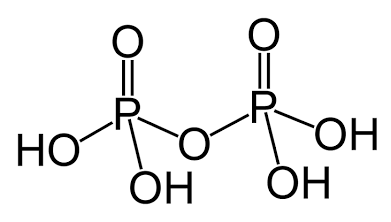
Pyrophosphoric acid is: $$H_4P_2O_7$$
Its structure contains:
- Two phosphorus atoms
- One $$P-O-P$$ linkage
- Four $$P-OH$$ bonds
- Two $$P=O$$ bonds
Structure analysis:
Sigma bonds:
From four $$O-H$$ bonds: $$4$$
From four $$P-O$$ single bonds attached to $$OH$$: $$4$$
From one $$P-O-P$$ bridge: $$2$$
(one sigma bond from each $$P-O$$)
From two $$P=O$$ bonds: $$2 \sigma$$
Total sigma bonds: $$4+4+2+2=12$$
Pi bonds:
Each $$P=O$$ contributes one $$\pi$$ bond.
Thus: $$2 \pi \text{ bonds}$$
Therefore the ratio of sigma and $$\pi$$ bonds is: $${12:2}$$ or $${6:1}$$
Based upon VSEPR theory, match the shape (geometry) of the molecules in List-I with the molecules in List-II
| List-I (Shape) | List-II (Molecules) |
|---|---|
| A T-shaped | I. $$XeF_4$$ |
| B Trigonal planar | II. $$SF_4$$ |
| C Square planar | III. $$ClF_3$$ |
| D See-saw | IV. $$BF_3$$ |
We use VSEPR theory to determine the molecular geometry of each molecule in List-II:
XeF$$_4$$ (I): Xe has 8 valence electrons. Four are used for bonding with F atoms, leaving 2 lone pairs. Total electron pairs = 6 (octahedral arrangement). With 4 bonding pairs and 2 lone pairs (in trans positions), the shape is square planar.
SF$$_4$$ (II): S has 6 valence electrons. Four are used for bonding with F atoms, leaving 1 lone pair. Total electron pairs = 5 (trigonal bipyramidal arrangement). With 4 bonding pairs and 1 lone pair, the shape is see-saw (distorted tetrahedron).
ClF$$_3$$ (III): Cl has 7 valence electrons. Three are used for bonding with F atoms, leaving 2 lone pairs. Total electron pairs = 5 (trigonal bipyramidal arrangement). With 3 bonding pairs and 2 lone pairs (both in equatorial positions), the shape is T-shaped.
BF$$_3$$ (IV): B has 3 valence electrons. All three are used for bonding with F atoms, leaving 0 lone pairs. Total electron pairs = 3. The shape is trigonal planar.
Matching: A (T-shaped) → III (ClF$$_3$$), B (Trigonal planar) → IV (BF$$_3$$), C (Square planar) → I (XeF$$_4$$), D (See-saw) → II (SF$$_4$$).
The answer is Option D: A-(III), B-(IV), C-(I), D-(II).
Bonding in which of the following diatomic molecule(s) become(s) stronger, on the basis of MO Theory, by removal of an electron?
(A) NO
(B) $$N_2$$
(C) $$O_2$$
(D) $$C_2$$
(E) $$B_2$$
Choose the most appropriate answer from the options given below :
A molecule's bond becomes stronger when an electron is removed if that electron was in an antibonding molecular orbital, since removing it increases the bond order.
Bond order = $$\frac{1}{2}$$(bonding electrons - antibonding electrons)
Let us analyze each molecule:
(A) NO: Total electrons = 15. Electronic configuration ends with one electron in $$\pi^*_{2p}$$ (antibonding). Removing this antibonding electron increases bond order from 2.5 to 3. Bond becomes stronger.
(B) $$N_2$$: Total electrons = 14. All bonding MOs are filled up to $$\sigma_{2p}$$, no antibonding electrons in the highest occupied MO. The last electron is in $$\sigma_{2p}$$ (bonding). Removing it decreases bond order from 3 to 2.5. Bond becomes weaker.
(C) $$O_2$$: Total electrons = 16. Has 2 electrons in $$\pi^*_{2p}$$ (antibonding). Removing one antibonding electron increases bond order from 2 to 2.5. Bond becomes stronger.
(D) $$C_2$$: Total electrons = 12. Last electrons are in $$\pi_{2p}$$ (bonding). Removing a bonding electron decreases bond order from 2 to 1.5. Bond becomes weaker.
(E) $$B_2$$: Total electrons = 10. Last electrons are in $$\pi_{2p}$$ (bonding). Removing a bonding electron decreases bond order from 1 to 0.5. Bond becomes weaker.
Only NO and $$O_2$$ have their highest occupied electrons in antibonding orbitals, so only A and C become stronger upon electron removal.
The correct answer is Option C: A, C only.
Identify the incorrect statement for $$PCl_5$$ from the following.
Analyze each statement about $$PCl_5$$.
Statement A: In $$PCl_5$$, phosphorus undergoes $$sp^3d$$ hybridization.
This is correct. Phosphorus has 5 bond pairs and uses one 3s, three 3p, and one 3d orbital for $$sp^3d$$ hybridization.
Statement B: The geometry of $$PCl_5$$ is trigonal bipyramidal.
This is correct. With 5 bond pairs and no lone pairs, the geometry is trigonal bipyramidal.
Statement C: $$PCl_5$$ has two axial bonds stronger than three equatorial bonds.
This is incorrect. In a trigonal bipyramidal structure, the axial bonds are longer and weaker than the equatorial bonds. The axial P-Cl bond length is 219 pm while the equatorial P-Cl bond length is 204 pm. This is because axial bonds experience greater repulsion from three equatorial bond pairs at 90°, whereas equatorial bonds have only two axial bonds at 90°.
Statement D: The three equatorial bonds of $$PCl_5$$ lie in a plane.
This is correct. The three equatorial bonds are coplanar, forming angles of 120° with each other.
The incorrect statement is Option C.
The answer is $$\boxed{\text{Option C}}$$.
Match List I with List II
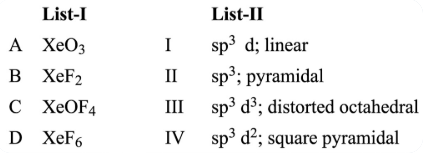
Choose the correct answer from the options given below
We need to match each xenon compound with its correct hybridization and geometry.
(A) $$XeO_3$$:
Xenon has 8 valence electrons. In $$XeO_3$$, Xe forms 3 double bonds with oxygen and has 1 lone pair. Total electron domains = 4 (3 bonding + 1 lone pair).
Hybridization: $$sp^3$$, Shape: Pyramidal → matches (II)
(B) $$XeF_2$$:
In $$XeF_2$$, Xe forms 2 bonds with fluorine and has 3 lone pairs. Total electron domains = 5 (2 bonding + 3 lone pairs).
Hybridization: $$sp^3d$$, Shape: Linear → matches (I)
(C) $$XeOF_4$$:
In $$XeOF_4$$, Xe forms 1 double bond with O and 4 bonds with F, plus 1 lone pair. Total electron domains = 6 (5 bonding + 1 lone pair).
Hybridization: $$sp^3d^2$$, Shape: Square pyramidal → matches (IV)
(D) $$XeF_6$$:
In $$XeF_6$$, Xe forms 6 bonds with fluorine and has 1 lone pair. Total electron domains = 7 (6 bonding + 1 lone pair).
Hybridization: $$sp^3d^3$$, Shape: Distorted octahedral → matches (III)
The correct matching is: A - II, B - I, C - IV, D - III
Hence, the correct answer is Option C.
Match List - I with List - II.
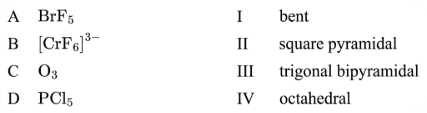
Choose the correct answer from the options given below
We need to match each compound with its molecular shape using VSEPR theory.
(A) BrF₅
Br has 7 valence electrons. With 5 F atoms bonded, there are 5 bond pairs and 1 lone pair.
Hybridization: $$sp^3d^2$$ (6 electron pairs)
Shape: Square pyramidal (II)
(B) [CrF₆]³⁻
Cr in [CrF₆]³⁻ has an oxidation state of +3. With 6 F atoms bonded, there are 6 bond pairs and 0 lone pairs.
Hybridization: $$sp^3d^2$$ or $$d^2sp^3$$
Shape: Octahedral (IV)
(C) O₃ (Ozone)
The central O atom has 2 bonding regions (one double bond and one coordinate bond to the terminal O atoms) and 1 lone pair.
Hybridization: $$sp^2$$
Shape: Bent (I)
(D) PCl₅
P has 5 valence electrons. With 5 Cl atoms bonded, there are 5 bond pairs and 0 lone pairs.
Hybridization: $$sp^3d$$
Shape: Trigonal bipyramidal (III)
Matching:
Therefore, the correct answer is Option C.
Arrange the following in increasing order of their covalent character.
(A) $$CaF_2$$
(B) $$CaCl_2$$
(C) $$CaBr_2$$
(D) $$CaI_2$$
Choose the correct answer from the options given below.
We need to arrange $$CaF_2$$, $$CaCl_2$$, $$CaBr_2$$, and $$CaI_2$$ in increasing order of covalent character.
Applying Fajans' Rules:
According to Fajans' rules, the covalent character of an ionic compound increases when:
1. The cation has a small size and high charge (greater polarizing power)
2. The anion has a large size and high charge (greater polarizability)
Here, the cation ($$Ca^{2+}$$) is the same in all compounds. The difference lies in the anions.
Comparing the anions by size:
$$F^- < Cl^- < Br^- < I^-$$
As the size of the anion increases, it becomes more easily polarized by the cation. A more polarized anion leads to greater sharing of electron density, which means greater covalent character.
Therefore, the increasing order of covalent character is:
$$CaF_2 < CaCl_2 < CaBr_2 < CaI_2$$
$$A < B < C < D$$
The correct answer is Option B.
Given below are two statements: One is labelled as Assertion A and the other is labelled as Reason R
Assertion A: Zero orbital overlap is an out of phase overlap.
Reason R: It results due to different orientation/direction of approach of orbitals.
In the light of the above statements, choose the correct answer from the options given below
We are given the following statements:
Assertion A: Zero orbital overlap is an out of phase overlap.
Reason R: It results due to different orientation/direction of approach of orbitals.
When two atomic orbitals approach each other, they can overlap in three ways: positive overlap (in-phase, leading to bonding), negative overlap (out-of-phase, leading to antibonding), and zero overlap. Zero overlap occurs when the positive and negative contributions to the overlap integral cancel each other out exactly, giving a net overlap of zero.
This zero overlap is indeed classified as an out-of-phase overlap because the regions of constructive overlap are exactly cancelled by regions of destructive overlap. For instance, when a $$p_x$$ orbital approaches an $$s$$ orbital along the y-axis, the positive lobe of the p-orbital overlaps with the s-orbital constructively on one side, while the negative lobe overlaps destructively on the other side, resulting in net zero overlap.
The reason this happens is precisely because of the orientation or direction of approach of the orbitals. When orbitals approach in a direction where their symmetries do not match for effective overlap, the result is zero net overlap. So Reason R correctly explains why zero overlap (an out-of-phase overlap) occurs.
Hence, both Assertion A and Reason R are true, and R is the correct explanation of A. The correct answer is Option A.
Match List-I with List-II
List-I List-II
(A) Cl$$_2$$O$$_7$$ (I) Amphoteric
(B) Na$$_2$$O (II) Basic
(C) Al$$_2$$O$$_3$$ (III) Neutral
(D) N$$_2$$O (IV) Acidic
Choose the correct answer from the options given below
Let us classify each oxide:
(A) $$Cl_2O_7$$ is the anhydride of perchloric acid ($$HClO_4$$). Chlorine is a non-metal, and $$Cl_2O_7$$ is an acidic oxide (IV).
(B) $$Na_2O$$, sodium being an alkali metal, reacts with water to form NaOH (a strong base), so $$Na_2O$$ is a basic oxide (II).
(C) $$Al_2O_3$$ is a classic example of an amphoteric oxide (I), reacting with both acids and bases: $$Al_2O_3 + 6HCl \rightarrow 2AlCl_3 + 3H_2O$$ and $$Al_2O_3 + 2NaOH \rightarrow 2NaAlO_2 + H_2O$$.
(D) $$N_2O$$ (nitrous oxide, laughing gas) is a neutral oxide (III) that does not react with acids or bases to form salts.
The correct matching is (A) - (IV), (B) - (II), (C) - (I), (D) - (III).
Hence, the correct answer is Option B.
Match List-I with List-II
| List-I | List-II |
|---|---|
| A. $$\Psi_{MO} = \Psi_A - \Psi_B$$ | I. Dipole moment |
| B. $$\mu = Q \times r$$ | II. Bonding molecular orbital |
| C. $$\frac{N_b - N_a}{2}$$ | III. Anti-bonding molecular orbital |
| D. $$\Psi_{MO} = \Psi_A + \Psi_B$$ | IV. Bond order |
We need to match items in List-I with those in List-II. For A, $$\Psi_{MO} = \Psi_A - \Psi_B$$ represents subtraction of atomic orbitals; since destructive interference yields an anti-bonding molecular orbital, A corresponds to III.
Next, for B, $$\mu = Q \times r$$ is the formula for dipole moment, where Q is the charge and r is the distance between the charges; hence, B matches with I.
Moving on to C, $$\frac{N_b - N_a}{2}$$ is the formula for bond order, where $$N_b$$ is the number of bonding electrons and $$N_a$$ is the number of anti-bonding electrons; thus, C pairs with IV.
Finally, for D, $$\Psi_{MO} = \Psi_A + \Psi_B$$ corresponds to constructive interference of atomic orbitals, giving a bonding molecular orbital, so D matches with II. From the above matchings, the correct matching is A-III, B-I, C-IV, D-II, and the correct answer is Option C.
Number of electron deficient molecules among the following $$PH_3, B_2H_6, CCl_4, NH_3, LiH$$ and $$BCl_3$$ is
An electron deficient molecule is one in which the central atom has fewer than 8 electrons in its valence shell (incomplete octet).
Let us check each molecule:
$$PH_3$$: Phosphorus has 5 valence electrons, forms 3 bonds with H and has 1 lone pair = 8 electrons around P. Not electron deficient.
$$B_2H_6$$: Boron has only 3 valence electrons. In $$B_2H_6$$, each boron is involved in 4 bonds but through 3-centre 2-electron bonds. Each B effectively has only 6 electrons in its valence shell. Electron deficient.
$$CCl_4$$: Carbon has 4 valence electrons, forms 4 bonds = 8 electrons around C. Not electron deficient.
$$NH_3$$: Nitrogen has 5 valence electrons, forms 3 bonds and has 1 lone pair = 8 electrons around N. Not electron deficient.
$$LiH$$: This is an ionic compound ($$Li^+$$ and $$H^-$$). It is not considered electron deficient in this context as $$H^-$$ has a complete 1s shell and $$Li^+$$ has a complete 1s shell.
$$BCl_3$$: Boron has 3 valence electrons, forms 3 bonds = only 6 electrons around B. Electron deficient.
The electron deficient molecules are $$B_2H_6$$ and $$BCl_3$$, giving a count of 2.
The correct answer is Option C.
The correct order of increasing intermolecular hydrogen bond strength is
The strength of a hydrogen bond depends on the electronegativity of the atoms involved (typically $$N$$, $$O$$, or $$F)$$.
Hence, Option C is correct
Which of the following pair of molecules contain odd electron molecule and an expanded octet molecule?
We need to identify which pair contains one odd-electron molecule and one expanded octet molecule.
An odd-electron molecule is one that has an odd total number of valence electrons, resulting in an unpaired electron. An expanded octet molecule is one where the central atom has more than 8 electrons in its valence shell, which is possible for elements in Period 3 and beyond that can use d-orbitals.
Let us examine each molecule. NO (nitric oxide): Nitrogen has 5 valence electrons, oxygen has 6, giving a total of 11 (odd). So NO is an odd-electron molecule. $$H_2SO_4$$: Sulfur is the central atom bonded to 4 oxygen atoms (two with OH groups). Sulfur has 6 valence electrons and forms bonds with 4 oxygens. In the structure with two S=O double bonds, sulfur has 12 electrons around it — this is an expanded octet. $$BCl_3$$: Boron has 3 valence electrons and forms 3 bonds with Cl, giving only 6 electrons around B — this is an incomplete (electron-deficient) octet, not an expanded octet. $$SF_6$$: Sulfur has 12 electrons around it (6 bonds) — this is also an expanded octet. But $$SF_6$$ is not paired with an odd-electron molecule in the same option as needed.
Looking at Option B: NO (odd-electron molecule) and $$H_2SO_4$$ (expanded octet molecule). This is the correct pairing.
Hence, the correct answer is Option B.
Consider the species CH$$_4$$, NH$$_4^+$$ and BH$$_4^-$$. Choose the correct option with respect to the three species:
We need to determine if CH₄, NH₄⁺, and BH₄⁻ are isoelectronic and whether they all have tetrahedral structures. CH₄ has C with 6 electrons and 4 H atoms contributing 4 electrons, for a total of 10 electrons. NH₄⁺ has N with 7 electrons and 4 H atoms contributing 4 electrons minus 1 for the positive charge, also totaling 10 electrons. BH₄⁻ has B with 5 electrons and 4 H atoms contributing 4 electrons plus 1 for the negative charge, again totaling 10 electrons. Therefore, all three species are isoelectronic with 10 electrons.
Each species features a central atom bonded to 4 hydrogen atoms with no lone pairs on the central atom, which corresponds to sp³ hybridisation and a tetrahedral geometry. Consequently, CH₄, NH₄⁺, and BH₄⁻ all adopt tetrahedral structures.
The answer is Option B: They are isoelectronic and all have tetrahedral structures.
Given below are two statements.
Statement I: $$O_2$$, $$Cu^{2+}$$ and $$Fe^{3+}$$ are weakly attracted by magnetic field and are magnetized in the same direction as magnetic field.
Statement II: $$NaCl$$ and $$H_2O$$ are weakly magnetized in opposite direction to magnetic field.
In the light of the above statements, choose the most appropriate answer form the options given below
We need to analyze two statements about magnetic properties of substances.
Statement I: $$O_2$$, $$Cu^{2+}$$, and $$Fe^{3+}$$ are weakly attracted by magnetic field and are magnetized in the same direction as the magnetic field.
Analysis of Statement I:
Substances that are weakly attracted by a magnetic field and magnetized in the same direction as the field are paramagnetic.
All three species are paramagnetic. Statement I is correct.
Statement II: $$NaCl$$ and $$H_2O$$ are weakly magnetized in opposite direction to the magnetic field.
Analysis of Statement II:
Substances that are weakly magnetized in the opposite direction to the magnetic field are diamagnetic.
Both substances are diamagnetic. Statement II is correct.
The correct answer is Option A: Both Statement I and Statement II are correct.
In the structure of SF$$_4$$, the lone pair of electrons on S is in.
$$SF_4$$ has sulfur with 6 valence electrons forming 4 bonds with fluorine atoms and 1 lone pair, giving a total of 5 electron pairs. The electron geometry is trigonal bipyramidal.
In a trigonal bipyramidal arrangement, the lone pair occupies the equatorial position to minimize repulsion: in this position it has 2 interactions at 90° (with the two axial bond pairs) and 2 interactions at 120° (with the other equatorial bond pairs), whereas in the axial position it would have 3 interactions at 90° (with all three equatorial bond pairs). Since lone pair - bond pair repulsions at 90° are strongest, minimizing the number of 90° repulsions is preferred.
With the lone pair equatorial, it makes 90° angles only with the 2 axial fluorine atoms, the other 2 equatorial atoms being at 120°, resulting in two lone pair - bond pair repulsions at 90°.
Hence, the correct answer is Option A: Equatorial position with two lone pair - bond pair repulsions at 90°.
Number of lone pairs of electrons in the central atom of $$SCl_2$$, $$O_3$$, $$ClF_3$$ and $$SF_6$$, respectively, are
We need to find the number of lone pairs on the central atom in each of $$SCl_2$$, $$O_3$$, $$ClF_3$$, and $$SF_6$$.
$$SCl_2$$: Sulfur is the central atom with 6 valence electrons. It forms 2 bonds with Cl atoms, using 2 electrons. The remaining 4 electrons form 2 lone pairs. So the central atom has 2 lone pairs.
$$O_3$$: The central oxygen atom has 6 valence electrons. In ozone, the central oxygen forms a double bond with one oxygen and a single bond (plus coordinate bond character) with the other. Using the Lewis structure, the central oxygen has 2 bonding domains and 1 lone pair. So the central atom has 1 lone pair.
$$ClF_3$$: Chlorine is the central atom with 7 valence electrons. It forms 3 bonds with F atoms, using 3 electrons. The remaining 4 electrons form 2 lone pairs. The shape is T-shaped (from a trigonal bipyramidal arrangement with 2 lone pairs in equatorial positions). So the central atom has 2 lone pairs.
$$SF_6$$: Sulfur is the central atom with 6 valence electrons. It forms 6 bonds with F atoms, using all 6 valence electrons (and expanding the octet). There are 0 lone pairs on sulfur.
The lone pairs are therefore 2, 1, 2, and 0 respectively.
Hence, the correct answer is Option B.
The correct order of bond orders of $$C_2^{2-}$$, $$N_2^{2-}$$ and $$O_2^{2-}$$ is
We need to find the correct order of bond orders of $$C_2^{2-}$$, $$N_2^{2-}$$, and $$O_2^{2-}$$.
Since each carbon atom contributes 6 electrons, the total electron count in $$C_2^{2-}$$ is:
$$2(6) + 2 = 14$$ electrons.
Similarly, nitrogen contributes 7 electrons each, so for $$N_2^{2-}$$:
$$2(7) + 2 = 16$$ electrons,
and oxygen contributes 8 electrons each, giving for $$O_2^{2-}$$:
$$2(8) + 2 = 18$$ electrons.
For $$C_2^{2-}$$ (14 electrons), which is isoelectronic with $$N_2$$, the molecular orbital configuration is:
$$(\sigma_{1s})^2 (\sigma_{1s}^*)^2 (\sigma_{2s})^2 (\sigma_{2s}^*)^2 (\pi_{2p})^4 (\sigma_{2p})^2$$
This configuration gives bonding electrons = $$2 + 2 + 4 + 2 = 10$$ and anti-bonding electrons = $$2 + 2 = 4$$. From the above,
$$\text{Bond Order} = \frac{10 - 4}{2} = \frac{6}{2} = 3$$
Now, for $$N_2^{2-}$$ (16 electrons), which is isoelectronic with $$O_2$$, the configuration becomes:
$$(\sigma_{1s})^2 (\sigma_{1s}^*)^2 (\sigma_{2s})^2 (\sigma_{2s}^*)^2 (\sigma_{2p})^2 (\pi_{2p})^4 (\pi_{2p}^*)^2$$
Here, bonding electrons = $$2 + 2 + 2 + 4 = 10$$ and anti-bonding electrons = $$2 + 2 + 2 = 6$$. Hence,
$$\text{Bond Order} = \frac{10 - 6}{2} = \frac{4}{2} = 2$$
Finally, for $$O_2^{2-}$$ (18 electrons), the peroxide ion, the configuration is:
$$(\sigma_{1s})^2 (\sigma_{1s}^*)^2 (\sigma_{2s})^2 (\sigma_{2s}^*)^2 (\sigma_{2p})^2 (\pi_{2p})^4 (\pi_{2p}^*)^4$$
This yields bonding electrons = $$2 + 2 + 2 + 4 = 10$$ and anti-bonding electrons = $$2 + 2 + 4 = 8$$, so
$$\text{Bond Order} = \frac{10 - 8}{2} = \frac{2}{2} = 1$$
From the above calculations, $$C_2^{2-}$$ has bond order 3, $$N_2^{2-}$$ has bond order 2, and $$O_2^{2-}$$ has bond order 1, giving the order:
$$C_2^{2-} > N_2^{2-} > O_2^{2-}$$
Therefore, the correct option is Option A: $$C_2^{2-} > N_2^{2-} > O_2^{2-}$$.
Number of lone pair (s) of electrons on central atom and the shape of BrF$$_3$$ molecule respectively, are:
We need to find the number of lone pairs on the central atom and the shape of BrF₃.
Bromine (Br) has 7 valence electrons, and each F atom contributes 1 electron. Total electron pairs around Br = $$\frac{7 + 3 \times 1}{2}$$. Br forms 3 bonds with F atoms, using 3 electrons, leaving 7 − 3 = 4 electrons that form 2 lone pairs. Thus, there are 3 bond pairs and 2 lone pairs, for a total of 5 electron pairs, corresponding to a trigonal bipyramidal electron geometry.
In this arrangement, the 2 lone pairs occupy equatorial positions to minimize repulsion, while the 3 F atoms occupy the 2 axial and 1 equatorial positions. This gives a bent T-shape molecular geometry.
Number of lone pairs on central atom = 2, Shape = bent T-shape. The answer is Option C: 2, bent T-shape.
Given below are two statements: one is labelled as Assertion A and the other is labelled as Reason R
Assertion A: Boron is unable to form $$BF_6^{3-}$$
Reason R: Size of B is very small.
In the light of the above statements, choose the correct answer from the options given below:
We need to evaluate the Assertion and Reason statements.
Assertion A: Boron is unable to form $$BF_6^{3-}$$. This statement is TRUE. Since boron has the electronic configuration 1s² 2s² 2p¹, it possesses only four orbitals in its valence shell (one 2s and three 2p). Therefore, its maximum coordination number is 4 and it cannot accommodate six fluorine atoms. For instance, boron can form $$BF_4^-$$ with coordination number 4 but not $$BF_6^{3-}$$ with coordination number 6, as it lacks d-orbitals in the second shell.
Reason R: Size of B is very small. This statement is TRUE because boron is indeed a very small atom.
From the above, the actual reason boron cannot form $$BF_6^{3-}$$ is the absence of d-orbitals in its valence shell, which restricts its coordination number to 4. Although the small size of boron is correct, it does not explain Assertion A; the unavailability of d-orbitals is the proper explanation.
Therefore, the correct answer is Option B: Both A and R are true but R is not the correct explanation of A.
The incorrect statement about the imperfections in solids is
We need to identify the incorrect statement about imperfections (defects) in solids.
Option A: "Schottky defect decreases the density of the substance."
In a Schottky defect, equal numbers of cations and anions are missing from their lattice sites, creating vacancies. Since atoms are missing but the volume remains approximately the same, the density decreases.
This statement is correct.
Option B: "Frenkel defect does not alter the density of the substance."
In a Frenkel defect, an ion leaves its normal lattice site and occupies an interstitial site. No atom leaves the crystal — it just moves to a different position within the same crystal. So the total number of atoms and the volume remain the same, meaning the density does not change.
This statement is correct.
Option C: "Interstitial defect increases the density of the substance."
In an interstitial defect, extra atoms or ions occupy the interstitial spaces (voids) in the crystal. This adds extra mass without significantly changing the volume, so the density increases.
This statement is correct.
Option D: "Vacancy defect increases the density of the substance."
In a vacancy defect, some atoms are missing from their lattice positions. This means the crystal has fewer atoms than the ideal structure while maintaining roughly the same volume. Therefore, the density decreases, not increases.
This statement is incorrect.
Hence, the correct answer is Option D.
The geometry around boron in the product 'B' formed from the following reaction is
$$BF_3 + NaH \xrightarrow{450K} A + NaF$$
$$A + NMe_3 \rightarrow B$$
The reaction of Xe and O$$_2$$F$$_2$$ gives a Xe compound P. The number of moles of HF produced by the complete hydrolysis of 1 mol of P is _______.
Dioxygen difluoride, $$O_2F_2$$, is an extremely powerful oxidising as well as fluorinating agent. When it is allowed to react with xenon, it oxidises xenon to the +6 oxidation state while simultaneously supplying four fluorine atoms. The compound obtained is the oxy-fluoride $$XeOF_4$$ (called xenon oxytetrafluoride).
A convenient balanced equation for its formation is
$$2\,Xe + 4\,O_2F_2 \;\longrightarrow\; 2\,XeOF_4 + 3\,O_2$$
Let the product $$P$$ be $$XeOF_4$$. To find the number of moles of $$HF$$ produced on complete hydrolysis of one mole of $$P$$, write its hydrolysis reaction:
$$XeOF_4 + 2\,H_2O \;\longrightarrow\; XeO_3 + 4\,HF$$
Checking the atom balance: Xe (1), O (1 + 2 = 3 on both sides), F (4), and H (4) are all balanced, so the equation is correct.
The equation shows that 1 mole of $$XeOF_4$$ yields 4 moles of $$HF$$ on complete hydrolysis.
Hence, the required number of moles of $$HF$$ produced per mole of $$P$$ is 4.
Thermal decomposition of AgNO$$_3$$ produces two paramagnetic gases. The total number of electrons present in the antibonding molecular orbitals of the gas that has the higher number of unpaired electrons is _______.
Silver nitrate decomposes on heating according to
$$2\,AgNO_3 \;\xrightarrow{\;\Delta\;}\; 2\,Ag \;+\; 2\,NO_2 \;+\; O_2$$
The two gaseous products are $$NO_2$$ and $$O_2$$. Both are paramagnetic, but the number of unpaired electrons differs:
• $$NO_2$$ has one unpaired electron (odd total electron count).
• $$O_2$$ has two unpaired electrons (the well-known dioxygen case).
Hence, the gas with the larger number of unpaired electrons is $$O_2$$.
Next, write the molecular orbital (MO) configuration of $$O_2$$ (total 16 electrons):
$$\sigma_{1s}^{2}\;\sigma_{1s}^{*\,2}\; \sigma_{2s}^{2}\;\sigma_{2s}^{*\,2}\; \sigma_{2p_z}^{2}\; \pi_{2p_x}^{2}\;\pi_{2p_y}^{2}\; \pi_{2p_x}^{*\,1}\;\pi_{2p_y}^{*\,1}$$
Antibonding orbitals are those marked with an asterisk ($$^*$$). Counting the electrons in these orbitals:
$$\sigma_{1s}^{*} : 2,\; \sigma_{2s}^{*} : 2,\; \pi_{2p_x}^{*} : 1,\; \pi_{2p_y}^{*} : 1$$
Total electrons in antibonding MOs
$$= 2 + 2 + 1 + 1 = 6$$
Therefore, the required number is 6.
For diatomic molecules, the correct statement(s) about the molecular orbitals formed by the overlap of two 2$$p_z$$ orbitals is(are)
The compound(s) which react(s) with NH$$_3$$ to give boron nitride (BN) is(are)
When a substance containing boron is heated with excess ammonia, formation of boron nitride BN is possible only when the overall reaction can supply the elements in the 1 : 1 atomic ratio B : N and simultaneously remove all other atoms (H, O, etc.) as stable volatile molecules such as $$H_2$$ or $$H_2O$$.
Option A B (elemental boron)
Elemental boron does not react with $$NH_3$$ even at red heat; it forms BN only with $$N_2$$ at temperatures above $$2000\;^{\circ}\!{\rm C}$$. Hence BN is not obtained from the reaction of boron with ammonia. Option A is therefore incorrect.
Option B $$B_2H_6$$ (diborane)
Diborane first forms a Lewis-adduct with ammonia:
$$B_2H_6 + 2NH_3 \;\longrightarrow\; \bigl[B_2H_6\cdot 2NH_3\bigr]$$
On heating the adduct strongly (≈1100 K) hydrogen is expelled and a very stable lattice of boron nitride is produced:
$$\bigl[B_2H_6\cdot 2NH_3\bigr] \;\xrightarrow[\;1100\text{ K}\;]{}\; 2BN + 6H_2$$
Thus $$B_2H_6$$ definitely yields BN with ammonia. Option B is correct.
Option C $$B_2O_3$$ (boric oxide)
Boric oxide reacts with dry ammonia at elevated temperatures (≈800-1000 K) according to
$$B_2O_3 + 2NH_3 \;\longrightarrow\; 2BN + 3H_2O$$
The water formed escapes as vapour, leaving a white solid of boron nitride. Hence $$B_2O_3$$ is also a precursor of BN with ammonia. Option C is correct.
Option D $$HBF_4$$ (fluoroboric acid)
Fluoroboric acid is already fully coordinated by four fluoride ions around boron. With ammonia it simply undergoes neutralisation to give ammonium fluoro-borate: $$HBF_4 + NH_3 \rightarrow NH_4BF_4$$. No B-N bond formation or elimination of side-products that could convert it to BN is observed. Therefore it does not give BN. Option D is incorrect.
Hence the compounds that react with $$NH_3$$ to give boron nitride are:
Option B (diborane, $$B_2H_6$$) and Option C (boric oxide, $$B_2O_3$$).
Final Answer: Option B, Option C
Among the following species $$N_2, N_2^+, N_2^-, N_2^{2-}, O_2, O_2^+, O_2^-, O_2^{2-}$$, the number of species showing diamagnetism is ______.
We need to count the number of diamagnetic species among: $$N_2, N_2^+, N_2^-, N_2^{2-}, O_2, O_2^+, O_2^-, O_2^{2-}$$.
A species is considered diamagnetic if all electrons are paired (no unpaired electrons).
Considering first the nitrogen species, we use the MO order $$\sigma_{1s}, \sigma^*_{1s}, \sigma_{2s}, \sigma^*_{2s}, \pi_{2p_x} = \pi_{2p_y}, \sigma_{2p_z}, \pi^*_{2p_x} = \pi^*_{2p_y}, \sigma^*_{2p_z}$$. In $$N_2$$ with 14 electrons the configuration is $$...\sigma_{2s}^2, {\sigma^*_{2s}}^{2}, \pi_{2p_x}^2 = \pi_{2p_y}^2, \sigma_{2p_z}^2$$, so all electrons are paired and the molecule is diamagnetic.
In $$N_2^+$$ there are 13 electrons, corresponding to the removal of one electron from $$\sigma_{2p_z}$$, which leaves one unpaired electron and therefore makes it paramagnetic.
Adding an electron to $$N_2$$ gives $$N_2^-$$ with 15 electrons, where the extra electron occupies a $$\pi^*_{2p}$$ orbital, resulting in one unpaired electron and paramagnetism.
In $$N_2^{2-}$$ the two additional electrons occupy $${\pi^*_{2p_x}}^{1}$$ and $${\pi^*_{2p_y}}^{1}$$, producing two unpaired electrons and a paramagnetic species.
Turning to the oxygen species, we adopt the MO order $$\sigma_{2s}, \sigma^*_{2s}, \sigma_{2p_z}, \pi_{2p_x} = \pi_{2p_y}, \pi^*_{2p_x} = \pi^*_{2p_y}, \sigma^*_{2p_z}$$. For $$O_2$$ with 16 electrons the configuration is $$...\sigma_{2p_z}^2, \pi_{2p_x}^2 = \pi_{2p_y}^2, {\pi^*_{2p_x}}^{1} = {\pi^*_{2p_y}}^{1}$$, which has two unpaired electrons and is therefore paramagnetic.
Removing one electron from $$O_2$$ yields $$O_2^+$$ with 15 electrons, leaving one electron in a $$\pi^*$$ orbital and one unpaired electron; this species is paramagnetic.
In $$O_2^-$$ the 17th electron enters $$\pi^*_{2p_x}$$, resulting in the configuration $${\pi^*_{2p_x}}^{2}, {\pi^*_{2p_y}}^{1}$$ and one unpaired electron, so it is paramagnetic.
The peroxide ion $$O_2^{2-}$$ has 18 electrons filling both $$\pi^*_{2p_x}$$ and $$\pi^*_{2p_y}$$ orbitals with paired electrons, making it diamagnetic.
Among the eight species considered, only $$N_2$$ and $$O_2^{2-}$$ have all electrons paired, giving two diamagnetic species.
Hence, the answer is 2.
Amongst the following the number of oxide(s) which are paramagnetic in nature is ______
$$Na_2O, KO_2, NO_2, N_2O, ClO_2, NO, SO_2, Cl_2O$$
To determine whether an oxide is paramagnetic or diamagnetic, we check for the presence of unpaired electrons.
Species containing unpaired electrons are paramagnetic.
Species with all electrons paired are diamagnetic.
$$\mathrm{Na_2O}$$
Contains:
$$\mathrm{Na^+ \ and\ O^{2-}}$$
The oxide ion has completely filled orbitals:
$$\mathrm{O^{2-} : 1s^2\ 2s^2\ 2p^6}$$
All electrons are paired.
Hence:
$$\mathrm{Na_2O \ is\ diamagnetic}$$
$$\mathrm{KO_2}$$
Contains the superoxide ion:
$$\mathrm{O_2^-}$$
The superoxide ion possesses one unpaired electron in the antibonding $$\mathrm{\pi^*}$$ orbital.
Hence:
$$\mathrm{KO_2 \ is\ paramagnetic}$$
$$\mathrm{NO_2}$$
Total valence electrons:
$$\mathrm{= 5 + 2(6) = 17}$$
Odd number of electrons ⇒ one unpaired electron.
Hence:
$$\mathrm{NO_2 \ is\ paramagnetic}$$
$$\mathrm{ClO_2}$$
Total valence electrons:
$$\mathrm{= 7 + 2(6) = 19}$$
Odd number of electrons ⇒ one unpaired electron.
Hence:
$$\mathrm{ClO_2 \ is\ paramagnetic}$$
$$\mathrm{NO}$$
Total valence electrons:
$$\mathrm{= 5 + 6 = 11}$$
Odd number of electrons ⇒ one unpaired electron.
Hence:
$$\mathrm{NO \ is\ paramagnetic}$$
$$\mathrm{N_2O}$$
Total valence electrons:
$$\mathrm{= 2(5) + 6 = 16}$$
All electrons are paired.
Hence:
$$\mathrm{N_2O \ is\ diamagnetic}$$
$$\mathrm{SO_2}$$
Total valence electrons:
$$\mathrm{= 6 + 2(6) = 18}$$
All electrons are paired.
Hence:
$$\mathrm{SO_2 \ is\ diamagnetic}$$
$$\mathrm{Cl_2O}$$
Total valence electrons:
$$\mathrm{= 2(7) + 6 = 20}$$
All electrons are paired.
Hence:
$$\mathrm{Cl_2O \ is\ diamagnetic}$$
Paramagnetic species:
$$\mathrm{KO_2,\ NO_2,\ ClO_2,\ NO}$$
Total number of paramagnetic oxides:
$$\boxed{\mathrm{4}}$$
According to MO theory, number of species/ions from the following having identical bond order is ______
$$CN^-, NO^+, O_2, O_2^+, O_2^{2+}$$
We need to find how many species/ions from the given list have identical bond order using Molecular Orbital theory.
Bond order = $$\frac{N_b - N_a}{2}$$ where $$N_b$$ is the number of bonding electrons and $$N_a$$ is the number of antibonding electrons.
For $$CN^-$$, the total number of electrons is 6 + 7 + 1 = 14, and its molecular orbital configuration is $$(\sigma_{1s})^2(\sigma^*_{1s})^2(\sigma_{2s})^2(\sigma^*_{2s})^2(\pi_{2p})^4(\sigma_{2p})^2$$. Substituting into the bond order formula gives $$\frac{10 - 4}{2} = 3$$.
Since $$NO^+$$ is isoelectronic with $$CN^-$$ (7 + 8 − 1 = 14 electrons), it has the same MO configuration and therefore the same bond order: $$\frac{10 - 4}{2} = 3$$.
For $$O_2$$, which has 16 electrons (8 + 8), the MO configuration is $$(\sigma_{1s})^2(\sigma^*_{1s})^2(\sigma_{2s})^2(\sigma^*_{2s})^2(\sigma_{2p})^2(\pi_{2p})^4(\pi^*_{2p})^2$$, yielding a bond order of $$\frac{10 - 6}{2} = 2$$.
When one electron is removed to form $$O_2^+$$ (16 − 1 = 15 electrons), the configuration becomes $$(\sigma_{1s})^2(\sigma^*_{1s})^2(\sigma_{2s})^2(\sigma^*_{2s})^2(\sigma_{2p})^2(\pi_{2p})^4(\pi^*_{2p})^1$$, giving a bond order of $$\frac{10 - 5}{2} = 2.5$$.
Removing two electrons to obtain $$O_2^{2+}$$ (16 − 2 = 14 electrons) leads to the configuration $$(\sigma_{1s})^2(\sigma^*_{1s})^2(\sigma_{2s})^2(\sigma^*_{2s})^2(\sigma_{2p})^2(\pi_{2p})^4$$, and the bond order is $$\frac{10 - 4}{2} = 3$$.
From the above calculations, $$CN^-$$, $$NO^+$$, and $$O_2^{2+}$$ each have a bond order of 3. Therefore, the number of species with identical bond order is 3.
Consider, $$PF_5, BrF_5, PCl_3, SF_6, ICl_4^-, ClF_3$$ and $$IF_5$$. Amongst the above molecule(s)/ion(s), the number of molecule(s)/ion(s) having $$sp^3d^2$$ hybridisation is
We need to determine how many of the given species — $$PF_5$$, $$BrF_5$$, $$PCl_3$$, $$SF_6$$, $$ICl_4^-$$, $$ClF_3$$, and $$IF_5$$ — have $$sp^3d^2$$ hybridisation.
We determine the hybridisation of each species by counting the number of electron domains (bond pairs + lone pairs) around the central atom using the steric number.
$$PF_5$$: Phosphorus has 5 bond pairs and 0 lone pairs, giving a steric number of 5. This corresponds to $$sp^3d$$ hybridisation (trigonal bipyramidal geometry). Not $$sp^3d^2$$.
$$BrF_5$$: Bromine has 7 valence electrons; 5 are used for bonding with fluorine, and 1 lone pair remains. The steric number is 5 + 1 = 6, which corresponds to $$sp^3d^2$$ hybridisation (square pyramidal geometry). This is $$sp^3d^2$$.
$$PCl_3$$: Phosphorus has 3 bond pairs and 1 lone pair, giving a steric number of 4. This is $$sp^3$$ hybridisation (trigonal pyramidal). Not $$sp^3d^2$$.
$$SF_6$$: Sulphur has 6 bond pairs and 0 lone pairs, giving a steric number of 6. This is $$sp^3d^2$$ hybridisation (octahedral geometry). This is $$sp^3d^2$$.
$$ICl_4^-$$: Iodine has 7 valence electrons plus 1 from the negative charge = 8. Four are used for bonding with Cl, leaving 2 lone pairs. The steric number is 4 + 2 = 6, which is $$sp^3d^2$$ hybridisation (square planar geometry). This is $$sp^3d^2$$.
$$ClF_3$$: Chlorine has 7 valence electrons; 3 are used for bonding with fluorine, leaving 2 lone pairs. The steric number is 3 + 2 = 5, which is $$sp^3d$$ hybridisation (T-shaped geometry). Not $$sp^3d^2$$.
$$IF_5$$: Iodine has 7 valence electrons; 5 are used for bonding with fluorine, leaving 1 lone pair. The steric number is 5 + 1 = 6, which is $$sp^3d^2$$ hybridisation (square pyramidal geometry). This is $$sp^3d^2$$.
The species with $$sp^3d^2$$ hybridisation are: $$BrF_5$$, $$SF_6$$, $$ICl_4^-$$, and $$IF_5$$. That gives us a count of 4.
Hence, the correct answer is 4.
How many of the following molecules are with non-zero net dipole moment,
$$NH_3$$, HCl, $$H_2O$$, $$BeF_2$$, $$BH_3$$, $$CCl_4$$
We need to determine which of the given molecules have a non-zero net dipole moment.
Analyzing each molecule:
1. $$NH_3$$ (Ammonia): Trigonal pyramidal geometry. The three N-H bond dipoles do not cancel out due to the lone pair on nitrogen. Non-zero dipole moment.
2. HCl (Hydrogen chloride): Linear diatomic molecule with different atoms. The bond is polar and there is no symmetry to cancel the dipole. Non-zero dipole moment.
3. $$H_2O$$ (Water): Bent geometry (bond angle ~104.5°). The two O-H bond dipoles do not cancel due to the bent shape. Non-zero dipole moment.
4. $$BeF_2$$ (Beryllium fluoride): Linear geometry (180°). The two Be-F bond dipoles are equal and opposite, so they cancel out. Zero dipole moment.
5. $$BH_3$$ (Borane): Trigonal planar geometry (120°). The three B-H bond dipoles cancel out due to symmetry. Zero dipole moment.
6. $$CCl_4$$ (Carbon tetrachloride): Tetrahedral geometry. The four C-Cl bond dipoles cancel out due to perfect symmetry. Zero dipole moment.
Count: $$NH_3$$, HCl, and $$H_2O$$ have non-zero dipole moments.
The number of molecules with non-zero net dipole moment is 3.
The hybridization of P exhibited in $$PF_5$$ is $$sp^x d^y$$. The value of $$y$$ is ______
We need to find the value of $$y$$ in the hybridization $$sp^x d^y$$ of phosphorus in $$PF_5$$. Phosphorus (P) is the central atom, with 5 valence electrons, bonded to 5 fluorine atoms and having no lone pairs.
The steric number (the number of bonded atoms plus lone pairs) for phosphorus is 5 + 0 = 5. For a steric number of 5, the hybridization is $$sp^3d$$ and the molecular geometry is trigonal bipyramidal.
In $$sp^3d$$ hybridization, one s-orbital, three p-orbitals, and one d-orbital combine to form five hybrid orbitals, each forming a sigma bond with a fluorine atom.
This hybridization can be denoted as $$sp^3d^1$$, which corresponds to $$sp^x d^y$$ with $$x = 3$$ and $$y = 1$$. Therefore, the correct answer is $$y = 1$$.
The number of molecule(s) or ion(s) from the following having non-planar structure is ______.
$$NO_3^-$$, $$H_2O_2$$, $$BF_3$$, $$PCl_3$$, $$XeF_4$$, $$SF_4$$, $$XeO_3$$, $$PH_4^+$$, $$SO_3$$, $$[Al(OH)_4]^-$$
We need to find the number of molecules/ions with non-planar structure from the given list.
Let us analyze each species:
1. $$NO_3^-$$
Nitrogen has 3 bond pairs and 0 lone pairs. Hybridization: $$sp^2$$. Shape: Trigonal planar. $$\Rightarrow$$ Planar
2. $$H_2O_2$$
Hydrogen peroxide has an open book structure. The two O-H bonds are in different planes due to the lone pairs on each oxygen. Shape: Non-planar (open book/skewed). $$\Rightarrow$$ Non-planar
3. $$BF_3$$
Boron has 3 bond pairs and 0 lone pairs. Hybridization: $$sp^2$$. Shape: Trigonal planar. $$\Rightarrow$$ Planar
4. $$PCl_3$$
Phosphorus has 3 bond pairs and 1 lone pair. Hybridization: $$sp^3$$. Shape: Trigonal pyramidal. $$\Rightarrow$$ Non-planar
5. $$XeF_4$$
Xenon has 4 bond pairs and 2 lone pairs. Hybridization: $$sp^3d^2$$. Shape: Square planar. $$\Rightarrow$$ Planar
6. $$SF_4$$
Sulphur has 4 bond pairs and 1 lone pair. Hybridization: $$sp^3d$$. Shape: See-saw. $$\Rightarrow$$ Non-planar
7. $$XeO_3$$
Xenon has 3 bond pairs and 1 lone pair. Hybridization: $$sp^3$$. Shape: Trigonal pyramidal. $$\Rightarrow$$ Non-planar
8. $$PH_4^+$$
Phosphorus has 4 bond pairs and 0 lone pairs. Hybridization: $$sp^3$$. Shape: Tetrahedral. $$\Rightarrow$$ Non-planar
9. $$SO_3$$
Sulphur has 3 bond pairs and 0 lone pairs. Hybridization: $$sp^2$$. Shape: Trigonal planar. $$\Rightarrow$$ Planar
10. $$[Al(OH)_4]^-$$
Aluminium has 4 bond pairs and 0 lone pairs. Hybridization: $$sp^3$$. Shape: Tetrahedral. $$\Rightarrow$$ Non-planar
Counting non-planar species:
$$H_2O_2$$, $$PCl_3$$, $$SF_4$$, $$XeO_3$$, $$PH_4^+$$, $$[Al(OH)_4]^-$$ = 6
Hence, the answer is 6.
Amongst $$SF_4, XeF_4, CF_4$$ and $$H_2O$$, the number of species with two lone pairs of electrons is ______
We need to find the number of species with exactly two lone pairs of electrons on the central atom among $$SF_4$$, $$XeF_4$$, $$CF_4$$, and $$H_2O$$.
Sulfur has 6 valence electrons.
In $$SF_4$$, sulfur forms 4 bonds with fluorine atoms.
Lone pairs on S = $$\frac{6 - 4}{2} = 1$$ lone pair.
The geometry of $$SF_4$$ is see-saw (sp$$^3$$d hybridization) and it has 1 lone pair.
Xenon has 8 valence electrons.
In $$XeF_4$$, xenon forms 4 bonds with fluorine atoms.
Lone pairs on Xe = $$\frac{8 - 4}{2} = 2$$ lone pairs.
The geometry of $$XeF_4$$ is square planar (sp$$^3$$d$$^2$$ hybridization) and it has 2 lone pairs.
Carbon has 4 valence electrons.
In $$CF_4$$, carbon forms 4 bonds with fluorine atoms.
Lone pairs on C = $$\frac{4 - 4}{2} = 0$$ lone pairs.
The geometry of $$CF_4$$ is tetrahedral (sp$$^3$$ hybridization) and it has 0 lone pairs.
Oxygen has 6 valence electrons.
In $$H_2O$$, oxygen forms 2 bonds with hydrogen atoms.
Lone pairs on O = $$\frac{6 - 2}{2} = 2$$ lone pairs.
The geometry of $$H_2O$$ is bent (sp$$^3$$ hybridization) and it has 2 lone pairs.
The species with two lone pairs are $$XeF_4$$ and $$H_2O$$.
Therefore, the number of species with two lone pairs is 2.
The number of paramagnetic species among the following is $$B_2, Li_2, C_2, C_2^-, O_2^{2-}, O_2^+$$ and $$He_2^+$$
A paramagnetic species has one or more unpaired electrons. We use Molecular Orbital Theory (MOT) to determine the electronic configuration and count unpaired electrons for each species.
Key MOT orbital filling order:
For $$B_2$$, $$C_2$$, $$N_2$$ (up to 14 electrons): $$\sigma_{1s} \lt \sigma^*_{1s} \lt \sigma_{2s} \lt \sigma^*_{2s} \lt \pi_{2p_x} = \pi_{2p_y} \lt \sigma_{2p_z} \lt \pi^*_{2p_x} = \pi^*_{2p_y} \lt \sigma^*_{2p_z}$$
For $$O_2$$ and heavier (15+ electrons): $$\sigma_{1s} \lt \sigma^*_{1s} \lt \sigma_{2s} \lt \sigma^*_{2s} \lt \sigma_{2p_z} \lt \pi_{2p_x} = \pi_{2p_y} \lt \pi^*_{2p_x} = \pi^*_{2p_y} \lt \sigma^*_{2p_z}$$
1. $$B_2$$ (total electrons = 5 + 5 = 10):
Configuration: $$\sigma_{1s}^2\, {\sigma^*_{1s}}^{2}\, \sigma_{2s}^2\, {\sigma^*_{2s}}^{2}\, \pi_{2p_x}^1\, \pi_{2p_y}^1$$
The last two electrons enter the two degenerate $$\pi_{2p}$$ orbitals with parallel spins (Hund's rule), giving 2 unpaired electrons.
Bond order = $$\f\frac{6-4}{2} = 1$$. Paramagnetic.
2. $$Li_2$$ (total electrons = 3 + 3 = 6):
Configuration: $$\sigma_{1s}^2\, {\sigma^*_{1s}}^{2}\, \sigma_{2s}^2$$
All electrons are paired. 0 unpaired electrons.
Bond order = $$\f\frac{4-2}{2} = 1$$. Diamagnetic.
3. $$C_2$$ (total electrons = 6 + 6 = 12):
Configuration: $$\sigma_{1s}^2\, {\sigma^*_{1s}}^{2}\, \sigma_{2s}^2\, {\sigma^*_{2s}}^{2}\, \pi_{2p_x}^2\, \pi_{2p_y}^2$$
Both $$\pi_{2p}$$ orbitals are completely filled. 0 unpaired electrons.
Bond order = $$\f\frac{8-4}{2} = 2$$. Diamagnetic.
4. $$C_2^-$$ (total electrons = 12 + 1 = 13):
Configuration: $$\sigma_{1s}^2\, {\sigma^*_{1s}}^{2}\, \sigma_{2s}^2\, {\sigma^*_{2s}}^{2}\, \pi_{2p_x}^2\, \pi_{2p_y}^2\, \sigma_{2p_z}^1$$
The 13th electron enters the $$\sigma_{2p_z}$$ orbital (which comes after $$\pi_{2p}$$ in the filling order for lighter elements). This gives 1 unpaired electron.
Bond order = $$\f\frac{9-4}{2} = 2.5$$. Paramagnetic.
5. $$O_2^{2-}$$ (total electrons = 16 + 2 = 18):
Configuration (using O-type ordering): $$\sigma_{1s}^2\, {\sigma^*_{1s}}^{2}\, \sigma_{2s}^2\, {\sigma^*_{2s}}^{2}\, \sigma_{2p_z}^2\, \pi_{2p_x}^2\, \pi_{2p_y}^2\, {\pi^*_{2p_x}}^{2}\, {\pi^*_{2p_y}}^{2}$$
Both antibonding $$\pi^*$$ orbitals are completely filled. 0 unpaired electrons.
Bond order = $$\f\frac{10-8}{2} = 1$$. Diamagnetic.
6. $$O_2^+$$ (total electrons = 16 - 1 = 15):
Configuration: $$\sigma_{1s}^2\, {\sigma^*_{1s}}^{2}\, \sigma_{2s}^2\, {\sigma^*_{2s}}^{2}\, \sigma_{2p_z}^2\, \pi_{2p_x}^2\, \pi_{2p_y}^2\, {\pi^*_{2p_x}}^{1}$$
One electron is removed from the antibonding $$\pi^*$$ orbital, leaving 1 unpaired electron.
Bond order = $$\f\frac{10-5}{2} = 2.5$$. Paramagnetic.
7. $$He_2^+$$ (total electrons = 2 + 2 - 1 = 3):
Configuration: $$\sigma_{1s}^2\, {\sigma^*_{1s}}^{1}$$
The antibonding orbital has one electron. 1 unpaired electron.
Bond order = $$\f\frac{2-1}{2} = 0.5$$. Paramagnetic.
Summary:
| Species | Total $$e^-$$ | Unpaired $$e^-$$ | Nature |
|---|---|---|---|
| $$B_2$$ | 10 | 2 | Paramagnetic |
| $$Li_2$$ | 6 | 0 | Diamagnetic |
| $$C_2$$ | 12 | 0 | Diamagnetic |
| $$C_2^-$$ | 13 | 1 | Paramagnetic |
| $$O_2^{2-}$$ | 18 | 0 | Diamagnetic |
| $$O_2^+$$ | 15 | 1 | Paramagnetic |
| $$He_2^+$$ | 3 | 1 | Paramagnetic |
The paramagnetic species are: $$B_2$$, $$C_2^-$$, $$O_2^+$$, and $$He_2^+$$.
Therefore, the number of paramagnetic species is 4.
The sum of number of lone pairs of electrons present on the central atoms of $$XeO_3$$, $$XeOF_4$$ and $$XeF_6$$ is ______.
We need to find the sum of the number of lone pairs on the central atoms of $$XeO_3$$, $$XeOF_4$$, and $$XeF_6$$.
Analyze $$XeO_3$$
Xe is the central atom. Xe has 8 valence electrons. It forms 3 double bonds with oxygen (uses 6 electrons).
Remaining electrons on Xe = 8 - 6 = 2, which gives 1 lone pair.
Geometry: Trigonal pyramidal (sp$$^3$$ hybridization).
Analyze $$XeOF_4$$
Xe has 8 valence electrons. It forms 4 single bonds with F (uses 4 electrons) and 1 double bond with O (uses 2 electrons).
Remaining electrons on Xe = 8 - 6 = 2, which gives 1 lone pair.
Geometry: Square pyramidal with one lone pair (sp$$^3$$d$$^2$$ hybridization).
Analyze $$XeF_6$$
Xe has 8 valence electrons. It forms 6 single bonds with F (uses 6 electrons).
Remaining electrons on Xe = 8 - 6 = 2, which gives 1 lone pair.
Geometry: Distorted octahedral (sp$$^3$$d$$^3$$ hybridization).
Calculate the sum
$$\text{Total lone pairs} = 1 + 1 + 1 = 3$$
The answer is 3.
Metal deficiency defect is shown by $$Fe_{0.93}O$$. In the crystal, some $$Fe^{2+}$$ cations are missing and loss of positive charge is compensated by the presence of $$Fe^{3+}$$ ions. The percentage of $$Fe^{2+}$$ ions in the $$Fe_{0.93}O$$ crystals is ______ (Nearest integer)
In the crystal $$Fe_{0.93}O$$, some $$Fe^{2+}$$ ions are missing and replaced by $$Fe^{3+}$$ ions to maintain electrical neutrality.
Let us assume that in the formula $$Fe_{0.93}O$$, let $$x$$ be the number of $$Fe^{3+}$$ ions and $$(0.93 - x)$$ be the number of $$Fe^{2+}$$ ions per formula unit.
Charge balance:
The total positive charge must equal the total negative charge.
Charge from $$Fe^{2+}$$: $$2(0.93 - x)$$
Charge from $$Fe^{3+}$$: $$3x$$
Charge from $$O^{2-}$$: $$-2(1) = -2$$
For electrical neutrality:
$$2(0.93 - x) + 3x = 2$$
$$1.86 - 2x + 3x = 2$$
$$1.86 + x = 2$$
$$x = 0.14$$
So, number of $$Fe^{3+}$$ ions = 0.14
Number of $$Fe^{2+}$$ ions = $$0.93 - 0.14 = 0.79$$
Percentage of $$Fe^{2+}$$ ions:
$$\% Fe^{2+} = \frac{0.79}{0.93} \times 100$$
$$= \frac{79}{93} \times 100$$
$$= 84.95\%$$
$$\approx 85\%$$
Hence, the percentage of $$Fe^{2+}$$ ions is 85 (nearest integer).
Atoms of element X form hcp lattice and those of element Y occupy $$\frac{2}{3}$$ of its tetrahedral voids. The percentage of element X in the lattice is (Nearest integer) ______
Let the number of atoms forming the hcp lattice be $$\mathrm{N}$$.
In a close-packed structure, total tetrahedral voids are $$\mathrm{2N}$$.
Atoms occupy $$\mathrm{\frac{2}{3}}$$ of the tetrahedral voids.
Hence, number of atoms in tetrahedral voids is $$\mathrm{\frac{2}{3} \times 2N = \frac{4N}{3}}$$.
Ratio of lattice atoms to atoms in voids:
$$\mathrm{N : \frac{4N}{3}}$$
Multiplying by 3 gives:
$$\mathrm{3 : 4}$$
Therefore, the formula is $$\mathrm{X_3Y_4}$$.
Total atoms in one formula unit:
$$\mathrm{3 + 4 = 7}$$
Percentage of lattice atoms:
$$\mathrm{\frac{3}{7} \times 100}$$
$$\mathrm{= 42.857\% \approx 43\%}$$
In a solid AB, A atoms are in ccp arrangement and B atoms occupy all the octahedral sites. If two atoms from the opposite faces are removed, then the resultant stoichiometry of the compound is $$A_xB_y$$. The value of $$x$$ is ______ [nearest integer]
We need to find the value of x in the stoichiometry $$A_xB_y$$ after removing two A atoms from opposite faces of a solid AB with ccp arrangement.
In a ccp (FCC) unit cell, A atoms are arranged in cubic close packing:
Corner A atoms: 8 corners × $$\frac{1}{8}$$ = 1
Face-center A atoms: 6 faces × $$\frac{1}{2}$$ = 3
Total A atoms per unit cell = 1 + 3 = 4
B atoms occupy all octahedral sites:
Body center: 1 × 1 = 1
Edge centers: 12 × $$\frac{1}{4}$$ = 3
Total B atoms per unit cell = 1 + 3 = 4
Initial formula: $$A_4B_4$$ = AB
Two A atoms are removed from opposite faces. Each face-center atom contributes $$\frac{1}{2}$$ to the unit cell.
Removing 2 face-center atoms reduces A by: $$2 \times \frac{1}{2} = 1$$
New A atoms = 4 - 1 = 3
B atoms remain = 4 (unchanged)
The formula becomes $$A_3B_4$$.
So $$x = 3$$.
Therefore, the value of x is 3.
The distance between $$Na^+$$ and $$Cl^-$$ ions in solid NaCl of density $$43.1$$ g cm$$^{-3}$$ is ______ $$\times 10^{-10}$$ m. (Nearest Integer)
(Given : $$N_A = 6.02 \times 10^{23}$$ mol$$^{-1}$$)
To begin with, we need to find the distance between $$Na^+$$ and $$Cl^-$$ ions in solid NaCl. Recall that NaCl crystallizes in a face-centered cubic (FCC) structure and that each unit cell contains four formula units of NaCl, so the number of formula units per unit cell is $$Z = 4$$.
Next, the density of a crystal is given by
$$\rho = \frac{Z \times M}{N_A \times a^3}$$
where $$Z = 4$$, $$M = 23 + 35.5 = 58.5$$ g mol$$^{-1}$$ is the molar mass of NaCl, $$N_A = 6.02 \times 10^{23}$$ mol$$^{-1}$$, and $$\rho = 43.1$$ g cm$$^{-3}$$. Rearranging for $$a^3$$ yields
$$a^3 = \frac{Z \times M}{N_A \times \rho} = \frac{4 \times 58.5}{6.02 \times 10^{23} \times 43.1}$$ which in turn gives
$$a^3 = \frac{234}{2.5946 \times 10^{25}} = 9.02 \times 10^{-24} \text{ cm}^3$$ and hence
$$a = (9.02 \times 10^{-24})^{1/3} = 2.08 \times 10^{-8} \text{ cm}.$$
Then, in the NaCl FCC structure, the $$Na^+$$ and $$Cl^-$$ ions alternate along each edge of the unit cell, so the nearest-neighbor distance (distance between adjacent $$Na^+$$ and $$Cl^-$$) is exactly half the edge length of the unit cell:
$$d = \frac{a}{2} = \frac{2.08 \times 10^{-8} \text{ cm}}{2} = 1.04 \times 10^{-8} \text{ cm}.$$
Finally, since $$1 \text{ cm} = 10^{-2} \text{ m}$$, it follows that
$$d = 1.04 \times 10^{-8} \text{ cm} = 1.04 \times 10^{-10} \text{ m}.$$ Expressing this result as $$d = n \times 10^{-10}$$ m gives $$n \approx 1$$ (to the nearest integer).
The correct answer is $$\mathbf{1}$$.
Amongst the following, the linear species is:
To identify the linear species, we apply VSEPR theory by counting the steric number (number of bonding pairs + lone pairs) around the central atom of each molecule.
For $$\text{NO}_2$$: nitrogen is the central atom with 17 total valence electrons (5 from N + 6+6 from two O). After forming two N-O bonds, nitrogen has one unpaired electron remaining. The electron geometry is trigonal planar (steric number 3), and the molecular geometry is bent with a bond angle of about 134°. This is not linear.
For $$\text{Cl}_2\text{O}$$: oxygen is the central atom with 20 valence electrons (7+7 from two Cl + 6 from O). Oxygen forms two single bonds with chlorine and has two lone pairs, giving a steric number of 4. The molecular geometry is bent (similar to water), so this is not linear.
For $$\text{O}_3$$: the central oxygen has 18 valence electrons (6+6+6). After forming bonds with the two terminal oxygens, the central oxygen has one lone pair, giving a steric number of 3. The molecular geometry is bent with a bond angle of about 117°. This is not linear.
For $$\text{N}_3^-$$: this ion has 16 valence electrons (5+5+5 from three N + 1 for the negative charge). The central nitrogen forms two double bonds with the terminal nitrogen atoms and has no lone pairs, giving a steric number of 2. With two bonding regions and zero lone pairs, the geometry is linear with a bond angle of 180°.
Therefore, the linear species is $$\text{N}_3^-$$, which is Option D.
Given below are two statements: one is labelled as Assertion A and the other is labelled as Reason R:
Assertion A: The H-O-H bond angle in water molecule is 104.5°.
Reason R: The lone pair - lone pair repulsion of electrons is higher than the bond pair - bond pair repulsion.
The water molecule has two lone pairs on the central oxygen atom and two bond pairs (O-H bonds). According to VSEPR theory, the electron geometry around oxygen is tetrahedral.
In a perfect tetrahedral arrangement, the bond angle would be $$109.5°$$. However, the lone pair-lone pair repulsion is greater than lone pair-bond pair repulsion, which in turn is greater than bond pair-bond pair repulsion. The two lone pairs on oxygen push the bonding pairs closer together, reducing the H-O-H bond angle from the ideal $$109.5°$$ to $$104.5°$$.
Therefore, Assertion A is true — the H-O-H bond angle in water is indeed $$104.5°$$. Reason R is also true — lone pair-lone pair repulsion is higher than bond pair-bond pair repulsion. Moreover, R correctly explains A, because it is precisely this stronger lone pair repulsion that compresses the bond angle from $$109.5°$$ to $$104.5°$$.
The correct answer is Option (4): Both A and R are true, and R is the correct explanation of A.
Number of paramagnetic oxides among the following given oxides is _________.
Li$$_2$$O, CaO, Na$$_2$$O$$_2$$, KO$$_2$$, MgO and K$$_2$$O
First, recall the basic idea: a species shows paramagnetism when it possesses one or more unpaired electrons. Diamagnetic species have all electrons paired. For oxides of s-block metals, the magnetic behaviour is governed by the type of oxygen-containing ion present - oxide $$\left(\mathrm O^{2-}\right)$$, peroxide $$\left(\mathrm O_2^{2-}\right)$$ or superoxide $$\left(\mathrm O_2^{-}\right)$$.
We now look at each given oxide.
1. Li2O, CaO, MgO and K2O
All four are simple ionic oxides. In each of them the oxygen is present as the monatomic oxide ion $$\mathrm O^{2-}$$.
The oxide ion has
$$\text{electrons} = 8\;(\text{from O atom}) + 2\;(\text{extra}) = 10$$
This is the same electron count as neon. Every orbital (1s, 2s, 2p) is completely filled, so
$$\text{number of unpaired electrons} = 0$$
Hence $$\mathrm O^{2-}$$ is diamagnetic, and therefore Li2O, CaO, MgO and K2O are all diamagnetic.
2. Na2O2 (peroxide)
This compound contains the peroxide ion $$\mathrm O_2^{2-}$$. Let us use the molecular-orbital (MO) picture of the O2 molecule and then add electrons.
For O2 (16 electrons) the last two electrons occupy the degenerate antibonding $$\pi^\ast_{2p_x}$$ and $$\pi^\ast_{2p_y}$$ orbitals singly, giving two unpaired electrons and paramagnetism. The peroxide ion has two extra electrons:
$$16 + 2 = 18\;\text{electrons}$$
These two extra electrons pair up in the antibonding $$\pi^\ast$$ orbitals, so now
$$\text{number of unpaired electrons} = 0$$
Thus $$\mathrm O_2^{2-}$$ and hence Na2O2 are diamagnetic.
3. KO2 (superoxide)
KO2 contains the superoxide ion $$\mathrm O_2^{-}$$. Starting again from O2 (16 electrons) and adding one extra electron gives
$$16 + 1 = 17\;\text{electrons}$$
With 17 electrons, one of the antibonding $$\pi^\ast$$ orbitals now contains a single unpaired electron:
$$\text{number of unpaired electrons} = 1$$
Because of this unpaired electron, $$\mathrm O_2^{-}$$ is paramagnetic, and therefore KO2 is paramagnetic.
Counting the paramagnetic oxides
Only KO2 is paramagnetic. All the others are diamagnetic.
So, the required number of paramagnetic oxides is
$$1$$
Hence, the correct answer is Option A.
Which among the following species has unequal bond lengths?
We need to identify which species has unequal bond lengths among the given options.
$$SiF_4$$ has a tetrahedral geometry with all four Si-F bonds equivalent, so all bond lengths are equal. $$XeF_4$$ has a square planar geometry with all four Xe-F bonds equivalent, so all bond lengths are equal. $$BF_4^-$$ has a tetrahedral geometry with all four B-F bonds equivalent, so all bond lengths are equal.
$$SF_4$$ has a see-saw (distorted tetrahedral) geometry based on a trigonal bipyramidal electron arrangement with one lone pair. In this geometry, there are two types of S-F bonds: two axial bonds and two equatorial bonds. The axial bonds are longer than the equatorial bonds because the axial positions experience greater repulsion from the three equatorial electron pairs (two bonding pairs and one lone pair).
Therefore, $$SF_4$$ has unequal bond lengths, and the correct answer is option (2).
A central atom in a molecule has two lone pairs of electrons and forms three single bonds. The shape of this molecule is:
The central atom has 2 lone pairs and forms 3 single bonds, giving a total of $$2 + 3 = 5$$ electron pairs around it. According to VSEPR theory, 5 electron pairs arrange themselves in a trigonal bipyramidal geometry to minimize repulsion.
In a trigonal bipyramidal arrangement, lone pairs preferentially occupy the equatorial positions because these positions have more space (only two 90-degree interactions with axial positions, compared to three 90-degree interactions if placed axially). With 2 lone pairs in equatorial positions, the 3 bonding pairs occupy the remaining positions: 1 equatorial and 2 axial.
This gives a T-shaped molecular geometry, where the three bonded atoms form a shape resembling the letter T. A classic example of this geometry is $$ClF_3$$.
Therefore, the shape of the molecule is T-shaped, which is option (C).
Match List-I with List-II
| (a) SF$$_4$$ | (i) sp$$^3$$d$$^2$$ |
| (b) IF$$_5$$ | (ii) d$$^2$$sp$$^3$$ |
| (c) NO$$_2^+$$ | (iii) sp$$^3$$d |
| (d) NH$$_4^+$$ | (iv) sp$$^3$$ |
| (v) sp |
Choose the correct answer from the options given below:
We determine the hybridisation of the central atom in each species.
SF$$_4$$: Sulphur has 6 valence electrons; 4 are used for bonding with F, leaving 1 lone pair. Total electron pairs around S = 4 bonding pairs + 1 lone pair = 5, giving $$sp^3d$$ hybridisation (iii).
IF$$_5$$: Iodine has 7 valence electrons; 5 are used for bonding with F, leaving 1 lone pair. Total electron pairs = 5 bonding + 1 lone pair = 6, giving $$sp^3d^2$$ hybridisation (i).
NO$$_2^+$$: This cation has no lone pairs on nitrogen (N loses one electron, giving a linear structure). With 2 double bonds and no lone pairs, the steric number is 2, giving $$sp$$ hybridisation (v).
NH$$_4^+$$: Nitrogen forms 4 equivalent N-H bonds with no lone pairs (the lone pair donated into the extra bond). Total electron pairs = 4, giving $$sp^3$$ hybridisation (iv).
The correct matching is (a)-(iii), (b)-(i), (c)-(v) and (d)-(iv), which corresponds to option (3).
The compound/s which will show significant intermolecular H-bonding is/are:
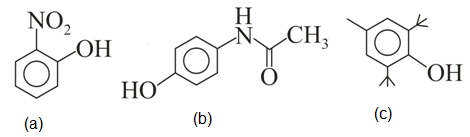
Intermolecular hydrogen bonding is the hydrogen bonding that occurs between different molecules due to the attraction between H attached to highly electronegative atoms (O, N, F) and lone pairs present on another molecule.
(a) shows intramolecular hydrogen bonding because the -OH group and -NO₂ group are present at ortho positions, allowing H-bonding within the same molecule.
Hence, (a) does not show significant intermolecular H-bonding.
(b) contains both -OH and -NH groups and can form strong hydrogen bonding between different molecules.
Hence, (b) shows significant intermolecular hydrogen bonding.
(c) is a sterically hindered phenol due to bulky groups near the -OH group, preventing effective intermolecular H-bonding.
Hence, (c) does not show significant intermolecular hydrogen bonding.
Therefore, the correct answer is:
$$\boxed{(b)}$$
The correct set from the following in which both pairs are in correct order of melting point is:
The melting point of an ionic compound depends on the lattice energy, which in turn depends on the charges of the ions and the interionic distance. According to the Born-Landé equation, lattice energy is directly proportional to the product of ionic charges and inversely proportional to the sum of ionic radii.
Comparing LiF and LiCl: Both have the same cation ($$\text{Li}^+$$) and the same charges ($$+1$$ and $$-1$$). The fluoride ion ($$\text{F}^-$$) is smaller than the chloride ion ($$\text{Cl}^-$$), so the interionic distance in LiF is smaller than in LiCl. This means LiF has a higher lattice energy and therefore a higher melting point: $$\text{LiF} > \text{LiCl}$$.
Comparing MgO and NaCl: MgO consists of $$\text{Mg}^{2+}$$ and $$\text{O}^{2-}$$ ions (charges $$+2$$ and $$-2$$), while NaCl consists of $$\text{Na}^+$$ and $$\text{Cl}^-$$ ions (charges $$+1$$ and $$-1$$). The product of charges in MgO ($$2 \times 2 = 4$$) is much greater than in NaCl ($$1 \times 1 = 1$$). Additionally, the ionic radii of $$\text{Mg}^{2+}$$ and $$\text{O}^{2-}$$ are smaller than those of $$\text{Na}^+$$ and $$\text{Cl}^-$$. Therefore, MgO has a significantly higher lattice energy and melting point: $$\text{MgO} > \text{NaCl}$$.
The correct set with both pairs in the correct order is: LiF $$>$$ LiCl and MgO $$>$$ NaCl.
Therefore, the correct answer is Option (4).
The interaction energy of London forces between two particles is proportional to $$r^x$$, where r is the distance between the particles. The value of x is:
London dispersion forces are weak intermolecular attractions that arise from momentary dipoles produced due to the movement of electrons in atoms or non-polar molecules.
The potential (interaction) energy $$E$$ of London forces varies with the separation $$r$$ between two particles according to the relation
$$$E \;\propto\; \dfrac{1}{r^{6}}$$$
Writing the proportionality in the form $$E \;\propto\; r^{\,x}$$ and comparing with $$$E \;\propto\; r^{-6}$$$, we obtain
$$x = -6$$
Hence, the exponent $$x$$ is $$-6$$, which corresponds to Option B.
Which of the following are isostructural pairs?
A. $$SO_4^{2-}$$ and $$CrO_4^{2-}$$
B. $$SiCl_4$$ and $$TiCl_4$$
C. $$NH_3$$ and $$NO_3^-$$
D. $$BCl_3$$ and $$BrCl_3$$
We need to identify which pairs of species are isostructural, meaning they have the same geometry and shape.
Pair A: $$SO_4^{2-}$$ and $$CrO_4^{2-}$$. In $$SO_4^{2-}$$, sulphur has 4 bond pairs and no lone pairs, giving a tetrahedral shape. In $$CrO_4^{2-}$$, chromium also has 4 bond pairs and no lone pairs, giving a tetrahedral shape. So this pair is isostructural.
Pair B: $$SiCl_4$$ and $$TiCl_4$$. In $$SiCl_4$$, silicon has 4 bond pairs and no lone pairs, giving a tetrahedral shape. In $$TiCl_4$$, titanium also has 4 bond pairs and no lone pairs, giving a tetrahedral shape. So this pair is isostructural.
Pair C: $$NH_3$$ and $$NO_3^-$$. In $$NH_3$$, nitrogen has 3 bond pairs and 1 lone pair, giving a trigonal pyramidal shape. In $$NO_3^-$$, nitrogen has 3 bond pairs and no lone pairs, giving a trigonal planar shape. These are not isostructural.
Pair D: $$BCl_3$$ and $$BrCl_3$$. In $$BCl_3$$, boron has 3 bond pairs and no lone pairs, giving a trigonal planar shape. In $$BrCl_3$$, bromine has 3 bond pairs and 2 lone pairs, giving a T-shaped geometry. These are not isostructural.
Hence, the isostructural pairs are A and B only.
Hence, the correct answer is Option 3.
Which one of the following species doesn't have a magnetic moment of 1.73 BM, (spin only value)?
A magnetic moment of 1.73 BM corresponds to spin-only value for one unpaired electron, since $$\mu = \sqrt{n(n+2)} = \sqrt{1 \times 3} = \sqrt{3} \approx 1.73$$ BM.
For $$O_2^+$$: molecular orbital configuration removes one electron from $$O_2$$. $$O_2$$ has 2 unpaired electrons; $$O_2^+$$ has 1 unpaired electron. So $$\mu = 1.73$$ BM. ✓
For $$O_2^-$$: adds one electron to $$O_2$$. This gives 1 unpaired electron (the extra electron pairs up one of the $$\pi^*$$ electrons). So $$\mu = 1.73$$ BM. ✓
For $$[\text{Cu(NH}_3)_4]Cl_2$$: here Cu is in +2 state (Cu²⁺). Cu²⁺ has configuration [Ar]$$3d^9$$, with 1 unpaired electron. So $$\mu = 1.73$$ BM. ✓
For CuI: here Cu is in +1 state (Cu⁺). Cu⁺ has configuration [Ar]$$3d^{10}$$, which is completely filled with no unpaired electrons. Therefore $$\mu = 0$$ BM, not 1.73 BM.
CuI does not have a magnetic moment of 1.73 BM.
According to molecular orbital theory, the species among the following that does not exist is:
According to Molecular Orbital Theory, a molecule exists only if its bond order is greater than zero. Bond order is calculated as $$\text{B.O.} = \frac{N_b - N_a}{2}$$, where $$N_b$$ is the number of bonding electrons and $$N_a$$ is the number of antibonding electrons.
For $$He_2^-$$ (5 electrons): The configuration is $$(\sigma 1s)^2(\sigma^* 1s)^2(\sigma 2s)^1$$. Bond order $$= \frac{3 - 2}{2} = 0.5$$. This species can exist.
For $$O_2^{2-}$$ (18 electrons): The configuration fills up to $$(\pi^* 2p)^4$$. Bond order $$= \frac{10 - 8}{2} = 1$$. This species can exist.
For $$He_2^+$$ (3 electrons): The configuration is $$(\sigma 1s)^2(\sigma^* 1s)^1$$. Bond order $$= \frac{2 - 1}{2} = 0.5$$. This species can exist.
For $$Be_2$$ (8 electrons): The configuration is $$(\sigma 1s)^2(\sigma^* 1s)^2(\sigma 2s)^2(\sigma^* 2s)^2$$. Bond order $$= \frac{4 - 4}{2} = 0$$. With zero bond order, this molecule does not exist.
Therefore, the species that does not exist is $$Be_2$$, which corresponds to option (4).
Given below are two statements: One is labelled as Assertion A and the other labelled as Reason R.
Assertion A : Lithium halides are somewhat covalent in nature.
Reason R : Lithium possess high polarisation capability.
In the light of the above statements, choose the most appropriate answer from the options given below:
We begin by reading the two statements carefully. Assertion A says that lithium halides are somewhat covalent in nature, while Reason R claims that lithium possesses high polarisation capability. In order to judge these statements, we must recall the concept of polarising power and Fajans’ rules.
Fajans’ rules state that the covalent character in an ionic bond increases when:
(i) the cation has a small radius and/or high charge,
(ii) the anion has a large radius and/or high charge,
because under such conditions the cation can strongly distort (polarise) the electron cloud of the anion. This distortion leads to sharing of electrons rather than complete transfer, imparting covalent character to the bond.
Now we apply these rules to lithium halides. The lithium ion is $$\text{Li}^+$$. Among all alkali-metal cations (Li $$^+, \text{Na}^+, \text{K}^+, \ldots)$$, $$\text{Li}^+$$ has the smallest ionic radius. Numerically,
$$r(\text{Li}^+) \approx 0.76\ \text{Å}, \quad r(\text{Na}^+) \approx 1.02\ \text{Å}, \quad r(\text{K}^+) \approx 1.38\ \text{Å}$$
and so on. Because the charge on each of these ions is the same $$(+1)$$, a smaller radius means a larger charge density, i.e.
Charge density $$= \frac{+1}{\text{smaller volume}} \ \Longrightarrow \ \text{larger electric field around Li}^+.$$
The polarising power is directly proportional to this charge density. Therefore $$\text{Li}^+$$ shows the highest polarising power among alkali cations.
Let us see the direct consequence for lithium halides. The general reaction for the formation of a lithium halide is
Li $$^+ + \text{X}^- \longrightarrow \text{LiX}, \quad \text{where } \text{X}^- = \text{F}^-,\ \text{Cl}^-,\ \text{Br}^-,\ \text{I}^-.$$
Because $$\text{Li}^+$$ is so small and highly polarising, it pulls the electron cloud of $$\text{X}^-$$ towards itself. This polarisation produces partial sharing of the electrons between Li and X, and that partial sharing manifests as partial covalent character in the Li-X bond. Thus, lithium halides are indeed somewhat covalent instead of being purely ionic.
Therefore Assertion A is true.
Next we evaluate Reason R. We have just argued—using size, charge density and Fajans’ rules—that $$\text{Li}^+$$ has a high polarising power. Hence Reason R is also true.
Finally, we must determine whether R correctly explains A. Since A (lithium halides are covalent) directly follows from the high polarising capability of $$\text{Li}^+$$ as described in R, Reason R is the correct and relevant explanation of Assertion A.
Hence, the correct answer is Option D.
In the following the correct bond order sequence is:
For molecules and ions of oxygen we have to use the Molecular Orbital (MO) theory. According to MO theory, the electronic energy-level sequence for the 2p orbitals in O2 and its ions is
$$\sigma_{2p_z}\,\lt \,\pi_{2p_x}=\pi_{2p_y}\,\lt \,\pi^{*}_{2p_x}=\pi^{*}_{2p_y}\,\lt \,\sigma^{*}_{2p_z}$$
All lower-energy 1s and 2s orbitals are completely filled in every species and will be included in the counting. The bond order of any species is obtained from the formula that MO theory gives:
$$\text{Bond order}= \frac{N_b-N_a}{2}$$
where $$N_b$$ is the total number of electrons in bonding MOs and $$N_a$$ is the total number of electrons in antibonding MOs.
Now we shall count electrons one by one for each species, write the values of $$N_b$$ and $$N_a$$ explicitly, and then apply the formula.
1. The neutral molecule $$O_2$$ (16 electrons)
The filling is
$$\sigma_{1s}^2\,\sigma_{1s}^{*\,2}\,\sigma_{2s}^2\,\sigma_{2s}^{*\,2}\, \sigma_{2p_z}^2\,\pi_{2p_x}^2\,\pi_{2p_y}^2\,\pi^{*1}_{2p_x}\,\pi^{*1}_{2p_y}$$
Counting electrons:
Bonding electrons $$N_b=2+2+2+2+2=10$$ Antibonding electrons $$N_a=2+2+1+1=6$$
Hence
$$\text{B.O.}(O_2)=\dfrac{10-6}{2}=2$$
2. The ion $$O_2^{+}$$ (15 electrons)
Removal of one electron occurs from the highest occupied antibonding orbital, so
$$\pi^{*1}_{2p_x}\,\pi^{*0}_{2p_y}$$
Now
Antibonding electrons $$N_a=2+2+1=5$$ (Bonding electrons remain $$N_b=10$$.)
Thus
$$\text{B.O.}(O_2^{+})=\dfrac{10-5}{2}=2.5$$
3. The ion $$O_2^{-}$$ (17 electrons)
An extra electron goes into the still singly occupied antibonding orbital, giving
$$\pi^{*1}_{2p_x}\,\pi^{*2}_{2p_y}$$
Antibonding electrons $$N_a=2+2+1+2=7$$ (Bonding electrons are still $$N_b=10$$.)
Therefore
$$\text{B.O.}(O_2^{-})=\dfrac{10-7}{2}=1.5$$
4. The ion $$O_2^{2-}$$ (18 electrons)
The added electron pairs up in the remaining antibonding orbital, making both $$\pi^{*}$$ orbitals completely filled:
$$\pi^{*2}_{2p_x}\,\pi^{*2}_{2p_y}$$
Antibonding electrons $$N_a=2+2+2+2=8$$ (Bonding electrons again $$N_b=10$$.)
So
$$\text{B.O.}(O_2^{2-})=\dfrac{10-8}{2}=1$$
We now have all four bond orders:
$$O_2^{+}:2.5,\; O_2:2,\; O_2^{-}:1.5,\; O_2^{2-}:1$$
Clearly the descending order of bond order is
$$O_2^{+} \;\gt \; O_2 \;\gt \; O_2^{-} \;\gt \; O_2^{2-}$$
This matches Option C in the list provided.
Hence, the correct answer is Option C.
Statement I: Sodium hydride can be used as an oxidising agent.
Statement II: The lone pair of electrons on nitrogen in pyridine makes it basic.
Choose the CORRECT answer from the options given below:
Statement I says sodium hydride (NaH) can be used as an oxidising agent. In NaH, hydrogen is in the $$-1$$ oxidation state. To act as an oxidising agent, hydrogen would need to gain electrons (become more negative), but it is already at its lowest oxidation state of $$-1$$. Instead, NaH acts as a strong reducing agent, as $$H^-$$ readily donates electrons to become $$H_2$$ (oxidation state 0). Therefore, Statement I is false.
Statement II says the lone pair of electrons on nitrogen in pyridine makes it basic. Pyridine has a nitrogen atom with a lone pair in an $$sp^2$$ hybrid orbital that lies in the plane of the ring and is not part of the aromatic $$\pi$$ system. This lone pair is available to accept a proton ($$H^+$$), making pyridine a base. Therefore, Statement II is true.
Since Statement I is false and Statement II is true, the correct answer is option (3).
The bond order and magnetic behaviour of $$O_2^-$$ ion are, respectively:
The electronic configuration of one $$\text{O}$$ atom is $$1s^2\,2s^2\,2p^4$$ (i.e. six valence electrons).
Therefore the neutral $$\text{O}_2$$ molecule contains $$2\times6 = 12$$ valence electrons.
For molecules from $$\text{N}_2$$ to $$\text{Ne}_2$$ the molecular-orbital energy order is:
$$$\sigma(1s),\;\sigma^*(1s),\;\sigma(2s),\;\sigma^*(2s),\;\sigma(2p_z),\;\pi(2p_x)=\pi(2p_y),\;\pi^*(2p_x)=\pi^*(2p_y),\;\sigma^*(2p_z)$$$.
Filling these orbitals with 12 electrons (Hund’s rule + Pauli principle) gives neutral $$\text{O}_2$$ the configuration
$$$\sigma(1s)^2\, \sigma^*(1s)^2\, \sigma(2s)^2\, \sigma^*(2s)^2\, \sigma(2p_z)^2$$$ $$$\pi(2p_x)^2\, \pi(2p_y)^2\, \pi^*(2p_x)^1\, \pi^*(2p_y)^1$$$.
Bond order is defined as
$$$\text{Bond order} = \frac{(\text{number of bonding electrons}) - (\text{number of antibonding electrons})}{2}$$$.
For neutral $$\text{O}_2$$:
Bonding electrons $$= 8$$ (in $$\sigma(2p_z),\;\pi(2p_x),\;\pi(2p_y)$$).
Antibonding electrons $$= 4$$ (in $$\pi^*(2p_x),\;\pi^*(2p_y)$$).
Thus $$\text{B.O.} = \frac{8-4}{2} = 2$$.
Now consider $$\text{O}_2^-$$ (superoxide ion). It possesses one extra electron, so total valence electrons $$= 12 + 1 = 13$$.
This extra electron enters the next available orbital $$\pi^*(2p)$$, giving the configuration
$$\dots \pi^*(2p_x)^2\,\pi^*(2p_y)^1$$.
Counting again:
Bonding electrons remain $$8$$.
Antibonding electrons become $$5$$.
Hence
$$\text{Bond order} = \frac{8 - 5}{2} = \frac{3}{2} = 1.5$$.
Magnetic behaviour depends on unpaired electrons. In $$\text{O}_2^-$$ the orbitals contain one unpaired electron (in the singly-occupied $$\pi^*$$ orbital). Any species with at least one unpaired electron is paramagnetic.
Therefore the superoxide ion $$\text{O}_2^-$$ has
Bond order = 1.5, Paramagnetic behaviour.
Thus, correct choice: Option B.
The correct shape and I - I - I bond angles respectively in $$I_3^-$$ ion are:
The $$I_3^-$$ ion is formed when an iodide ion ($$I^-$$) donates a lone pair to an iodine molecule ($$I_2$$). The central iodine atom in $$I_3^-$$ has 7 valence electrons plus 1 from the negative charge, giving a total of 8 valence electrons around it. Of these, 2 electrons form bonds with the two terminal iodine atoms, and the remaining 6 electrons form 3 lone pairs.
According to VSEPR theory, the central iodine atom has 5 electron pairs (2 bonding pairs and 3 lone pairs), which corresponds to a trigonal bipyramidal electron geometry. The two bonding pairs occupy the axial positions (which are 180° apart) to minimise lone pair-bonding pair repulsions, while the three lone pairs occupy the equatorial positions.
With the bonding pairs in the axial positions, the molecular shape of $$I_3^-$$ is linear, and the $$I-I-I$$ bond angle is $$180°$$.
Therefore, the correct answer is Option (4): Linear; 180°.
The hybridisations of the atomic orbitals of nitrogen in NO$$_2^-$$, NO$$_2^+$$ and NH$$_4^+$$ respectively are:
For $$NO_2^-$$ (nitrite ion): Nitrogen has 5 valence electrons, and with the negative charge, nitrogen forms 2 bonds with oxygen and has one lone pair. The electron geometry around nitrogen has 3 regions of electron density (2 bonding + 1 lone pair), giving $$sp^2$$ hybridisation. The bond angle is about 115°.
For $$NO_2^+$$ (nitronium ion): Nitrogen forms two double bonds with two oxygen atoms, giving 2 electron domains around nitrogen with no lone pair. This corresponds to $$sp$$ hybridisation with a linear geometry (180° bond angle).
For $$NH_4^+$$ (ammonium ion): Nitrogen is bonded to 4 hydrogen atoms with no lone pairs, giving a tetrahedral geometry with $$sp^3$$ hybridisation.
Therefore, the hybridisations of nitrogen in $$NO_2^-$$, $$NO_2^+$$ and $$NH_4^+$$ are $$sp^2$$, $$sp$$ and $$sp^3$$ respectively.
Which of the following compound CANNOT act as a Lewis base?
A Lewis base is a species that can donate a lone pair of electrons. For a molecule to act as a Lewis base, its central atom must have at least one lone pair of electrons available for donation.
In $$NF_3$$, nitrogen has one lone pair and can donate it, so it acts as a Lewis base. In $$SF_4$$, sulfur has one lone pair available for donation. In $$ClF_3$$, chlorine has two lone pairs and can donate one of them.
However, in $$PCl_5$$, phosphorus uses all five of its valence electrons to form five bonds with chlorine atoms. The phosphorus atom has no lone pairs remaining, meaning it cannot donate any electron pair to act as a Lewis base. In fact, $$PCl_5$$ is an electron-deficient species at phosphorus and tends to act as a Lewis acid instead.
Therefore, the compound that cannot act as a Lewis base is $$PCl_5$$, which is option (B).
Given below are two statements : One is labelled as Assertion A and other is labelled as Reason R.
Assertion A : The dihedral angles in H$$_2$$O$$_2$$ in gaseous phase is 90.2$$^\circ$$ and in solid phase is 111.5$$^\circ$$.
Reason R : The change in dihedral angle in solid and gaseous phase is due to the difference in the intermolecular forces.
Choose the most appropriate answer from the options given below for A and R.
Hydrogen peroxide $$\mathrm{(H_2O_2)}$$ has a non-planar (open-book) structure in both the gas phase and the solid phase.
Each oxygen atom is approximately $$sp^3$$ hybridized and contains two lone pairs. Due to lone pair-lone pair repulsion, the molecule does not adopt a planar arrangement and instead possesses a finite dihedral angle between the two $$\mathrm{O-H}$$ bonds.
In the gas phase:
In the solid phase (at $$110\ \mathrm{K}$$):
The variation in bond lengths and angles between the gas and solid phases arises from intermolecular interactions, particularly hydrogen bonding in the solid state.
Hence, hydrogen peroxide exists as a non-planar molecule with a dihedral angle of approximately $$111.5^\circ$$ in the gas phase and $$90.2^\circ$$ in the solid phase.
Identify the species having one $$\pi$$-bond and maximum number of canonical forms from the following:
First, remember that in any covalent structure a double bond contains one σ-bond and one π-bond, while a single bond contains only a σ-bond. Hence, to know the number of $$\pi$$-bonds we simply count the number of double bonds present in the Lewis structure of each species; every double bond contributes exactly one $$\pi$$-bond.
We also recall that canonical (resonance) forms are different valid Lewis structures obtained by shifting only electrons (not nuclei). The greater the number of ways in which double bonds and lone pairs can be redistributed without violating the octet rule, the greater will be the number of canonical forms.
Now we examine every option one by one.
Option A : $$SO_3$$
A common Lewis representation places one double bond between sulphur and each oxygen: $$O=S(=O)_2$$. That means three S-O double bonds, so there are three $$\pi$$-bonds, not one. Hence this option is rejected on the ground of the $$\pi$$-bond count.
Option B : $$O_2$$
Molecular oxygen is written as $$O=O$$, a single O=O double bond. Therefore it possesses exactly one $$\pi$$-bond. Concerning resonance, the ordinary Lewis picture has essentially a single dominant form; alternative forms involving charged or diradical species can be drawn but they are far less significant. Thus the practical number of important canonical forms is small (basically one), so this is not the species with the maximum number of canonical structures.
Option C : $$SO_2$$
The usual Lewis description shows two S=O double bonds, each contributing one $$\pi$$-bond, giving a total of two $$\pi$$-bonds. Therefore it fails the one-$$\pi$$-bond requirement and is ruled out.
Option D : $$CO_3^{2-}$$
Let us write one canonical form explicitly:
$$\displaystyle O^{-}\;-\;C(=O)\;-\;O^{-}$$
Here only the C=O linkage is a double bond, supplying one $$\pi$$-bond. Now, by moving the position of this double bond to the other two C-O connections, we can obtain two more equivalent Lewis structures. Thus:
1. $$O^{-}\;-\;C(=O)\;-\;O^{-}$$
2. $$O^{-}=C\;-\;O^{-}$$
3. $$O^{-}\;-\;C\;=\;O^{-}$$
So the carbonate ion has three canonical forms, all equally important and generated simply by rotating the location of the single $$\pi$$-bond. Among all the species that satisfy the “one $$\pi$$-bond” condition, $$CO_3^{2-}$$ possesses the largest number of significant resonance structures.
Therefore the species that fulfils both requirements—exactly one $$\pi$$-bond and the maximum possible number of canonical forms—is the carbonate ion, $$CO_3^{2-}$$, corresponding to Option D.
Hence, the correct answer is Option D.
Match List-I with List-II.
| List-I (Molecule) | List-II (Bond order) |
|---|---|
| (a) $$Ne_2$$ | (i) 1 |
| (b) $$N_2$$ | (ii) 2 |
| (c) $$F_2$$ | (iii) 0 |
| (d) $$O_2$$ | (iv) 3 |
We need to determine the bond order of each molecule using molecular orbital theory. The bond order is calculated as $$\text{Bond Order} = \frac{N_b - N_a}{2}$$, where $$N_b$$ is the number of electrons in bonding molecular orbitals and $$N_a$$ is the number of electrons in antibonding molecular orbitals.
(a) $$Ne_2$$: Each neon atom has 10 electrons (electronic configuration: $$1s^2 \, 2s^2 \, 2p^6$$), so $$Ne_2$$ has 20 electrons total. The molecular orbital configuration is $$$(\sigma_{1s})^2 (\sigma^*_{1s})^2 (\sigma_{2s})^2 (\sigma^*_{2s})^2 (\sigma_{2p_z})^2 (\pi_{2p_x})^2 (\pi_{2p_y})^2 (\pi^*_{2p_x})^2 (\pi^*_{2p_y})^2 (\sigma^*_{2p_z})^2$$$. This gives $$N_b = 10$$ and $$N_a = 10$$, so the bond order is $$\frac{10 - 10}{2} = 0$$. This matches (iii).
(b) $$N_2$$: Each nitrogen atom has 7 electrons, so $$N_2$$ has 14 electrons. The molecular orbital configuration is $$$(\sigma_{1s})^2 (\sigma^*_{1s})^2 (\sigma_{2s})^2 (\sigma^*_{2s})^2 (\pi_{2p_x})^2 (\pi_{2p_y})^2 (\sigma_{2p_z})^2$$$. Here $$N_b = 10$$ and $$N_a = 4$$, giving bond order $$= \frac{10 - 4}{2} = 3$$. This matches (iv).
(c) $$F_2$$: Each fluorine atom has 9 electrons, so $$F_2$$ has 18 electrons. The molecular orbital configuration is $$$(\sigma_{1s})^2 (\sigma^*_{1s})^2 (\sigma_{2s})^2 (\sigma^*_{2s})^2 (\sigma_{2p_z})^2 (\pi_{2p_x})^2 (\pi_{2p_y})^2 (\pi^*_{2p_x})^2 (\pi^*_{2p_y})^2$$$. Here $$N_b = 10$$ and $$N_a = 8$$, giving bond order $$= \frac{10 - 8}{2} = 1$$. This matches (i).
(d) $$O_2$$: Each oxygen atom has 8 electrons, so $$O_2$$ has 16 electrons. The molecular orbital configuration is $$$(\sigma_{1s})^2 (\sigma^*_{1s})^2 (\sigma_{2s})^2 (\sigma^*_{2s})^2 (\sigma_{2p_z})^2 (\pi_{2p_x})^2 (\pi_{2p_y})^2 (\pi^*_{2p_x})^1 (\pi^*_{2p_y})^1$$$. Here $$N_b = 10$$ and $$N_a = 6$$, giving bond order $$= \frac{10 - 6}{2} = 2$$. This matches (ii).
The correct matching is (a)$$\to$$(iii), (b)$$\to$$(iv), (c)$$\to$$(i), (d)$$\to$$(ii), which corresponds to Option (2).
Which one among the following resonating structures is not correct?
To determine which resonance structure is not correct, we must evaluate the stability of the charge distribution in each option. The molecule features a conjugated diene system attached to a nitro group ($-NO_2$). The nitro group is a strongly electron-withdrawing substituent, pulling electron density towards itself via both inductive ($-I$) and resonance ($-M$) effects.
When examining Structure A, we observe that the internal carbon-carbon double bond has been polarized, placing a formal negative charge on one carbon and a formal positive charge on the adjacent carbon that is directly bonded to the nitrogen atom.
In a standard nitro group, the central nitrogen atom inherently carries a formal positive charge because it is bonded to four atoms (a double bond to one oxygen, a single bond to the other negatively charged oxygen, and a single bond to the carbon chain).
Consequently, Structure A places a formal positive charge on a carbon atom directly next to a nitrogen atom that also bears a formal positive charge. Having two identical, localized charges (positive and positive) on directly adjacent atoms creates tremendous electrostatic repulsion. This severe repulsion makes the structure incredibly unstable, rendering it chemically invalid as a contributing resonance structure.
The other options (B, C, and D) represent valid resonance structures because they do not force like charges onto adjacent atoms. Instead, they correctly depict the flow of pi electrons towards the electron-withdrawing nitro group, or they position opposite charges adjacently, which is stabilizing.
Because of the adjacent positive charges, Structure A is the incorrect resonating structure.
The incorrect statement about $$B_2H_6$$ is:
Diborane ($$B_2H_6$$) has a bridged structure with two types of B-H bonds: four terminal B-H bonds and two bridging B-H-B bonds (three-centre two-electron bonds).
Let us examine each statement:
Option (2) states that the two types of B-H bonds (bridging and terminal) are not of the same length. This is correct; terminal B-H bonds are shorter (about 1.19 Å) than bridging B-H bonds (about 1.33 Å).
Option (3) states that terminal B-H bonds have less p-character compared to bridging bonds. This is correct; terminal bonds are formed using $$sp^2$$ or $$sp^3$$-like hybrid orbitals, while bridging bonds involve orbitals with higher p-character.
Option (4) states that $$BH_3$$ behaves as a Lewis acid. This is correct; $$BH_3$$ has an empty p-orbital and is electron-deficient, making it an excellent Lewis acid.
Option (1) states that all B-H-B angles are 120°. This is incorrect. The B-H-B bridge angle in diborane is approximately 97°, not 120°. The terminal H-B-H angles are close to 120° (the boron atoms are approximately $$sp^3$$ hybridized, but the terminal atoms lie in a plane), but the B-H-B bridging angles are significantly less than 120°.
Therefore, the incorrect statement about $$B_2H_6$$ is option (1).
In the following molecules,
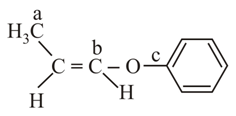
Hybridisation of carbon a, b and c respectively are :
To find the hybridization of an atom, calculate its steric number by adding the number of sigma ($$\sigma$$) bonds to the number of lone pairs on that atom. A sum of 2 indicates $$sp$$, 3 indicates $$sp^2$$, and 4 indicates $$sp^3$$.
Thus, the right option is C.
Match List - I with List - II:
List-I (Species) List-II (Number of lone pairs of electrons on the central atom)
(a) XeF$$_2$$ (i) 0
(b) XeO$$_2$$F$$_2$$ (ii) 1
(c) XeO$$_3$$F$$_2$$ (iii) 2
(d) XeF$$_4$$ (iv) 3
Choose the most appropriate answer from the options given below:
For every xenon compound we first count the eight valence electrons that xenon already possesses. Whenever xenon forms a bond it in effect “uses up’’ one of these electrons. Hence, after we know xenon’s oxidation state (the number of electrons it has formally donated to the surrounding atoms) we can find the electrons that remain as non-bonding or lone-pair electrons.
The relation we shall use is stated first: $$\text{Number of electrons left on Xe} = 8 - (\text{oxidation number of Xe}).$$ Because two electrons make one lone pair, the number of lone pairs is then $$\text{lone pairs} = \dfrac{8-\text{oxidation number}}{2}.$$
(a) XeF$$_2$$
Let the oxidation number of xenon be $$x.$$ For the neutral molecule we write $$x + 2(-1) = 0 \;\;\Longrightarrow\;\; x = +2.$$ Now, using the formula, the electrons that remain on xenon are $$8-2 = 6\text{ electrons}.$$ Dividing by two, the lone pairs are $$\dfrac{6}{2}=3.$$ So XeF$$_2$$ possesses three lone pairs.
(b) XeO$$_2$$F$$_2$$
The oxidation-number equation is $$x + 2(-2) + 2(-1) = 0 \;\;\Longrightarrow\;\; x = +6.$$ Electrons left on xenon: $$8-6 = 2\text{ electrons}.$$ Therefore the lone pairs are $$\dfrac{2}{2}=1.$$ XeO$$_2$$F$$_2$$ has one lone pair.
(c) XeO$$_3$$F$$_2$$
Writing the oxidation-number balance, $$x + 3(-2) + 2(-1) = 0 \;\;\Longrightarrow\;\; x = +8.$$ Electrons still on xenon: $$8-8 = 0.$$ Hence the lone pairs are $$\dfrac{0}{2}=0.$$ XeO$$_3$$F$$_2$$ carries no lone pair at all.
(d) XeF$$_4$$
The oxidation-number calculation is $$x + 4(-1) = 0 \;\;\Longrightarrow\;\; x = +4.$$ Electrons left on xenon: $$8-4 = 4\text{ electrons}.$$ Thus the lone pairs are $$\dfrac{4}{2}=2.$$ XeF$$_4$$ therefore contains two lone pairs.
Collecting all the results, we have $$\begin{aligned} \text{XeF}_2 &\longrightarrow 3 \text{ lone pairs} \;(iv)\\ \text{XeO}_2\text{F}_2 &\longrightarrow 1 \text{ lone pair} \;(ii)\\ \text{XeO}_3\text{F}_2 &\longrightarrow 0 \text{ lone pairs} \;(i)\\ \text{XeF}_4 &\longrightarrow 2 \text{ lone pairs} \;(iii) \end{aligned}$$
Matching List-I with List-II we obtain
(a) XeF$$_2$$ - (iv), (b) XeO$$_2$$F$$_2$$ - (ii), (c) XeO$$_3$$F$$_2$$ - (i), (d) XeF$$_4$$ - (iii).
Hence, the correct answer is Option D.
A hard substance melts at high temperature and is an insulator in both solid and in molten state. This solid is most likely to be a / an :
A hard substance that melts at a high temperature and is an insulator in both the solid and molten states must be a covalent (network) solid. Ionic solids are hard with high melting points but conduct electricity in the molten state due to free ions. Molecular solids are soft with low melting points. Metallic solids conduct electricity in both states.
Covalent solids such as diamond and silicon carbide are extremely hard, have very high melting points, and do not conduct electricity in either state because all electrons are locked in strong covalent bonds with no free charge carriers.
The correct answer is option (4): Covalent solid.
Number of Cl = O bonds in chlorous acid, chloric acid and perchloric acid respectively are:
We first recall that an oxo-acid of chlorine has the general formula $$\mathrm{HClO_n}$$ where $$n$$ goes from $$1$$ to $$4$$. For each acid we must draw the most accepted Lewis structure, keeping in mind two guiding principles: (i) chlorine is in period $$3$$, therefore it can expand its octet, and (ii) the total number of valence electrons must be conserved. A Cl = O bond is a double bond between chlorine and oxygen, so after drawing the structure we simply count how many such double bonds appear.
We begin with chlorous acid, $$\mathrm{HClO_2}$$ (also written $$\mathrm{HOClO}$$). Chlorine contributes $$7$$ valence electrons, each oxygen contributes $$6$$, and hydrogen contributes $$1$$, so the electron count is
$$N_e = 7 + 2\times 6 + 1 = 20$$
We connect chlorine to two oxygens and attach the hydrogen to one of those oxygens so that $$\mathrm{O\!-\!H}$$ appears, which satisfies the acidic character. After distributing lone pairs so that every atom reaches an octet where possible, we are left with one double bond required to reduce the electron count to $$20$$. Thus only one of the two Cl-O links becomes a Cl = O double bond, whereas the other remains a single bond (bearing the hydrogen). Consequently,
$$\text{Number of Cl\!=\!O bonds in } \mathrm{HClO_2} = 1$$
Now we turn to chloric acid, $$\mathrm{HClO_3}$$. The valence-electron total is
$$N_e = 7 + 3\times 6 + 1 = 26$$
Chlorine is joined to three oxygens, with one of those oxygens still bonded to hydrogen. If we try an initial arrangement with all single bonds, the electron count is too high, so we convert single bonds to double bonds until the total matches $$26$$. Every conversion of a single bond to a double bond removes two electrons from the lone-pair pool. After algebraic checking we find that two of the three Cl-O links must be double bonds, while the O bearing hydrogen remains in a single bond. Therefore,
$$\text{Number of Cl\!=\!O bonds in } \mathrm{HClO_3} = 2$$
Finally, we analyse perchloric acid, $$\mathrm{HClO_4}$$. The electron count is
$$N_e = 7 + 4\times 6 + 1 = 32$$
Chlorine is attached to four oxygens, one of which carries the hydrogen. With four single Cl-O bonds the electron total would be too large, so we systematically introduce double bonds until we reach $$32$$ electrons. Algebra shows that three of the four Cl-O links must be double bonds; the remaining bond is the single bond to the $$\mathrm{OH}$$ group. Consequently,
$$\text{Number of Cl\!=\!O bonds in } \mathrm{HClO_4} = 3$$
Collecting the three counts we have:
$$\mathrm{HClO_2}: 1,\qquad \mathrm{HClO_3}: 2,\qquad \mathrm{HClO_4}: 3$$
These numbers correspond exactly to Option D, which lists “1, 2 and 3”.
Hence, the correct answer is Option D.
AB$$_3$$ is an interhalogen T-shaped molecule. The number of lone pairs of electrons on A is _________ (Integer answer)
We are told that the molecule is an inter-halogen of the type $$\mathrm{AB_3}$$ and that its observed geometry is T-shaped. In any VSEPR (Valence Shell Electron Pair Repulsion) discussion we first count total electron pairs around the central atom $$\mathrm A$$, because the geometry is fixed by the steric number (total regions of electron density = bond pairs + lone pairs).
Each halogen atom has seven valence electrons. Therefore the central halogen $$\mathrm A$$ also possesses $$7$$ valence electrons. We now account for the three $$\mathrm{A{-}B}$$ single bonds.
Every single (sigma) bond is a bond pair involving one electron from $$\mathrm A$$ and one from $$\mathrm B$$. So the three $$\mathrm{A{-}B}$$ bonds consume $$3$$ of the $$7$$ valence electrons of $$\mathrm A$$:
$$7\;(\text{valence electrons of A}) \;-\;3\;(\text{electrons used in three } \sigma\text{ bonds}) \;=\;4$$
The $$4$$ electrons that remain on $$\mathrm A$$ must stay as non-bonding electrons. Because two electrons make one lone pair, we have
$$\dfrac{4\; \text{non-bonding electrons}}{2\; \text{electrons per lone pair}} \;=\;2\; \text{lone pairs}.$$
Hence the electron-pair distribution around $$\mathrm A$$ is
$$3 \text{ bond pairs } + 2 \text{ lone pairs } = 5 \text{ regions of electron density}.$$
According to VSEPR theory, five regions adopt a trigonal-bipyramidal arrangement. When two of those five positions are occupied by lone pairs (preferentially the equatorial sites, because 90° repulsions are minimized), the three bond pairs occupy the remaining positions and the molecular shape observed is T-shaped, exactly as stated in the question. This matches the description $$\mathrm{AB_3E_2}$$, where $$\mathrm E$$ denotes a lone pair.
So, the number of lone pairs on the central atom $$\mathrm A$$ is clearly
$$2.$$
Hence, the correct answer is Option C.
According to molecular orbital theory, the number of unpaired electron(s) in O$$_2^{2-}$$ is _________.
First, we recall the basic postulate of Molecular Orbital (MO) Theory: when two atomic orbitals combine, they form one bonding molecular orbital and one antibonding molecular orbital. Electrons are filled into these MOs according to the Aufbau principle, obeying the Pauli Exclusion Principle and Hund’s Rule, just as in atomic orbitals.
For an oxygen atom the atomic number is 8, so a neutral O2 molecule contains
$$2 \times 8 = 16$$
electrons in total. Out of these, $$1s$$ core electrons (two per atom) do not influence magnetism, but we shall still count every electron explicitly so that no step is skipped.
When we talk about the peroxide ion $$ \mathrm{O_2^{2-}} $$, we must add two more electrons to the 16 already present in the neutral molecule:
$$16 + 2 = 18$$
Thus $$ \mathrm{O_2^{2-}} $$ possesses 18 electrons to be filled into molecular orbitals.
The energy ordering of MOs for homonuclear diatomic molecules of oxygen and heavier elements is
$$\sigma_{1s},\; \sigma_{1s}^{*},\; \sigma_{2s},\; \sigma_{2s}^{*},\; \sigma_{2p_z},\; \pi_{2p_x} = \pi_{2p_y},\; \pi_{2p_x}^{*} = \pi_{2p_y}^{*},\; \sigma_{2p_z}^{*}$$
Now we shall place all 18 electrons one after another.
1. The $$ \sigma_{1s} $$ bonding orbital receives 2 electrons:
$$\sigma_{1s}^2$$
2. The $$ \sigma_{1s}^{*} $$ antibonding orbital also receives 2 electrons:
$$\sigma_{1s}^{*\,2}$$
3. The $$ \sigma_{2s} $$ bonding orbital receives 2 electrons:
$$\sigma_{2s}^2$$
4. The $$ \sigma_{2s}^{*} $$ antibonding orbital receives 2 electrons:
$$\sigma_{2s}^{*\,2}$$
Up to this point we have placed
$$2 + 2 + 2 + 2 = 8$$
electrons. Ten electrons remain.
5. Next comes the $$ \sigma_{2p_z} $$ bonding orbital, which can hold 2 electrons. We place them as
$$\sigma_{2p_z}^2$$
Total electrons used so far:
$$8 + 2 = 10$$
Eight electrons are left.
6. The degenerate $$ \pi_{2p_x} $$ and $$ \pi_{2p_y} $$ bonding orbitals together can hold 4 electrons. According to Hund’s Rule we put one electron in each first, then pair them, yielding
$$\pi_{2p_x}^2\,\pi_{2p_y}^2$$
Electrons used so far:
$$10 + 4 = 14$$
Four electrons remain.
7. We now arrive at the degenerate antibonding orbitals $$ \pi_{2p_x}^{*} $$ and $$ \pi_{2p_y}^{*} $$. These two orbitals together can accommodate 4 electrons.
For the neutral O2 molecule (16 electrons) we would place only two electrons here, giving one electron to each orbital and resulting in two unpaired electrons. However, in $$ \mathrm{O_2^{2-}} $$ we have two extra electrons, so all four available spots in the pair of antibonding $$\pi^{*}$$ orbitals will now be filled:
$$\pi_{2p_x}^{*\,2}\,\pi_{2p_y}^{*\,2}$$
Electrons accounted for:
$$14 + 4 = 18$$
No electrons remain unplaced, so the electronic configuration is complete.
Because every MO that currently contains electrons now has them in pairs (each electron is matched with another of opposite spin inside the same orbital), there are absolutely no singly-occupied molecular orbitals. In other words, the count of unpaired electrons is
$$0.$$
Hence, the correct answer is Zero.
In gaseous triethyl amine the C-N-C bond angle is _________ degree.
We start by recalling the basic concept of valence shell electron-pair repulsion (VSEPR) theory. According to VSEPR, the geometry around any central atom is governed by the total number of electron pairs (bond pairs + lone pairs) that surround it. Each electron pair tries to stay as far away from the others as possible because of electrostatic repulsion.
In triethyl amine, whose condensed formula is $$\mathrm{N(CH_2CH_3)_3},$$ the nitrogen atom is the central atom. It is bonded to three carbon atoms (one from each ethyl group) and also possesses one lone pair. So, we have a total of
$$\text{Number of bond pairs} = 3$$
$$\text{Number of lone pairs} = 1$$
$$\text{Total electron pairs} = 3 + 1 = 4$$
When there are four electron pairs, the ideal arrangement that maximizes separation is tetrahedral. For a perfectly tetrahedral set of four identical repulsions, the bond angle is
$$\theta_{\text{ideal}} = 109.5^\circ$$
However, VSEPR also tells us that the repulsion strengths are not exactly equal. The generally accepted order is
$$\text{lone-pair-lone-pair repulsion} \; > \; \text{lone-pair-bond-pair repulsion} \; > \; \text{bond-pair-bond-pair repulsion}$$
Our nitrogen atom has one lone pair and three bond pairs, so each C-N-C angle is affected by one lone-pair-bond-pair interaction and two bond-pair-bond-pair interactions. Because the lone pair exerts slightly greater repulsion than a bond pair, it pushes the three N-C bond pairs a little closer together. Consequently, the observed bond angle becomes slightly smaller than the ideal $$109.5^\circ.$$ Numerically, experimental gas-phase studies on trialkyl amines have shown that the reduction is typically about $$1.0^\circ$$-$$2.0^\circ.$$ Subtracting this small decrease, we obtain
$$\theta_{\text{observed}} \approx 109.5^\circ - 1.5^\circ \; \approx \; 108^\circ$$
This experimentally measured value of $$108^\circ$$ is therefore fully consistent with the VSEPR prediction that a lone pair will compress the bond angle slightly below the tetrahedral ideal.
So, the answer is $$108^\circ$$.
The number of lone pairs of electrons on the central I atom in I$$_3^-$$ is ___.
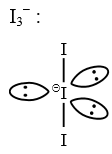
There are 2 bond pairs and 3 lone pairs on the central atom.
The number of species below that have two lone pairs of electrons in their central atom is ___ (Round off to the Nearest integer)
SF$$_4$$, BF$$_4^-$$, ClF$$_3$$, AsF$$_3$$, PCl$$_5$$, BrF$$_5$$, XeF$$_4$$, SF$$_6$$
To find which species have exactly two lone pairs on the central atom, we apply VSEPR theory to each species using the formula: lone pairs $$= \frac{V - B}{2}$$, where $$V$$ is the number of valence electrons on the central atom (adjusted for charge) and $$B$$ is the number of bonding pairs (equal to the number of surrounding atoms in simple cases).
For $$\text{SF}_4$$: sulphur has 6 valence electrons and forms 4 bonds, leaving $$6 - 4 = 2$$ electrons, so 1 lone pair. For $$\text{BF}_4^-$$: boron has 3 + 1 = 4 effective valence electrons and forms 4 bonds, so 0 lone pairs. For $$\text{ClF}_3$$: chlorine has 7 valence electrons and forms 3 bonds, leaving 4 electrons, so 2 lone pairs. This qualifies.
For $$\text{AsF}_3$$: arsenic has 5 valence electrons and forms 3 bonds, leaving 2 electrons, so 1 lone pair. For $$\text{PCl}_5$$: phosphorus has 5 valence electrons and forms 5 bonds, so 0 lone pairs. For $$\text{BrF}_5$$: bromine has 7 valence electrons and forms 5 bonds, leaving 2 electrons, so 1 lone pair.
For $$\text{XeF}_4$$: xenon has 8 valence electrons and forms 4 bonds, leaving 4 electrons, so 2 lone pairs. This qualifies. For $$\text{SF}_6$$: sulphur has 6 valence electrons and forms 6 bonds, so 0 lone pairs.
The species with exactly two lone pairs on the central atom are $$\text{ClF}_3$$ and $$\text{XeF}_4$$, giving a count of $$2$$.
The total number of electrons in all bonding molecular orbitals of $$O_2^{2-}$$ is _________ (Round off to the nearest integer)
For molecular-orbital (MO) treatment we start with the electronic details of the species.
Each oxygen atom has atomic number 8, so a neutral $$\mathrm{O_2}$$ molecule contains $$2 \times 8 = 16$$ electrons. The dianion $$\mathrm{O_2^{2-}}$$ possesses two extra electrons. Hence the total electron count is
$$16 + 2 = 18.$$
Next we recall the accepted MO energy order for homonuclear diatomics of oxygen and beyond (i.e. having $$Z \ge 8$$):
$$ \sigma_{1s}\,<\,\sigma_{1s}^\ast\,<\, \sigma_{2s}\,<\,\sigma_{2s}^\ast\,<\, \sigma_{2p_z}\,<\, \pi_{2p_x} = \pi_{2p_y}\,<\, \pi_{2p_x}^\ast = \pi_{2p_y}^\ast\,<\, \sigma_{2p_z}^\ast . $$
We now place the 18 electrons, two per orbital in the sequence shown.
1. $$\sigma_{1s}$$ receives $$2$$ electrons $$\Rightarrow$$ running total $$=2$$.
2. $$\sigma_{1s}^\ast$$ receives $$2$$ electrons $$\Rightarrow$$ running total $$=4$$.
3. $$\sigma_{2s}$$ receives $$2$$ electrons $$\Rightarrow$$ running total $$=6$$.
4. $$\sigma_{2s}^\ast$$ receives $$2$$ electrons $$\Rightarrow$$ running total $$=8$$.
5. $$\sigma_{2p_z}$$ receives $$2$$ electrons $$\Rightarrow$$ running total $$=10$$.
6. $$\pi_{2p_x}$$ receives $$2$$ electrons.
$$\pi_{2p_y}$$ receives $$2$$ electrons $$\Rightarrow$$ running total $$=14$$.
7. The remaining $$18-14 = 4$$ electrons must enter the lowest antibonding set:
$$\pi_{2p_x}^\ast$$ receives $$2$$ electrons.
$$\pi_{2p_y}^\ast$$ receives $$2$$ electrons $$\Rightarrow$$ running total $$=18$$, filling is complete.
Our goal is to count only the electrons present in bonding MOs. These bonding orbitals are
$$\sigma_{1s},\;\sigma_{2s},\;\sigma_{2p_z},\;\pi_{2p_x},\;\pi_{2p_y}.$$
The electron population in them is therefore
$$ 2 \;(\sigma_{1s}) + 2 \;(\sigma_{2s}) + 2 \;(\sigma_{2p_z}) + 2 \;(\pi_{2p_x}) + 2 \;(\pi_{2p_y}) = 10. $$
So the total number of electrons occupying bonding molecular orbitals in $$\mathrm{O_2^{2-}}$$ is $$10$$.
Hence, the correct answer is Option C.
The difference between bond orders of CO and NO$$^{\oplus}$$ is $$\frac{x}{2}$$ where x = _________ (Round off to the Nearest Integer)
Electrons in $$NO^+$$ = 14$$e^-$$
Electrons in $$CO$$ = 14$$e^-$$
For molecules with 14 or fewer electrons (such as $N_2$, $B_2$, or $C_2$), the energy level sequence for molecular orbitals is:
$$ \sigma_{1s} < \sigma_{1s}^{*} < \sigma_{2s} < \sigma_{2s}^{*} < \pi_{2p_x} = \pi_{2p_y} < \sigma_{2p_z} < \pi_{2p_x}^{*} = \pi_{2p_y}^{*} < \sigma_{2p_z}^{*} $$
Filling all 14 electrons into this sequence yields the following configuration:
$$ \sigma_{1s}^{2} \sigma_{1s}^{*2} \sigma_{2s}^{2} \sigma_{2s}^{*2} \pi_{2p_x}^{2} \pi_{2p_y}^{2} \sigma_{2p_z}^{2} $$
The bond order is calculated using the formula:
$$ \text{Bond Order} = \frac{1}{2} (N_b - N_a) $$
Where:
Count the electrons:
Calculate the Bond Order:
$$ \text{Bond Order} = \frac{1}{2} (10 - 4) $$$$ \text{Bond Order} = \frac{1}{2} (6) $$$$ \text{Bond Order} = 3 $$
Therefore, any diatomic molecule or ion with exactly 14 electrons (like the $N_2$ molecule or the $CN^-$ ion) has a bond order of 3, indicating a stable triple bond.
The ionization enthalpy of Na$$^+$$ formation from $$Na_{(g)}$$ is 495.8 kJ mol$$^{-1}$$, while the electron gain enthalpy of Br is $$-325.0$$ kJ mol$$^{-1}$$. Given the lattice enthalpy of NaBr is $$-728.4$$ kJ mol$$^{-1}$$. The energy for the formation of NaBr ionic solid is $$(-) \underline{\hspace{1cm}} \times 10^{-1}$$ kJ mol$$^{-1}$$
We need to find the energy for the formation of NaBr ionic solid from its gaseous ions. The relevant energy terms are the ionization enthalpy of Na, the electron gain enthalpy of Br, and the lattice enthalpy of NaBr.
The formation of NaBr from gaseous atoms involves: $$Na_{(g)} \to Na^+_{(g)} + e^-$$ with ionization enthalpy $$= +495.8$$ kJ mol$$^{-1}$$, and $$Br_{(g)} + e^- \to Br^-_{(g)}$$ with electron gain enthalpy $$= -325.0$$ kJ mol$$^{-1}$$, and $$Na^+_{(g)} + Br^-_{(g)} \to NaBr_{(s)}$$ with lattice enthalpy $$= -728.4$$ kJ mol$$^{-1}$$.
The overall energy for the formation of NaBr ionic solid from gaseous Na and Br atoms is the sum of these three contributions: $$\Delta H = 495.8 + (-325.0) + (-728.4) = 495.8 - 325.0 - 728.4 = -557.6 \text{ kJ mol}^{-1}$$
The question asks for the answer in the form $$(-)\underline{\hspace{1cm}} \times 10^{-1}$$ kJ mol$$^{-1}$$. Since $$-557.6 = (-) 5576 \times 10^{-1}$$, the answer is $$\mathbf{5576}$$.
The number of species having non-pyramidal shape among the following is:
(A) SO$$_3$$
(B) NO$$_3^-$$
(C) PCl$$_3$$
(D) CO$$_3^{2-}$$
The correct answer is 3.
According to NCERT Class 11 Chemistry, Chapter 4: Chemical Bonding and Molecular Structure:
"The shape of a molecule depends upon the number of valence shell electron pairs (bonded or nonbonded) around the central atom."
To determine the shape and hybridization, we evaluate the number of bond pairs and lone pairs around the central atom for each species:
Hence, the species SO₃, NO₃⁻, and CO₃²⁻ are non-pyramidal.
Therefore, the total number of species having a non-pyramidal shape is 3.
The spin-only magnetic moment value of B$$_2^+$$ species is _________ $$\times 10^{-2}$$ BM (Nearest integer)
[Given: $$\sqrt{3}$$ = 1.73]
We begin with the electronic details of a single boron atom. A boron atom has atomic number 5, so its ground-state electronic configuration is $$1s^2\,2s^2\,2p^1$$.
In the diatomic ion B$$_2^{+}$$ we have two boron atoms, but one electron is missing because of the positive charge. Hence the total number of electrons present in the molecule is
$$2 \times 5 \;-\; 1 \;=\; 9.$$
For homonuclear diatomic molecules of the first-row elements up to nitrogen (Z ≤ 7), the well-established order of molecular orbitals is
$$\sigma(1s),\;\sigma^{\*}(1s),\;\sigma(2s),\;\sigma^{\*}(2s),\; \pi(2p_x)=\pi(2p_y),\;\sigma(2p_z).$$
Now we start filling these molecular orbitals with the nine electrons of B$$_2^{+}$$, always obeying the Pauli exclusion principle (maximum two electrons per orbital with opposite spins) and Hund’s rule (maximum multiplicity):
$$ \begin{aligned} \sigma(1s) &:& 2 \text{ electrons} \\ \sigma^{\*}(1s) &:& 2 \text{ electrons} \\ \sigma(2s) &:& 2 \text{ electrons} \\ \sigma^{\*}(2s) &:& 2 \text{ electrons} \\ \pi(2p_x) \text{ or } \pi(2p_y) &:& 1 \text{ electron (unpaired)} \end{aligned} $$
After placing eight electrons in the four lowest orbitals, one electron still remains. The degenerate $$\pi(2p_x)$$ and $$\pi(2p_y)$$ orbitals are next in energy, so the ninth electron enters either of these two orbitals singly. Consequently, there is exactly
$$n = 1$$
unpaired electron in B$$_2^{+}$$.
To find the spin-only magnetic moment, we explicitly state the formula first:
$$\mu_\text{spin only} = \sqrt{n(n+2)}\;\text{BM},$$
where $$n$$ is the number of unpaired electrons and “BM” stands for Bohr magneton.
Substituting $$n = 1$$ gives
$$ \mu = \sqrt{1(1+2)} \\ \mu = \sqrt{3}\;\text{BM}. $$
We are given $$\sqrt{3} = 1.73$$. Therefore,
$$\mu = 1.73\;\text{BM}.$$
The problem asks for the value in the form “ ______ $$\times 10^{-2}$$ BM” and instructs us to give the nearest integer. Writing $$1.73\;\text{BM}$$ in that format, we have
$$1.73\;\text{BM} = 173 \times 10^{-2}\;\text{BM}.$$
Because 173 is already an integer, no further rounding is required.
Hence, the correct answer is Option 173.
Diamond has a three dimensional structure of C atoms formed by covalent bonds. The structure of diamond has face centred cubic lattice where 50% of the tetrahedral voids are also occupied by carbon atoms. The number of carbon atoms present per unit cell of diamond is ___.
Diamond has a face-centred cubic (FCC) unit cell with additional carbon atoms occupying 50% of the tetrahedral voids.
The number of carbon atoms from the FCC lattice points per unit cell: In an FCC arrangement, there are 8 corner atoms (each shared by 8 unit cells) and 6 face-centred atoms (each shared by 2 unit cells).
$$\text{FCC atoms} = \frac{8}{8} + \frac{6}{2} = 1 + 3 = 4$$
The number of tetrahedral voids in an FCC unit cell is twice the number of lattice points:
$$\text{Tetrahedral voids} = 2 \times 4 = 8$$
50% of these voids are occupied by additional carbon atoms:
$$\text{Extra C atoms} = 0.5 \times 8 = 4$$
Therefore, the total number of carbon atoms per unit cell of diamond is:
$$4 + 4 = \mathbf{8}$$
The empirical formula for a compound with a cubic close packed arrangement of anions and with cations occupying all the octahedral sites in A$$_x$$B. The value of x is _________. (Integer answer)
We begin by recognising that the anions $$B^{\,-}$$ form a cubic close-packed (ccp, also called fcc) lattice. A fundamental fact about a ccp lattice is that each unit cell contains $$4$$ lattice points of the constituent particle. Therefore, in one unit cell we have
$$N_B = 4$$
anions.
Next we recall the relation between the number of lattice particles and the number of interstitial voids in a ccp lattice. The rule is stated as follows:
“In a cubic close-packed (ccp) or face-centred cubic (fcc) arrangement, the number of octahedral voids is numerically equal to the number of particles that constitute the lattice.”
Applying this rule, the total number of octahedral sites present in one unit cell will be
$$N_{\text{octa}} = N_B = 4.$$
The statement of the problem tells us that the cations $$A^{\,+}$$ occupy all of these octahedral sites. Hence, in one unit cell the number of cations is
$$N_A = N_{\text{octa}} = 4.$$
We now have the absolute numbers of the two species in a single unit cell:
$$N_A : N_B = 4 : 4.$$
To obtain the empirical formula we divide by the highest common factor (here, $$4$$) so that we arrive at the simplest whole-number ratio:
$$\frac{N_A}{4} : \frac{N_B}{4} = 1 : 1.$$
Therefore, the empirical formula of the compound is
$$AB.$$
Comparing this result with the general form $$A_xB$$, we immediately read off
$$x = 1.$$
So, the answer is $$1$$.
The unit cell of copper corresponds to a face centered cube of edge length 3.596 $$\mathring{A}$$ with one copper atom at each lattice point. The calculated density of copper in kg/m$$^3$$ is ______. [Molar mass of Cu: 63.54 g; Avogadro Number $$= 6.022 \times 10^{23}$$]
For a face-centered cubic (FCC) unit cell, there are 4 atoms per unit cell (8 corner atoms contributing $$\frac{1}{8}$$ each, and 6 face atoms contributing $$\frac{1}{2}$$ each: $$8 \times \frac{1}{8} + 6 \times \frac{1}{2} = 4$$).
The density formula for a unit cell is $$\rho = \frac{Z \times M}{N_A \times a^3}$$, where $$Z = 4$$ is the number of atoms per unit cell, $$M = 63.54$$ g/mol is the molar mass of copper, $$N_A = 6.022 \times 10^{23}$$ mol$$^{-1}$$ is Avogadro's number, and $$a = 3.596$$ Å $$= 3.596 \times 10^{-8}$$ cm is the edge length.
First, we calculate $$a^3 = (3.596 \times 10^{-8})^3 = (3.596)^3 \times 10^{-24}$$ cm$$^3$$. Computing $$(3.596)^3 = 3.596 \times 3.596 \times 3.596 = 12.931 \times 3.596 = 46.504$$. So $$a^3 = 46.504 \times 10^{-24}$$ cm$$^3$$.
Substituting into the density formula: $$\rho = \frac{4 \times 63.54}{6.022 \times 10^{23} \times 46.504 \times 10^{-24}} = \frac{254.16}{6.022 \times 46.504 \times 10^{-1}} = \frac{254.16}{28.005} = 9.076$$ g/cm$$^3$$.
Converting to kg/m$$^3$$: $$\rho = 9.076 \times 1000 = 9076$$ kg/m$$^3$$.
The calculated density of copper is $$\boxed{9076}$$ kg/m$$^3$$.
A copper complex crystallising in a CCP lattice with a cell edge of 0.4518 nm has been revealed by employing X-ray diffraction studies. The density of a copper complex is found to be 7.62 g cm$$^{-3}$$. The molar mass of copper complex is ___ gmol$$^{-1}$$
(Nearest integer): [Given : N$$_A$$ = 6.022 $$\times 10^{23}$$ mol$$^{-1}$$]
In a CCP (cubic close-packed, i.e., FCC) lattice, the number of formula units per unit cell is $$Z = 4$$. The cell edge is $$a = 0.4518 \text{ nm} = 0.4518 \times 10^{-7} \text{ cm} = 4.518 \times 10^{-8} \text{ cm}$$.
The density formula for a crystal is $$\rho = \frac{Z \times M}{N_A \times a^3}$$, where $$M$$ is the molar mass. Rearranging: $$M = \frac{\rho \times N_A \times a^3}{Z}$$.
Computing $$a^3$$: $$(4.518 \times 10^{-8})^3 = 4.518^3 \times 10^{-24}$$. Now $$4.518^3 = 4.518 \times 4.518 = 20.412$$, and $$20.412 \times 4.518 = 92.22$$. So $$a^3 = 92.22 \times 10^{-24} \text{ cm}^3 = 9.222 \times 10^{-23} \text{ cm}^3$$.
Substituting: $$M = \frac{7.62 \times 6.022 \times 10^{23} \times 9.222 \times 10^{-23}}{4} = \frac{7.62 \times 6.022 \times 9.222}{4}$$.
Evaluating the numerator: $$7.62 \times 6.022 = 45.89$$, and $$45.89 \times 9.222 = 423.2$$. Dividing by 4: $$M = \frac{423.2}{4} = 105.8 \approx 106 \text{ g/mol}$$.
The answer is $$106$$.
The number of octahedral voids per lattice site in a lattice is ______. (Rounded off to the nearest integer)
In a close-packed lattice (such as FCC or HCP), the number of octahedral voids per lattice site (i.e., per atom) is a well-known result in solid state chemistry.
For a face-centred cubic (FCC) lattice, the number of atoms per unit cell is 4. The octahedral voids are located at the body centre (1 void) and at the midpoints of each edge (12 edges, each shared among 4 unit cells, giving $$12 \times \frac{1}{4} = 3$$ voids). The total number of octahedral voids per unit cell is $$1 + 3 = 4$$.
The ratio of octahedral voids to lattice sites is $$\frac{4}{4} = 1$$.
Therefore, the number of octahedral voids per lattice site is $$1$$.
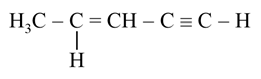
The number of sigma bonds in the above molecule is ___.
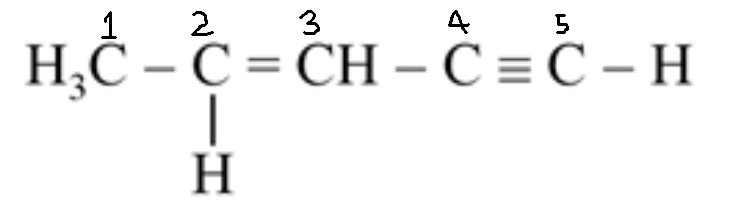
The carbon numbered $$1$$ has $$3$$ sigma bonds to hydrogen.
There is $$1$$ sigma bond between carbons $$1$$ and $$2$$.
The carbon numbered $$2$$ has $$1$$ sigma bond to hydrogen.
There is $$1$$ sigma bond between carbons $$2$$ and $$3$$.
The carbon numbered $$3$$ has $$1$$ sigma bond to hydrogen.
There is $$1$$ sigma bond between carbons $$3$$ and $$4$$.
There is $$1$$ sigma bond between carbons $$4$$ and $$5$$.
The carbon numbered $$5$$ has $$1$$ sigma bond to hydrogen.
$$\text{Total sigma bonds} = 3+1+1+1+1+1+1+1 = 10$$
The coordination number of an atom in a body-centered cubic structure is ______
[Assume that the lattice is made up of atoms.]
We need to find the coordination number of an atom in a body-centered cubic (BCC) structure.
In a BCC unit cell, there is one atom at the centre of the cube and one atom at each of the 8 corners. The central atom is the nearest neighbour to all 8 corner atoms.
The nearest neighbour distance in BCC is along the body diagonal. The body diagonal has length $$\sqrt{3}a$$, where $$a$$ is the edge length. The distance between the central atom and a corner atom is $$\frac{\sqrt{3}a}{2}$$.
The distance between two adjacent corner atoms is $$a$$ (along the edge), which is larger than $$\frac{\sqrt{3}a}{2} \approx 0.866a$$. So the nearest neighbours of any atom are the 8 atoms connected along the body diagonal directions.
For the corner atom, the 8 nearest neighbours are the body-centre atoms of the 8 unit cells that share that corner. For the body-centre atom, the 8 nearest neighbours are the 8 corner atoms of its unit cell.
So the coordination number in BCC is 8.
So, the answer is $$8$$.
If the boiling point of $$H_2O$$ is 373 K, and the boiling point of $$H_2S$$ will be:
We are asked to compare the boiling point of $$H_2S$$ with that of $$H_2O$$, whose boiling point is already given as $$373\ \text{K}$$. The guiding idea is that the boiling point of a liquid rises or falls according to how strong the intermolecular attractions are inside that liquid. In simple words, the stronger the attractions, the more heat is required for the molecules to escape into the vapour phase, and therefore the higher the boiling point becomes.
Now, we recall the following qualitative relation:
$$\text{Boiling point}\; \propto \; \text{Strength of intermolecular forces}$$
The main intermolecular forces relevant here are:
1. $$\text{Hydrogen bonding}$$ - a particularly strong dipole-dipole attraction that occurs when hydrogen is bonded to a small, highly electronegative atom such as $$\text{F, O, N}$$.
2. $$\text{Dipole-dipole interactions}$$ - weaker than hydrogen bonding, present between any polar molecules.
3. $$\text{London dispersion (van der Waals) forces}$$ - present in all molecules, but they are the only attractions available when the molecule is neither highly polar nor capable of hydrogen bonding.
We examine the two specific molecules in the question one by one.
For $$H_2O$$:
• Oxygen is highly electronegative.
• Each $$H$$ is covalently bonded to $$O$$, so every $$H$$ is attached to a strongly electronegative atom.
• This meets the classical criterion for hydrogen bonding, therefore $$H_2O$$ engages in extensive hydrogen bonding in the liquid state.
• Because hydrogen bonding is very strong, a large amount of heat is required to make $$H_2O$$ boil, giving it a high boiling point of $$T_\text{b}(H_2O)=373\ \text{K}$$.
For $$H_2S$$:
• Sulphur is far less electronegative than oxygen.
• Although the $$H-S$$ bond is polar, the polarity is not large enough to enable hydrogen bonding.
• Consequently, $$H_2S$$ molecules can only interact through ordinary dipole-dipole forces and London dispersion forces, which are much weaker than hydrogen bonds.
• Weaker intermolecular attractions imply that much less heat is needed for the molecules to escape into the vapour phase.
• Therefore the boiling point of $$H_2S$$ must be markedly lower than that of $$H_2O$$.
Next, we match this qualitative deduction with the numerical ranges supplied in the options. The actual experimental boiling point of $$H_2S$$ is around $$212\ \text{K}$$, which is well below $$300\ \text{K}$$. Even without memorising the exact numeric value, realising that it is far below $$373\ \text{K}$$ tells us it lies in the range
$$T_\text{b}(H_2S) < 300\ \text{K}.$$
Scanning the alternatives:
A. less than 300 K
B. equal to 373 K
C. more than 373 K
D. greater than 300 K but less than 373 K
Only Option A precisely states that the boiling point is lower than $$300\ \text{K}$$, which aligns with our analysis.
Hence, the correct answer is Option A.
Arrange the following bonds according to their average bond energies in descending order:
C-Cl, C-Br, C-F, C-I
We recall the basic idea that the energy of a covalent bond depends mainly on the extent of overlap between the two atoms’ valence orbitals. A simple proportionality often stated in texts is
$$\text{Bond energy} \;\propto\; \dfrac{1}{\text{Bond length}}$$
because a shorter bond keeps the two nuclei closer, which strengthens the electrostatic attraction between the shared electron pair and both nuclei. Now let us examine the carbon-halogen bonds one by one.
Fluorine has the smallest atomic radius among the halogens. Consequently, the $$\text{C-F}$$ bond length is the shortest in the whole series. Substituting this shortest distance into the inverse relation above, we obtain the largest bond energy for $$\text{C-F}$$.
Chlorine is larger than fluorine but smaller than bromine and iodine. Hence the $$\text{C-Cl}$$ bond length is longer than that of $$\text{C-F}$$ yet shorter than those of $$\text{C-Br}$$ and $$\text{C-I}$$. Therefore its bond energy lies between that of $$\text{C-F}$$ and $$\text{C-Br}$$.
Bromine’s atomic radius is greater than chlorine’s, so the $$\text{C-Br}$$ bond is still longer, leading to a further decrease in bond energy compared with $$\text{C-Cl}$$.
Iodine is the largest halogen in the list. The $$\text{C-I}$$ bond has the greatest bond length, and substituting this maximum distance into the inverse proportionality shows that its bond energy is the smallest of all four bonds.
Putting the individual conclusions together, we write
$$\text{C-F} \;\gt\; \text{C-Cl} \;\gt\; \text{C-Br} \;\gt\; \text{C-I}$$
This sequence matches Option A in the given list.
Hence, the correct answer is Option A.
If $$AB_4$$ molecule is a polar molecule, a possible geometry of $$AB_4$$ is:
A molecule is polar if the individual bond dipole moments do not cancel each other out. Highly symmetric molecular geometries cause these dipoles to cancel perfectly, resulting in a nonpolar molecule ($$\mu = 0$$).
Option A: Square Pyramidal
Option B: Tetrahedral
Option C: Rectangular Planar
Option D: Square Planar
Among the given arrangements, tetrahedral, rectangular planar, and square planar geometries are perfectly symmetrical and lead to a nonpolar molecule. Only a square pyramidal arrangement breaks this directional symmetry, resulting in a polar molecule.
Answer: Option A — Square pyramidal
Of the species, NO, NO$$^+$$, NO$$^{2+}$$ and NO$$^-$$, the one with minimum bond strength is:
We have to compare the bond strengths of four related species. In Molecular Orbital (MO) theory, bond strength is directly connected with the bond order. A larger bond order means more bonding electrons (or fewer antibonding electrons), the bond becomes shorter and stronger; a smaller bond order means the bond is weaker.
The numerical relation is stated first:
$$$\text{Bond order} \; (B.O.) \;=\; \dfrac{N_b - N_a}{2}$$$
where $$N_b$$ is the total number of electrons present in bonding molecular orbitals and $$N_a$$ is the total number of electrons present in antibonding molecular orbitals.
For all second-period diatomic species (B$$_2$$ to N$$_2$$, O$$_2$$, F$$_2$$ and their ions) the order of the valence MOs that we must fill is the same:
$$$\sigma(2s)\,\lt \,\sigma^\*(2s)\,\lt \,\sigma(2p_z)\,\lt \,\pi(2p_x)=\pi(2p_y)\,\lt \,\pi^\*(2p_x)=\pi^\*(2p_y)\,\lt \,\sigma^\*(2p_z)$$$
Now we count the valence electrons in each species.
For atomic nitrogen, $$Z_N = 7$$, so $$N(2s^2 2p^3)$$ contributes $$5$$ valence electrons.
For atomic oxygen, $$Z_O = 8$$, so $$O(2s^2 2p^4)$$ contributes $$6$$ valence electrons.
Hence the neutral molecule NO has
$$$5 + 6 = 11 \text{ valence electrons.}$$$
Starting from this neutral 11-electron case, we can reach the ions simply by adding or removing electrons:
NO $$\; :\; 11 \text{ e}^-$$
NO$$^+$$ $$\; :\; 10 \text{ e}^-$$ (one electron removed)
NO$$^{2+}$$ $$: \; 9 \text{ e}^-$$ (two electrons removed)
NO$$^-$$ $$: \; 12 \text{ e}^-$$ (one electron added)
Now we place these electrons into the MO ladder one by one and calculate $$N_b$$ and $$N_a$$ every time. Because the first four electrons (two in $$\sigma(2s)$$ and two in $$\sigma^\*(2s)$$) cancel each other’s bonding effect, we can do the bookkeeping efficiently from the 5th electron onward, but for clarity every single filling step is shown.
(1) The neutral molecule NO - 11 electrons
$$$\sigma(2s)^2\;\; \sigma^\*(2s)^2\;\; \sigma(2p_z)^2\;\; \pi(2p_x)^2\;\; \pi(2p_y)^2\;\; \pi^\*(2p_x)^1$$$
Bonding electrons: $$N_b = 2 + 2 + 4 = 8$$
Antibonding electrons: $$N_a = 2 + 1 = 3$$
$$B.O._{\text{NO}} = \dfrac{8 - 3}{2} = \dfrac{5}{2} = 2.5$$
(2) The cation NO$$^+$$ - 10 electrons
The electron removed comes from the highest-energy occupied orbital of NO, i.e. the antibonding $$\pi^\*(2p)$$. So after removal:
$$$\sigma(2s)^2\;\; \sigma^\*(2s)^2\;\; \sigma(2p_z)^2\;\; \pi(2p_x)^2\;\; \pi(2p_y)^2$$$
Bonding electrons: $$N_b = 2 + 2 + 4 = 8$$
Antibonding electrons: $$N_a = 2$$
$$B.O._{\text{NO}^+} = \dfrac{8 - 2}{2} = 3$$
The bond order has increased, so the bond in NO$$^+$$ is stronger than in NO.
(3) The dication NO$$^{2+}$$ - 9 electrons
The second electron must now be removed from the next highest occupied MO, which is a bonding $$\pi(2p)$$ orbital. We therefore have:
$$$\sigma(2s)^2\;\; \sigma^\*(2s)^2\;\; \sigma(2p_z)^2\;\; \pi(2p_x)^2\;\; \pi(2p_y)^1$$$
Bonding electrons: $$N_b = 2 + 2 + (2+1) = 7$$
Antibonding electrons: $$N_a = 2$$
$$B.O._{\text{NO}^{2+}} = \dfrac{7 - 2}{2} = \dfrac{5}{2} = 2.5$$
The bond order comes back down to 2.5, the same as the neutral molecule.
(4) The anion NO$$^-$$ - 12 electrons
The extra electron has nowhere to go except the partially filled antibonding $$\pi^\*(2p)$$ level, giving:
$$$\sigma(2s)^2\;\; \sigma^\*(2s)^2\;\; \sigma(2p_z)^2\;\; \pi(2p_x)^2\;\; \pi(2p_y)^2\;\; \pi^\*(2p_x)^2$$$
Bonding electrons: $$N_b = 2 + 2 + 4 = 8$$
Antibonding electrons: $$N_a = 2 + 2 = 4$$
$$B.O._{\text{NO}^-} = \dfrac{8 - 4}{2} = 2$$
Now we compile the bond orders:
$$$\text{NO}^{2+} : 2.5,\quad \text{NO}^+ : 3,\quad \text{NO} : 2.5,\quad \text{NO}^- : 2$$$
The smallest bond order is $$2$$, which belongs to NO$$^-$$. Because bond strength decreases as bond order decreases, the species with the minimum bond strength is the anion NO$$^-$$.
Hence, the correct answer is Option D.
The acidic, basic and amphoteric oxides, respectively, are:
First, we recall the general rule about the nature of oxides. Oxides of highly electropositive metals (especially the alkali and alkaline-earth metals) are basic. Oxides of non-metals are usually acidic because the non-metal is electronegative and pulls electron density away from oxygen, making the O atom less able to donate a pair. Finally, certain metal oxides lying near the metal-non-metal border (for example $$Al,\,Zn,\,Sn,\,Pb$$) can behave both as acids and as bases; these are called amphoteric oxides.
We now analyse every oxide that appears in the four options one by one, classifying each as acidic, basic or amphoteric.
1. $$Na_2O$$
Sodium is an alkali metal. Alkali-metal oxides react with water to give a strong base: $$Na_2O + H_2O \rightarrow 2\,NaOH$$. Hence $$Na_2O$$ is basic.
2. $$SO_3$$
Sulphur is a non-metal, and its oxide reacts with water to give sulphuric acid: $$SO_3 + H_2O \rightarrow H_2SO_4$$. Therefore $$SO_3$$ is acidic.
3. $$Al_2O_3$$
Aluminium lies on the diagonal boundary between metals and non-metals. Its oxide dissolves in acids as well as in strong bases, showing dual behaviour:
$$Al_2O_3 + 6\,HCl \rightarrow 2\,AlCl_3 + 3\,H_2O$$ (acts as a base)
$$Al_2O_3 + 2\,NaOH + 3\,H_2O \rightarrow 2\,Na[Al(OH)_4]$$ (acts as an acid)
Hence $$Al_2O_3$$ is amphoteric.
4. $$Cl_2O$$
Chlorine is a non-metal; its oxide reacts with water to form hypochlorous acid: $$Cl_2O + H_2O \rightarrow 2\,HOCl$$. Thus $$Cl_2O$$ is acidic.
5. $$CaO$$
Calcium is an alkaline-earth metal. $$CaO + H_2O \rightarrow Ca(OH)_2$$, producing a strong base. So $$CaO$$ is basic.
6. $$P_4O_{10}$$
Phosphorus is a non-metal. $$P_4O_{10} + 6\,H_2O \rightarrow 4\,H_3PO_4$$. Hence $$P_4O_{10}$$ is acidic.
7. $$N_2O_3$$
Nitrogen is a non-metal, and the oxide reacts with water to give nitrous acid: $$N_2O_3 + H_2O \rightarrow 2\,HNO_2$$. Therefore $$N_2O_3$$ is acidic.
8. $$Li_2O$$
Lithium is an alkali metal. $$Li_2O + H_2O \rightarrow 2\,LiOH$$. Thus $$Li_2O$$ is basic.
9. $$MgO$$
Magnesium, an alkaline-earth metal, forms oxide that reacts with acids producing salt and water, so it is basic.
With all the classifications complete, we inspect every option to see whether the first oxide is acidic, the second one basic, and the third one amphoteric, exactly in that order.
Option A: $$Na_2O$$ (basic), $$SO_3$$ (acidic), $$Al_2O_3$$ (amphoteric) - the sequence is basic-acidic-amphoteric, not correct.
Option B: $$Cl_2O$$ (acidic), $$CaO$$ (basic), $$P_4O_{10}$$ (acidic) - the third oxide is not amphoteric, so the option is wrong.
Option C: $$N_2O_3$$ (acidic), $$Li_2O$$ (basic), $$Al_2O_3$$ (amphoteric). This exactly matches the required pattern acidic-basic-amphoteric.
Option D: $$MgO$$ (basic), $$Cl_2O$$ (acidic), $$Al_2O_3$$ (amphoteric) - again the order is basic-acidic-amphoteric, hence not correct.
Only Option C satisfies the given order.
Hence, the correct answer is Option C.
The bond order and the magnetic characteristic of CN$$^-$$ are
First, we find the total number of electrons present in the cyanide ion $$\text{CN}^-.$$
Carbon has atomic number 6, so it contributes $$6$$ electrons. Nitrogen has atomic number 7, so it contributes $$7$$ electrons. Because of the extra negative charge, the ion possesses one additional electron.
Hence the total electron count is $$6 + 7 + 1 \;=\; 14.$$
We now recall that a diatomic species with $$14$$ electrons is isoelectronic with the molecule $$\text{N}_2,$$ which also contains $$14$$ electrons. Therefore, $$\text{CN}^-$$ will have exactly the same pattern of molecular-orbital occupation as $$\text{N}_2.$$
For second-period diatomic molecules whose total atomic numbers are $$\le 14$$ (that is, up to nitrogen), the accepted energy order of molecular orbitals is $$\sigma_{1s},\;\sigma_{1s}^{*},\;\sigma_{2s},\;\sigma_{2s}^{*},\;\pi_{2p_x} = \pi_{2p_y},\;\sigma_{2p_z},\;\pi_{2p_x}^{*} = \pi_{2p_y}^{*},\;\sigma_{2p_z}^{*}.$$
We now place the $$14$$ electrons of $$\text{CN}^-$$ into these orbitals, filling from lower to higher energy and pairing spins whenever possible:
$$$\begin{aligned} \sigma_{1s}&^2 \\[-2pt] \sigma_{1s}^{*}&^2 \\[-2pt] \sigma_{2s}&^2 \\[-2pt] \sigma_{2s}^{*}&^2 \\[-2pt] \pi_{2p_x}&^2 \\[-2pt] \pi_{2p_y}&^2 \\[-2pt] \sigma_{2p_z}&^2 \end{aligned}$$$
All electrons are paired, so the species is diamagnetic.
To calculate bond order we use the standard formula
$$\text{Bond order} \;=\; \dfrac{N_b \;-\; N_a}{2},$$
where $$N_b$$ is the number of electrons in bonding molecular orbitals and $$N_a$$ is the number in antibonding molecular orbitals.
From the configuration we have
$$$\begin{aligned} N_b &= 2(\sigma_{1s}) + 2(\sigma_{2s}) + 4(\pi_{2p_x},\pi_{2p_y}) + 2(\sigma_{2p_z}) \;=\; 10,\\[4pt] N_a &= 2(\sigma_{1s}^{*}) + 2(\sigma_{2s}^{*}) \;=\; 4. \end{aligned}$$$
Substituting into the formula, we get
$$\text{Bond order} \;=\; \dfrac{10 - 4}{2} \;=\; \dfrac{6}{2} \;=\; 3.$$
Thus, $$\text{CN}^-$$ has a bond order of $$3$$ and is diamagnetic.
Hence, the correct answer is Option B.
The increasing order of boiling points of the following compounds is:
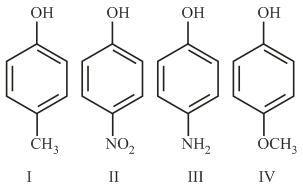
To determine the increasing order of boiling points of the given substituted phenols, we compare the intermolecular forces present in each compound, particularly hydrogen bonding and dipole-dipole interactions.
All four compounds contain a phenolic $$-OH$$ group capable of forming intermolecular hydrogen bonds. Therefore, differences in boiling point arise mainly from the nature of the substituent attached to the benzene ring, which influences the strength of these intermolecular interactions.
In $$p$$-cresol (I), the $$-CH_3$$ group is an electron-donating substituent through the $$+I$$ effect. It slightly decreases the acidity of the phenolic $$-OH$$ group and weakens intermolecular hydrogen bonding, resulting in the lowest boiling point among the given compounds.
In $$p$$-methoxyphenol (IV), the $$-OCH_3$$ group donates electrons through the $$+R$$ effect. Although it enhances molecular polarity to some extent, its overall contribution to intermolecular attraction is greater than that of the methyl group, giving it a boiling point slightly higher than $$p$$-cresol.
In $$p$$-nitrophenol (II), the strongly electron-withdrawing $$-NO_2$$ group exerts both $$-I$$ and $$-R$$ effects, increasing the acidity of the phenolic $$-OH$$ group and strengthening intermolecular hydrogen bonding. The high polarity of the nitro group also enhances dipole-dipole interactions, leading to a comparatively higher boiling point.
In $$p$$-aminophenol (III), the $$-NH_2$$ group itself can participate in intermolecular hydrogen bonding in addition to the phenolic $$-OH$$ group. The presence of both hydrogen bond donor and acceptor sites creates an extensive hydrogen-bonding network, resulting in the highest boiling point among the four compounds.
Therefore, the increasing order of boiling points is
$$\boxed{\text{I} < \text{IV} < \text{II} < \text{III}}$$
which corresponds to the option B.
The potential energy curve for the $$\text{H}_2$$ molecule as a function of internuclear distance is:
For a diatomic molecule such as $$\text{H}_2$$ we define the potential energy $$V(r)$$ as a function of the internuclear distance $$r$$, where $$r$$ is the separation between the two hydrogen nuclei. By convention, the energy of the two hydrogen atoms taken infinitely far apart is set equal to zero, that is
$$\displaystyle \lim_{r \to \infty} V(r)=0.$$
When the two atoms come closer than this “infinite” separation, two opposite effects operate simultaneously:
(i) The electrostatic attraction between the electron of one atom and the nucleus of the other atom lowers the energy. In the simplest qualitative form, this attractive part is proportional to $$-\dfrac{A}{r}$$, where $$A$$ is a positive constant.
(ii) At very small separations the two positively charged nuclei repel each other strongly, and Pauli‐exclusion‐driven electron repulsion also becomes important. The repulsive part is often written phenomenologically as $$\dfrac{B}{r^{n}}$$ or, more realistically, $$Be^{-cr}$$ with $$B,c>0$$, so that it rises steeply as $$r$$ decreases.
Adding the two contributions we obtain a qualitative expression
$$V(r)= -\dfrac{A}{r}+Be^{-cr},$$
which is negative for an intermediate range of $$r$$ (because the attractive term dominates) and becomes positive when $$r$$ is made very small (because the repulsion takes over). The curve therefore has a single minimum at a particular separation $$r=r_0$$, called the equilibrium bond length. Mathematically, at this point
$$\left.\dfrac{dV}{dr}\right|_{r=r_0}=0 \quad\text{and}\quad V(r_0)<0.$$
As $$r\to\infty$$ the curve approaches the zero line from below, representing the dissociation of the molecule into two separate hydrogen atoms with no interaction energy. Summarising the essential features:
1. $$V(r)$$ is negative for $$r$$ near $$r_0$$ and has its minimum there.
2. $$V(r)\to +\infty$$ as $$r\to 0$$ because of strong repulsion.
3. $$V(r)\to 0^{-}$$ as $$r\to\infty$$, approaching the horizontal axis asymptotically.
Among the four curves supplied in the options, only Option (2) displays exactly these three characteristics: it starts very high and positive at $$r=0$$, dips below the zero line to a distinct minimum, and then climbs gradually to reach zero from the negative side at large $$r$$. The other curves fail to satisfy one or more of these conditions (for example, some never become negative, some do not rise steeply at small $$r$$, and so on).
Hence, the correct answer is Option B (Option 2).
The reaction in which the hybridisation of the underlined atom is affected is
We begin by recalling that the hybridisation of the central atom in any species is decided by the total number of σ-bonds plus lone pairs around that atom. A convenient expression for the steric number (SN) is
$$\text{SN}=\frac12\left(V+M-C+A\right),$$
where
$$V=\text{valence electrons of the central atom},$$
$$M=\text{number of monovalent atoms attached},$$
$$C=\text{charge on the cation (if any)},$$
$$A=\text{charge on the anion (if any)}.$$
The hybridisation is then
$$ \begin{aligned} \text{SN}=2 &\;\Rightarrow\; sp,\\ \text{SN}=3 &\;\Rightarrow\; sp^2,\\ \text{SN}=4 &\;\Rightarrow\; sp^3,\\ \text{SN}=5 &\;\Rightarrow\; sp^3d,\\ \text{SN}=6 &\;\Rightarrow\; sp^3d^2. \end{aligned} $$
Now we analyse every option one by one, always determining the steric number before and after the reaction.
Option A: $$\underline{H_3PO_2}\;\overset{\text{disproportionation}}{\rightarrow}\;PH_3+H_3PO_3$$
• In $$H_3PO_2$$ the phosphorus forms two $$P\!-\!H$$ $$\sigma$$-bonds, one $$P\!-\!OH$$ $$\sigma$$-bond and contains one lone pair: SN $$=3\sigma+1\text{ LP}=4\Rightarrow sp^3.$$
• In $$PH_3$$ the phosphorus has three $$P\!-\!H$$ bonds and one lone pair: SN $$=4\Rightarrow sp^3.$$
• In $$H_3PO_3$$ the phosphorus has three $$P\!-\!OH$$ bonds and one lone pair: SN $$=4\Rightarrow sp^3.$$
Because the hybridisation remains $$sp^3$$ throughout, the underlined atom’s hybridisation is unchanged.
Option B: $$H_2SO_4+NaCl\overset{420\,\text{K}}{\rightarrow}\;NaHSO_4+HCl$$
• Sulphur in both $$H_2SO_4$$ and $$NaHSO_4$$ is present in the tetrahedral $$\text{SO}_4^{2-}$$ skeleton. Each has four σ-bonds and no lone pair on sulphur, so SN $$=4\Rightarrow sp^3.$$
Hence the hybridisation of sulphur does not change.
Option C: $$\underline{NH_3}\overset{H^+}{\rightarrow}NH_4^+$$
• In $$NH_3$$ we have three $$N\!-\!H$$ bonds and one lone pair: SN $$=4\Rightarrow sp^3.$$
• In $$NH_4^+$$ we have four $$N\!-\!H$$ bonds and no lone pair: SN $$=4\Rightarrow sp^3.$$
So the nitrogen retains $$sp^3$$ hybridisation; no change occurs.
Option D: $$\underline{Xe}F_4+SbF_5\;\longrightarrow\;XeF_3^++SbF_6^-$$
• In $$XeF_4$$ xenon is surrounded by four $$Xe\!-\!F$$ σ-bonds and two lone pairs: SN $$=4\sigma+2\text{ LP}=6\Rightarrow sp^3d^2.$$ (This corresponds to the square-planar shape after accounting for lone-pair positions.)
• In $$XeF_3^+$$ xenon carries three $$Xe\!-\!F$$ σ-bonds and now only two lone pairs because of the positive charge: SN $$=3\sigma+2\text{ LP}=5\Rightarrow sp^3d.$$ The geometry becomes T-shaped.
Thus the steric number drops from 6 to 5 and the hybridisation changes from $$sp^3d^2$$ to $$sp^3d.$$
Among all the options, only in Option D does the underlined atom experience a change in hybridisation.
Hence, the correct answer is Option 4.
The shape/structure of $$[XeF_5]^-$$ and $$XeO_3F_2$$, respectively are:
We begin with the anion $$[XeF_5]^-.$$
For VSEPR calculations we first count the electrons present on the central atom in the following standard way:
Steric number = $$\dfrac{\text{valence electrons of the central atom} + \text{electrons contributed by all monovalent ligands} - \text{charge}}{2}.$$
• Xenon belongs to group 18, so it possesses $$8$$ valence electrons.
• Five fluorine atoms are monovalent; each contributes one electron to a σ-bond, giving $$5$$ electrons.
• The ion carries a charge of $$-1,$$ which adds one more electron.
Putting these values into the formula, we get
$$\text{Steric number}=\dfrac{8+5+1}{2}= \dfrac{14}{2}=7.$$
So around xenon there are $$7$$ electron pairs: $$5$$ bonding pairs (one for every Xe-F σ-bond) and $$2$$ lone pairs. For steric number 7 the ideal electron-pair arrangement is pentagonal bipyramidal. To minimise repulsion, both lone pairs occupy the two axial positions, leaving the five fluorine atoms in a single equatorial plane. Hence the observable molecular geometry is
$$\boxed{\text{pentagonal planar}}.$$
Now we examine $$XeO_3F_2.$$
Here xenon is bonded to three oxygen atoms and two fluorine atoms, giving a total of five σ-bonds.
• Xenon again supplies $$8$$ valence electrons.
• Two Xe-F σ-bonds use one electron each from xenon, consuming $$2$$ electrons.
• Each oxygen is double-bonded to xenon. A double bond contains one σ and one π pair; the σ part consumes one electron from Xe, the π part consumes a second electron. Thus the three Xe=O bonds together take $$3\times2=6$$ electrons from xenon.
• Altogether xenon uses $$2+6=8$$ of its electrons in bonding, exhausting its valence shell and leaving $$0$$ electrons for lone pairs.
Therefore
number of σ-bonds $$=5,\qquad \text{number of lone pairs}=0,$$
so the steric number equals $$5.$$ The electron-pair geometry for steric number 5 is trigonal bipyramidal, and because there are no lone pairs, the molecular shape is also
$$\boxed{\text{trigonal bipyramidal}}.$$
Thus the geometries are pentagonal planar for $$[XeF_5]^-$$ and trigonal bipyramidal for $$XeO_3F_2.$
Comparing with the choices given, Option A lists these two shapes in the required order.
Hence, the correct answer is Option A.
If the magnetic moment of a di-oxygen species is 1.73 B.M., it may be:
We start with the spin‐only magnetic-moment formula that is used for molecules and transition-metal ions:
$$\mu = \sqrt{n(n+2)}\;\text{B.M.}$$
Here $$n$$ is the number of unpaired electrons and $$\mu$$ is given in Bohr Magnetons (B.M.).
The question tells us that the observed magnetic moment is $$\mu = 1.73\;\text{B.M.}$$
Now we substitute this value into the formula and solve for $$n$$:
$$1.73 = \sqrt{n(n+2)}$$
Squaring both sides gives
$$1.73^2 = n(n+2).$$
Since $$1.73^2 \approx 3.00,$$ we have
$$n(n+2) = 3.$$
Because $$n$$ must be a whole number (one cannot have a fractional unpaired electron), we test small integral values of $$n$$:
For $$n = 0:\;0(0+2)=0\ne3$$
For $$n = 1:\;1(1+2)=1\times3=3$$
The equality is satisfied when $$n = 1$$. So the species we are looking for must possess exactly one unpaired electron.
Next we examine the molecular orbital configurations of the given dioxygen species using the well-accepted ordering for $$\mathrm{O_2}$$ and its ions (after $$\sigma_{2p_z}$$ the $$\pi_{2p_x}$$ and $$\pi_{2p_y}$$ come before $$\pi_{2p_x}^\*,\;\pi_{2p_y}^\*$$):
Neutral $$\mathrm{O_2}$$ has 16 electrons. Its valence-orbital filling ends as
$$\pi_{2p_x}^2\;\pi_{2p_y}^2\;\pi_{2p_x}^\*{}^1\;\pi_{2p_y}^\*{}^1$$
This leaves two unpaired electrons (one in each $$\pi^\*$$), so $$n = 2$$ and $$\mu \approx 2.83\;\text{B.M.}$$, not 1.73.
The cation $$\mathrm{O_2^+}$$ has one electron fewer (15 electrons). Removing one of the antibonding electrons gives
$$\pi_{2p_x}^2\;\pi_{2p_y}^2\;\pi_{2p_x}^\*{}^1\;\pi_{2p_y}^\*{}^0$$
Now only one antibonding orbital contains a single electron, so $$n = 1$$ and $$\mu = 1.73\;\text{B.M.}$$ exactly as required.
The anion $$\mathrm{O_2^-}$$ has one electron more than neutral $$\mathrm{O_2}$$ (17 electrons). The extra electron enters one of the antibonding $$\pi^\*$$ orbitals:
$$\pi_{2p_x}^2\;\pi_{2p_y}^2\;\pi_{2p_x}^\*{}^2\;\pi_{2p_y}^\*{}^1$$
Again there is only one unpaired electron (now in the other $$\pi^\*$$), so $$n = 1$$ and $$\mu = 1.73\;\text{B.M.}$$
Finally, $$\mathrm{O_2^{2-}}$$ (peroxide) would have even numbers of electrons in all orbitals, giving $$n = 0$$, so it is diamagnetic and not listed among the options anyway.
Putting everything together, the species that exhibit a magnetic moment of $$1.73\;\text{B.M.}$$ are those containing exactly one unpaired electron, namely $$\mathrm{O_2^-}$$ and $$\mathrm{O_2^+}$$.
Hence, the correct answer is Option A.
Match the type of interaction in column A with the distance dependence of their interaction energy in column B:
A B
(i) ion - ion (a) $$\frac{1}{r}$$
(ii) Dipole - dipole (b) $$\frac{1}{r^2}$$
(iii) London dispersion (c) $$\frac{1}{r^3}$$
(iv) $$\frac{1}{r^6}$$
We begin by recalling the general form of the potential (interaction) energy for the three kinds of intermolecular or inter-ionic forces given in the question.
For two oppositely or similarly charged ions (ion-ion interaction), Coulomb’s law tells us that the potential energy $$E$$ varies inversely with the separation $$r$$ between their centres. Stated mathematically, the law is
$$E \;=\; \dfrac{kq_1q_2}{r},$$
where $$k$$ is Coulomb’s constant and $$q_1, q_2$$ are the ionic charges. The key point for matching is the $$\dfrac{1}{r}$$ dependence.
Next, for two permanent electric dipoles (dipole-dipole interaction) the classical electrostatic derivation gives
$$E \;=\; -\,\dfrac{\mu_1\mu_2}{4\pi\varepsilon_0\,r^{3}},$$
where $$\mu_1, \mu_2$$ are the dipole moments. Here we clearly see the $$\dfrac{1}{r^{3}}$$ dependence.
Finally, London dispersion forces (also called induced-dipole-induced-dipole forces) arise from correlated instantaneous charge fluctuations. Quantum-mechanical treatment leads to the well-known expression
$$E \;=\; -\,\dfrac{C_6}{r^{6}},$$
where $$C_6$$ is a constant characteristic of the interacting species. Thus the dependence is $$\dfrac{1}{r^{6}}$$.
Let us now compare these powers of $$r$$ with the entries listed in column B.
We have
$$\dfrac{1}{r}\;=\;(a), \qquad \dfrac{1}{r^{2}}\;=\;(b), \qquad \dfrac{1}{r^{3}}\;=\;(c), \qquad \dfrac{1}{r^{6}}\;=\;(d).$$
Substituting the results obtained above:
• Ion-ion corresponds to $$\dfrac{1}{r} \;\Rightarrow\; (a).$$
• Dipole-dipole corresponds to $$\dfrac{1}{r^{3}} \;\Rightarrow\; (c).$$
• London dispersion corresponds to $$\dfrac{1}{r^{6}} \;\Rightarrow\; (d).$$
Putting these matches together, we get
$$(i)\!-\!(a),\; (ii)\!-\!(c),\; (iii)\!-\!(d).$$
Looking at the four options supplied, this exact sequence appears only in Option D.
Hence, the correct answer is Option D.
The compound that has the largest $$H-M-H$$ bond angle ($$M = N, O, S, C$$) is:
We recall VSEPR theory, which states that the shape of a molecule is decided by the total number of electron pairs (bond pairs + lone pairs) surrounding the central atom. The ideal geometries and the corresponding bond angles can be predicted once we know this number. Larger bond angles arise when there are fewer lone-pair-bond-pair repulsions, because lone pairs occupy more space than bond pairs.
Let us examine each molecule one by one.
First, $$\text{H}_2\text{O}$$. The central atom is oxygen. Oxygen has $$6$$ valence electrons. With two $$\text{O-H}$$ bonds, two electrons are used in each bond pair, so $$4$$ electrons remain as two lone pairs. Thus, total electron pairs $$= 2$$ bond pairs $$+ 2$$ lone pairs $$= 4$$. According to VSEPR, $$4$$ electron pairs give a tetrahedral arrangement. However, because there are two lone pairs, the molecular shape becomes bent (angular). Lone-pair-lone-pair and lone-pair-bond-pair repulsions compress the $$\text{H-O-H}$$ angle below the ideal $$109.5^\circ$$. Experimentally,
$$\angle \text{H-O-H}=104.5^\circ.$$
Next, $$\text{NH}_3$$. The nitrogen atom has $$5$$ valence electrons. Three electrons take part in three $$\text{N-H}$$ bonds, leaving $$2$$ electrons as one lone pair. Total electron pairs $$= 3$$ bond pairs $$+ 1$$ lone pair $$= 4$$, again a tetrahedral arrangement of electron pairs. Only one lone pair is present, so the compression is less than in water. The measured bond angle is
$$\angle \text{H-N-H}=107^\circ.$$
Now, $$\text{H}_2\text{S}$$. Sulphur has $$6$$ valence electrons like oxygen, so the count is identical to water: two bond pairs and two lone pairs. Because sulphur is larger and the $$\text{S-H}$$ bonds are longer, the bond-pair-bond-pair repulsion is even weaker, allowing lone pairs to spread out more, which further contracts the bond angle. The observed value is approximately
$$\angle \text{H-S-H}\approx92^\circ.$$
Finally, $$\text{CH}_4$$. Carbon has $$4$$ valence electrons, each forming a $$\text{C-H}$$ bond. There are
$$4\text{ bond pairs} + 0\text{ lone pairs} = 4\text{ electron pairs}.$$
With no lone pairs, the geometry remains the ideal tetrahedron, and no compression occurs. Therefore,
$$\angle \text{H-C-H}=109.5^\circ.$$
Comparing all the angles we obtained:
$$\angle\text{H-C-H}=109.5^\circ > \angle\text{H-N-H}=107^\circ > \angle\text{H-O-H}=104.5^\circ > \angle\text{H-S-H}\approx92^\circ.$$
Clearly, the largest $$\text{H-M-H}$$ bond angle is in methane, $$\text{CH}_4$$, which corresponds to Option D.
Hence, the correct answer is Option D.
The dipole moments of CCl$$_4$$, CHCl$$_3$$ and CH$$_4$$ are in the order
First, we recall the definition of dipole moment. The magnitude of the dipole moment is written as $$\mu = q \times d$$, where $$q$$ is the magnitude of charge and $$d$$ is the distance between the centres of positive and negative charges. In a molecule, the individual bond dipoles are treated as vectors, and the net dipole moment is obtained by vector (head-to-tail) addition of all the bond dipoles.
Now we analyse each of the three molecules one by one, keeping in mind their shapes and the directions of the individual bond dipoles.
For $$CH_4$$ (methane) the molecular geometry is perfectly tetrahedral. All four $$C-H$$ bonds are identical and symmetrically oriented at equal angles of $$109.5^{\circ}$$. Each $$C-H$$ bond has a small bond dipole pointing from carbon towards hydrogen because carbon is slightly more electronegative than hydrogen. Because the four bond dipoles are equal in magnitude and symmetrically arranged, the vector sum of the four dipoles is exactly zero:
$$\vec{\mu}_{CH_4} = \vec{\mu}_1 + \vec{\mu}_2 + \vec{\mu}_3 + \vec{\mu}_4 = 0$$
Hence, $$\mu(CH_4) = 0\;\text{Debye}$$. So methane is a non-polar molecule.
For $$CCl_4$$ (carbon tetrachloride) the geometry is again perfectly tetrahedral. Now each $$C-Cl$$ bond dipole is larger in magnitude than a $$C-H$$ bond dipole because chlorine is much more electronegative than carbon. However, the four $$C-Cl$$ bond dipoles are still equal in magnitude and symmetrically oriented at the tetrahedral angles. The vector addition again gives zero:
$$\vec{\mu}_{CCl_4} = \vec{\mu}'_1 + \vec{\mu}'_2 + \vec{\mu}'_3 + \vec{\mu}'_4 = 0$$
Thus $$\mu(CCl_4) = 0\;\text{Debye}$$ as well. Even though each individual $$C-Cl$$ bond is quite polar, the symmetry causes complete cancellation.
For $$CHCl_3$$ (chloroform) the molecular geometry is still tetrahedral, but now three positions are occupied by chlorine atoms and one position by a hydrogen atom. Let us denote the bond dipoles by vectors. Each $$C-Cl$$ bond dipole is strong and points from carbon to chlorine, while the $$C-H$$ bond dipole is weak and points from carbon to hydrogen. The three identical $$C-Cl$$ vectors do not cancel each other perfectly because they occupy only three corners of the tetrahedron; the fourth corner has a weaker $$C-H$$ dipole. When we add these four vectors, the much larger resultant of the three $$C-Cl$$ vectors is only partially cancelled by the smaller $$C-H$$ vector. Consequently, a non-zero net dipole moment is obtained:
$$\vec{\mu}_{CHCl_3} = (\vec{\mu}_{C-Cl,1} + \vec{\mu}_{C-Cl,2} + \vec{\mu}_{C-Cl,3}) + \vec{\mu}_{C-H} \neq 0$$
Thus $$\mu(CHCl_3) > 0\;\text{Debye}$$ and its value is significantly larger than the (zero) dipole moments of $$CH_4$$ and $$CCl_4$$.
Collecting the results, we have
$$\mu(CH_4) = 0,\; \mu(CCl_4) = 0,\; \mu(CHCl_3) > 0.$$
Therefore the order of dipole moments is
$$CH_4 = CCl_4 \;<\; CHCl_3.$$
Among the given options, this corresponds exactly to
Option D: $$CH_4 = CCl_4 \;<\; CHCl_3$$.
Hence, the correct answer is Option D.
The intermolecular potential energy for the molecules A, B, C and D given below suggests that:
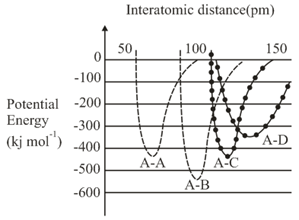
The molecule in which hybrid MOs involve only one d-orbital of the central atom is:
We begin by recalling that the type of hybridisation tells us how many and which orbitals of the central atom mix to form the hybrid molecular orbitals (MOs).
For our purpose we must identify the species in which exactly one 3d (or 4d, 5d …) orbital of the central atom participates.
The possible common hybrid schemes are:
$$\text{dsp} ^2 :\; 1d + 1s + 2p \;( \text{total } 4$$ hybrids, square-planar $$)$$
$$\text{sp} ^3 \text{d} ^2 \;( \text{or } \text{d} ^2 \text{sp} ^3):\; 2d + 1s + 3p \;( \text{total } 6$$ hybrids, octahedral or its derivatives $$)$$
Thus, a species showing dsp2 hybridisation will involve only one d orbital, whereas any species with sp3d2 (or d2sp3) must necessarily involve two d orbitals.
Now we analyse each option one by one.
Option A: $$[Ni(CN)_4]^{2-}$$
Nickel is the central atom. First we write its ground-state configuration:
$$\mathrm{Ni}:\; [Ar]\,3d^8 4s^2$$
In the complex, nickel is present as $$\mathrm{Ni^{2+}}$$, so we remove two 4s electrons:
$$\mathrm{Ni^{2+}}:\; [Ar]\,3d^8$$
The ligand $$\mathrm{CN^-}$$ is a strong field ligand (spectrochemical series), so it pairs up the 3d electrons. After pairing we have:
$$\text{Filled }3d: \uparrow\downarrow\,\uparrow\downarrow\,\uparrow\downarrow\,\uparrow\downarrow$$
$$\text{Empty }3d: \_\_\_$$
Thus one 3d orbital (usually $$d_{x^2-y^2}$$) becomes vacant and can participate in hybridisation together with one 4s and two 4p orbitals:
$$1(3d) + 1(4s) + 2(4p) \;\longrightarrow\; 4\,\text{dsp}^2\text{ hybrids}$$
This is square-planar geometry. Hence only one d-orbital is involved.
Option B: $$BrF_5$$
$$\mathrm{Br}$$ has seven valence electrons, and five $$\mathrm{F}$$ atoms plus one lone pair give six electron domains in total. Hybridisation is therefore $$\text{sp}^3\text{d}^2$$ (or $$\text{d}^2\text{sp}^3$$), which uses two d orbitals.
Option C: $$XeF_4$$
For xenon, six electron domains (four bonds + two lone pairs) again require $$\text{sp}^3\text{d}^2$$ hybridisation, involving two d orbitals.
Option D: $$[CrF_6]^{3-}$$
Whether we describe it as inner-orbital $$\text{d}^2\text{sp}^3$$ or outer-orbital $$\text{sp}^3\text{d}^2$$, an octahedral species always employs two d orbitals.
From the above comparison, the only species whose hybrid MOs draw upon exactly one d orbital is $$[Ni(CN)_4]^{2-}$$.
Hence, the correct answer is Option A.
The predominant intermolecular forces present in ethyl acetate, a liquid, are:
We begin by recalling that in any molecular liquid three main types of intermolecular forces are possible—London dispersion forces, dipole–dipole interactions, and hydrogen bonding.
First, London dispersion forces arise from momentary fluctuations in electron distribution that create instantaneous dipoles. These forces act between all molecules, whether polar or non-polar. Hence every liquid, including ethyl acetate, necessarily possesses London dispersion forces.
Next, we must check for a permanent molecular dipole. Ethyl acetate has the molecular formula $$\mathrm{CH_3COOCH_2CH_3}$$. The carbonyl group $$\mathrm{C=O}$$ is strongly polarized because oxygen is more electronegative than carbon. Therefore the electron cloud is pulled toward the oxygen, creating a permanent partial negative charge ($$\delta^-$$) on the oxygen and a corresponding partial positive charge ($$\delta^+$$) on the carbon. This permanent charge separation means the molecule is polar. A polar molecule experiences dipole–dipole interactions with its neighbours. Thus dipole–dipole forces are also present in ethyl acetate.
Finally, we test the conditions for hydrogen bonding. The rule is that a hydrogen bond can form only when a hydrogen atom is covalently bonded to a highly electronegative atom, specifically $$\mathrm{F}$$, $$\mathrm{O}$$, or $$\mathrm{N}$$. In ethyl acetate every hydrogen is bonded to carbon, not to fluorine, oxygen, or nitrogen. Therefore ethyl acetate molecules cannot serve as hydrogen donors, and true intermolecular hydrogen bonding does not occur between them.
Collecting all our observations:
$$\text{Present forces} = \text{London dispersion} + \text{dipole–dipole}$$
$$\text{Absent force} = \text{hydrogen bonding}$$
Among the given choices, only Option A lists exactly London dispersion and dipole–dipole interactions.
Hence, the correct answer is Option A.
The molecular geometry of $$SF_6$$ is octahedral. What is the geometry of $$SF_4$$ (including lone pair(s) of electrons, if any)?
We begin by counting the total number of valence electrons around the central atom sulphur in $$SF_4$$.
Atomic sulphur lies in Group 16, so it provides $$6$$ valence electrons. Each fluorine atom lies in Group 17 and contributes $$7$$ valence electrons. Because there are four fluorine atoms, the contribution from fluorine is $$4 \times 7 = 28$$ electrons.
Adding these values we obtain the total number of valence electrons present in one $$SF_4$$ molecule:
$$6 + 28 = 34 \text{ electrons}$$
Next, we distribute these electrons to form single S-F bonds. A single covalent bond contains two electrons. With four S-F bonds we must allocate
$$4 \times 2 = 8 \text{ electrons}$$
Subtracting these from the total gives the electrons that are still unassigned:
$$34 - 8 = 26 \text{ electrons}$$
Every fluorine atom requires an octet. Each already owns two bonding electrons, so each fluorine still needs $$6$$ more. For all four fluorine atoms this means
$$4 \times 6 = 24 \text{ electrons}$$
Placing those $$24$$ electrons as lone pairs on fluorine leaves
$$26 - 24 = 2 \text{ electrons}$$
These two electrons remain with sulphur as one lone pair. Thus around the central sulphur we have
• $$4$$ bonding pairs (one along each S-F bond)
• $$1$$ lone pair.
The sum of bonding pairs and lone pairs is called the steric number. Therefore
$$\text{Steric number} = 4 + 1 = 5$$
VSEPR (Valence-Shell Electron-Pair Repulsion) theory states: "An arrangement of $$5$$ electron pairs around a central atom adopts a trigonal-bipyramidal electron-pair geometry to minimize repulsions."
Hence the electron-pair geometry of $$SF_4$$, which explicitly includes the lone pair, is trigonal bipyramidal.
(If one talks only about the positions of the atoms and ignores the lone pair, the molecular shape is a see-saw, but that choice is not offered in the options.)
So, the geometry requested in the problem—"including lone pair(s) of electrons"—is trigonal bipyramidal.
Hence, the correct answer is Option 2.
The relative strength of the interionic/ intermolecular forces in a decreasing order is:
We begin by recalling Coulomb’s law, which gives the electrostatic force between two point charges:
$$F \;=\; \dfrac{k\,|q_1 q_2|}{r^{2}}$$
Here $$k$$ is Coulomb’s constant, $$q_1$$ and $$q_2$$ are the magnitudes of the charges and $$r$$ is the separation between them. When both interacting species carry full charges (ions), each particle behaves like a point charge, so the interaction is purely $$1/r^{2}$$ and very strong.
Next, we consider an ion interacting with a polar molecule (a dipole). A permanent dipole may be represented by two equal and opposite charges $$+q$$ and $$-q$$ separated by a small distance $$d$$. The resultant dipole moment is $$\mu = qd$$. When such a dipole approaches an ion of charge $$Q$$, the force varies as
$$F \;\propto\; \dfrac{|Q|\mu}{r^{3}}$$
because the ion feels attractions and repulsions from the two ends of the dipole that do not cancel completely. The extra power of $$r$$ in the denominator ($$r^{3}$$ instead of $$r^{2}$$) shows that the ion-dipole force decays faster with distance and is therefore weaker than the ion-ion force.
Finally, we analyse dipole-dipole interaction. Two permanent dipoles with moments $$\mu_1$$ and $$\mu_2$$ interact with a force that, in its simplest angular average, follows
$$F \;\propto\; \dfrac{\mu_1 \mu_2}{r^{4}}$$
The $$r^{4}$$ dependence means that this force falls off even more rapidly with distance, so it is weaker than both ion-ion and ion-dipole interactions.
Putting these observations together, we obtain the following descending order of strength:
$$\text{ion-ion} \; > \; \text{ion-dipole} \; > \; \text{dipole-dipole}$$
This sequence exactly matches the arrangement given in Option D.
Hence, the correct answer is Option D.
Hydrogen peroxide, in the pure state, is:
We begin with the formula of hydrogen peroxide, which is written as $$\mathrm{H_2O_2}$$. Each oxygen atom in this molecule possesses two lone pairs of electrons in addition to the two bonds it forms (one $$\mathrm{O\!-\!O}$$ bond and one $$\mathrm{O\!-\!H}$$ bond). Because a total of four regions of electron density surround every oxygen, we invoke the VSEPR (Valence Shell Electron Pair Repulsion) principle, which tells us that
$$$\text{four electron pairs} \;\Longrightarrow\; \text{approximately tetrahedral electron-pair geometry}.$$$
Now, in such a tetrahedral arrangement, the two lone pairs occupy positions that push the bonding pairs away, creating bond angles smaller than the ideal $$109.5^{\circ}$$. Importantly, the two $$\mathrm{O\!-\!H}$$ bonds do not lie in the same plane as the $$\mathrm{O\!-\!O}$$ bond; instead they fold out of the plane, giving the entire $$\mathrm{H_2O_2}$$ molecule a twisted “open-book” shape. Experimental measurements show that the dihedral angle between the two $$\mathrm{HO\!-\!O}$$ planes is about $$94^{\circ}$$. Because the four atoms $$\mathrm{H-O-O-H}$$ cannot be placed in a single plane simultaneously, we say the molecule is non-planar (and certainly not linear).
Next, we consider its appearance. Absolutely pure hydrogen peroxide is a very pale blue, syrup-like liquid. However, the blue tint is so faint that in ordinary laboratory samples—or in thin layers—it looks essentially colorless to the naked eye. Chemists therefore describe the substance as “almost colorless.”
Putting these two points together:
• Geometry ⇒ non-planar (definitely not linear).
• Colour ⇒ almost colorless (not appreciably blue to normal vision).
These two characteristics match exactly with Option A.
Hence, the correct answer is Option A.
A crystal is made up of metal ions 'M1' and 'M2' and oxide ions. Oxide ions form a ccp lattice structure. The cation 'M1' occupies 50% of octahedral voids and the cation 'M2' occupies 12.5% of tetrahedral voids of oxide lattice. The oxidation numbers of 'M1' and 'M2' are respectively:
We are told that oxide ions build a cubic close-packed (ccp, i.e. face-centred cubic) lattice. In a ccp lattice:
• The number of anions (oxide ions, here) present in one unit cell is 4.
• The number of octahedral voids present in one unit cell is equal to the number of lattice points, so it is also 4.
• The number of tetrahedral voids present in one unit cell is twice the number of lattice points, so it is 8.
Let us now count how many metal ions are inserted into these voids.
The cation $$\mathrm{M_1}$$ occupies 50 % of the octahedral voids. We have
$$\text{Number of octahedral voids}=4, \qquad 50\%=\dfrac{50}{100}=0.5.$$So
$$\text{Number of }\mathrm{M_1}\text{ ions}=4 \times 0.5 = 2.$$The cation $$\mathrm{M_2}$$ occupies 12.5 % of the tetrahedral voids. We have
$$\text{Number of tetrahedral voids}=8, \qquad 12.5\%=\dfrac{12.5}{100}=0.125.$$So
$$\text{Number of }\mathrm{M_2}\text{ ions}=8 \times 0.125 = 1.$$Now we summarise the contents of one unit cell:
$$\mathrm{O^{2-}} : 4, \qquad \mathrm{M_1} : 2, \qquad \mathrm{M_2} : 1.$$Hence the empirical formula of the solid is
$$\mathrm{M_1}_2\mathrm{M_2}\mathrm{O}_4.$$Next we use charge neutrality. Let the oxidation numbers of $$\mathrm{M_1}$$ and $$\mathrm{M_2}$$ be $$x$$ and $$y$$ respectively. We write the total charge balance equation:
$$\underbrace{2x}_{\text{from }\mathrm{M_1}} \;+\; \underbrace{y}_{\text{from }\mathrm{M_2}} \;+\; \underbrace{4(-2)}_{\text{from }4\mathrm{O^{2-}}}=0.$$Simplifying, we obtain
$$2x + y - 8 = 0,$$ $$2x + y = 8.$$We now test the given options one by one.
Option A gives $$x=+2,\;y=+4.$$ Substituting,
$$2(2) + 4 = 4 + 4 = 8,$$which satisfies $$2x + y = 8.$$
Option B gives $$x=+1,\;y=+3$$ giving $$2(1)+3 = 5 \neq 8.$$
Option C gives $$x=+3,\;y=+1$$ giving $$2(3)+1 = 7 \neq 8.$$
Option D gives $$x=+4,\;y=+2$$ giving $$2(4)+2 = 10 \neq 8.$$
Only Option A fulfils the electro-neutrality condition.
Hence, the correct answer is Option A.
'X' melts at low temperature and is a bad conductor of electricity in both liquid and solid state. X is:
We begin by recalling some fundamental bonding concepts:
1. Metals possess a sea of delocalised electrons, so they conduct electricity in the $$\text{solid}$$ as well as in the $$\text{liquid}$$ state. Their melting points are usually moderate to high.
2. Ionic compounds (for example, sodium chloride) consist of oppositely charged ions held together by strong electrostatic forces. Therefore, they generally have very high melting points. They are $$\text{non-conductors}$$ in the solid state because the ions are locked in position, but they become $$\text{good conductors}$$ when molten or dissolved in water, as the ions are then free to move.
3. Giant covalent (network) solids such as $$\text{SiC}$$ or diamond have extremely strong covalent bonds throughout the lattice. Consequently, they melt only at very high temperatures and are usually $$\text{electrical insulators}$$ (diamond) or at best semiconductors (SiC).
4. Simple (discrete) covalent molecular substances are held together internally by covalent bonds but interact with one another only through weak van der Waals forces. Because these intermolecular forces are weak, the melting points are low. In addition, there are no free ions or mobile electrons, so these substances are $$\text{poor conductors}$$ of electricity in both the solid and the liquid state.
Now we examine each option in the light of these points:
(A) Zinc sulphide, $$\text{ZnS}$$
Zinc sulphide crystallises in a close-packed lattice akin to $$\text{ZnS}$$ (zinc-blend) structure. The bonding is largely ionic with a degree of covalency. Because of the strong lattice, its melting point is very high (well above $$1000\ ^\circ\text{C}$$). Although it is an electrical insulator in the solid state, its molten form contains mobile $$\text{Zn}^{2+}$$ and $$\text{S}^{2-}$$ ions and would thus conduct electricity. Therefore, it does not match the given description.
(B) Mercury, $$\text{Hg}$$
Mercury is a metal. A characteristic property of metals is the presence of delocalised electrons; hence mercury conducts electricity in both states. Although mercury indeed melts at the unusually low temperature of $$-38.9\ ^\circ\text{C}$$, the key phrase "bad conductor of electricity in both liquid and solid state" rules it out.
(C) Silicon carbide, $$\text{SiC}$$
Silicon carbide is a giant covalent (network) crystal similar to diamond. Its melting point is extremely high (about $$2730\ ^\circ\text{C}$$), immediately disqualifying it, since the substance in question melts "at low temperature." Moreover, while pure $$\text{SiC}$$ is an insulator at room temperature, at elevated temperatures it shows semiconducting behaviour, so electrical properties still do not fully satisfy the requirement.
(D) Carbon tetrachloride, $$\text{CCl}_{4}$$
Carbon tetrachloride is a simple covalent molecule. The only attractive forces between individual $$\text{CCl}_{4}$$ molecules are weak London dispersion forces. Consequently, its melting point is very low (about $$-23\ ^\circ\text{C}$$). There are no free electrons or ions present in either the solid or liquid form, so $$\text{CCl}_{4}$$ is a $$\text{bad conductor}$$ of electricity in both states.
Comparing all four options, only carbon tetrachloride simultaneously satisfies both criteria: $$\text{low melting point}$$ and $$\text{poor electrical conductivity}$$ in solid as well as liquid form.
Hence, the correct answer is Option D.
A diatomic molecule $$\text{X}_2$$ has a body-centred cubic (bcc) structure with a cell edge of $$300\,\text{pm}$$. The density of the molecule is $$6.17\,\text{g cm}^{-3}$$. The number of molecules present in $$200\,\text{g}$$ of $$\text{X}_2$$ is: (Avogadro constant $$(N_A) = 6 \times 10^{23}\,\text{mol}^{-1}$$)
We make use of the well-known relation that connects density $$\rho$$ of a crystalline solid with its unit-cell parameters:
$$\rho \;=\; \dfrac{Z\,M}{N_A\,a^{3}}$$
Here $$Z$$ is the number of formula units (molecules, in the present case) per unit cell, $$M$$ is the molar mass of the formula unit, $$N_A$$ is Avogadro’s constant, and $$a$$ is the edge length of the cubic unit cell.
The question states that the solid has a body-centred cubic (bcc) structure. In a bcc lattice there is one lattice point at each of the eight corners and one at the body centre, so the total number of lattice points per cell is two. Because each lattice point is occupied by one molecule of $$\text{X}_2$$, we have
$$Z \;=\; 2$$
The edge length is given as $$300\,\text{pm}$$. First we convert this to centimetres because the density is in $$\text{g cm}^{-3}$$:
$$1\,\text{pm} = 10^{-12}\,\text{m} = 10^{-10}\,\text{cm}$$
So
$$a \;=\; 300\,\text{pm} = 300 \times 10^{-10}\,\text{cm} = 3.0 \times 10^{-8}\,\text{cm}$$
The volume of the cubic unit cell is therefore
$$a^{3} = \bigl(3.0 \times 10^{-8}\,\text{cm}\bigr)^{3} = 27 \times 10^{-24}\,\text{cm}^{3} = 2.7 \times 10^{-23}\,\text{cm}^{3}$$
The density is provided as $$\rho = 6.17\,\text{g cm}^{-3}$$, and Avogadro’s constant is $$N_A = 6 \times 10^{23}\,\text{mol}^{-1}$$. Substituting all known quantities into the density formula gives
$$6.17 \;=\; \dfrac{2\,M}{\bigl(6 \times 10^{23}\bigr)\,\bigl(2.7 \times 10^{-23}\bigr)}$$
We now isolate $$M$$ algebraically. Multiplying both sides by $$6 \times 10^{23}\,\times\,2.7 \times 10^{-23}$$ and then dividing by $$2$$ we obtain
$$M \;=\; \dfrac{6.17 \times \bigl(6 \times 10^{23}\bigr) \times \bigl(2.7 \times 10^{-23}\bigr)}{2}$$
Notice that $$10^{23} \times 10^{-23} = 10^{0} = 1$$, so the powers of ten cancel out. Hence only the numerical factors remain:
$$M \;=\; \dfrac{6.17 \times 6 \times 2.7}{2}$$
First multiply $$6 \times 2.7 = 16.2$$, then multiply by $$6.17$$:
$$6.17 \times 16.2 = 99.954$$
Finally divide by $$2$$:
$$M \;=\; \dfrac{99.954}{2} \approx 49.977 \,\text{g mol}^{-1}$$
For practical purposes we round this to
$$M \approx 50 \,\text{g mol}^{-1}$$
This is the molar mass of one $$\text{X}_2$$ molecule. We are asked for the number of molecules in $$200\,\text{g}$$ of the substance. The number of moles present is
$$n = \dfrac{\text{mass}}{\text{molar mass}} = \dfrac{200\,\text{g}}{50\,\text{g mol}^{-1}} = 4\,\text{mol}$$
The number of molecules equals the number of moles multiplied by Avogadro’s constant:
$$N_{\text{molecules}} = n\,N_A = 4 \times N_A = 4\,N_A$$
Hence, the correct answer is Option C.
Which of the following has the shortest C - Cl bond?
First, let us recall a general fact from chemical bonding: $$\text{Bond length} \propto \dfrac1{\text{Bond order}}.$$
So, if any factor increases the bond order of the $$\text{C-Cl}$$ bond (that is, gives it some double-bond character), the bond will become shorter. Conversely, anything that decreases the bond order will make the bond longer.
In vinyl chlorides the lone pair on chlorine can take part in resonance with the adjacent $$\mathrm C=C$$ double bond. We write the two principal resonance structures as
$$$Cl{-}CH=CH\!-\!R \;\longleftrightarrow\; Cl^{+}=CH{-}CH^{-}\!-\!R$$$
where $$R$$ stands for the group attached to the second carbon ($$CH_2,\ NO_2,\ CH_3,\ OCH_3$$ in the four alternatives). In the right-hand structure the $$\text{C-Cl}$$ bond is a double bond ($$Cl^{+}=C$$), so a greater contribution of this structure means a higher bond order and a shorter bond.
Now we must analyse how the substituent $$R$$ affects the contribution of this resonance form.
• If $$R$$ is an electron-withdrawing group (strong −I / −M effect), it pulls electron density away from the $$\pi$$-system. The negative charge on the second carbon in the resonance form $$Cl^{+}=CH{-}CH^{-}\!-\!R$$ is then stabilised because the group can accommodate or disperse that negative charge. This stabilisation increases the importance of the double-bond structure, raises the bond order of $$\text{C-Cl}$$, and consequently shortens the bond.
• If $$R$$ is an electron-donating group (+I or +M), it pushes electrons toward the double bond. That makes the negatively charged resonance form less favourable, decreases the double-bond character between C and Cl, lowers the bond order, and lengthens the bond.
Let us classify each substituent provided:
$$$\begin{aligned} R &= CH_2 \quad &(\text{no strong effect}) \\ R &= NO_2 \quad &(\text{strong } -I \text{ and } -M,\ \text{very electron-withdrawing}) \\ R &= CH_3 \quad &(\text{weak } +I,\ \text{slightly electron-releasing}) \\ R &= OCH_3 \quad &(\text{strong } +M,\ \text{electron-donating by resonance}) \end{aligned}$$$
Among these, $$NO_2$$ is by far the strongest electron-withdrawing group. Therefore the resonance form containing $$Cl^{+}=C$$ is most stabilised when $$R = NO_2$$, giving the $$\text{C-Cl}$$ bond its greatest double-bond character and the least length.
Writing this conclusion explicitly:
$$$\text{Bond order of C-Cl: } NO_2 > CH_2 \approx CH_3 > OCH_3$$$
Hence, the $$\text{C-Cl}$$ bond is shortest in $$Cl{-}CH=CH{-}NO_2$$, which corresponds to Option B.
Hence, the correct answer is Option 2.
An element crystallises in a face-centred cubic (fcc) unit cell with cell edge $$a$$. The distance between the centres of two nearest octahedral voids in the crystal lattice is:
In a face-centred cubic (fcc) lattice, the octahedral voids are located at two kinds of positions inside every unit cell.
• The first kind lies at the body centre with fractional coordinates $$\left(\frac12,\frac12,\frac12\right).$$
• The second kind lies at the centres of all twelve edges. For example, one such void is at $$\left(\frac12,0,0\right),$$ another at $$\left(0,\frac12,0\right),$$ and so on.
To find the shortest possible distance between any two octahedral voids, we choose the pair of voids that are geometrically closest. Inspection of the coordinates shows that the void at $$\left(\frac12,0,0\right)$$ is nearest either to the body-centre void $$\left(\frac12,\frac12,\frac12\right)$$ or to the adjacent edge-centre void $$\left(0,\frac12,0\right).$$ We shall calculate one of these distances explicitly; both give the same result.
Using the three-dimensional distance formula,
$$d \;=\; a\,\sqrt{(x_2-x_1)^2 + (y_2-y_1)^2 + (z_2-z_1)^2},$$
we substitute $$\bigl(x_1,y_1,z_1\bigr)=\left(\frac12,0,0\right)$$ and $$\bigl(x_2,y_2,z_2\bigr)=\left(0,\frac12,0\right):$$
$$\begin{aligned} d &= a\,\sqrt{\left(0-\frac12\right)^2 + \left(\frac12-0\right)^2 + (0-0)^2} \\ &= a\,\sqrt{\left(\frac12\right)^2 + \left(\frac12\right)^2 + 0} \\ &= a\,\sqrt{\frac14 + \frac14} \\ &= a\,\sqrt{\frac12} \\ &= \frac{a}{\sqrt2}. \end{aligned}$$
No other pair of octahedral voids is closer than this value, so $$\dfrac{a}{\sqrt{2}}$$ is the minimum (nearest-neighbour) separation required by the question.
Hence, the correct answer is Option A.
The number of $$sp^2$$ hybrid orbitals in a molecule of benzene is:
We begin by recalling what an $$sp^2$$ hybrid orbital is. When an atom undergoes $$sp^2$$ hybridisation, one $$s$$ orbital mixes with two $$p$$ orbitals to form three equivalent $$sp^2$$ hybrid orbitals. Thus, a single $$sp^2$$-hybridised atom always possesses exactly three $$sp^2$$ hybrid orbitals.
Benzene has the molecular formula $$\mathrm{C_6H_6}$$. Every carbon atom in benzene is $$sp^2$$ hybridised because each carbon forms two $$\sigma$$ bonds with neighbouring carbons, one $$\sigma$$ bond with a hydrogen, and retains one unhybridised $$p$$ orbital to participate in the delocalised $$\pi$$ system.
So, for one carbon atom we have
$$\text{Number of }sp^2\text{ hybrid orbitals per carbon}=3$$
Now we multiply by the total number of carbon atoms present in benzene:
$$\text{Total }sp^2\text{ hybrid orbitals}=3 \times 6 = 18$$
Hydrogen atoms do not contribute any $$sp^2$$ orbitals because a hydrogen atom contains only a $$1s$$ orbital, which does not hybridise with $$p$$ orbitals.
Therefore, the molecule of benzene as a whole contains $$18$$ $$sp^2$$ hybrid orbitals.
Hence, the correct answer is Option C.
The structure of $$\text{PCl}_5$$ in the solid state is:
We recall first that $$\text{PCl}_5$$ shows different structures in different physical states. In the gaseous or liquid phase it behaves as a discrete, covalent molecule and adopts the $$\text{trigonal\ bipyramidal}$$ geometry predicted from VSEPR theory for five electron pairs around phosphorus. However, when we cool the substance sufficiently to obtain the solid state, experimental X-ray diffraction studies reveal that individual $$\text{PCl}_5$$ molecules do not survive intact. Instead, each molecule ionises inside the crystal lattice.
The ionisation process can be written as
$$\text{PCl}_5 \longrightarrow [\text{PCl}_4]^+ + [\text{PCl}_6]^-. $$
Now we identify the geometries of the two ions produced.
1. For $$[\text{PCl}_4]^+$$ we have a central phosphorus atom surrounded by four chloride ions. According to VSEPR theory, “four regions of electron density” around a central atom lead to the $$\text{tetrahedral}$$ arrangement because a tetrahedron keeps the four bonding pairs as far apart as possible, minimising repulsion. Therefore $$[\text{PCl}_4]^+$$ is tetrahedral.
2. For $$[\text{PCl}_6]^-$$ there are six chloride ions bonded to the central phosphorus atom. VSEPR tells us that “six regions of electron density” produce an $$\text{octahedral}$$ shape, again because an octahedron best minimises repulsions among six bonding pairs. Hence $$[\text{PCl}_6]^-$$ is octahedral.
Combining these observations we see that the solid contains discrete $$[\text{PCl}_4]^+$$ tetrahedral cations and $$[\text{PCl}_6]^-$$ octahedral anions packed together in an ionic lattice. This description matches exactly the statement given in Option A.
Hence, the correct answer is Option A.
An element with molar mass $$2.7 \times 10^{-2}$$ kg mol$$^{-1}$$ forms a cubic unit cell with edge length 405 pm. If its density is $$2.7 \times 10^3$$ kg m$$^{-3}$$, the radius of the element is approximately ......... $$\times 10^{-12}$$ m (to the nearest integer)
We are given the data - molar mass $$M = 2.7 \times 10^{-2}\; \text{kg mol}^{-1}$$, edge length of the cubic unit cell $$a = 405\ \text{pm} = 405 \times 10^{-12}\ \text{m}$$ and density $$\rho = 2.7 \times 10^{3}\; \text{kg m}^{-3}$$. To identify the type of cubic unit cell we first connect these quantities through the density relation for crystals.
The general density formula is
$$\rho \;=\; \dfrac{Z\,M}{N_A\,a^{3}}$$
where $$Z$$ is the number of atoms per unit cell and $$N_A = 6.022 \times 10^{23}\ \text{mol}^{-1}$$ is Avogadro’s constant.
Re-arranging for $$Z$$ we get
$$Z \;=\; \dfrac{\rho\,N_A\,a^{3}}{M}$$
Now we substitute the given values one by one. First we evaluate $$a^{3}$$:
$$a = 405 \times 10^{-12}\ \text{m}$$
$$a^{3} = (405 \times 10^{-12})^{3} \text{ m}^{3} = 405^{3}\times 10^{-36}\ \text{m}^{3}$$
We calculate $$405^{3}$$ explicitly:
$$405^{3} = 405 \times 405 \times 405 = 164{,}025 \times 405 = 66{,}836{,}125$$
Hence
$$a^{3} = 66{,}836{,}125 \times 10^{-36}\ \text{m}^{3} = 6.6836125 \times 10^{-29}\ \text{m}^{3}$$
Next we assemble $$\rho N_A a^{3}$$:
$$\rho\,N_A\,a^{3} = (2.7 \times 10^{3})\,(6.022 \times 10^{23})\,(6.6836125 \times 10^{-29})$$
Multiplying the numerical parts in steps,
$$2.7 \times 6.022 = 16.2594$$
$$16.2594 \times 6.6836125 \approx 108.6707$$
For the powers of ten we have $$10^{3}\times10^{23}\times10^{-29}=10^{-3}$$. So
$$\rho\,N_A\,a^{3} \approx 108.6707 \times 10^{-3} = 0.1086707$$
Now we divide by the molar mass:
$$Z = \dfrac{0.1086707}{M}\,, \qquad M = 2.7 \times 10^{-2} = 0.027$$
$$Z = \dfrac{0.1086707}{0.027} \approx 4.024 \approx 4$$
Obtaining the nearest integer value $$Z = 4$$ tells us that the unit cell is face-centred cubic (fcc).
For an fcc lattice the relation between the edge length $$a$$ and the atomic radius $$r$$ is obtained from the face diagonal. On the face diagonal we have four radii, hence
$$4r = \sqrt{2}\,a \quad\Longrightarrow\quad r = \dfrac{\sqrt{2}}{4}\,a = \dfrac{a}{2\sqrt{2}}$$
Substituting $$a = 405 \times 10^{-12}\ \text{m}$$ gives
$$r = \dfrac{405 \times 10^{-12}}{2\sqrt{2}} = \dfrac{405}{2 \times 1.414}\times 10^{-12}\ \text{m}$$
Calculating the numerator-denominator ratio,
$$\dfrac{405}{2.828} \approx 143.2$$
Hence
$$r \approx 143.2 \times 10^{-12}\ \text{m}$$
and to the nearest integer the radius is $$143 \times 10^{-12}\ \text{m}$$.
Hence, the correct answer is Option 143.
The number of $$\text{Cl} = \text{O}$$ bonds in perchloric acid is, $$n$$.........
Perchloric acid is written as $$\text{HClO}_{4}$$. We first recall that chlorine belongs to Group 17 and has seven valence electrons, while oxygen has six valence electrons and hydrogen has one valence electron.
To construct the Lewis structure, we begin by counting the total number of valence electrons available. We have
$$\text{Cl} : 7$$
$$4\,\text{O} : 4 \times 6 = 24$$
$$\text{H} : 1$$
So the total is
$$7 + 24 + 1 = 32 \text{ valence electrons}.$$
Chlorine is the least electronegative (among Cl and O) and thus becomes the central atom. We connect each of the four oxygen atoms to chlorine with single bonds, and we attach the hydrogen atom to one of those oxygens because hydrogen can form only one bond. This initial skeleton uses
$$5 \text{ single bonds} \times 2 \text{ electrons per bond} = 10 \text{ electrons}.$$
We subtract these 10 electrons from the total of 32, leaving
$$32 - 10 = 22 \text{ electrons}$$
to distribute as lone pairs on the outer atoms so that every oxygen obeys the octet rule.
After completing the octets on the four oxygens, we find that we need to use double bonds to satisfy chlorine’s expanded octet and remove any formal charge imbalance. We convert three of the Cl-O single bonds into Cl=O double bonds. Each conversion uses one lone pair from oxygen to make an extra shared pair, but the total electron count remains conserved.
Thus, in the final structure of $$\text{HClO}_{4}$$ we have:
• One $$\text{O-H}$$ single bond attached to an oxygen which in turn is single-bonded to chlorine.
• Three $$\text{Cl}= \text{O}$$ double bonds.
Therefore, the total number of $$\text{Cl}= \text{O}$$ bonds present in perchloric acid is
$$n = 3.$$
So, the answer is $$3$$.
The type of hybridization and no. of lone pair(s) of electron of Xe in $$XeOF_4$$, respectively, are:
First, we note that xenon has the electronic configuration $$[Kr]\,4d^{10}\,5s^{2}\,5p^{6}$$, so the number of valence electrons on $$\text{Xe}$$ is $$8$$.
In the molecule $$XeOF_{4}$$ the central atom is xenon, which is bonded to one oxygen atom and four fluorine atoms. We must count all the electrons of xenon that participate in these bonds.
The Xe-O bond is a double bond. A double bond consists of one $$\sigma$$-bond and one $$\pi$$-bond. Each $$\sigma$$-bond requires one electron from xenon, and each $$\pi$$-bond also requires one electron from xenon. Thus, for the Xe-O linkage xenon contributes
$$1 \,(\sigma\text{-electron}) + 1 \,(\pi\text{-electron}) = 2 \text{ electrons}.$$
Every Xe-F bond is a single bond and therefore contains only one $$\sigma$$-bond. Xenon must contribute one electron to each of the four Xe-F $$\sigma$$-bonds, hence
$$4 \times 1 = 4 \text{ electrons}.$$
Adding together the electrons of xenon used in all the bonds, we have
$$2 \text{(for Xe-O)} + 4 \text{(for four Xe-F)} = 6 \text{ electrons}.$$
Xenon started with $$8$$ valence electrons, so the electrons that remain unshared (and therefore form lone pairs) are
$$8 - 6 = 2 \text{ electrons}.$$
Two electrons constitute one lone pair. Thus xenon possesses exactly one lone pair in $$XeOF_{4}$$.
Now we determine the hybridization. We employ the concept of the steric number, which is defined as
$$\text{Steric number} = \text{number of } \sigma\text{-bonds} + \text{number of lone pairs}.$$
In $$XeOF_{4}$$ xenon forms
$$1 \,(\sigma\text{-bond with }O) + 4 \,(\sigma\text{-bonds with }F) = 5 \,\sigma\text{-bonds}.$$
Including the one lone pair, we get
$$\text{Steric number} = 5 + 1 = 6.$$
A steric number of $$6$$ corresponds to $$sp^{3}d^{2}$$ hybridization (since six hybrid orbitals are required: one $$s$$, three $$p$$, and two $$d$$ orbitals).
Therefore, the xenon atom in $$XeOF_{4}$$ is $$sp^{3}d^{2}$$ hybridised and carries one lone pair of electrons.
Hence, the correct answer is Option A.
Among the following species, the diamagnetic molecule is:
For a gaseous molecule, its magnetic behaviour is decided by the presence or absence of unpaired electrons in the molecular orbitals obtained from Molecular Orbital (MO) Theory. If all electrons are paired, the molecule is said to be diamagnetic; if one or more electrons are unpaired, the molecule becomes paramagnetic.
To check the pairing we must, for every species, (i) count the total number of valence electrons supplied by the two atoms, (ii) fill these electrons in the correct MO energy order for second-period diatomic species, and (iii) note how many electrons remain unpaired. The magnetic moment formula
$$\mu = \sqrt{n(n+2)}\; \text{BM}$$
states that $$\mu = 0$$ when $$n = 0$$, i.e. when there are no unpaired electrons, giving diamagnetism.
1. B2 : Each boron atom (Z = 5) contributes 5 electrons, so total electrons $$= 5 + 5 = 10$$. For molecules having total electrons <= 14 (up to N2) the MO energy order is
$$\sigma_{1s},\; \sigma_{1s}^{*},\; \sigma_{2s},\; \sigma_{2s}^{*},\; \pi_{2p_x} = \pi_{2p_y},\; \sigma_{2p_z},\; \pi_{2p_x}^{*} = \pi_{2p_y}^{*},\; \sigma_{2p_z}^{*}$$
Filling ten electrons step by step gives
$$\sigma_{1s}^2\;\sigma_{1s}^{*2}\;\sigma_{2s}^2\;\sigma_{2s}^{*2}\; \pi_{2p_x}^1\;\pi_{2p_y}^1$$
The last two electrons enter the degenerate $$\pi_{2p_x}$$ and $$\pi_{2p_y}$$ orbitals singly (Hund’s rule), so $$n = 2$$ → paramagnetic.
2. O2 : Each oxygen atom (Z = 8) supplies 8 electrons, so total electrons $$= 16$$. For molecules containing elements with Z ≥ 8 (O2, F2, etc.) the order changes to
$$\sigma_{1s},\; \sigma_{1s}^{*},\; \sigma_{2s},\; \sigma_{2s}^{*},\; \sigma_{2p_z},\; \pi_{2p_x} = \pi_{2p_y},\; \pi_{2p_x}^{*} = \pi_{2p_y}^{*},\; \sigma_{2p_z}^{*}$$
Placing sixteen electrons we get
$$\sigma_{1s}^2\;\sigma_{1s}^{*2}\;\sigma_{2s}^2\;\sigma_{2s}^{*2}\; \sigma_{2p_z}^2\;\pi_{2p_x}^2\;\pi_{2p_y}^2\; \pi_{2p_x}^{*1}\;\pi_{2p_y}^{*1}$$
Here the two antibonding $$\pi^*$$ orbitals each hold one unpaired electron, so $$n = 2$$ → paramagnetic.
3. NO : Nitrogen contributes 7 electrons and oxygen 8 electrons, so total electrons $$= 7 + 8 = 15$$. Being a heteronuclear molecule its exact energy ordering is slightly shifted, but the occupation pattern (verified experimentally) is
$$\sigma_{1s}^2\;\sigma_{1s}^{*2}\;\sigma_{2s}^2\;\sigma_{2s}^{*2}\; \sigma_{2p_z}^2\;\pi_{2p_x}^2\;\pi_{2p_y}^2\; \pi_{2p_x}^{*1}$$
There is one unpaired electron in $$\pi_{2p_x}^{*}$$, so $$n = 1$$ → paramagnetic.
4. CO : Carbon supplies 6 electrons and oxygen 8 electrons, giving total electrons $$= 6 + 8 = 14$$. With 14 electrons the same order as N2 is followed; filling proceeds as
$$\sigma_{1s}^2\;\sigma_{1s}^{*2}\;\sigma_{2s}^2\;\sigma_{2s}^{*2}\; \pi_{2p_x}^2\;\pi_{2p_y}^2\;\sigma_{2p_z}^2$$
Every molecular orbital is either empty or completely filled; no orbital contains a single electron. Thus the number of unpaired electrons is
$$n = 0$$
Substituting into the magnetic moment formula gives $$\mu = \sqrt{0(0+2)} = 0$$, confirming that CO is diamagnetic.
Summarising, B2, O2 and NO are paramagnetic, while only CO has all electrons paired. Hence, the correct answer is Option A.
Two pi and half sigma bonds are present in:
We first translate the verbal condition. “Two $$\pi$$ bonds and half a $$\sigma$$ bond” means that in the molecular-orbital picture the total bond order is
$$\;2\;(\text{from }\pi\text{ orbitals}) \;+\;0.5\;(\text{from a }\sigma\text{ orbital}) \;=\;2.5.$$
The bond order of any homonuclear di-atomic species is found with the well-known formula
$$\text{Bond order}\;=\;\dfrac{N_b-N_a}{2},$$
where $$N_b$$ is the total number of electrons in bonding molecular orbitals and $$N_a$$ is the total number in antibonding molecular orbitals.
For second-period molecules the sequence of valence MOs depends on the atomic number. For $$B_{2},C_{2},N_{2}$$ and their ions (that is, for $$Z\le 7$$) the order is
$$\sigma(2s),\,\sigma^{*}(2s),\,\pi(2p_x)=\pi(2p_y),\,\sigma(2p_z),\,\pi^{*}(2p_x)=\pi^{*}(2p_y),\,\sigma^{*}(2p_z).$$
For $$O_{2},F_{2}$$ and their ions ($$Z\ge 8$$) the two $$\pi(2p)$$ bonding orbitals lie below $$\sigma(2p_z).$$ That change in order does not affect the total count of bonding and antibonding electrons, so the bond order calculation remains straightforward.
We now examine each option in turn.
(A) $$O_{2}^-$$
Each O contributes 6 valence electrons, the extra negative charge adds one more, so we have $$6+6+1=13$$ valence electrons (core 1s electrons cancel out). Filling the MOs for oxygen-type ordering gives
$$\sigma 2s^2,\;\sigma^{*}2s^2,\;\sigma 2p_z^2,\;\pi 2p_x^2,\;\pi 2p_y^2,\;\pi^{*}2p_x^2,\;\pi^{*}2p_y^{\,1}.$$
Thus $$N_b=8$$ (the first five orbitals) and $$N_a=5$$ (the last three antibonding electrons), so
$$\text{Bond order}=\dfrac{8-5}{2}=1.5.$$
This is smaller than the required $$2.5,$$ so option A is discarded.
(B) $$N_{2}^+$$
Here each N supplies 5 valence electrons; the positive charge removes one electron, leaving $$5+5-1=9$$ valence electrons. Because $$Z\le 7,$$ the MO order with $$\pi(2p)$$ below $$\sigma(2p_z)$$ is used. Filling proceeds as
$$\sigma 2s^2,\;\sigma^{*}2s^2,\;\pi 2p_x^2,\;\pi 2p_y^2,\;\sigma 2p_z^{\,1}.$$
Counting electrons,
$$N_b=7\quad(2+0+2+2+1),\qquad N_a=2\quad(\text{from }\sigma^{*}2s).$$
Hence
$$\text{Bond order}=\dfrac{7-2}{2}=2.5.$$
To see the nature of those 2.5 bonds, we compare bonding and antibonding occupancy orbital by orbital:
• The two degenerate $$\pi(2p)$$ bonding orbitals contain four electrons, while their antibonding counterparts contain none, so the net contribution from the $$\pi$$ set is
$$\dfrac{4-0}{2}=2\text{ (two }\pi\text{ bonds)}.$$
• The $$\sigma(2p_z)$$ bonding orbital holds only one electron, with no electron in $$\sigma^{*}(2p_z).$$ That single extra bonding electron gives
$$\dfrac{1-0}{2}=0.5\text{ (half a }\sigma\text{ bond)}.$$
All other $$\sigma$$ contributions (from $$\sigma 2s$$ versus $$\sigma^{*}2s$$) cancel. Therefore $$N_{2}^+$$ indeed possesses “two $$\pi$$ and half a $$\sigma$$ bond,” exactly matching the statement.
(C) $$N_{2}$$
With ten valence electrons the filling is
$$\sigma 2s^2,\;\sigma^{*}2s^2,\;\pi 2p_x^2,\;\pi 2p_y^2,\;\sigma 2p_z^2.$$
This gives $$N_b=8,\;N_a=2,$$ so
$$\text{Bond order}=\dfrac{8-2}{2}=3.0,$$
corresponding to two $$\pi$$ bonds and one full $$\sigma$$ bond, not the required pattern. Option C is ruled out.
(D) $$O_{2}$$
Twelve valence electrons produce the configuration
$$\sigma 2s^2,\;\sigma^{*}2s^2,\;\sigma 2p_z^2,\;\pi 2p_x^2,\;\pi 2p_y^2,\;\pi^{*}2p_x^{\,1},\;\pi^{*}2p_y^{\,1}.$$
Here $$N_b=8,\;N_a=4,$$ giving a bond order of $$2.0.$$ The breakup is one $$\sigma$$ bond and one $$\pi$$ bond (because each $$\pi$$-$$\pi^{*}$$ pair contributes only half a bond). This is again not what we need.
The only species whose molecular orbital analysis yields exactly two $$\pi$$ bonds and half a $$\sigma$$ bond is $$N_{2}^+.$$ Hence, the correct answer is Option B.
According to molecular orbital theory, which of the following is true with respect to $$Li_2^+$$ and $$Li_2^-$$?
We begin with the basic molecular-orbital (MO) framework for homonuclear diatomics formed by second-period atoms. In the energy sequence valid for $$Li_2$$ the orbitals fill in the order $$\sigma(1s),\ \sigma^*(1s),\ \sigma(2s),\ \sigma^*(2s)$$ because no $$2p$$ orbitals are reached with the small number of electrons involved.
Each lithium atom contributes three electrons, so we first write the parent configuration for the neutral molecule $$Li_2$$ and then adjust it for the ions.
The formula for bond order is stated first, because it will be used repeatedly:
$$\text{Bond order} \; (B.O.) \;=\; \dfrac{N_b - N_a}{2}$$
Here $$N_b$$ is the number of electrons occupying bonding MOs, and $$N_a$$ is the number of electrons occupying antibonding MOs.
Step 1: The neutral molecule $$Li_2$$ (for reference)
Total electrons $$= 2 \times 3 = 6$$.
Filling the MOs one by one we get
$$\sigma(1s)^2\,\sigma^*(1s)^2\,\sigma(2s)^2$$
Counting electrons, $$N_b = 2 + 2 = 4$$ (two in $$\sigma(1s)$$ and two in $$\sigma(2s)$$), while $$N_a = 2$$ (in $$\sigma^*(1s)$$). Hence
$$B.O._{Li_2} = \dfrac{4 - 2}{2} = 1$$
a positive value, so neutral $$Li_2$$ is stable. This reference will help confirm that adding or removing a single electron will not cancel the bond completely.
Step 2: The cation $$Li_2^+$$
This species has one electron fewer than neutral $$Li_2$$, so its total electron count is $$6 - 1 = 5$$.
Removing the highest-energy electron (which sits in $$\sigma(2s)$$) we obtain
$$\sigma(1s)^2\,\sigma^*(1s)^2\,\sigma(2s)^1$$
Now the counting proceeds:
Bonding electrons $$N_b = 2 + 1 = 3$$ (two in $$\sigma(1s)$$ and one in $$\sigma(2s)$$).
Antibonding electrons $$N_a = 2$$ (still the two in $$\sigma^*(1s)$$).
Substituting into the formula,
$$B.O._{Li_2^+} = \dfrac{3 - 2}{2} = \dfrac{1}{2} = 0.5$$
The bond order remains positive, though smaller than that of the neutral molecule, so $$Li_2^+$$ is predicted to be stable.
Step 3: The anion $$Li_2^-$$
This ion carries one extra electron compared with $$Li_2$$, so the total number of electrons is $$6 + 1 = 7$$.
The extra electron must occupy the next available MO, $$\sigma^*(2s)$$, giving
$$\sigma(1s)^2\,\sigma^*(1s)^2\,\sigma(2s)^2\,\sigma^*(2s)^1$$
Now we count again:
Bonding electrons $$N_b = 2 + 2 = 4$$ (from $$\sigma(1s)$$ and $$\sigma(2s)$$).
Antibonding electrons $$N_a = 2 + 1 = 3$$ (two in $$\sigma^*(1s)$$ and one in $$\sigma^*(2s)$$).
Hence,
$$B.O._{Li_2^-} = \dfrac{4 - 3}{2} = \dfrac{1}{2} = 0.5$$
Again the bond order is positive, so $$Li_2^-$$ is also stable.
Conclusion
Both $$Li_2^+$$ and $$Li_2^-$$ possess positive bond orders (0.5 each), indicating that both species are capable of existing as bound molecules. Therefore, both ions are stable according to molecular orbital theory.
Hence, the correct answer is Option C.
Among the following, the molecule expected to be stabilized by anion formation is: C$$_2$$, O$$_2$$, NO, F$$_2$$
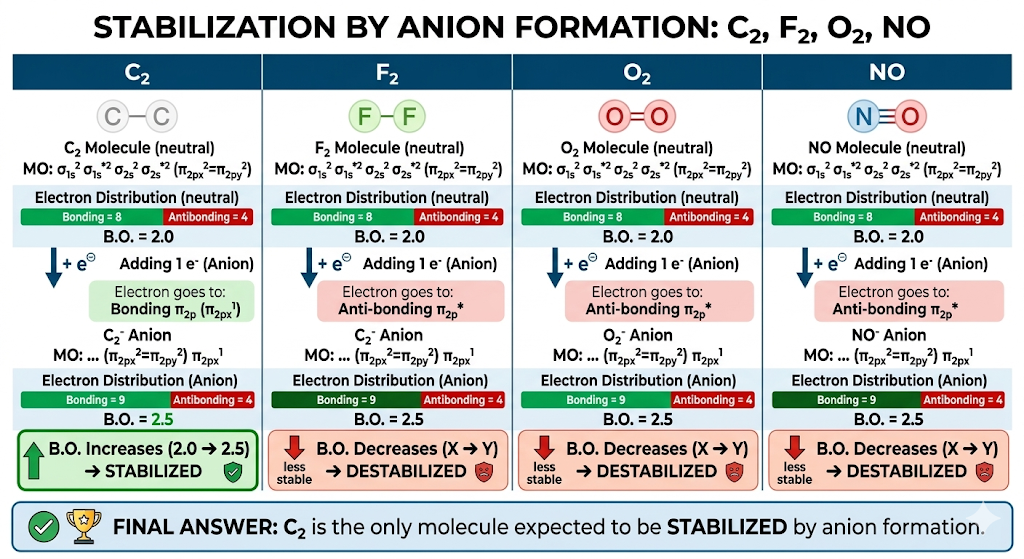
During the change of O$$_2$$ to O$$_2^-$$, the incoming electron goes to the orbital:
First, recall the order of molecular orbitals produced by the linear combination of the 2s and 2p atomic orbitals for homonuclear diatomic molecules with $$Z > 7$$ (that is, for O, F, Ne etc.). Stated in increasing energy, the sequence is
$$\sigma_{1s},\; \sigma_{1s}^\ast,\; \sigma_{2s},\; \sigma_{2s}^\ast,\; \sigma_{2p_z},\; \pi_{2p_x}=\pi_{2p_y},\; \pi_{2p_x}^\ast=\pi_{2p_y}^\ast,\; \sigma_{2p_z}^\ast.$$
This ordering is the foundation we shall use for electron filling (Aufbau principle), together with the Pauli exclusion principle and Hund’s rule of maximum multiplicity.
The dioxygen molecule $$\mathrm{O_2}$$ possesses a total of $$16$$ electrons (each O contributes $$8$$). We begin to place these electrons in the above energy-ordered molecular orbitals, two per orbital where possible:
$$ \begin{aligned} \sigma_{1s}^2 &\;(2\text{ e}^-)\\ \sigma_{1s}^{\ast\,2} &\;(4\text{ e}^-)\\ \sigma_{2s}^2 &\;(6\text{ e}^-)\\ \sigma_{2s}^{\ast\,2} &\;(8\text{ e}^-)\\ \sigma_{2p_z}^2 &\;(10\text{ e}^-)\\ \pi_{2p_x}^2\;\pi_{2p_y}^2 &\;(14\text{ e}^-)\\ \pi_{2p_x}^{\ast\,1}\;\pi_{2p_y}^{\ast\,1} &\;(16\text{ e}^-) \end{aligned} $$
At this stage, each of the degenerate antibonding $$\pi^\ast$$ orbitals carries one unpaired electron, in full agreement with the experimentally observed paramagnetism of $$\mathrm{O_2}$$.
Now we examine the species $$\mathrm{O_2^-}$$. The superscript “-” indicates that one additional electron is supplied to the system, giving a total of $$17$$ electrons to distribute.
After the first $$16$$ electrons have occupied the same orbitals as in neutral $$\mathrm{O_2}$$, the seventeenth electron must be placed in the next available molecular orbital of lowest energy. According to the sequence stated above, the two degenerate antibonding orbitals $$\pi_{2p_x}^\ast$$ and $$\pi_{2p_y}^\ast$$ are still the lowest in energy that are not yet completely filled.
Because these two $$\pi^\ast$$ orbitals are exactly equal in energy (degenerate), the extra electron can enter either one of them. Conventionally we choose one—for instance $$\pi_{2p_x}^\ast$$—to depict the process.
Hence the incoming electron in the conversion
$$\mathrm{O_2} \longrightarrow \mathrm{O_2^-}$$
enters the antibonding $$\pi_{2p_x}^\ast$$ molecular orbital.
Therefore, among the given options, the correct choice is
$$\pi^{\ast}\;2p_x.$$
Hence, the correct answer is Option B.
In which of the following processes, the bond order has increased and paramagnetic character has changed to diamagnetic?
We have to check, for every given process, two things simultaneously: whether the bond order $$\left(BO\right)$$ has increased and whether a paramagnetic molecule (containing at least one unpaired electron) has become diamagnetic (all electrons paired) after the process.
First of all, recall the formula that comes from Molecular Orbital Theory:
$$BO=\dfrac{N_b-N_a}{2}$$
where $$N_b$$ is the total number of electrons present in bonding molecular orbitals and $$N_a$$ is the total number of electrons present in antibonding molecular orbitals.
The magnetic property is judged as follows: if any molecular orbital has an unpaired electron, the species is paramagnetic; if every electron is paired, the species is diamagnetic.
Now we shall apply these ideas one‐by‐one to every option.
Option A : $$O_2\;\rightarrow\;O_2^{+}$$
• For $$O_2$$ the total number of electrons is $$16$$. The valence-shell molecular orbital configuration (for elements after atomic number $$7$$) is
$$\sigma_{2p_z}^2\;\pi_{2p_x}^2=\pi_{2p_y}^2\;\pi_{2p_x}^{*\,1}=\pi_{2p_y}^{*\,1}$$
This gives $$N_b=10,\;N_a=6$$ and hence
$$BO(O_2)=\dfrac{10-6}{2}=2$$
The two $$\pi_{2p}^{*}$$ electrons are unpaired, so $$O_2$$ is paramagnetic.
• In $$O_2^{+}$$ one electron is removed, obviously from the highest‐energy orbital $$\pi_{2p}^{*}$$. The configuration becomes
$$\sigma_{2p_z}^2\;\pi_{2p_x}^2=\pi_{2p_y}^2\;\pi_{2p_x}^{*\,1}$$
Now $$N_b=10,\;N_a=5$$, giving
$$BO(O_2^{+})=\dfrac{10-5}{2}=2.5$$
There is still one unpaired electron, so the cation remains paramagnetic. Bond order has indeed increased, but magnetic nature is unchanged. Hence this option does not satisfy the requirement.
Option B : $$NO\;\rightarrow\;NO^{+}$$
Because $$NO$$ is heteronuclear, we count electrons directly. Nitrogen contributes $$7$$ electrons, oxygen contributes $$8$$, making $$15$$ in all.
Using the same orbital ordering as $$O_2$$ (a good approximation), the last electron enters a $$\pi_{2p}^{*}$$ orbital, giving one unpaired electron. Thus $$NO$$ is paramagnetic.
Bond-order calculation:
$$N_b=10,\;N_a=5\quad\Rightarrow\quad BO(NO)=\dfrac{10-5}{2}=2.5$$
Now we remove one electron to form $$NO^{+}$$. The electron leaves that singly occupied $$\pi_{2p}^{*}$$ orbital, so the cation has $$14$$ electrons—exactly the same count as $$N_2$$, with all electrons paired.
The numbers now are $$N_b=10,\;N_a=4$$, so
$$BO(NO^{+})=\dfrac{10-4}{2}=3$$
Hence, bond order increases from $$2.5$$ to $$3$$, and because no orbital contains an unpaired electron, $$NO^{+}$$ is diamagnetic. Therefore this process fulfils both required conditions.
Option C : $$O_2\;\rightarrow\;O_2^{-}$$
Adding one electron to $$O_2$$ means the new electron enters a $$\pi_{2p}^{*}$$ orbital, giving
$$\pi_{2p_x}^{*\,2}=\pi_{2p_y}^{*\,1}$$
Now $$N_b=10,\;N_a=7$$, so
$$BO(O_2^{-})=\dfrac{10-7}{2}=1.5$$
Because a $$\pi_{2p}^{*}$$ orbital still holds an unpaired electron, the anion remains paramagnetic, and bond order has in fact decreased. Hence this option fails on both counts.
Option D : $$N_2\;\rightarrow\;N_2^{+}$$
• For $$N_2$$ (total electrons $$=14$$) the ordering up to $$\sigma_{2p_z}$$ is
$$\sigma_{2p_z}^2\;\pi_{2p_x}^2=\pi_{2p_y}^2$$
All electrons are paired, so $$N_2$$ is diamagnetic. The bonding and antibonding electrons are $$N_b=10,\;N_a=4$$, giving
$$BO(N_2)=\dfrac{10-4}{2}=3$$
• Removing one electron to form $$N_2^{+}$$ takes it from the highest occupied bonding orbital $$\pi_{2p}$$, resulting in one unpaired electron.
Now $$N_b=9,\;N_a=4$$, so
$$BO(N_2^{+})=\dfrac{9-4}{2}=2.5$$
The bond order has fallen and the magnetic behaviour has changed from diamagnetic to paramagnetic, i.e.\ in the wrong direction.
After examining every option we see that only the process $$NO\rightarrow NO^{+}$$ simultaneously raises the bond order and converts a paramagnetic molecule into a diamagnetic one.
Hence, the correct answer is Option B.
The correct statement among the following is:
We start by recalling the general shape of an amine. For a simple trialkylamine like $$\mathrm{(CH_3)_3N}$$ the nitrogen is $$\mathrm{sp^3}$$-hybridised. Three of the hybrid orbitals contain $$\sigma$$-bonding pairs (one to each carbon) and the fourth contains the lone pair. With four regions of electron density, VSEPR predicts a tetrahedral arrangement of orbitals and, because one of those regions is a lone pair, the observed molecular geometry becomes pyramidal. Thus $$\mathrm{(CH_3)_3N}$$ is pyramidal.
Now we examine $$\mathrm{(SiH_3)_3N}$$. Each silicon atom possesses energetically accessible empty 3d orbitals, while the nitrogen atom has a filled $$\mathrm{p}$$-type lone pair. A lone pair on nitrogen can overlap sideways with the vacant 3d orbitals on the three silicon atoms. This interaction is described as $$p\!\!-\!d$$ $$\pi$$ back-bonding. Whenever such delocalisation occurs, the requirement for a localised tetrahedral lone pair on nitrogen is removed, and the three $$\sigma$$ bonds together with the delocalised lone pair adopt a trigonal arrangement. In other words, the molecule flattens out at nitrogen to give a trigonal-planar shape. Therefore $$\mathrm{(SiH_3)_3N}$$ is planar.
Basicity depends on the availability of the lone pair for protonation. In $$\mathrm{(CH_3)_3N}$$ the lone pair is localised and free to donate; its electron density is concentrated on nitrogen, so the molecule is reasonably basic. In $$\mathrm{(SiH_3)_3N}$$ the lone pair is partially withdrawn from nitrogen into the $$p\!\!-\!d$$ $$\pi$$ system. Delocalisation lowers the electron density on nitrogen and makes the lone pair less available for bonding to $$\mathrm{H^+}$$. Consequently its basic strength decreases.
Putting the two pieces together, we have:
$$\mathrm{(SiH_3)_3N}$$ is planar and less basic than $$\mathrm{(CH_3)_3N}$$.
Option A states exactly this relationship.
Hence, the correct answer is Option A.
Among the following molecules/ions, $$C_2^{2-}$$, $$N_2^{2-}$$, $$O_2^{2-}$$, $$O_2$$, which one is diamagnetic and has the shortest bond length?
First we recall the Molecular Orbital (MO) theory facts that will be required. For second-period homonuclear diatomics we consider only the valence electrons (2s and 2p). Up to atomic number 7 (that is, for $$B_2,\,C_2,\,N_2$$) the order of valence MOs is $$\sigma(2s),\;\sigma^{*}(2s),\;\pi(2p_x)=\pi(2p_y),\;\sigma(2p_z),\;\pi^{*}(2p_x)=\pi^{*}(2p_y),\;\sigma^{*}(2p_z).$$ From oxygen onwards the order changes to $$\sigma(2s),\;\sigma^{*}(2s),\;\sigma(2p_z),\;\pi(2p_x)=\pi(2p_y),\;\pi^{*}(2p_x)=\pi^{*}(2p_y),\;\sigma^{*}(2p_z).$$
The two rules we shall apply repeatedly are:
• The bond order formula $$\text{B.O.}= \dfrac{n_b-n_a}{2},$$ where $$n_b$$ = number of bonding electrons and $$n_a$$ = number of antibonding electrons. • A species is diamagnetic when all electrons are paired and paramagnetic when at least one electron is unpaired.
We now examine each species one by one.
1. $$C_2^{2-}$$
Each C atom has 4 valence electrons, so for two carbon atoms we have $$8$$.
Because of the $$2-$$ charge we add two more electrons, giving
$$8+2=10\text{ valence e}^-.$$
Using the $$B,\,C,\,N$$ order we fill the MOs:
$$ \begin{aligned} \sigma(2s)&:2 \quad (2)\\ \sigma^{*}(2s)&:2 \quad (4)\\ \pi(2p_x)&:2 \quad (6)\\ \pi(2p_y)&:2 \quad (8)\\ \sigma(2p_z)&:2 \quad (10) \end{aligned} $$
All electrons are paired, so the species is diamagnetic. Bonding electrons $$n_b = 2+4+2 = 8$$, antibonding electrons $$n_a = 2$$. So
$$\text{B.O.}= \dfrac{8-2}{2}=3.$$
2. $$N_2^{2-}$$
Each N atom supplies 5 valence electrons, total $$10$$, plus $$2$$ extra for the negative charge: $$12\text{ e}^-.$$
The same energy order (up to N) is used:
$$ \begin{aligned} \sigma(2s)&:2 \quad (2)\\ \sigma^{*}(2s)&:2 \quad (4)\\ \pi(2p_x)&:2 \quad (6)\\ \pi(2p_y)&:2 \quad (8)\\ \sigma(2p_z)&:2 \quad (10)\\ \pi^{*}(2p_x)&:1 \quad (11)\\ \pi^{*}(2p_y)&:1 \quad (12) \end{aligned} $$
Two unpaired electrons appear in the $$\pi^{*}$$ set, so $$N_2^{2-}$$ is paramagnetic. Here $$n_b = 2+4+2 = 8$$ and $$n_a = 2+2 = 4$$, giving
$$\text{B.O.}= \dfrac{8-4}{2}=2.$$
3. $$O_2$$
Each O atom has 6 valence electrons, so neutral $$O_2$$ possesses $$12\text{ valence e}^-.$$
For oxygen the changed order must be employed:
$$ \begin{aligned} \sigma(2s)&:2 \quad (2)\\ \sigma^{*}(2s)&:2 \quad (4)\\ \sigma(2p_z)&:2 \quad (6)\\ \pi(2p_x)&:2 \quad (8)\\ \pi(2p_y)&:2 \quad (10)\\ \pi^{*}(2p_x)&:1 \quad (11)\\ \pi^{*}(2p_y)&:1 \quad (12) \end{aligned} $$
Again two unpaired electrons are present, so $$O_2$$ is paramagnetic. Now $$n_b = 2+2+4 = 8$$ and $$n_a = 2+2 = 4$$, hence
$$\text{B.O.}= \dfrac{8-4}{2}=2.$$
4. $$O_2^{2-}$$
Adding two extra electrons to $$O_2$$ gives $$14\text{ valence e}^-.$$
Continuing the same filling order:
$$ \begin{aligned} \sigma(2s)&:2 \quad (2)\\ \sigma^{*}(2s)&:2 \quad (4)\\ \sigma(2p_z)&:2 \quad (6)\\ \pi(2p_x)&:2 \quad (8)\\ \pi(2p_y)&:2 \quad (10)\\ \pi^{*}(2p_x)&:2 \quad (12)\\ \pi^{*}(2p_y)&:2 \quad (14) \end{aligned} $$
All electrons are paired, so $$O_2^{2-}$$ is diamagnetic. Here $$n_b = 2+2+4 = 8$$ and $$n_a = 2+4 = 6$$, which gives
$$\text{B.O.}= \dfrac{8-6}{2}=1.$$
We now summarise the crucial results:
Diamagnetic species: $$C_2^{2-}$$ (B.O. 3) and $$O_2^{2-}$$ (B.O. 1). The bond length trend is inversely related to bond order, so the shortest bond belongs to the highest bond order. Because $$C_2^{2-}$$ has $$\text{B.O.}=3$$, its bond is the strongest and therefore the shortest among the given options.
Hence, the correct answer is Option D.
The number of 2-centre-2-electron and 3-centre-2-electron bonds in $$B_2H_6$$, respectively, are:
We first recall the general idea of an ordinary covalent bond. A normal single bond involves two atoms sharing two electrons and is therefore called a “two-centre two-electron” bond, abbreviated as $$2c\!-\!2e$$.
Sometimes, however, two electrons are shared by more than two atoms. When exactly two electrons are shared by three atoms we call the bond a “three-centre two-electron” bond, abbreviated as $$3c\!-\!2e$$. Such bonds are also known by the popular name “banana bonds.”
Now we examine the molecule $$\mathrm{B_2H_6}$$, diborane. Its experimentally determined skeletal framework is
H H
\ /
B — B
/ \
H H
\ /
H H
In words, each boron atom is attached to two “terminal” hydrogens (those that point outward) and is simultaneously bridged by two additional hydrogens that sit between the two boron atoms.
Let us count the two kinds of bonds one by one.
Step 1: Counting the ordinary $$2c\!-\!2e$$ bonds. Each boron has two terminal B-H bonds. Therefore
Number of terminal B-H bonds $$= 2 \text{ (per B)} \times 2 \text{ (B atoms)} = 4.$$
Because every terminal B-H linkage involves only one boron and one hydrogen and uses two electrons, all four of these are regular $$2c\!-\!2e$$ bonds.
Step 2: Identifying the $$3c\!-\!2e$$ bonds. The two bridging hydrogens each form a bond that involves the following three centres: B1, Hbridge, and B2. Experimental evidence (electron-diffraction, infrared spectra, etc.) shows that only two electrons are shared among these three centres. Thus every bridge corresponds to one $$3c\!-\!2e$$ bond.
There are exactly two such bridging hydrogens, hence
Number of $$3c\!-\!2e$$ bonds $$= 2.$$
Step 3: Summarising the count.
$$\text{Number of }2c\!-\!2e\text{ bonds} = 4$$
$$\text{Number of }3c\!-\!2e\text{ bonds} = 2$$
Comparing these numbers with the options given, we see that the pair “4 and 2” exactly matches Option A.
Hence, the correct answer is Option A.
The hydride that is NOT electron deficient is:
First, let us recall the meaning of the term “electron-deficient hydride”. A hydride is called electron deficient when the central atom does not attain an octet of electrons in the usual two-electron covalent bonds and therefore needs multi-centre (3-centre-2-electron) bonding or some other delocalisation to hold the molecule together.
We will now examine each option one by one and count the electrons present around the central atom in the simple Lewis picture.
For a single ordinary covalent bond, the shared pair contains $$2$$ electrons. To satisfy the octet rule, an atom ideally needs $$8$$ electrons in its valence shell.
Option A : $$SiH_4$$
Silicon belongs to group 14, so its valence electron count is $$4$$. In $$SiH_4$$ the silicon forms four Si-H single bonds. Each bond contributes $$2$$ electrons to the valence shell of silicon. Hence the total number of electrons around silicon is
$$4 \text{ bonds}\times 2 \text{ electrons per bond}=8 \text{ electrons}.$$
The octet is exactly satisfied, so $$SiH_4$$ is not electron deficient.
Option B : $$B_2H_6$$
Boron is in group 13 with $$3$$ valence electrons. Even if each boron made three normal B-H bonds it would receive only $$6$$ shared electrons, not $$8$$. The actual structure of $$B_2H_6$$ contains two three-centre two-electron (3c-2e) B-H-B bridges to compensate for the deficiency. The presence of 3c-2e bonds is a hallmark of electron-deficient compounds, so $$B_2H_6$$ is electron deficient.
Option C : $$GaH_3$$
Gallium too is a group 13 element with $$3$$ valence electrons. In $$GaH_3$$ the gallium would share $$3\times 2 = 6$$ electrons, falling short of the octet. Like the other group-13 trihydrides, it is electron deficient (polymeric with bridge bonds in the solid state).
Option D : $$AlH_3$$
Aluminium is also a group 13 element. In monomeric $$AlH_3$$, aluminium would again receive only $$6$$ electrons from the three Al-H bonds. To remedy this, $$AlH_3$$ forms polymeric chains with 3c-2e Al-H-Al bridges; therefore it is electron deficient.
From this detailed comparison we see that the only hydride in which the central atom achieves a complete octet through ordinary two-electron bonds is $$SiH_4$$.
Hence, the correct answer is Option A.
NaH is an example of:
The compound under consideration is sodium hydride, written chemically as $$\text{NaH}$$.
We first recall that hydrides are classified into three main types on the basis of the nature of bonding between hydrogen and the other element:
$$\text{1. Saline (ionic) hydrides}$$ - formed when hydrogen combines with highly electropositive $$s$$-block metals (group 1: alkali metals and group 2: alkaline-earth metals except Be and Mg). In such hydrides, hydrogen exists as the hydride ion $$\text{H}^-$$ and the metal exists as a cation, giving the general formula $$\text{M}^+\text{H}^-$$ or $$\text{M}^{2+}(\text{H}^-)_{2}$$. These compounds are crystalline, high-melting, and conduct electricity in the molten state.
$$\text{2. Metallic (interstitial) hydrides}$$ - formed by many transition metals. Here hydrogen atoms occupy interstitial sites in the metallic lattice, leading to non-stoichiometric compositions.
3. Molecular (covalent) or electron-rich hydrides - formed by $$p$$-block elements where hydrogen is covalently bonded, often giving rise to discrete molecules. When these molecules have more electrons than needed for simple covalent bonding, they are specifically called electron-rich hydrides; typical examples include $$\text{NH}_3$$ and $$\text{H}_2\text{O}$$.
Now we analyse $$\text{NaH}$$. Sodium belongs to group 1 of the periodic table and is a highly electropositive alkali metal. On reacting with hydrogen, sodium donates one electron to hydrogen:
$$\text{Na} \rightarrow \text{Na}^+ + e^-$$
$$\tfrac12\,\text{H}_2 + e^- \rightarrow \text{H}^-$$
Combining these half-reactions, we obtain
$$\text{Na} + \tfrac12\,\text{H}_2 \rightarrow \text{Na}^+\text{H}^-$$
The product contains discrete ionic species $$\text{Na}^+$$ and $$\text{H}^-$$. Thus the bonding is predominantly ionic and fits exactly into the description of a saline (ionic) hydride.
Since $$\text{NaH}$$ does not contain a metallic lattice with hydrogen in interstices, option B is eliminated. It is also not a covalent molecular hydride, nor does it possess excess electrons as found in electron-rich hydrides, so options A and D are also ruled out.
Therefore, $$\text{NaH}$$ is correctly categorised as a saline hydride.
Hence, the correct answer is Option C.
Correct statements among regarding silicones are:
(a) They are polymers with hydrophobic character.
(b) They are biocompatible.
(c) In general, they have high thermal stability and low dielectric strength.
(d) Usually, they are resistant to oxidation and used as greases.
We first recall what a silicone (also called a polysiloxane) is: it is a polymer that possesses a repeating $$\bigl[-\text{Si(R)}_2-\text{O}-\bigr]_n$$ backbone, where each silicon atom is bonded to two organic substituents $$R$$ (most commonly $$\text{CH}_3$$). Because there are no -OH or -NH groups attached directly to the surface of the chain, the exterior of the polymer is almost completely covered with non-polar $$\text{C-H}$$ bonds.
This structural feature makes the entire chain non-polar. A non-polar surface is unable to interact appreciably with water, and therefore silicones repel water. So, they possess a strong water-repelling or hydrophobic character. Hence statement (a) “They are polymers with hydrophobic character” is true.
Next, we look at the interaction of silicones with living tissue. Since they are chemically inert, do not release toxic ions, and are flexible, silicones can be implanted in the human body (for example, in breast implants or catheters) without producing immunological rejection. That property of being harmless and compatible with biological systems is called biocompatibility. Therefore statement (b) “They are biocompatible” is also true.
We now examine their thermal and electrical behaviour. The $$\text{Si-O}$$ bond has a very high bond enthalpy (about $$\;452\;\text{kJ mol}^{-1}$$), and the bond angle $$\bigl(\approx 143^\circ\bigr)$$ is large, which hampers rotation-generated strain. These factors make the chain extremely stable toward heat; many silicone oils remain liquid even beyond $$200^{\circ}\text{C}$$. As for electrical properties, silicone oils are frequently used as cable insulators mainly because they do not conduct current. However, when we compare their dielectric strength (the maximum field they can withstand without breakdown) with that of specialised high-voltage transformer oils or cross-linked polyethylene, the value for silicones is somewhat lower. In other words, silicones have high thermal stability but a lower dielectric strength relative to the best insulating fluids. Hence statement (c) “In general, they have high thermal stability and low dielectric strength” is accepted as true.
Finally, we consider their behaviour toward oxidation. The same inertness that makes silicones biocompatible also renders them resistant to atmospheric oxygen. Because they maintain lubricity over a wide temperature range, they are widely used as high-temperature lubricating greases and release agents. Thus statement (d) “Usually, they are resistant to oxidation and used as greases” is likewise true.
All four statements (a), (b), (c) and (d) are therefore correct, so we choose the option that lists every one of them.
Hence, the correct answer is Option C.
A compound of formula $$A_2B_3$$ has the HCP lattice. Which atom forms the HCP lattice and what fraction of the tetrahedral voids are occupied by the other atoms?
We have a compound whose simplest formula is $$A_2B_3$$. One kind of atom is arranged in a hexagonal close-packed lattice (hcp) and the other kind occupies only tetrahedral voids. We must identify which atom sits on the hcp points and what fraction of the tetrahedral voids the second atom occupies.
First, recall an essential fact about close packing:
In any hcp (or ccp) lattice containing $$N$$ atoms, the number of tetrahedral voids is $$2N$$.
Let us assume that atom $$B$$ constitutes the hcp lattice. Thus, the number of $$B$$ atoms present is
$$N_B = N.$$
The total number of tetrahedral voids created by these $$N$$ atoms equals
$$2N.$$
Suppose a fraction $$f$$ of these tetrahedral voids is occupied by atom $$A$$. Then the number of $$A$$ atoms is
$$N_A = f \times 2N = 2fN.$$
The compound’s overall stoichiometry gives the fixed ratio
$$\frac{N_A}{N_B} = \frac{2}{3}.$$
Substituting $$N_A = 2fN$$ and $$N_B = N$$ into this ratio, we obtain
$$\frac{2fN}{N} = \frac{2}{3} \;\;\Longrightarrow\;\; 2f = \frac{2}{3} \;\;\Longrightarrow\;\; f = \frac{1}{3}.$$
So exactly one-third of all the tetrahedral voids are filled by the $$A$$ atoms. The remaining two-thirds of the tetrahedral sites stay empty.
Now let us verify quickly that placing $$A$$ on the hcp lattice instead would fail. If $$A$$ were hcp, we would have $$N_A = N$$ and tetrahedral voids $$= 2N$$. To achieve the formula $$A_2B_3$$ we would need
$$N_B = \frac{3}{2}N = 1.5N,$$
which would mean filling $$\frac{1.5N}{2N} = 0.75$$ or $$75\%$$ of all tetrahedral voids with $$B$$. This scenario does not match any of the given options (they mention $$\frac{2}{3} = 0.667$$, not $$0.75$$). Hence our earlier assumption that $$B$$ is the hcp atom is the only one that fits an available choice.
Therefore, $$B$$ atoms form the hcp framework, and exactly $$\dfrac{1}{3}$$ of the tetrahedral voids are occupied by $$A$$ atoms.
Hence, the correct answer is Option C.
At 100$$^{\circ}$$C, copper (Cu) has FCC unit cell structure with cell edge length of $$x$$ $$\text{Å}$$. What is the approximate density of Cu (in g cm$$^{-3}$$) at this temperature? [Atomic Mass of Cu = 63.55 u]
For any crystalline solid, the density $$\rho$$ is obtained from the general relation
$$\rho=\dfrac{Z\,M}{N_A\,a^{3}}$$
where
$$Z=$$ number of atoms in one unit cell,
$$M=$$ molar (atomic) mass in g mol−1,
$$N_A=$$ Avogadro constant, and
$$a=$$ edge length of the cubic unit cell in cm.
We are told that copper crystallises in the face-centred cubic (FCC) structure at 100 $$^{\circ}$$C. In an FCC unit cell we have
$$Z=4$$
The atomic mass of copper is given as
$$M = 63.55\ \text{g mol}^{-1}$$
The edge length is quoted as $$x\ \text{Å}$$. Because our density must come out in g cm−3, we first convert the edge length to centimetres. The conversion factor is
$$1\ \text{Å}=1\times10^{-8}\ \text{cm}$$
So
$$a = x\ \text{Å}=x\times10^{-8}\,\text{cm}$$
Now we substitute every symbol into the density formula:
$$\rho=\dfrac{Z\,M}{N_A\,a^{3}}=\dfrac{4\;\times\;63.55}{\;6.022\times10^{23}\; \times\;(x\times10^{-8})^{3}}\ \text{g cm}^{-3}$$
Let us treat the edge length factor first:
$$(x\times10^{-8})^{3}=x^{3}\times(10^{-8})^{3}=x^{3}\times10^{-24}$$
Inserting this result gives
$$\rho=\dfrac{4\times63.55}{6.022\times10^{23}\times x^{3}\times10^{-24}}\ \text{g cm}^{-3}$$
We now focus on the powers of ten. The product $$6.022\times10^{23}\times10^{-24}=6.022\times10^{-1}=0.6022$$. Hence
$$\rho=\dfrac{4\times63.55}{0.6022\,x^{3}}\ \text{g cm}^{-3}$$
The numerator multiplies to
$$4\times63.55=254.20$$
Therefore
$$\rho=\dfrac{254.20}{0.6022\,x^{3}}\ \text{g cm}^{-3}$$
Carrying out the division,
$$\dfrac{254.20}{0.6022}\approx422$$
So we finally have
$$\rho\approx\dfrac{422}{x^{3}}\ \text{g cm}^{-3}$$
This matches the expression offered in Option C.
Hence, the correct answer is Option C.
Consider the bcc unit cells of the solids 1 and 2 with the position of atoms as shown below. The radius of atom B is twice that of atom A. The unit cell edge length is 50% more in solid 2 than in 1. What is the approximate packing efficiency in solid 2?
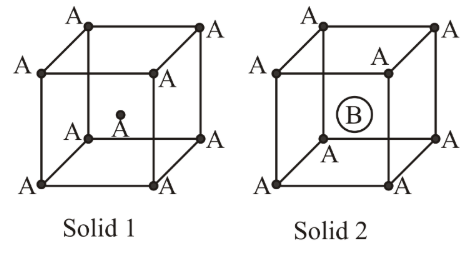
In a body-centered cubic (BCC) unit cell, the constituent atoms touch along the body diagonal of the cube. Let the edge length of Solid 2 be $$a_2$$. The length of its body diagonal is equal to $$\sqrt{3}a_2$$.
According to the diagram for Solid 2:
Therefore, along the body diagonal:
$$\sqrt{3}a_2 = 2r_A + 2r_B$$
We are given that the radius of atom B is twice that of atom A ($$r_B = 2r_A$$). Substituting this in:
$$\sqrt{3}a_2 = 2r_A + 2(2r_A) = 6r_A$$
Solving for the unit cell edge length $$a_2$$ in terms of $$r_A$$:
$$a_2 = \frac{6r_A}{\sqrt{3}} = 2\sqrt{3}r_A$$
Let's calculate the effective number of atoms and their volumes contained inside the unit cell:
The total volume occupied by the spheres ($$V_{\text{atoms}}$$) is:
$$V_{\text{atoms}} = \left(1 \times \frac{4}{3}\pi r_A^3\right) + \left(1 \times \frac{4}{3}\pi r_B^3\right)$$
Substitute $$r_B = 2r_A$$:
$$V_{\text{atoms}} = \frac{4}{3}\pi r_A^3 + \frac{4}{3}\pi(2r_A)^3 = \frac{4}{3}\pi r_A^3 (1 + 8) = 12\pi r_A^3$$
The total volume of the cube ($$V_{\text{cell}}$$) is given by $$(a_2)^3$$:
$$V_{\text{cell}} = (2\sqrt{3}r_A)^3 = 24\sqrt{3}r_A^3$$
Packing efficiency is the percentage of total space occupied by the spheres:
$$\text{Packing Efficiency} = \frac{V_{\text{atoms}}}{V_{\text{cell}}} \times 100\%$$
$$\text{Packing Efficiency} = \frac{12\pi r_A^3}{24\sqrt{3}r_A^3} \times 100\% = \frac{\pi}{2\sqrt{3}} \times 100\%$$
Substituting the values $$\pi \approx 3.1416$$ and $$\sqrt{3} \approx 1.732$$:
$$\text{Packing Efficiency} \approx \frac{3.1416}{3.464} \times 100\% \approx 90.7\%$$
The calculated value yields an approximate space occupancy of roughly $$90\%$$, which matches Option A perfectly.
Answer: Option A — 90 %
The radius of the largest sphere which fits properly at the centre of the edge of a body centred cubic unit cell is: (Edge length is represented by 'a')
First, we recall the geometry of a body-centred cubic (bcc) unit cell. There are atoms at the eight corners $$(0,0,0)$$, $$(1,0,0)$$, $$(0,1,0)$$, $$(0,0,1)$$, $$(1,1,0)$$, $$(1,0,1)$$, $$(0,1,1)$$, $$(1,1,1)$$ and one atom at the body centre $$\left(\dfrac12,\dfrac12,\dfrac12\right)$$, the coordinates being expressed in units of the edge length $$a.$$
In a bcc lattice, the atoms touch each other along the body diagonal. The length of the body diagonal is $$\sqrt{3}\,a,$$ and along this diagonal we have four radii laid end to end (corner atom - body-centre atom - opposite corner atom). Stating this contact condition, we write
$$4\,r_{\text{atom}}=\sqrt{3}\,a,$$
so that the atomic radius is obtained as
$$r_{\text{atom}}=\frac{\sqrt{3}}{4}\,a\;\;(\approx 0.433\,a).$$
We now focus on the void situated at the centre of an edge. Let us take the edge that runs from the corner $$(0,0,0)$$ to the corner $$(1,0,0)$$. Its midpoint, the centre of the edge, has the coordinates
$$\left(\dfrac12,\,0,\,0\right).$$
To find the largest sphere that can be placed at this point without overlapping the neighbouring atoms, we calculate its distance to the nearest atoms.
(i) Distance to the two corner atoms lying on the same edge:
Using the distance formula $$d=\sqrt{(x_2-x_1)^2+(y_2-y_1)^2+(z_2-z_1)^2},$$ the distance from $$\left(\dfrac12,0,0\right)$$ to $$(0,0,0)$$ (and identically to $$(1,0,0)$$) is
$$d_{\text{corner}}=\sqrt{\left(\dfrac12\,a-0\right)^2+0^2+0^2}=\dfrac{a}{2}=0.500\,a.$$
(ii) Distance to the body-centre atom $$\left(\dfrac12,\dfrac12,\dfrac12\right)$$:
$$d_{\text{body}}=\sqrt{\left(\dfrac12\,a-\dfrac12\,a\right)^2+\left(0-\dfrac12\,a\right)^2+\left(0-\dfrac12\,a\right)^2}=\sqrt{0+\left(\dfrac{a}{2}\right)^2+\left(\dfrac{a}{2}\right)^2} =\sqrt{2}\,\dfrac{a}{2}=\dfrac{a}{\sqrt{2}}\;(\approx 0.707\,a).$$
The nearest atoms are therefore the two corner atoms at a distance $$\dfrac{a}{2}.$$ The body-centre atom lies farther away and does not limit the size of the void sphere.
The small sphere we wish to fit will touch these two corner atoms. Hence, its radius is the gap between the centre-to-centre distance and the radius of a corner atom:
$$r_{\text{void}}=d_{\text{corner}}-r_{\text{atom}} =\dfrac{a}{2}-\dfrac{\sqrt{3}}{4}\,a =\left(\dfrac12-\dfrac{\sqrt{3}}{4}\right)a.$$
Evaluating the numerical factor:
$$\dfrac12-\dfrac{\sqrt{3}}{4}=0.500-\dfrac{1.732}{4}=0.500-0.433=0.067.$$
Thus,
$$r_{\text{void}}=0.067\,a.$$
Hence, the correct answer is Option D.
A solid having density of $$9 \times 10^3$$ kg m$$^{-3}$$ forms face centred cubic crystals of edge length $$200\sqrt{2}$$ pm. What is the molar mass of the solid? [Avogadro constant $$\approx 6 \times 10^{23}$$ mol$$^{-1}$$, $$\pi \approx 3$$]
We have a solid of density $$\rho = 9 \times 10^{3}\ \text{kg m}^{-3}$$ which crystallises in a face-centred cubic (fcc) lattice.
For any cubic lattice the general relation between density, molar mass and edge length is stated first:
$$\rho \;=\; \frac{Z\,M}{a^{3}\,N_{A}}$$
where
$$Z = \text{number of atoms per unit cell},$$
$$M = \text{molar mass (kg mol}^{-1}\text{)},$$
$$a = \text{edge length of the unit cell (m)},$$
$$N_{A} = \text{Avogadro constant (mol}^{-1}\text{)}.$$
In an fcc structure, every unit cell contains
$$Z = 4\ \text{atoms}.$$
The edge length is given as $$200\sqrt{2}\ \text{pm}$$. We first convert this completely into metres because the density is in kg m$$^{-3}$$.
1 picometre $$= 10^{-12}\ \text{m}$$, so
$$a = 200\sqrt{2}\ \text{pm} = 200\sqrt{2}\times 10^{-12}\ \text{m}.$$
Putting $$\sqrt{2}\approx1.414$$ we obtain
$$a = 200 \times 1.414 \times 10^{-12}\ \text{m} = 282.8 \times 10^{-12}\ \text{m}.$$
This may be written more compactly as
$$a = 2.828 \times 10^{-10}\ \text{m}.$$
Now we calculate the volume of one unit cell. Because the cell is cubic,
$$a^{3} = (2.828 \times 10^{-10}\ \text{m})^{3}.$$
Carrying out the cube step by step,
$$2.828^{2} = 8.000$$ (because $$2.828 = 2\sqrt{2}$$ and $$(2\sqrt{2})^{2}=8$$), and then
$$2.828^{3} = 8.000 \times 2.828 = 22.624.$$
The power of ten is cubed separately:
$$(10^{-10})^{3}=10^{-30}.$$
Therefore
$$a^{3} = 22.624 \times 10^{-30}\ \text{m}^{3}.$$
To keep only one non-zero digit before the decimal, we rewrite it as
$$a^{3} = 2.2624 \times 10^{-29}\ \text{m}^{3}.$$
Next we determine the mass contained in one unit cell using density:
$$\text{mass of one cell} = \rho \, a^{3} = (9 \times 10^{3})(2.2624 \times 10^{-29})\ \text{kg}.$$
Multiplying the numerical parts,
$$9 \times 2.2624 = 20.3616,$$
and combining the powers of ten,
$$10^{3}\times10^{-29}=10^{-26}.$$
Hence
$$\text{mass of one cell} = 20.3616 \times 10^{-26}\ \text{kg}.$$
Again moving the decimal once to the left,
$$\text{mass of one cell} = 2.03616 \times 10^{-25}\ \text{kg}.$$
Now we insert this mass into the density relation rearranged to give molar mass. From the original formula,
$$M = \frac{\rho\,a^{3}\,N_{A}}{Z}.$$
Substituting each symbol with its value,
$$M = \frac{(2.03616 \times 10^{-25}\ \text{kg}) \; (6 \times 10^{23}\ \text{mol}^{-1})}{4}.$$
First multiply the mass of the unit cell by Avogadro’s number:
$$2.03616 \times 10^{-25} \times 6 \times 10^{23} = 12.21696 \times 10^{-2}\ \text{kg}.$$
Since $$10^{-2}=0.01$$, this is
$$12.21696 \times 0.01\ \text{kg} = 0.1221696\ \text{kg}.$$
Now divide by $$Z = 4$$:
$$M = \frac{0.1221696\ \text{kg}}{4} = 0.0305424\ \text{kg mol}^{-1}.$$
Rounding to three significant figures,
$$M \approx 0.0305\ \text{kg mol}^{-1}.$$
Looking at the given options, this value corresponds to Option C.
Hence, the correct answer is Option C.
The one that is extensively used as a piezoelectric material is:
First, let us recall the physical principle involved. The piezoelectric effect is the phenomenon in which certain anisotropic crystalline solids develop an electric potential difference across opposite faces when mechanical stress is applied, and conversely undergo mechanical deformation when an external electric field is placed across them. Thus, a substance suitable for piezoelectric applications must have a crystal structure that lacks a centre of symmetry so that displacement of charge centres under stress can create a net dipole moment.
Now, among the substances listed in the four options we examine their crystal nature one by one.
We have Option A, Tridymite. Tridymite is one of the high-temperature polymorphs of silica, $$\mathrm{SiO_2}$$, that crystallises in an orthorhombic or hexagonal form only at temperatures >870 °C. Although it is crystalline, it is rare, unstable at room temperature, and therefore is not commonly employed in practical devices.
Next we come to Option B, Quartz. Quartz (also $$\mathrm{SiO_2}$$) possesses a trigonal crystal structure at ordinary temperatures that inherently lacks a centre of symmetry. This lack of inversion symmetry fulfils the chief requirement for strong piezoelectric behaviour. Natural and synthetic quartz crystals are cut in specific orientations (AT-cut, BT-cut, etc.) so that when a mechanical pressure is applied, a measurable voltage appears across selected faces and vice versa. Because of its mechanical strength, chemical inertness, ease of growth in large flawless crystals, and stability over a wide temperature range, quartz is extensively used in piezoelectric oscillators, resonators, microphones, pressure sensors, and crystal clocks.
Option C, Amorphous silica (commonly called fused silica or silica glass), by definition lacks a long-range ordered crystal lattice. In the absence of periodic ionic arrangement, no net dipole can be generated by external stress, so amorphous silica is non-piezoelectric.
Lastly, Option D, Mica, although crystalline and electrically insulating, belongs to a different family of layered alumino-silicate minerals. Its crystal class (monoclinic 2/m) possesses a centre of symmetry, which cancels out the piezoelectric effect. Thus mica is widely used as an electrical insulator and dielectric but not as a piezoelectric material.
Among all the candidates, the only substance that satisfies the crystallographic criterion and is also extensively utilised in commercial piezoelectric devices is quartz.
Hence, the correct answer is Option B.
The ratio of number of atoms present in a simple cubic, body centered cubic and face centered cubic structure are, respectively:
First, we recall that a unit cell can have atoms at its corners, at the centres of its faces and/or at its body centre. Whenever we count the effective number of atoms inside one unit cell, we must take into account the sharing of these positions with neighbouring cells.
Corner contribution. A corner atom is shared by 8 adjacent unit cells. Hence each corner atom contributes
$$\text{Contribution of one corner atom}= \dfrac{1}{8}$$
There are always 8 corners in a cubic unit cell, so the total contribution coming from all the corner atoms is
$$8\times\dfrac{1}{8}=1$$
Now we examine the three specific types of cubic lattices one by one.
1. Simple Cubic (SC). The simple cubic unit cell has atoms only at the 8 corners and nowhere else. Therefore the effective number of atoms per simple-cubic unit cell is
$$N_{\text{SC}} = 1$$
2. Body-centred Cubic (BCC). Besides the 8 corner atoms already counted, a BCC unit cell possesses one additional atom at its body centre. The body-centre atom is not shared with any other unit cell, so it contributes fully:
$$\text{Body-centre contribution}=1$$
Hence,
$$N_{\text{BCC}} = 1\;(\text{corners}) + 1\;(\text{body centre}) = 2$$
3. Face-centred Cubic (FCC). In an FCC cell, in addition to the 8 corner atoms we have one atom at the centre of each of the 6 faces. A face-centre atom is shared by 2 adjacent unit cells, thus each face-centre atom contributes
$$\dfrac{1}{2}$$
With 6 faces the total face-centre contribution is
$$6 \times \dfrac{1}{2} = 3$$
Therefore,
$$N_{\text{FCC}} = 1\;(\text{corners}) + 3\;(\text{faces}) = 4$$
We have now found the number of atoms per unit cell for all three lattices:
$$N_{\text{SC}} : N_{\text{BCC}} : N_{\text{FCC}} = 1 : 2 : 4$$
Hence, the correct answer is Option B.
Element B forms ccp structure and A occupies half of the octahedral voids, while oxygen atoms occupy all the tetrahedral voids. The structure of bimetallic oxide is:
We have a crystal in which the atoms of element B are arranged in a cubic close-packed (ccp or fcc) lattice. It is well known that a ccp unit cell contains $$4$$ atoms of the parent element. Before proceeding, let us recall the standard relationships between the atoms present in a close-packed array and the number of interstitial (void) sites produced by that array.
In a ccp (fcc) lattice:
• Number of octahedral voids $$=$$ number of close-packed atoms present.
• Number of tetrahedral voids $$=$$ twice the number of close-packed atoms present.
Stating these facts algebraically for a single unit cell:
$$\text{Number of B atoms} = 4$$
$$\text{Number of octahedral voids} = 4$$
$$\text{Number of tetrahedral voids} = 2 \times 4 = 8$$
According to the question, element A occupies exactly one-half of all the octahedral voids. Therefore
$$\text{Number of A atoms} = \dfrac{1}{2}\times(\text{number of octahedral voids}) = \dfrac{1}{2}\times4 = 2$$
Next, every tetrahedral void is filled by an oxygen atom. So
$$\text{Number of O atoms} = \text{number of tetrahedral voids} = 8$$
Collecting the numbers obtained per unit cell, we have the ratios
$$A : B : O = 2 : 4 : 8$$
To express the composition as the simplest integral formula, divide each subscript by the highest common factor, here $$2$$:
$$A : B : O = \dfrac{2}{2} : \dfrac{4}{2} : \dfrac{8}{2} = 1 : 2 : 4$$
So the empirical formula of the bimetallic oxide becomes
$$AB_2O_4$$
Examining the options given, this matches Option B.
Hence, the correct answer is Option B.
Which primitive unit cell has unequal edge lengths ($$a \neq b \neq c$$) and all axial angles different from 90$$^{\circ}$$?
In the language of solid-state chemistry, every crystal system is recognised by specifying two sets of geometric parameters:
• the three edge lengths, written as $$a,\;b,\;c$$, and
• the three axial (inter-axial) angles, written as $$\alpha,\;\beta,\;\gamma$$.
When we compare any stated unit cell with the seven recognised crystal systems, we match these six parameters with the characteristic conditions that define each system. Before matching, let us recall the essential conditions for the four systems mentioned in the options.
Hexagonal system (Option A):
We have $$a=b\neq c$$ and the angles satisfy $$\alpha = \beta = 90^{\circ},\;\gamma = 120^{\circ}.$$ Clearly, here two edges are equal, so $$a=b$$, which does not agree with $$a\neq b\neq c$$.
Monoclinic system (Option B):
We have $$a\neq b\neq c$$ (so the edges are indeed unequal) but only one of the three axial angles is different from $$90^{\circ}$$. Specifically, $$\alpha = \gamma = 90^{\circ},\;\beta \neq 90^{\circ}.$$ Thus, in the monoclinic case, two angles remain right angles. This fails the requirement “all axial angles different from $$90^{\circ}$$.”
Triclinic system (Option C):
We have $$a\neq b\neq c$$ and simultaneously $$\alpha \neq \beta \neq \gamma \neq 90^{\circ}.$$ That is, every edge length is distinct and all three angles are individually oblique (none equals $$90^{\circ}$$). This matches the description in the question word for word.
Tetragonal system (Option D):
We have $$a=b\neq c$$ together with $$\alpha = \beta = \gamma = 90^{\circ}.$$ Here again two edges are equal and every angle is a right angle, so the condition fails in two ways.
Only the triclinic (also called anorthic) primitive unit cell fulfils the twin conditions $$a\neq b\neq c$$ and $$\alpha\neq\beta\neq\gamma\neq 90^{\circ}.$$
Hence, the correct answer is Option C.
An element has a face-centered cubic fcc structure with a cell edge of a. The distance between the centres of two nearest tetrahedral voids in the lattice is
We have a face-centred cubic (fcc) crystal whose unit-cell edge length is denoted by $$a$$.
In an fcc lattice the tetrahedral voids are situated at those points whose fractional coordinates, measured from one corner of the unit cell, are of the form
$$\left(\frac14,\;\frac14,\;\frac14\right),\; \left(\frac34,\;\frac14,\;\frac14\right),\; \left(\frac14,\;\frac34,\;\frac14\right),\; \left(\frac34,\;\frac34,\;\frac14\right),$$
and the four analogous points obtained by replacing the $$z$$-coordinate $$\frac14$$ by $$\frac34$$. Thus there are eight tetrahedral voids per unit cell, symmetrically distributed.
To obtain the smallest or “nearest” separation between two tetrahedral void centres we look for a pair whose coordinates differ by the least possible amount. The simplest choice is the pair
$$T_1\;:\;\left(\frac14,\;\frac14,\;\frac14\right)$$ $$T_2\;:\;\left(\frac14,\;\frac34,\;\frac14\right)$$
These two points lie on the same $$x$$ and $$z$$ coordinates, differing only along the $$y$$-direction.
Now, the difference in their fractional coordinates is
$$\Delta x = \frac14 - \frac14 = 0,$$ $$\Delta y = \frac34 - \frac14 = \frac12,$$ $$\Delta z = \frac14 - \frac14 = 0.$$
In Cartesian form the actual linear distance is obtained by multiplying each fractional difference by the cell edge $$a$$, then applying the three-dimensional distance formula. Stating that formula first:
$$d = \sqrt{(\Delta x \,a)^2 + (\Delta y \,a)^2 + (\Delta z \,a)^2}.$$
Substituting the individual components we get
$$d = \sqrt{\bigl(0 \cdot a\bigr)^2 + \left(\frac12\,a\right)^2 + \bigl(0 \cdot a\bigr)^2}$$ $$\;\; = \sqrt{0 + \frac14\,a^2 + 0}$$ $$\;\; = \sqrt{\frac14\,a^2}$$ $$\;\; = \frac12\,a.$$
So the minimum (nearest-neighbour) distance between the centres of two tetrahedral voids in the fcc lattice is $$\displaystyle \frac{a}{2}.$$
Hence, the correct answer is Option A.
HF has highest boiling point among hydrogen halides, because it has:
First, let us recall the general idea that the boiling point of a substance is directly related to the strength of the intermolecular forces holding its molecules together in the liquid state. When these forces are strong, a greater amount of energy (in the form of heat) is required to overcome them and convert the liquid into the gaseous phase, leading to a higher boiling point.
Among the hydrogen halides $$\text{HX}$$ where $$\text{X} = \text{F, Cl, Br, I}$$, we experimentally observe the boiling-point order
$$\text{HF} \; > \; \text{HI} \; > \; \text{HBr} \; > \; \text{HCl}.$$
Now, we must identify the specific type of intermolecular force that makes $$\text{HF}$$ stand out. In molecular systems, three main kinds of intermolecular attractions are normally considered:
1. van der Waals’ (London dispersion) forces - present in all molecules but generally weak and increasing with molecular size.
2. Dipole-dipole interactions - present when the molecule is polar.
3. Hydrogen bonding - a special, particularly strong type of dipole-dipole interaction that occurs when hydrogen is covalently bonded to a highly electronegative atom such as $$\text{F, O,}$$ or $$\text{N}$$, and the hydrogen atom simultaneously interacts with a lone pair on another electronegative atom.
We have $$\text{HF}$$ containing hydrogen directly attached to fluorine, the most electronegative element. Because of this, the $$\text{H-F}$$ bond is highly polar, giving a large partial positive charge on hydrogen ($$ \delta^+ $$) and a large partial negative charge on fluorine ($$ \delta^- $$). Consequently, very strong hydrogen bonds of the form
$$\text{F}\;\!\!\!\delta^- \; \cdots \; \text{H}\;\!\!\!\delta^+ - \text{F}\;\!\!\!\delta^-$$
are formed between one $$\text{HF}$$ molecule and its neighbors. These hydrogen bonds are far stronger than ordinary van der Waals’ forces or simple dipole-dipole attractions. As a result, to break this network of hydrogen bonds and vaporize $$\text{HF}$$, a large amount of energy is needed, and the boiling point becomes exceptionally high.
Let us now examine each option in the problem statement:
Option A speaks of “lowest dissociation enthalpy.” Lower bond-dissociation enthalpy would imply a weaker $$\text{H-F}$$ covalent bond, but in reality the $$\text{H-F}$$ bond is the strongest among the $$\text{H-X}$$ bonds, not the weakest. Therefore this option cannot explain the high boiling point.
Option B mentions “strongest van der Waals’ interactions.” While dispersion forces do increase with molecular mass, fluorine is the lightest halogen, so $$\text{HF}$$ actually has the weakest van der Waals’ dispersive attraction among the series. Hence this option is also incorrect.
Option C states “strongest hydrogen bonding.” As explained, hydrogen bonded to the most electronegative atom fluorine allows exceptionally strong intermolecular hydrogen bonds, making the liquid difficult to boil. This perfectly accounts for the observation.
Option D claims “lowest ionic character.” Ionic character affects properties like lattice energy in solids such as $$\text{NaF}$$ or $$\text{KCl}$$, but liquid $$\text{HF}$$ is molecular, not ionic. Thus this option is irrelevant to its boiling point.
Among the provided choices, only Option C correctly identifies the dominant factor responsible for the highest boiling point of $$\text{HF}$$.
Hence, the correct answer is Option C.
The ion that has sp$$^3$$d$$^2$$ hybridization for the central atom is:
First, we recall the VSEPR-hybridisation relation:
For any species, the total number of hybrid orbitals required (also called the steric number) equals the total number of electron pairs around the central atom. The formula is
Steric number } = \dfrac{$$\text{(valence electrons of central atom)} + \text{(electrons donated by surrounding atoms)}$$ \;$$\pm$$\; $$\text{(charge)}$$}{2
Each value of the steric number corresponds to a set of hybrid orbitals:
$$\begin{aligned} \text{Steric number } 2 &\to sp \\ \text{Steric number } 3 &\to sp^2 \\ \text{Steric number } 4 &\to sp^3 \\ \text{Steric number } 5 &\to sp^3d \\ \text{Steric number } 6 &\to sp^3d^2 \\ \text{Steric number } 7 &\to sp^3d^3 \end{aligned}$$
Now we test each option one by one.
Option A : BrF$$_2^{-}$$
We have Br as the central atom.
Valence electrons on Br = 7
Electrons coming from two F atoms = 2
Negative charge contributes one extra electron = 1
So, total electrons around Br = $$7+2+1 = 10$$
Number of electron pairs (steric number) = $$\dfrac{10}{2}=5$$
Steric number 5 means $$sp^3d$$ hybridisation, not $$sp^3d^2$$.
Option B : ICl$$_4^{-}$$
The central atom is I.
Valence electrons on I = 7
Electrons from four Cl atoms = 4
Extra electron due to -1 charge = 1
Total electrons around I = $$7+4+1 = 12$$
Number of electron pairs = $$\dfrac{12}{2}=6$$
Steric number 6 corresponds to $$sp^3d^2$$ hybridisation. Hence this ion indeed possesses $$sp^3d^2$$ hybridisation for the central atom.
Option C : IF$$_6^{-}$$
Central atom I.
Valence electrons on I = 7
Electrons from six F atoms = 6
Extra electron for -1 charge = 1
Total electrons = $$7+6+1 = 14$$
Number of electron pairs = $$\dfrac{14}{2}=7$$
Steric number 7 means $$sp^3d^3$$ hybridisation, not $$sp^3d^2$$.
Option D : ICl$$_2^{-}$$
Central atom I.
Valence electrons on I = 7
Electrons from two Cl atoms = 2
One extra electron for -1 charge = 1
Total electrons = $$7+2+1 = 10$$
Number of electron pairs = $$\dfrac{10}{2}=5$$
Steric number 5 gives $$sp^3d$$ hybridisation, not $$sp^3d^2$$.
So only ICl$$_4^{-}$$ has a steric number of 6 and therefore exhibits $$sp^3d^2$$ hybridisation.
Hence, the correct answer is Option 2.
The correct statement about ICl$$_5$$ and ICl$$_4^{-}$$ is:
We begin by recalling the basic idea of VSEPR (Valence Shell Electron Pair Repulsion) theory. According to VSEPR, the arrangement of electron pairs (bonding pairs + lone pairs) around a central atom is chosen so that the repulsions among these pairs are minimised. First, we find the total number of valence‐shell electron pairs (abbreviated as $$\text{VSEPR}$$ pairs) around the central atom, then we locate how many of them are bonding pairs (BP) and how many are lone pairs (LP). The electron-pair geometry is decided by the total number of pairs, while the observed molecular shape is obtained after “removing” (i.e., not showing) the lone pairs.
Let us apply this step by step to the two species in the question.
For $$\mathrm{ICl_5}:$$
• Iodine brings $$7$$ valence electrons because it is in group $$17.$$ • Each of the five chlorine atoms forms one single bond with iodine, using $$5 \times 1 = 5$$ electrons from iodine’s valence shell. • Electrons used in bonding pairs $$= 5 \text{ BP} \times 2 \text{ e}^- = 10 \text{ e}^-,$$ but for VSEPR counting we simply note the number of pairs, i.e., $$5 \text{ BP}.$$ • Electrons left on iodine $$= 7 - 5 = 2,$$ which constitute one lone pair (because $$2 \text{ e}^- = 1 \text{ LP}$$).
So the total number of electron pairs around iodine in $$\mathrm{ICl_5}$$ is
$$\text{Total pairs} = \text{BP} + \text{LP} = 5 + 1 = 6.$$
Six electron pairs correspond to an octahedral electron-pair geometry. When one of those six positions is occupied by a lone pair, the remaining five bonding pairs occupy a square-pyramidal arrangement (a square base with one atom above the centre of the square). Thus,
$$\boxed{\mathrm{ICl_5}\ \text{is square pyramidal}.}$$
Now for $$\mathrm{ICl_4^-}:$$
• Iodine again supplies $$7$$ valence electrons. • The extra negative charge contributes $$1$$ more electron. • Hence total electrons on iodine $$= 7 + 1 = 8.$$ • Four chlorine atoms form four single bonds, so iodine uses $$4$$ electrons in bonding, corresponding to $$4 \text{ BP}.$$ • Electrons left on iodine $$= 8 - 4 = 4,$$ which make up $$2 \text{ LP}$$ (because $$4 \text{ e}^- = 2 \text{ LP}$$).
The total number of electron pairs around iodine in $$\mathrm{ICl_4^-}$$ is therefore
$$\text{Total pairs} = \text{BP} + \text{LP} = 4 + 2 = 6.$$
Again we have octahedral electron-pair geometry. When two opposite (axial) positions are occupied by lone pairs, the four bonding pairs remain in a square plane. Consequently,
$$\boxed{\mathrm{ICl_4^-}\ \text{is square planar}.}$$
Combining our two results, $$\mathrm{ICl_5}$$ is square pyramidal, while $$\mathrm{ICl_4^-}$$ is square planar. This description matches exactly with option D.
Hence, the correct answer is Option D.
According to molecular orbital theory, which of the following molecule will not be available?
According to molecular orbital (MO) theory we first combine the two atomic $$1s$$ orbitals of hydrogen or helium to obtain two molecular orbitals: a lower-energy bonding orbital $$\sigma(1s)$$ and a higher-energy antibonding orbital $$\sigma^{\*}(1s)$$.
The total number of electrons of the species is distributed in these two orbitals in the order of increasing energy, following the Pauli principle and Hund’s rule whenever necessary.
Before we start filling electrons, we recall the bond-order formula that MO theory gives us:
$$\text{Bond order} \;=\; \frac{N_b - N_a}{2}$$
where $$N_b$$ is the number of electrons in all bonding molecular orbitals and $$N_a$$ is the number of electrons in all antibonding molecular orbitals. A positive value of bond order means the molecule/ion is stable enough to be isolated, while a zero or negative value means it will not exist under normal conditions.
Now we examine every option one by one and compute its bond order step by step.
Option A : $$H_2^{2-}$$
Neutral $$H_2$$ possesses 2 electrons. The charge $$2-$$ adds 2 more electrons, so
$$\text{Total electrons}=2+2=4$$
We fill the MOs:
$$\sigma(1s)\,2e^-;\; \sigma^{\*}(1s)\,2e^-$$
Thus $$N_b=2,\; N_a=2$$ and
$$\text{Bond order}=\frac{2-2}{2}=0$$
Because the bond order is zero, no net bond is left, so $$H_2^{2-}$$ cannot exist.
Option B : $$He_2^{2+}$$
Neutral $$He_2$$ would have $$2\times 2=4$$ electrons. The $$2+$$ charge removes 2 electrons, leaving
$$\text{Total electrons}=4-2=2$$
Electron filling:
$$\sigma(1s)\,2e^-;\; \sigma^{\*}(1s)\,0e^-$$
So $$N_b=2,\; N_a=0$$
$$\text{Bond order}=\frac{2-0}{2}=1$$
A positive bond order of 1 shows that $$He_2^{2+}$$ is stable enough to be detectable.
Option C : $$He_2^{+}$$
Again start from 4 electrons of $$He_2$$ and remove 1 electron for the $$+$$ charge:
$$\text{Total electrons}=4-1=3$$
Electron filling:
$$\sigma(1s)\,2e^-;\; \sigma^{\*}(1s)\,1e^-$$
Thus $$N_b=2,\; N_a=1$$
$$\text{Bond order}=\frac{2-1}{2}=0.5$$
Since the bond order is positive, $$He_2^{+}$$ can exist, although it is weaker than $$He_2^{2+}$$.
Option D : $$H_2^{-}$$
Neutral $$H_2$$ has 2 electrons; the $$-$$ charge adds 1 more:
$$\text{Total electrons}=2+1=3$$
Electron filling:
$$\sigma(1s)\,2e^-;\; \sigma^{\*}(1s)\,1e^-$$
So $$N_b=2,\; N_a=1$$
$$\text{Bond order}=\frac{2-1}{2}=0.5$$
This positive value indicates that $$H_2^{-}$$ is also a realizable species.
Among all the given species, only $$H_2^{2-}$$ has a bond order of zero, meaning it will not be available in practice.
Hence, the correct answer is Option A.
Which of the following compounds contain(s) no covalent bond(s)?
KCl, PH$$_3$$, O$$_2$$, B$$_2$$H$$_6$$, H$$_2$$SO$$_4$$
First, we recall the basic definition of bond types. A covalent bond is formed when two atoms share electron pairs, generally occurring between non-metals of comparable electronegativity. An ionic bond is produced when one atom donates electrons completely to another, leading to cations and anions held together by electrostatic attraction; such bonds are typical when a metal combines with a non-metal having a large electronegativity difference.
Now we inspect every given compound one by one and decide whether at least one covalent bond is present.
We begin with potassium chloride, $$\text{KCl}$$. Potassium is a metal belonging to Group 1 and readily loses one electron to form the cation $$\text{K}^+$$. Chlorine, a non-metal of Group 17, gains that electron to form the anion $$\text{Cl}^-$$. The attraction between $$\text{K}^+$$ and $$\text{Cl}^-$$ is purely electrostatic. No pair of electrons is shared; therefore the bond in $$\text{KCl}$$ is strictly ionic. Hence $$\text{KCl}$$ contains no covalent bond.
Next we look at phosphine, $$\text{PH}_3$$. Phosphorus (P) and hydrogen (H) are both non-metals. Phosphorus contributes one electron and hydrogen contributes one electron in each P-H linkage, creating three shared pairs in total. These P-H linkages are covalent. So $$\text{PH}_3$$ definitely possesses covalent bonds.
For dioxygen, $$\text{O}_2$$, each oxygen atom shares two electrons to make a double bond, written as $$\text{O}= \text{O}$$. This is the classical example of a covalent bond, specifically a covalent double bond. Hence $$\text{O}_2$$ contains covalent bonds.
Consider diborane, $$\text{B}_2\text{H}_6$$. The structure involves four conventional two-centre two-electron B-H covalent bonds and two special three-centre two-electron B-H-B bridge bonds, which are also classified as covalent (though multicentre). Thus $$\text{B}_2\text{H}_6$$ is a fully covalently bonded molecule.
Finally, sulfuric acid, $$\text{H}_2\text{SO}_4$$, has the following connectivity: each hydrogen is bonded to oxygen in an $$\text{O-H}$$ single bond, each outer oxygen is bonded to sulfur through $$\text{S=O}$$ double bonds or $$\text{S-O}$$ single bonds depending on the resonance structure. All these $$\text{O-H}, \text{S-O},$$ and $$\text{S=O}$$ linkages are covalent. So $$\text{H}_2\text{SO}_4$$ certainly contains covalent bonds.
Summarising our findings:
$$\begin{aligned} \text{KCl} & : \text{no covalent bond} \\ \text{PH}_3 & : \text{contains covalent bonds} \\ \text{O}_2 & : \text{contains covalent bonds} \\ \text{B}_2\text{H}_6 & : \text{contains covalent bonds} \\ \text{H}_2\text{SO}_4 & : \text{contains covalent bonds} \end{aligned}$$
Hence, the only compound in the list that contains no covalent bond is $$\text{KCl}$$.
Therefore, the correct option is D, comprising only $$\text{KCl}$$.
Hence, the correct answer is Option D.
Which of the following conversions involves change in both shape and hybridisation?
To identify the conversion that shows a change in both geometric shape and hybridisation, we examine every option one by one.
Option A : $$H_2O \;\rightarrow\; H_3O^+$$
For the water molecule $$H_2O$$ the central atom is oxygen. Oxygen has the ground-state configuration $$1s^2\,2s^2\,2p^4$$. In $$H_2O$$ it forms two σ-bonds with hydrogen and possesses two lone pairs. The steric number is therefore
$$\text{Steric number}= \text{number of σ-bonds}+ \text{lone pairs}=2+2=4.$$
For steric number $$4$$ we recall the rule:
$$\text{Steric number }4 \;\longrightarrow\; sp^3 \text{ hybridisation.}$$
Hence $$H_2O$$ is $$sp^3$$ hybridised. With two bonding and two lone pairs, the observed shape (after taking lone-pair repulsion into account) is bent.
In the ion $$H_3O^+$$ oxygen forms three σ-bonds with hydrogen and carries one lone pair. The steric number again is $$3+1=4$$, so the hybridisation remains $$sp^3$$. With one lone pair the shape is now trigonal pyramidal. Thus the shape changes (bent → pyramidal) but the hybridisation stays the same ($$sp^3$$). Therefore Option A does not satisfy the condition.
Option B : $$BF_3 \;\rightarrow\; BF_4^-$$
For $$BF_3$$ the central atom boron has three σ-bonds to fluorine and no lone pair. The steric number is $$3+0=3$$, and we use the rule:
$$\text{Steric number }3 \;\longrightarrow\; sp^2 \text{ hybridisation.}$$
The three $$sp^2$$ orbitals lie in one plane at $$120^\circ$$, so the molecular shape is trigonal planar.
In the tetrafluoroborate ion $$BF_4^-$$ boron forms four σ-bonds with fluorine and again has no lone pair. The steric number is $$4+0=4$$, leading to
$$\text{Steric number }4 \;\longrightarrow\; sp^3 \text{ hybridisation.}$$
The four $$sp^3$$ orbitals point toward the corners of a regular tetrahedron, giving a tetrahedral shape.
Here we observe:
Shape changes: trigonal planar → tetrahedral.
Hybridisation changes: $$sp^2 \;\rarr\; sp^3.$$
Both properties change, so Option B satisfies the requirement.
Option C : $$CH_4 \;\rightarrow\; C_2H_6$$
In methane $$CH_4$$ carbon makes four σ-bonds and has zero lone pairs, giving steric number $$4$$ and hybridisation $$sp^3$$ with a tetrahedral shape.
In ethane $$C_2H_6$$ each carbon still forms four σ-bonds (three to H and one to the other carbon) with no lone pairs, so each carbon remains $$sp^3$$ and the local shape around each carbon is still tetrahedral. Neither the hybridisation nor the shape changes, so Option C is eliminated.
Option D : $$NH_3 \;\rightarrow\; NH_4^+$$
For $$NH_3$$, nitrogen has three σ-bonds and one lone pair, giving steric number $$4$$ ⇒ $$sp^3$$ hybridisation. One lone pair leads to a trigonal pyramidal shape.
In $$NH_4^+$$ nitrogen forms four σ-bonds and has no lone pair, steric number $$4$$ ⇒ still $$sp^3$$ hybridised, with a tetrahedral shape. Thus the shape changes but the hybridisation remains $$sp^3$$, so Option D also fails the “both change” condition.
Among all four possibilities, only Option B ($$BF_3 \rightarrow BF_4^-$$) exhibits a simultaneous change in both hybridisation (from $$sp^2$$ to $$sp^3$$) and molecular shape (from trigonal planar to tetrahedral).
Hence, the correct answer is Option B.
In the molecular orbital diagram for the molecular ion, N$$_2^+$$, the number of electrons in the $$\sigma_{2p}$$ molecular orbital is:
We begin by counting the electrons that must be accommodated in the molecular orbitals. Each nitrogen atom has atomic number 7, so its ground-state electronic configuration is $$1s^2\,2s^2\,2p^3.$$
In the neutral molecule $$\mathrm{N_2}$$ the total number of electrons is therefore $$2 \times 7 \;=\;14.$$ For the molecular ion $$\mathrm{N_2^{+}}$$ one electron is removed, leaving $$14-1 \;=\;13$$ electrons to place in the molecular orbitals.
For homonuclear diatomic molecules made of atoms with atomic number $$Z\le 7$$ (that is, for $$\mathrm{B_2},\; \mathrm{C_2},\; \mathrm{N_2}$$ and their ions), experimental evidence shows that the energy ordering of the valence molecular orbitals arising from the $$2s$$ and $$2p$$ atomic orbitals is
$$\sigma_{2s}\; <\; \sigma_{2s}^\* \; <\; \pi_{2p_x} = \pi_{2p_y}\; <\; \sigma_{2p_z}\; <\; \pi_{2p_x}^\* = \pi_{2p_y}^\*\; <\; \sigma_{2p_z}^\*.$$
We now fill these molecular orbitals with the 13 electrons, obeying the Aufbau principle (lower energy orbitals are filled first), the Pauli exclusion principle (maximum two electrons per orbital with opposite spins) and Hund’s rule (for degenerate orbitals, electrons remain unpaired as long as possible).
Step-by-step filling
1. $$\sigma_{1s}$$ receives $$2$$ electrons → total used $$2$$.
2. $$\sigma_{1s}^\*$$ receives $$2$$ electrons → total used $$4$$.
3. $$\sigma_{2s}$$ receives $$2$$ electrons → total used $$6$$.
4. $$\sigma_{2s}^\*$$ receives $$2$$ electrons → total used $$8$$.
5. The degenerate pair $$\pi_{2p_x}$$ and $$\pi_{2p_y}$$ together hold $$4$$ electrons (2 in each) → total used $$12$$.
6. We have now placed 12 electrons; one electron still remains (because 13 are required). The next orbital in the energy ladder is $$\sigma_{2p_z}$$, so this remaining electron enters that orbital.
Thus the population of the $$\sigma_{2p}$$ bonding molecular orbital (specifically $$\sigma_{2p_z}$$) in $$\mathrm{N_2^{+}}$$ is
$$1\;\text{electron}.$$
Since the options list the possible counts of electrons in $$\sigma_{2p}$$ as 0, 2, 3 and 1, we select the value 1.
Hence, the correct answer is Option D.
The most polar compound among the following is:
Total number of lone pair of electrons in I$$_3^-$$ ion is:
First, we recall the basic idea of a Lewis structure: we must distribute all the valence electrons of the species in the form of bonding pairs and lone (non-bonding) pairs such that every atom attains a stable electronic configuration.
Iodine belongs to Group 17, so one isolated I atom possesses $$7$$ valence electrons. The species under consideration is $$\mathrm{I_3^-},$$ which contains three iodine atoms and an extra negative charge (one extra electron).
Therefore, the total number of valence electrons is obtained by the formula
$$\text{Total valence e}^- = ( \text{number of I atoms} ) \times ( \text{valence e}^- \text{ per I} ) + ( \text{extra electrons from charge} ).$$
Substituting the required numbers, we have
$$\text{Total valence e}^- = 3 \times 7 + 1 = 21 + 1 = 22 \text{ electrons}.$$
Since each pair of electrons consists of two electrons, the total number of electron pairs available is
$$\frac{22}{2} = 11 \text{ pairs}.$$
Now we decide on the skeletal structure. Experimentally and from VSEPR considerations, two iodine atoms are placed terminally and one iodine atom is chosen as the central atom, so the skeleton is $$\mathrm{I - I - I}.$$ To connect the three iodine atoms, we require two single bonds:
$$\mathrm{I\,{:}\!\!-\!\!:I\,{:}\!\!-\!\!:I}.$$
Each single bond utilizes one pair of electrons. Hence the bonding requirement consumes
$$2 \text{ bonds} \times 1 \text{ pair per bond} = 2 \text{ pairs}.$$
The number of pairs remaining for allocation as lone pairs is now
$$11 - 2 = 9 \text{ pairs}.$$
Next, we satisfy the octet of the two terminal iodine atoms. Each terminal iodine already shares one pair in its I-I bond, so it still needs three additional lone pairs to complete an octet (total of four pairs around it).
Thus for the two terminal atoms we allot
$$2 \text{ terminals} \times 3 \text{ pairs per terminal} = 6 \text{ pairs}.$$
Subtracting these from the pool of remaining pairs, we obtain
$$9 - 6 = 3 \text{ pairs}.$$
These 3 pairs are finally placed on the central iodine atom as lone pairs because it already has two bonding pairs and can expand its octet (iodine is a period-5 element and has available d-orbitals).
Counting all the lone-pair allocations we have just made, we see
$$\text{Total lone pairs} = (3 \text{ lone pairs on each of 2 terminal I atoms}) + (3 \text{ lone pairs on the central I atom})$$
$$= 2 \times 3 + 3 = 6 + 3 = 9 \text{ lone pairs}.$$
Hence, the correct answer is Option D.
Which of the following best describes the diagram of molecular orbital?
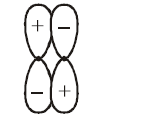
Identify the pair in which the geometry of the species is T-shape and square pyramidal, respectively:
To decide the geometry of every species we shall apply the VSEPR (Valence-Shell Electron-Pair Repulsion) model, which states that the arrangement of electron-pairs around the central atom is the one that minimises repulsions. The steric number, SN = (number of sigma bonds) + (number of lone pairs), tells us the basic electron-pair geometry, after which the positions of the lone pairs decide the final molecular shape.
Option A ICl$$\_2^-$$ and ICl$$\_5$$
ICl$$\_2^-$$ : The central iodine has two sigma bonds and three lone pairs, so $$\text{SN}=2+3=5$$, giving a trigonal-bipyramidal electron skeleton. Placing the three lone pairs in the equatorial belt leaves the two Cl atoms axial, producing a linear, not T-shaped, molecule.
ICl$$\_5$$ : Iodine has five sigma bonds and one lone pair, so $$\text{SN}=5+1=6$$, i.e. an octahedral skeleton. One lone pair occupies one position, leaving a square pyramidal shape. Thus the first member is not T-shaped, so the pair fails.
Option B IO$$\_3^-$$ and IO$$\_2$$F$$\_2^-$$
IO$$\_3^-$$ : Three sigma bonds + one lone pair ⇒ $$\text{SN}=4$$, giving a tetrahedral skeleton and a trigonal-pyramidal shape.
IO$$\_2$$F$$\_2^-$$ : Four sigma bonds + one lone pair ⇒ $$\text{SN}=5$$, giving a trigonal-bipyramidal skeleton. With one lone pair, the shape is see-saw, not square pyramidal. Hence option B is wrong.
Option C ClF$$\_3$$ and IO$$\_4^-$$
ClF$$\_3$$ : Three sigma bonds + two lone pairs ⇒ $$\text{SN}=5$$, electron skeleton trigonal-bipyramidal. The two lone pairs occupy equatorial positions, so the three F atoms form a T-shape. Good so far.
IO$$\_4^-$$ : Four sigma bonds + zero lone pairs ⇒ $$\text{SN}=4$$, giving a tetrahedral shape, not square pyramidal. Therefore option C is eliminated.
Option D XeOF$$\_2$$ and XeOF$$\_4$$
We now examine both species carefully.
XeOF$$\_2$$
• Valence electrons on Xe = 8. • One O atom and two F atoms each form one sigma bond with Xe, so there are three sigma bonds. • The total steric number around Xe is obtained from $$\text{SN} \;=\; \frac{\text{valence electrons of Xe} + \text{number of monovalent atoms} - \text{charge}}{2} = \frac{8 + 3 - 0}{2} = 5.$$ (Here O is counted once because it provides one sigma bond.) • With $$\text{SN}=5$$ the electron-pair geometry is trigonal bipyramidal. We still have $$5 - 3 = 2$$ lone pairs to place. According to VSEPR, lone pairs prefer equatorial sites to minimise 90° repulsions, so both lone pairs go equatorial. The remaining three bonded atoms (O, F, F) occupy two axial and one equatorial position which produces a right-angled arrangement, i.e. a T-shape. So XeOF$$\_2$$ is T-shaped.
XeOF$$\_4$$
• Valence electrons on Xe = 8. • One O atom + four F atoms give five sigma bonds. • The steric number is $$\text{SN} = \frac{8 + 5 - 0}{2} = 6.$$ • $$\text{SN}=6$$ corresponds to an octahedral electron skeleton. The total lone pairs are $$6 - 5 = 1.$$ • Placing the single lone pair in any one of the six positions of an octahedron leaves a square base of four ligands with the fifth ligand occupying the position trans to the lone pair. This yields a square pyramidal molecular geometry. Hence XeOF$$\_4$$ is square pyramidal.
Thus, in option D the first species (XeOF$$\_2$$) is T-shaped and the second species (XeOF$$\_4$$) is square pyramidal. No other option satisfies the required pair of shapes.
Hence, the correct answer is Option D.
The incorrect geometry is represented by:
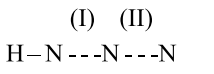
In graphite and diamond, the percentage of p characters of the hybrid orbitals in hybridization are respectively:
We first recall the general formula that relates the designation of a hybrid orbital to the percentage of p-character present in it. If an orbital is described as $$\text{sp}^n,$$ this means that one $$s$$ orbital and $$n$$ identical $$p$$ orbitals are mixed. The total number of atomic orbitals mixed is therefore $$1+n.$$ Hence:
Percentage of $$s$$-character $$=\dfrac{1}{1+n}\times 100$$
Percentage of $$p$$-character $$=\dfrac{n}{1+n}\times 100$$
Now we analyse the two carbon allotropes one by one.
In graphite, every carbon atom is trigonal-planar and uses $$\text{sp}^2$$ hybridisation. Here we have $$n=2.$$ Substituting $$n=2$$ in the above expression for the $$p$$-character, we get
$$\text{Percentage of }p\text{ in graphite}= \dfrac{2}{1+2}\times 100=\dfrac{2}{3}\times 100=66.67\%.$$
Rounding to the nearest whole number, this is $$67\%.$$
In diamond, every carbon atom is tetrahedral and uses $$\text{sp}^3$$ hybridisation. Now $$n=3.$$ Substituting $$n=3$$ into the same formula, we have
$$\text{Percentage of }p\text{ in diamond}= \dfrac{3}{1+3}\times 100=\dfrac{3}{4}\times 100=75\%.$$
So the required percentages of $$p$$-character are $$67\%$$ for graphite and $$75\%$$ for diamond.
Hence, the correct answer is Option B.
The decreasing order of bond angles in BF$$_3$$, NH$$_3$$, PF$$_3$$ and I$$_3^-$$ is:
First, we recall the VSEPR (Valence Shell Electron Pair Repulsion) principle which states that electron pairs surrounding a central atom arrange themselves in space so that the repulsion between them is minimized. The order of repulsion is
$$\text{lone pair-lone pair} \; > \; \text{lone pair-bond pair} \; > \; \text{bond pair-bond pair}.$$
More repulsion between pairs forces the bonded atoms farther apart, thus producing a larger bond angle. Conversely, less repulsion gives a smaller bond angle.
Analyzing each species one by one
We have $$\text{BF}_3$$. Boron contributes three valence electrons and each fluorine donates one electron for the bond, giving a total of three bond pairs and, importantly, no lone pair on the central boron. According to VSEPR, $$3$$ bond pairs adopt a trigonal-planar geometry. The standard bond angle for a perfect trigonal plane is
$$120^\circ.$$
Next, we look at $$\text{NH}_3$$. Nitrogen has five valence electrons. It forms three $$\sigma$$ bonds with three hydrogen atoms (three bond pairs) and is left with one lone pair. Thus, there are $$4$$ regions of electron density (three bond pairs + one lone pair). VSEPR tells us that the electron pairs would choose a tetrahedral electron-pair arrangement, whose ideal bond angle is $$109.5^\circ$$. However, one of these positions is occupied by a lone pair, and we already know
$$\text{lone pair-bond pair repulsion} > \text{bond pair-bond pair repulsion}.$$
This extra repulsion squeezes the three $$\text{N-H}$$ bonds closer together, reducing the angle from the ideal $$109.5^\circ$$ to about
$$107^\circ.$$
Now consider $$\text{PF}_3$$. Phosphorus is in the same group as nitrogen but one period lower. It also has five valence electrons, so it similarly forms three $$\sigma$$ bonds with fluorine and retains one lone pair. Thus the qualitative geometry is again trigonal-pyramidal. Nevertheless, two additional factors decrease the bond angle relative to $$\text{NH}_3$$:
(i) The larger size of the central phosphorus nucleus spreads the bonding pairs slightly farther from each other.
(ii) Fluorine is highly electronegative, pulling bonding electron density toward itself. This diminishes the bond-pair electron density close to phosphorus, so $$\text{bond pair-bond pair}$$ repulsion becomes weaker. A weaker repulsion allows the angle to contract further.
Experimentally the $$\text{F-P-F}$$ bond angle is found to be close to
$$96^\circ.$$
Finally we examine $$\text{I}_3^-$$. The central iodine atom is surrounded by two bond pairs (the two terminal I atoms) and three lone pairs, giving a total of $$5$$ electron pairs. According to VSEPR, five electron pairs adopt a trigonal-bipyramidal electron-pair geometry. Of these, the three lone pairs preferentially occupy the equatorial positions (to minimize lone-pair-lone-pair repulsion), while the two bond pairs occupy the two axial positions. Axial positions in a trigonal-bipyramidal arrangement are located in a straight line, so the $$\text{I-I-I}$$ bond angle becomes
$$180^\circ,$$
i.e. the molecule is linear.
Putting the values in descending order
$$180^\circ \; (\text{I}_3^-) \; > \; 120^\circ \; (\text{BF}_3) \; > \; 107^\circ \; (\text{NH}_3) \; > \; 96^\circ \; (\text{PF}_3).$$
Writing the corresponding molecular formulas in the same sequence gives
$$\text{I}_3^- \; > \; \text{BF}_3 \; > \; \text{NH}_3 \; > \; \text{PF}_3.$$
This matches exactly with Option A in the question statement.
Hence, the correct answer is Option A.
Which of the following are Lewis acids?
First, recall the definition of a Lewis acid. A Lewis acid is defined as a chemical species that accepts an electron pair. Conversely, a Lewis base donates an electron pair. With this definition in mind, let us examine each substance mentioned in the four options one by one.
We have $$\text{BCl}_3$$. Boron is a Group 13 element possessing only three valence electrons. In $$\text{BCl}_3$$, boron forms three covalent bonds, one with each chlorine atom. Counting the electrons around boron, we get $$3 \times 2 = 6$$ electrons, which is two short of the octet. Therefore the boron atom has an empty $$p$$-orbital that can accept a pair of electrons from an external donor. By the stated definition, $$\text{BCl}_3$$ behaves as a Lewis acid.
Next, consider $$\text{AlCl}_3$$. Aluminium, also in Group 13, mirrors boron’s electronic situation. In $$\text{AlCl}_3$$ the aluminium atom likewise possesses only six valence electrons in its bonding shell, leaving an empty orbital available for accepting an extra pair. Thus $$\text{AlCl}_3$$ is also a Lewis acid.
Now, look at $$\text{PH}_3$$. Phosphorus is in Group 15 and brings five valence electrons. In $$\text{PH}_3$$, three of those electrons form three $$\text{P-H}$$ sigma bonds, using up $$3 \times 2 = 6$$ electrons in shared pairs. That leaves one lone pair on phosphorus. Because this lone pair can be donated rather than accepted, $$\text{PH}_3$$ acts as a Lewis base, not a Lewis acid.
Finally, examine $$\text{CCl}_4$$. Carbon sits in the centre bonded to four chlorine atoms, giving it the full octet of $$8$$ valence electrons (four shared pairs). There is neither an empty orbital on carbon nor a deficiency of electrons, so $$\text{CCl}_4$$ neither seeks to accept nor readily donates an electron pair. Consequently, it is generally regarded as neither a Lewis acid nor a Lewis base under ordinary circumstances.
Summarising these observations:
$$\begin{aligned} \text{BCl}_3 &:;; \text{Lewis acid} \\ \text{AlCl}_3 &:;; \text{Lewis acid} \\ \text{PH}_3 &:;; \text{Lewis base (not acid)} \\ \text{CCl}_4 &:;; \text{neither acid nor base} \end{aligned}$$
The only option that lists exclusively Lewis acids is the one containing $$\text{BCl}_3$$ and $$\text{AlCl}_3$$, namely Option A.
Hence, the correct answer is Option A.
Which of the following is a Lewis acid?
First, recall the definition of a Lewis acid and a Lewis base. According to G. N. Lewis,
$$\text{Lewis acid} = \text{a species that can accept an electron pair},$$
$$\text{Lewis base} = \text{a species that can donate an electron pair}.$$
Now, we examine every option one by one, asking whether the central atom in each molecule has an empty orbital that can accept an electron pair.
Option A is $$\text{PH}_3.$$ We note that phosphorus in $$\text{PH}_3$$ has the electronic configuration $$[Ne]\,3s^23p^3.$$ In the molecule, the three $$3p$$ electrons form σ-bonds with three hydrogens, and the remaining lone pair occupies the fourth position of a tetrahedron. All valence orbitals are filled; phosphorus does not possess an empty orbital of sufficiently low energy to accept another pair easily. Consequently, $$\text{PH}_3$$ behaves as a Lewis base (because of its lone pair) rather than a Lewis acid.
Option B is $$\text{NF}_3.$$ Nitrogen has the electronic configuration $$1s^22s^22p^3.$$ Just like in ammonia, nitrogen in $$\text{NF}_3$$ holds one lone pair. Again, this lone pair makes $$\text{NF}_3$$ a potential Lewis base, while no vacant orbital is available on nitrogen to accept an electron pair. Therefore, $$\text{NF}_3$$ is not a Lewis acid.
Option C is $$\text{NaH}.$$ Sodium hydride is best described as an ionic solid composed of $$\text{Na}^+$$ and $$\text{H}^-$$ ions. The hydride ion $$\text{H}^-$$ is a powerful electron-pair donor, hence unquestionably a Lewis base. The $$\text{Na}^+$$ ion, while electron-deficient, usually acts as a spectator cation and does not function as a conventional Lewis acid in simple molecular interactions. Thus, $$\text{NaH}$$ does not qualify as a Lewis acid.
Option D is $$\text{B(CH}_3)_3.$$ Boron in this molecule has the electronic configuration $$1s^22s^22p^1.$$ In $$\text{B(CH}_3)_3$$, boron forms three σ-bonds with the three $$\text{CH}_3$$ groups. After forming these bonds, boron possesses only six valence electrons:
$$\text{Total electrons around B}=3\times2\;(\text{from three σ-bonds})=6<8.$$
This electron deficiency means boron has an empty $$2p$$ orbital. Because that orbital can accept an electron pair from some donor, $$\text{B(CH}_3)_3$$ satisfies the definition of a Lewis acid. Indeed, trialkyl- and trialkoxy-boranes are classic textbook examples of Lewis acids, forming adducts such as $$\text{B(CH}_3)_3\!:\!NH_3$$ when a Lewis base like ammonia donates its lone pair into boron’s vacant orbital.
Comparing all four choices, only $$\text{B(CH}_3)_3$$ clearly possesses a vacant orbital capable of accepting an electron pair. Hence it alone behaves as a Lewis acid among the given compounds.
Hence, the correct answer is Option D.
All of the following share the same crystal structure except:
Which type of 'defect' has the presence of cations in the interstitial sites?
We begin by recalling the standard point defects possible in an ionic (or even non-ionic) crystalline solid. In the syllabus, four named defects are important: vacancy defect, metal (cation or anion) deficiency defect, Schottky defect and Frenkel defect. Each defect is identified by what actually happens to the ions in the lattice.
For the present question, we are asked: which defect involves "the presence of cations in the interstitial sites"? An interstitial site is a normally empty space between the regular lattice points. Therefore the defect must be one in which at least one of the ions leaves its normal lattice position and occupies such a gap, without maintaining its original site.
We now briefly review each listed defect in this context.
For a vacancy defect, an atom or ion simply leaves its lattice point, creating a vacant site, but it does not relocate to an interstitial space; it may completely leave the crystal or remain on the surface. Thus, interstitial occupation is not involved.
For a Schottky defect, equal numbers of cations and anions leave their lattice points, again creating vacancies but not occupying interstitials. The crystal maintains electrical neutrality because the missing positive and negative ions are equal in number, yet no interstitial occupancy is introduced.
For a metal deficiency defect (also called cation deficiency defect), certain cations are missing from their lattice points, and to maintain charge balance, some of the remaining cations attain a higher positive oxidation state. Here too, no ion sits in an interstitial position; instead, oxidation state adjustment compensates for the missing cations.
Finally, consider the Frenkel defect. In this defect, an ion—usually the smaller ion, most often a cation—leaves its normal lattice site and migrates to an interstitial site within the same crystal. Because the ion remains inside the crystal but in a non-lattice position, the overall stoichiometry and charge balance are preserved. The presence of the same number of vacancies (where the ion left) and interstitials (where it now sits) characterises the Frenkel defect.
Hence, the only defect among the four that definitely "has the presence of cations in the interstitial sites" is the Frenkel defect.
Therefore, the correct choice is Option 4 (Frenkel defect).
Hence, the correct answer is Option 4.
Which of the following arrangements shows the schematic alignment of magnetic moments of antiferromagnetic substance?
In XeO$$_3$$ F$$_2$$, the number of bond pair(s), $$\pi$$-bond(s) and lone pair(s) on Xe atom respectively are:
We begin with the central atom xenon. Xenon belongs to group 18, so it has $$8$$ valence electrons.
The molecule is $$\mathrm{XeO_3F_2}$$, that is, xenon is surrounded by three oxygen atoms and two fluorine atoms – five atoms in all. Therefore xenon will furnish five $$\sigma$$-bonds, one to each surrounding atom.
First we count the total number of valence electrons present in the molecule.
$$\begin{aligned} \text{Electrons from Xe}&=&8\\ \text{Electrons from }3\,\text{O}&=&3\times6=18\\ \text{Electrons from }2\,\text{F}&=&2\times7=14\\[2pt] \text{Total valence electrons}&=&8+18+14=40 \end{aligned}$$
Now we draw an initial skeleton with five single bonds ($$5$$ bond pairs). Forming a single bond uses one pair of electrons, so
$$\text{Electrons consumed in }5\;\sigma\text{-bonds}=5\times2=10$$
$$\text{Electrons still to be placed}=40-10=30$$
Next we complete the octets of the surrounding atoms:
• Each fluorine already has two electrons in the Xe–F bond and therefore needs six more (three lone pairs). Thus $$2\times6=12$$ electrons are needed for both fluorine atoms.
• Each oxygen, if left with only a single bond, would need six more electrons to fill its octet. Hence $$3\times6=18$$ electrons are needed for the three oxygens.
The total demanded by the outer atoms is
$$12+18=30$$
and exactly the same $$30$$ electrons are still unassigned, so every outer atom’s octet can indeed be completed. At this stage xenon has
$$5$$ bond pairs and $$0$$ lone pairs, carrying a positive formal charge, while each oxygen carries a negative formal charge. To remove these opposite charges we invoke the common octet-expansion rule for elements of the 3rd period and beyond: we convert lone-pair electrons on oxygen into $$\pi$$-bonds with xenon.
Moving one lone pair from each oxygen toward xenon produces three Xe=O double bonds. Each new double bond keeps its original $$\sigma$$-bond and introduces one $$\pi$$-bond. The formal-charge accounting now becomes
$$ \begin{aligned} \text{Formal charge on O}&=&6-(4+2)=0,\\ \text{Formal charge on Xe}&=&8-(0+8)=0, \end{aligned} $$
so the structure is completely neutral.
Finally we list the required counts for the xenon atom:
• Bond pairs (i.e. $$\sigma$$-bonds): Xe is attached to each of five terminal atoms, so $$5$$ bond pairs are present.
• $$\pi$$-bonds: every Xe=O double bond adds one $$\pi$$-bond, and there are three such doubles, so $$3$$ $$\pi$$-bonds occur.
• Lone pairs on Xe: all eight of xenon’s valence electrons participate in bonding (five $$\sigma$$ pairs and three $$\pi$$ pairs), leaving $$0$$ lone pairs.
Thus the ordered set (bond pair, $$\pi$$-bond, lone pair) on xenon is $$\bigl(5,\;3,\;0\bigr)$$.
Hence, the correct answer is Option A.
Which of the following is paramagnetic?
We recall that a substance is said to be paramagnetic when it possesses at least one unpaired electron. Whenever all electrons are paired the substance is diamagnetic. For homonuclear or simple di-atomic molecules and ions of the second period, the easiest way to check the presence of unpaired electrons is to write the complete Molecular Orbital (MO) electronic configuration and then look for singly-occupied orbitals.
First we note the sequence of MOs that we shall use:
For species having total electrons $$\le 13$$ (for example $$B_2$$) the energetic order is
$$\sigma(2s)\,<\,\sigma^{\*}(2s)\,<\,\pi(2p_x)=\pi(2p_y)\,<\,\sigma(2p_z)\,<\,\pi^{\*}(2p_x)=\pi^{\*}(2p_y)\,<\,\sigma^{\*}(2p_z)$$
For species having $$\ge 14$$ electrons (for example $$CO,\,NO^{+},\,O_2^{2-}$$) the order changes slightly to
$$\sigma(2s)\,<\,\sigma^{\*}(2s)\,<\,\sigma(2p_z)\,<\,\pi(2p_x)=\pi(2p_y)\,<\,\pi^{\*}(2p_x)=\pi^{\*}(2p_y)\,<\,\sigma^{\*}(2p_z)$$
Now we examine every option one by one.
Option A : $$CO$$
Carbon contributes $$6$$ electrons and oxygen contributes $$8$$ electrons, so
$$\text{Total electrons} =6+8 =14$$
Because the total is $$14$$ we use the second ordering. We fill the MOs in the order written:
$$\sigma(2s)^2\,\sigma^{\*}(2s)^2\,\sigma(2p_z)^2\,\pi(2p_x)^2\,\pi(2p_y)^2$$
All orbitals are doubly occupied; there is no unpaired electron. So $$CO$$ is diamagnetic.
Option B : $$NO^{+}$$
Neutral $$NO$$ has $$7+8=15$$ electrons. The positive charge removes one electron, hence
$$\text{Total electrons in }NO^{+}=15-1 =14$$
Again we use the sequence for $$\ge 14$$ electrons and fill exactly as for $$N_2$$ or $$CO$$:
$$\sigma(2s)^2\,\sigma^{\*}(2s)^2\,\sigma(2p_z)^2\,\pi(2p_x)^2\,\pi(2p_y)^2$$
All electrons are paired, therefore $$NO^{+}$$ is diamagnetic.
Option C : $$O_2^{2-}$$
Neutral $$O_2$$ possesses $$8+8=16$$ electrons. The $$2-$$ charge adds two more electrons:
$$\text{Total electrons in }O_2^{2-}=16+2 =18$$
We again employ the $$\ge 14$$ order and fill up to $$18$$ electrons:
$$\sigma(2s)^2\,\sigma^{*}(2s)^2\,\sigma(2p_z)^2\,\pi(2p_x)^2\,\pi(2p_y)^2\,\pi^{*}(2p_x)^2\,\pi^{*}(2p_y)^2$$
The antibonding $$\pi^{\*}$$ orbitals are now completely filled; all electrons remain paired. Therefore $$O_2^{2-}$$ is diamagnetic.
Option D : $$B_2$$
Each boron atom carries $$5$$ electrons, so
$$\text{Total electrons} =5+5 =10$$
Because $$10<13$$ we must adopt the first energy sequence. We now fill ten electrons:
$$\sigma(2s)^2\,\sigma^{\*}(2s)^2\,\pi(2p_x)^1\,\pi(2p_y)^1$$
The $$\pi(2p_x)$$ and $$\pi(2p_y)$$ each contain a single electron. These two electrons are unpaired. As unpaired electrons are present, $$B_2$$ is unequivocally paramagnetic.
Only $$B_2$$ possesses unpaired electrons; the remaining three species have all electrons paired.
Hence, the correct answer is Option D.
$$sp^3d^2$$ hybridization is not displayed by
To decide whether the central atom in a molecule or ion uses $$sp^3d^2$$ hybrid orbitals, we first recall a basic rule from valence-shell electron-pair repulsion (VSEPR) theory.
The steric number of the central atom is defined as
$$\text{steric number}= \text{number of atoms directly bonded} + \text{number of lone pairs on the central atom}.$$
Once this number is known, the hybridization is fixed by the following correspondence:
$$ \begin{aligned} \text{steric number } 2 &\;\rightarrow\; sp,\\ \text{steric number } 3 &\;\rightarrow\; sp^2,\\ \text{steric number } 4 &\;\rightarrow\; sp^3,\\ \text{steric number } 5 &\;\rightarrow\; sp^3d,\\ \text{steric number } 6 &\;\rightarrow\; sp^3d^2.\\ \end{aligned} $$
Now we examine every given species one by one.
For $$SF_6$$:
The sulfur atom is bonded to six fluorine atoms and possesses no lone pair. Therefore
$$\text{steric number}=6+0=6.$$
A steric number of $$6$$ demands $$sp^3d^2$$ hybridization. So $$SF_6$$ indeed shows $$sp^3d^2$$ hybridization.
For $$BrF_5$$:
The bromine atom is bonded to five fluorine atoms and has one lone pair. Hence
$$\text{steric number}=5+1=6.$$
Again the steric number is $$6$$, and consequently bromine uses $$sp^3d^2$$ hybrid orbitals in $$BrF_5$$.
For $$PF_5$$:
The phosphorus atom is bonded to five fluorine atoms and carries no lone pair. So
$$\text{steric number}=5+0=5.$$
A steric number of $$5$$ matches $$sp^3d$$ hybridization, not $$sp^3d^2$$. Therefore $$PF_5$$ does not employ $$sp^3d^2$$ hybridization.
For $$[CrF_6]^{3-}$$:
The chromium ion $$Cr^{3+}$$ lies at the center of an octahedral coordination environment with six fluoride ligands and no lone pair. Thus
$$\text{steric number}=6+0=6.$$
An octahedral arrangement (steric number $$6$$) once more requires $$sp^3d^2$$ hybridization when an outer-orbital (high-spin) set of orbitals is used with weak-field fluoride ligands. Hence $$[CrF_6]^{3-}$$ is also $$sp^3d^2$$.
Among all the options, only $$PF_5$$ has a steric number less than $$6$$ and therefore lacks $$sp^3d^2$$ hybridization.
Hence, the correct answer is Option C.
The group having triangular planar structure is:
First, let us recall the basic idea that the shape of a molecule or ion is decided by the steric number of the central atom and the presence or absence of lone-pairs. For main-group species, we use the Valence Shell Electron Pair Repulsion (VSEPR) concept.
The rule says: if the steric number is $$3$$ and there are no lone-pairs on the central atom, the hybridisation is $$sp^2$$ and the geometry is trigonal (triangular) planar. Whenever one of the three positions is occupied by a lone-pair, the shape becomes trigonal pyramidal instead of planar.
Now we examine every species that appears in the four option sets.
1. $$BF_3$$ The central boron has three valence electrons and forms three $$\sigma$$ bonds with three fluorine atoms. The steric number is $$3$$ and there is no lone-pair on boron, so $$BF_3$$ is $$sp^2$$ hybridised and trigonal planar.
2. $$NF_3$$ Nitrogen has five valence electrons. Three are used for three $$\sigma$$ bonds with fluorine; the remaining two constitute one lone-pair. Thus steric number $$= 3 \text{ bonds } + 1 \text{ lone-pair } = 4$$, giving $$sp^3$$ hybridisation and a trigonal pyramidal shape, not planar.
3. $$CO_3^{2-}$$ (carbonate ion) Carbon forms three $$\sigma$$ bonds with three oxygen atoms. No lone-pair remains on carbon. Steric number $$=3$$, hybridisation $$sp^2$$, shape trigonal planar.
4. $$NO_3^-$$ (nitrate ion) Nitrogen is bonded to three oxygen atoms with no lone-pair on nitrogen (the extra electron is delocalised in $$\pi$$ bonding). Steric number $$=3$$, hybridisation $$sp^2$$, geometry trigonal planar.
5. $$SO_3$$ Sulphur uses three $$\sigma$$ bonds for three oxygen atoms; there is no lone-pair on sulphur in this structure. Steric number $$=3$$, hybridisation $$sp^2$$, and the molecule is trigonal planar.
6. $$NH_3$$ Three $$\sigma$$ bonds + one lone-pair on nitrogen give steric number $$4$$, $$sp^3$$ hybridisation, and trigonal pyramidal shape.
7. $$NCl_3$$ Exactly analogous to $$NH_3$$: three $$\sigma$$ bonds + one lone-pair, hence trigonal pyramidal.
8. $$BCl_3$$ Like $$BF_3$$, boron has no lone-pair; steric number $$3$$, so $$sp^2$$ and trigonal planar.
Having classified every species, we list those that are truly triangular planar:
$$BF_3,\; BCl_3,\; CO_3^{2-},\; NO_3^- ,\; SO_3$$
We now compare each option:
A. $$BF_3,\; NF_3,\; CO_3^{2-}$$ contains $$NF_3$$ (pyramidal) – reject.
B. $$CO_3^{2-},\; NO_3^-,\; SO_3$$ every member is trigonal planar – accept.
C. $$NH_3,\; SO_3,\; CO_3^{2-}$$ contains $$NH_3$$ (pyramidal) – reject.
D. $$NCl_3,\; BCl_3,\; SO_3$$ contains $$NCl_3$$ (pyramidal) – reject.
Only Option B satisfies the requirement that all species in the group possess a triangular planar structure.
Hence, the correct answer is Option 2.
The increasing order of the boiling points for the following compounds is:
(I) C$$_2$$H$$_5$$OH (II) C$$_2$$H$$_5$$Cl (III) C$$_2$$H$$_5$$CH$$_3$$ (IV) C$$_2$$H$$_5$$OCH$$_3$$
First we list the four species with their usual names so that we can compare them conveniently.
$$\begin{aligned} (I)\; &C_2H_5OH &&\text{is ethanol (an alcohol).}\\ (II)\; &C_2H_5Cl &&\text{is ethyl chloride (an alkyl halide).}\\ (III)\; &C_2H_5CH_3 &&\text{is }CH_3CH_2CH_3\text{, propane (a hydrocarbon).}\\ (IV)\; &C_2H_5OCH_3 &&\text{is }CH_3OCH_2CH_3\text{, ethyl methyl ether (an ether).} \end{aligned}$$
The boiling point of a liquid is governed by the strength of the intermolecular forces that must be overcome to convert it to vapour. We therefore analyse the type and relative magnitude of the forces present in each compound.
We have three main kinds of intermolecular attractions in organic molecules:
1. Hydrogen bonding (very strong): occurs when an O-H, N-H or F-H bond donates a hydrogen to the lone pair of another electronegative atom.
2. Dipole-dipole interaction (moderate): present in polar molecules that do not possess an H atom bonded directly to O, N or F.
3. London (dispersion) forces (weak but increase with molecular mass and surface area): present in all molecules, dominant in non-polar ones.
Now we consider each molecule in turn.
Ethanol, $$(I)\; C_2H_5OH$$
Ethanol contains an $$O-H$$ bond. According to the first criterion above, it can form intermolecular hydrogen bonds. These are the strongest of the three interactions listed, so ethanol is expected to have the highest boiling point among the four.
Ethyl methyl ether, $$(IV)\; C_2H_5OCH_3$$
The oxygen atom has lone pairs, making the molecule polar, but there is no $$O-H$$ bond. Hence it cannot donate a hydrogen for hydrogen bonding; it exhibits dipole-dipole interactions only. These are weaker than hydrogen bonds, so its boiling point is lower than that of ethanol.
Ethyl chloride, $$(II)\; C_2H_5Cl$$
Because of the electronegativity difference between $$C$$ and $$Cl$$, the $$C-Cl$$ bond is polar, giving the molecule a dipole moment. Thus it also shows dipole-dipole interactions, in addition to somewhat stronger dispersion forces than (IV) because the chlorine atom is heavier and more polarisable. Consequently its boiling point should be a little higher than that of the ether (IV) but still well below that of ethanol (I).
Propane, $$(III)\; C_2H_5CH_3 = CH_3CH_2CH_3$$
Propane is completely non-polar; the only forces holding its molecules together are London dispersion forces. Its molar mass (44 g mol$$^{-1}$$) is close to those of the other compounds, but the absence of polarity or hydrogen bonding makes its boiling point the lowest of the set.
Collecting these qualitative results, we write
London only $$\lt$$ dipole + London $$\lt$$ H-bond + dipole + London
Assigning each molecule to its category gives the numerical inequality
$$BP_{(III)} \lt BP_{(IV)} \lt BP_{(II)} \lt BP_{(I)}$$
or in words,
$$(III)\; C_2H_5CH_3 \; \lt \; (IV)\; C_2H_5OCH_3 \; \lt \; (II)\; C_2H_5Cl \; \lt \; (I)\; C_2H_5OH.$$
This sequence corresponds exactly to Option C in the question.
Hence, the correct answer is Option C.
Which of the following species is not paramagnetic?
First, we recall the basic rule for magnetic behaviour: a species that possesses at least one unpaired electron is called paramagnetic, while a species in which all electrons are paired is termed diamagnetic. So we must examine every option and decide whether unpaired electrons are present.
To do this rigorously we use the Molecular Orbital (MO) theory for homonuclear and heteronuclear diatomic molecules of the second period. The standard energy order of the MOs that we shall employ is stated below.
For species with a total of $$\le 14$$ electrons (that is, up to $$N_2$$) the order is
$$\sigma_{1s}\,<\,\sigma^*_{1s}\,<\,\sigma_{2s}\,<\,\sigma^*_{2s}\,<\,\pi_{2p_x}=\pi_{2p_y}\,<\,\sigma_{2p_z}\,<\,\pi^*_{2p_x}=\pi^*_{2p_y}\,<\,\sigma^*_{2p_z}$$
For species with $$>14$$ electrons (starting from $$O_2$$) the order changes slightly:
$$\sigma_{1s}\,<\,\sigma^*_{1s}\,<\,\sigma_{2s}\,<\,\sigma^*_{2s}\,<\,\sigma_{2p_z}\,<\,\pi_{2p_x}=\pi_{2p_y}\,<\,\pi^*_{2p_x}=\pi^*_{2p_y}\,<\,\sigma^*_{2p_z}$$
Now we treat each molecule one by one, always writing the electron count, filling the MOs in the proper sequence, and looking for unpaired electrons.
1. $$CO$$
The total number of valence electrons is obtained by simple addition:
$$\text{Electrons} = Z_{\text{C}} + Z_{\text{O}} = 6 + 8 = 14$$
Because the total equals $$14$$, we must use the first sequence of MO energies. We now fill the orbitals two electrons at a time (opposite spins) until all $$14$$ are placed:
$$\sigma_{1s}^2\,\sigma_{1s}^{*2}\; \sigma_{2s}^2\,\sigma_{2s}^{*2}\; \pi_{2p_x}^2\,\pi_{2p_y}^2\; \sigma_{2p_z}^2$$
We reach $$14$$ electrons exactly at $$\sigma_{2p_z}^2$$, and no higher orbital contains any electrons. Because every occupied orbital carries an even superscript, all electrons are paired. Therefore $$CO$$ is diamagnetic.
2. $$O_2$$
Here
$$\text{Electrons} = Z_{\text{O}} + Z_{\text{O}} = 8 + 8 = 16$$
Since the total exceeds $$14$$, we choose the second order of energy. Filling step by step:
$$\sigma_{1s}^2\,\sigma_{1s}^{*2}\; \sigma_{2s}^2\,\sigma_{2s}^{*2}\; \sigma_{2p_z}^2\; \pi_{2p_x}^2\,\pi_{2p_y}^2\; \pi_{2p_x}^{*1}\,\pi_{2p_y}^{*1}$$
We have now placed all $$16$$ electrons. Observe the last line: each $$\pi^*$$ orbital contains a single electron, so two electrons remain unpaired. Hence $$O_2$$ is paramagnetic.
3. $$B_2$$
For $$B_2$$ we count
$$\text{Electrons} = Z_{\text{B}} + Z_{\text{B}} = 5 + 5 = 10$$
Because $$10 \le 14$$, the first sequence applies. Filling the orbitals gives
$$\sigma_{1s}^2\,\sigma_{1s}^{*2}\; \sigma_{2s}^2\,\sigma_{2s}^{*2}\; \pi_{2p_x}^1\,\pi_{2p_y}^1$$
Only eight electrons are required up to $$\sigma_{2s}^{*2}$$, so the remaining two fill the degenerate $$\pi_{2p_x}$$ and $$\pi_{2p_y}$$ orbitals singly according to Hund’s rule. Both of these electrons are unpaired, and consequently $$B_2$$ is paramagnetic.
4. $$NO$$
This heteronuclear molecule has
$$\text{Electrons} = Z_{\text{N}} + Z_{\text{O}} = 7 + 8 = 15$$
The total exceeds $$14$$, so we again use the second energy order. Adding electrons stepwise yields
$$\sigma_{1s}^2\,\sigma_{1s}^{*2}\; \sigma_{2s}^2\,\sigma_{2s}^{*2}\; \sigma_{2p_z}^2\; \pi_{2p_x}^2\,\pi_{2p_y}^2\; \pi_{2p_x}^{*1}$$
The final electron enters a $$\pi^*$$ orbital alone, leaving it unpaired. This single unpaired electron renders $$NO$$ paramagnetic.
Putting all the conclusions together:
$$CO$$ diamagnetic; $$O_2$$ paramagnetic; $$B_2$$ paramagnetic; $$NO$$ paramagnetic
Since the question asks for the species that is not paramagnetic, we identify $$CO$$.
Hence, the correct answer is Option A.
Among the following compounds, the compound which shows the highest dipole-moment is

Dipole moment depends on:
(I) shows strong charge-separated resonance (cyclopropenone ↔ cyclopropenyl cation + O⁻), leading to a very large dipole moment.
In (II) and (III), conjugation causes delocalization, which reduces effective dipole magnitude.
In (IV), due to symmetry, dipoles largely cancel out
Thus, order of dipole moment: $$I>II>III>IV$$
A metal crystallizes in a face centred cubic structure. If the edge length of its unit cell is 'a', the closest approach between two atoms in the metallic crystal will be
We have a metal that crystallizes in a face-centred cubic (fcc) lattice. In an fcc unit cell the atoms are in contact along the face diagonal of the cube.
Let the edge length of the cube be $$a$$ and the atomic radius be $$r$$.
For a square face of the cube, the diagonal is obtained from the Pythagoras theorem: the diagonal of a square of side $$a$$ is
$$\sqrt{a^{2}+a^{2}}=\sqrt{2}\,a.$$
Along this face diagonal we encounter three atoms in the order Corner-Face-centre-Corner. Because the atoms touch each other, the total distance from the centre of the first corner atom to the centre of the opposite corner atom equals four radii. Therefore we write the contact condition
$$4r=\sqrt{2}\,a.$$
Solving for the radius, we divide both sides by $$4$$:
$$r=\frac{\sqrt{2}\,a}{4}=\frac{a}{2\sqrt{2}}.$$
The distance of closest approach between two neighbouring atoms is simply twice the radius:
$$\text{Closest approach}=2r=2\left(\frac{a}{2\sqrt{2}}\right)=\frac{a}{\sqrt{2}}.$$
This value corresponds to Option C.
Hence, the correct answer is Option C.
The bond angle H-X-H is the greatest in the compound:
First, we recall VSEPR theory, which predicts molecular shapes by counting $$\text{bond pairs}$$ and $$\text{lone pairs}$$ on the central atom. The rule states that regions of electron density repel each other and arrange to minimize repulsion, deciding both shape and bond angles.
We list each molecule, the central atom, its valence electrons, the number of bonding pairs with hydrogen, and the number of lone pairs.
For $$PH_3$$ we have: $$P$$ is in group 15, so $$5$$ valence electrons. Bonding with three $$H$$ atoms uses $$3$$ pairs, leaving $$5-3=2$$ electrons, i.e. $$1$$ lone pair. Thus there are $$4$$ regions of electron density (3 bond pairs + 1 lone pair), giving a trigonal-pyramidal arrangement. By experience and experimental data, the bond angle is close to $$93.5^{\circ}$$ because the larger, more diffuse $$3p$$ orbitals of phosphorus do not overlap strongly with $$1s$$ of hydrogen, so bond-bond repulsion is weak.
For $$CH_4$$ we have: $$C$$ is in group 14 with $$4$$ valence electrons. It forms $$4$$ sigma bonds with $$H$$, using all its electrons and leaving $$0$$ lone pairs. Thus there are exactly $$4$$ regions of electron density, all bond pairs. According to VSEPR, $$4$$ bond pairs adopt a regular tetrahedral geometry. The standard tetrahedral bond angle is $$\displaystyle 109^{\circ}28'$$ (commonly written as $$109.5^{\circ}$$).
For $$NH_3$$ we have: $$N$$ is in group 15 with $$5$$ valence electrons. After making $$3$$ N-H bonds, $$5-3=2$$ electrons remain as $$1$$ lone pair. Again we get $$4$$ regions of electron density (3 bond pairs + 1 lone pair), giving a trigonal-pyramidal shape. However, nitrogen’s $$2p$$ orbitals are small and overlap well with hydrogen’s $$1s$$, producing stronger bond-bond repulsion than in $$PH_3$$. Still, the lone pair exerts extra repulsion and compresses the H-N-H angle to about $$107^{\circ}$$, which is less than the tetrahedral value.
For $$H_2O$$ we have: $$O$$ belongs to group 16 with $$6$$ valence electrons. Two electrons form two O-H bonds, so $$6-2=4$$ electrons remain as $$2$$ lone pairs. Now the total is $$4$$ regions of electron density (2 bond pairs + 2 lone pairs), leading to a bent (angular) geometry. Two lone pairs repel even more strongly, squeezing the H-O-H angle down to about $$104.5^{\circ}$$.
Now we compare the numerical bond angles obtained:
$$PH_3 : \approx 93.5^{\circ}$$
$$NH_3 : \approx 107^{\circ}$$
$$H_2O : \approx 104.5^{\circ}$$
$$CH_4 : 109.5^{\circ}$$
The greatest of these is clearly the tetrahedral angle $$109.5^{\circ}$$ in $$CH_4$$.
Hence, the correct answer is Option B.
The group of molecules having identical shape is:
A: PCl₅ - trigonal bipyramidal; IF₅ - square pyramidal; XeO₂F₂ - see-saw → Not identical
B: BF₃ - trigonal planar; PCl₃ - trigonal pyramidal; XeO₃ - trigonal pyramidal → Not identical
C: SF₄ - see-saw; XeF₄ - square planar; CCl₄ - tetrahedral → Not identical
D: ClF₃ - T-shaped; XeOF₂ - T-shaped; XeF₃⁺ - T-shaped → Identical
The species in which the N atom is in a state of sp hybridization is:
We begin by recalling the rule that decides hybridisation. The steric number is given by
$$\text{Steric number}= (\text{Number of } \sigma\text{-bonds on the central atom}) + (\text{Number of lone pairs on the central atom}).$$
If the steric number is $$2$$, the hybridisation is $$sp$$; if the steric number is $$3$$, the hybridisation is $$sp^2$$; if the steric number is $$4$$, the hybridisation is $$sp^3$$, and so on.
Now we examine each species one by one, always keeping nitrogen as the central atom.
1. The ion $$NO_3^-$$ (nitrate)
Total valence electrons:
$$N = 5,\; 3O = 3 \times 6 = 18,\; \text{extra charge} = 1.$$
So
$$5 + 18 + 1 = 24\text{ electrons} = 12\text{ pairs}.$$
The best Lewis structure gives nitrogen bonded to three oxygens through three $$\sigma$$-bonds. Nitrogen has no lone pair in this structure.
Therefore
$$\text{Steric number} = 3\sigma + 0\text{ lone} = 3 \implies \text{hybridisation } sp^2.$$
Hence nitrogen is not $$sp$$ here.
2. The molecule $$NO_2$$ (nitrogen dioxide)
Total valence electrons:
$$N = 5,\; 2O = 12,\; \text{charge} = 0.$$
Thus
$$5 + 12 = 17\text{ electrons}.$$
The odd number means one electron remains unpaired.
Nitrogen is attached to two oxygens through two $$\sigma$$-bonds, and one lone electron (not a pair) still counts as one region
of electron density, equivalent to one lone pair for geometry purposes.
So
$$\text{Steric number} = 2\sigma + 1\text{ lone region} = 3 \implies sp^2.$$
Nitrogen is again not $$sp$$.
3. The ion $$NO_2^+$$ (nitronium)
Total valence electrons:
$$N = 5,\; 2O = 12,\; \text{positive charge} = -1.$$
Thus
$$5 + 12 - 1 = 16\text{ electrons} = 8\text{ pairs}.$$
The optimum Lewis structure has nitrogen doubly bonded to each oxygen:
$$O=N=O$$
This gives nitrogen exactly two $$\sigma$$-bonds and no lone pairs.
Therefore
$$\text{Steric number} = 2\sigma + 0\text{ lone} = 2 \implies \boxed{sp\text{ hybridisation}}.$$
So in $$NO_2^+$$ the nitrogen atom is $$sp$$ hybridised.
4. The ion $$NO_2^-$$ (nitrite)
Total valence electrons:
$$N = 5,\; 2O = 12,\; \text{negative charge} = +1.$$
Thus
$$5 + 12 + 1 = 18\text{ electrons} = 9\text{ pairs}.$$
The preferred Lewis structure shows nitrogen bonded to two oxygens through two $$\sigma$$-bonds and possessing one lone pair.
Hence
$$\text{Steric number} = 2\sigma + 1\text{ lone} = 3 \implies sp^2.$$
Nitrogen is not $$sp$$ here either.
Comparing all four species, only $$NO_2^+$$ supplies a steric number of $$2$$ and therefore places nitrogen in the $$sp$$ state.
Hence, the correct answer is Option C.
Which intermolecular force is most responsible in allowing xenon gas to liquefy?
We begin by recalling that atoms or molecules in the gas phase are kept together in the liquid phase only because of weak attractive forces that operate between them. These attractive forces are collectively called intermolecular forces.
There are several recognised categories of intermolecular forces, each arising from a different physical origin:
• Ionic interactions involve the full positive charge of a cation being attracted to the full negative charge of an anion.
• Ion-dipole interactions involve an ion (bearing full charge) attracting the partial charge on the ends of a polar molecule.
• Dipole-dipole interactions arise when two permanently polar molecules align so that the partially positive end of one molecule is near the partially negative end of another.
• London dispersion forces (also called instantaneous dipole-induced dipole forces) arise even in atoms or molecules that have no permanent charge separation. They are caused by moment-to-moment fluctuations in the electron cloud that produce a temporary dipole. This temporary dipole can then induce a dipole in a neighbouring atom or molecule, and the two temporary dipoles attract each other.
Now we analyse the specific substance mentioned in the question: xenon, written as $$\text{Xe}$$.
Xenon is a noble-gas atom. Its outer electron shell is completely filled, so the atom is electrically neutral and non-polar; there is no permanent dipole moment in a xenon atom. Because of this:
• Xenon atoms cannot engage in ionic interactions with each other: there are no oppositely charged ions present.
• Xenon atoms cannot engage in ion-dipole interactions for the same reason: there is no ion and no permanent dipole.
• Xenon atoms also cannot engage in dipole-dipole interactions, because a dipole-dipole force requires each partner to possess a permanent dipole moment, which xenon does not have.
Therefore, the only class of intermolecular force that is available to xenon atoms is the one that operates even between completely non-polar species, namely the London dispersion force. These London forces, though individually weak, are numerous when many atoms are close together, and they are sufficient to hold xenon atoms in the liquid state when the gas is cooled and/or compressed.
Hence, the force that is most responsible for allowing xenon gas to liquefy is the London dispersion force.
Hence, the correct answer is Option A.
Which of the following statements about water is FALSE?
We begin by carefully examining each option and recalling the basic facts about water, $$H_2O$$. In the condensed phases (liquid water and ice) the individual water molecules interact through hydrogen bonds. A hydrogen bond is an attractive interaction of the type $$X{-}H\cdots Y$$ where $$X$$ and $$Y$$ are highly electronegative atoms such as $$O$$, $$N$$ or $$F$$. Two distinct situations are possible:
1. Intermolecular hydrogen bonding - the hydrogen bond forms between two different molecules.
2. Intramolecular hydrogen bonding - the hydrogen bond forms within the same molecule, holding together two different parts of that molecule.
With these definitions in place, we now test every given statement.
Option A states: “There is extensive intramolecular hydrogen bonding in the condensed phase.” The water molecule has the simple bent structure $$\angle H{-}O{-}H \approx 104.5^\circ$$, and within a single molecule the two $$O{-}H$$ bonds are already covalent. Because the $$O{-}H$$ groups are attached to the same central oxygen, there is no geometrical possibility for another site inside the very same molecule to accept a hydrogen bond from one of those hydrogens. What actually happens is that a hydrogen of one molecule hydrogen-bonds to the oxygen of a different molecule:
$$\text{H}_2\text{O}\;{-}\;H\cdots O{-}\text{H}_2\text{O}$$
This is clearly intermolecular. Hence, Option A describes the situation incorrectly. There is no extensive intramolecular hydrogen bonding; the bonding present is intermolecular.
Option B reads: “Ice formed by heavy water sinks in normal water.” Heavy water is $$D_2O$$, where $$D$$ (deuterium) has atomic mass $$2$$ instead of $$1$$. The molar mass of $$D_2O$$ is therefore $$20 \text{ g mol}^{-1}$$ compared with $$18 \text{ g mol}^{-1}$$ for ordinary $$H_2O$$. Because of the greater mass, both liquid heavy water and the ice formed from it are denser than their normal counterparts. Thus a block of $$D_2O$$ ice has density $$\rho_{D_2O\; \text{ice}} \approx 1.14 \text{ g cm}^{-3}$$, which is larger than the density of liquid ordinary water $$\rho_{H_2O\; \text{(l)}} = 1.00 \text{ g cm}^{-3}$$. According to Archimedes’ principle, an object sinks when its density exceeds that of the surrounding fluid, so $$D_2O$$ ice indeed sinks in normal water. Therefore Option B is a true statement.
Option C asserts: “Water is oxidized to oxygen during photosynthesis.” In the light-dependent reactions of photosynthesis, water is split according to the overall process
$$2H_2O \rightarrow O_2 + 4H^+ + 4e^-$$
Here water loses electrons; loss of electrons is oxidation. Thus water is oxidized to molecular oxygen. So Option C is also true.
Option D declares: “Water can act both as an acid and as a base.” This is the well-known amphoteric nature of water. In the Brønsted-Lowry sense:
As an acid (proton donor) in the presence of a strong base: $$H_2O + NH_2^- \rightarrow NH_3 + OH^-$$
As a base (proton acceptor) in the presence of a strong acid: $$H_2O + HCl \rightarrow H_3O^+ + Cl^-$$
Therefore Option D is absolutely correct.
Summarizing, Options B, C and D are all true, whereas Option A is false because the hydrogen bonding in water is intermolecular, not intramolecular.
Hence, the correct answer is Option A.
Identify the incorrect statement regarding heavy water:
Let us first recall that heavy water is nothing but deuterium oxide, written as $$D_2O$$. Wherever ordinary water $$H_2O$$ would react to give a hydrogen-containing product, heavy water behaves in exactly the same manner but now every hydrogen is replaced by deuterium $$D$$. Using this guiding idea we can test each statement.
Option A: In ordinary water the well-known reaction is
$$H_2O + SO_3 \rightarrow H_2SO_4.$$
Replacing $$H_2O$$ by $$D_2O$$ we obtain
$$D_2O + SO_3 \rightarrow D_2SO_4.$$
This merely changes every $$H$$ to $$D$$, so formation of deuterated sulphuric acid $$D_2SO_4$$ is perfectly correct. Hence Option A is a correct statement.
Option B: Heavy water is famous for its ability to slow down (moderate) fast neutrons in a nuclear reactor. A moderator is a substance that decreases the energy of neutrons so that the nuclear chain reaction can be sustained. Although ordinary (light) water can serve as both coolant and moderator, heavy water is employed almost exclusively as a moderator; the coolant in most reactor designs is usually ordinary light water or some other fluid such as pressurised CO2 or liquid metal. Therefore the sentence “It is used as a coolant in nuclear reactors’’ is not generally correct for heavy water. So Option B is very likely to be the wrong statement.
Option C: With ordinary water the calcium carbide reaction is
$$CaC_2 + 2\,H_2O \rightarrow C_2H_2 + Ca(OH)_2.$$
Writing $$H_2O$$ as $$D_2O$$ and replacing each hydrogen by deuterium we get
$$CaC_2 + 2\,D_2O \rightarrow C_2D_2 + Ca(OD)_2.$$
This is exactly what Option C states, so Option C is correct.
Option D: For aluminium carbide with ordinary water the reaction is
$$Al_4C_3 + 12\,H_2O \rightarrow 3\,CH_4 + 4\,Al(OH)_3.$$
Substituting $$D_2O$$ for $$H_2O$$ and again changing every $$H$$ to $$D$$ we obtain
$$Al_4C_3 + 12\,D_2O \rightarrow 3\,CD_4 + 4\,Al(OD)_3.$$
Thus Option D is also fully correct.
From the above examination, only Option B makes an incorrect claim about the role of heavy water in a nuclear reactor.
Hence, the correct answer is Option B.
Assertion: Among the carbon allotropes, diamond is an insulator, whereas, graphite is a good conductor of electricity.
Reason: Hybridization of carbon in diamond and graphite are sp$$^3$$ and sp$$^2$$ respectively.
First, let us read the two statements with care.
Assertion: “Among the carbon allotropes, diamond is an insulator, whereas graphite is a good conductor of electricity.”
Reason: “Hybridization of carbon in diamond and graphite are $$sp^3$$ and $$sp^2$$ respectively.”
We want to judge two things: (i) whether each sentence is factually correct, and (ii) whether the second sentence is the real, complete cause for the first sentence. We shall proceed slowly, checking all the chemical facts step by step.
Step 1 - Verifying the assertion. In diamond every carbon is covalently bonded to four other carbons in a three-dimensional network. No free or mobile electrons are left. Therefore the electrical conductivity $$\sigma$$ is practically zero; diamond is an insulator.
In graphite each carbon is covalently bonded to three other carbons in a two-dimensional hexagonal sheet. One valence electron of every carbon atom remains unbonded in a $$p_z$$ orbital. These $$p_z$$ orbitals overlap sideways over the whole sheet, producing a delocalised $$\pi$$-electron cloud. These delocalised electrons can move under an electric field, so graphite conducts electricity well, especially along the planes. Hence the assertion is true.
Step 2 - Verifying the reason. The carbon in diamond has four $$\sigma$$-bonds arranged tetrahedrally. According to valence bond theory, tetrahedral geometry corresponds to $$sp^3$$ hybridisation. In graphite the carbon forms only three $$\sigma$$-bonds lying in one plane at $$120^{\circ}$$. Planar trigonal geometry is obtained from $$sp^2$$ hybridisation. Thus the reason is also true.
Step 3 - Testing whether the reason explains the assertion.
We now ask: “Does merely stating that the hybridisations are $$sp^3$$ and $$sp^2$$ automatically explain the difference in conductivity?”
Because the assertion is correct, the reason is also correct, yet the reason does not sufficiently and directly explain the assertion, we select the option that says exactly this.
Option A states: “Both assertion and reason are correct, but the reason is not the correct explanation for the assertion.”
Hence, the correct answer is Option A.
The intermolecular interaction that is dependent on the inverse cube of distance between the molecules is:
We begin by recalling how the potential energy $$U$$ of different kinds of intermolecular forces varies with the centre-to-centre separation $$r$$ of the two interacting species. The power of $$r$$ in the denominator is the feature that differentiates one type of interaction from another.
For two ions carrying integral charges $$q_1$$ and $$q_2$$, Coulomb’s law gives the potential energy formula first:
$$U_{$$ ion-ion $$} \;=\;\dfrac{1}{4\pi\varepsilon_0}\dfrac{q_1q_2}{r}.$$
Because only a single factor of $$r$$ appears in the denominator, an ion-ion interaction is said to be proportional to $$r^{-1}$$.
Next, for an ion of charge $$q$$ placed near a polar molecule of permanent dipole moment $$\mu$$, the ion-dipole potential energy is obtained from electrostatics as:
$$U_{$$ ion-dipole $$} \;=\;-\dfrac{1}{4\pi\varepsilon_0}\dfrac{q\mu\cos\theta}{r^{2}}.$$
Here $$\theta$$ is the angle between the dipole axis and the ion-molecule line. The power of $$r$$ is now 2, so an ion-dipole interaction varies as $$r^{-2}$$.
For two molecules each possessing a permanent dipole moment $$\mu_1$$ and $$\mu_2$$, the classical electrostatic expression (for fixed orientations) is:
$$U_{$$ dipole-dipole $$} \;=\;-\dfrac{1}{4\pi\varepsilon_0}\dfrac{\mu_1\mu_2\,(2\cos\theta_1\cos\theta_2-\sin\theta_1\sin\theta_2\cos\phi)}{r^{3}}.$$
Because the leading denominator is $$r^{3}$$, a permanent dipole-dipole interaction is proportional to $$r^{-3}$$. A hydrogen bond is essentially a strong, highly directed dipole-dipole interaction that inherits this same distance dependence; the presence of the hydrogen atom bonded to a highly electronegative element (such as O, N or F) merely strengthens the interaction without changing the $$r^{-3}$$ dependence.
Finally, London dispersion forces (instantaneous dipole-induced dipole) have a quantum-mechanical origin. The London formula gives:
$$U_{\text{London}} \;=\;-\dfrac{C}{r^{6}},$$
so such forces vary as $$r^{-6}$$.
Collecting these results:
• Ion-ion $$\propto r^{-1}$$
• Ion-dipole $$\propto r^{-2}$$
• Dipole-dipole (hydrogen bond) $$\propto r^{-3}$$
• London force $$\propto r^{-6}$$
Because the question asks for the interaction that depends on the inverse cube of the distance, we must choose the hydrogen bond, which is a specialised dipole-dipole interaction and therefore follows the $$r^{-3}$$ law.
Hence, the correct answer is Option A.
The shape of $$XeOF_4$$ by VSEPR theory is:
To determine the shape of the molecule $$XeOF_4$$ using VSEPR theory, we first recall that VSEPR theory predicts molecular geometry based on the repulsion between electron pairs around the central atom. The central atom here is xenon (Xe).
We start by calculating the total number of valence electrons in $$XeOF_4$$. Xenon (Xe) is in group 18 and has 8 valence electrons. Oxygen (O) is in group 16 and has 6 valence electrons. Each fluorine (F) is in group 17 and has 7 valence electrons, and there are four fluorine atoms. So, total valence electrons = valence electrons from Xe + valence electrons from O + valence electrons from four F atoms = $$8 + 6 + (4 \times 7) = 8 + 6 + 28 = 42$$.
Next, we draw the Lewis structure. Xenon is bonded to one oxygen atom and four fluorine atoms, forming five bonds. To minimize formal charges and achieve stability, xenon has one lone pair. Each fluorine atom forms one single bond with xenon and has three lone pairs to complete its octet. Oxygen forms one single bond with xenon and has three lone pairs. Now, let's verify the electron count: the lone pair on xenon accounts for 2 electrons. The five bonds (one Xe-O and four Xe-F) each consist of 2 electrons, so they account for $$5 \times 2 = 10$$ electrons. Each fluorine has three lone pairs (6 electrons), so four fluorines account for $$4 \times 6 = 24$$ electrons. Oxygen has three lone pairs, accounting for 6 electrons. Total electrons = lone pair on Xe + bonding electrons + lone pairs on F + lone pairs on O = $$2 + 10 + 24 + 6 = 42$$, which matches the total valence electrons. Formal charges: xenon has a formal charge of +1 (calculated as valence electrons - lone pair electrons - half bonding electrons = $$8 - 2 - \frac{10}{2} = 8 - 2 - 5 = +1$$), oxygen has a formal charge of -1 ($$6 - 6 - \frac{2}{2} = 6 - 6 - 1 = -1$$), and each fluorine has formal charge 0 ($$7 - 6 - \frac{2}{2} = 7 - 6 - 1 = 0$$), summing to zero for the molecule.
In VSEPR theory, we consider electron domains (bonding pairs and lone pairs) around the central atom. Xenon has five bonding pairs (one to O and four to F) and one lone pair, giving a total of six electron domains. Six electron domains arrange themselves in an octahedral geometry to minimize repulsion, as this geometry maximizes the angles between domains.
The molecular geometry is determined by the positions of the atoms, ignoring lone pairs. In octahedral electron geometry, when one position is occupied by a lone pair, the five bonding pairs occupy the remaining positions, resulting in a square pyramidal molecular geometry. This is because the lone pair occupies one apex, and the five atoms form a square base with xenon slightly above the plane.
Comparing with the options: trigonal bipyramidal (option A) has five domains with no lone pairs, pentagonal planar (option C) is not standard for six domains, and octahedral (option D) would require all six positions occupied by atoms. Hence, the correct geometry is square pyramidal.
Hence, the correct answer is Option B.
After understanding the assertion and reason, choose the correct option.
Assertion: In the bonding molecular orbital (MO) of $$H_2$$, electron density is increased between the nuclei.
Reason: The bonding MO is $$\psi_A + \psi_B$$, which shows destructive interference of the combining electron waves.
First, let's understand the Assertion and Reason given in the question.
The Assertion states: In the bonding molecular orbital (MO) of $$H_2$$, electron density is increased between the nuclei.
The Reason states: The bonding MO is $$\psi_A + \psi_B$$, which shows destructive interference of the combining electron waves.
To evaluate these, we need to recall how molecular orbitals are formed in the hydrogen molecule ($$H_2$$). Each hydrogen atom contributes a 1s atomic orbital, denoted as $$\psi_A$$ for atom A and $$\psi_B$$ for atom B. When these atomic orbitals combine, they form two molecular orbitals: a bonding molecular orbital (BMO) and an antibonding molecular orbital (ABMO).
The bonding molecular orbital (BMO) is formed by the constructive interference (in-phase combination) of the atomic orbitals. This is mathematically represented as:
$$\psi_{\text{BMO}} = \psi_A + \psi_B$$
The antibonding molecular orbital (ABMO) is formed by the destructive interference (out-of-phase combination) and is represented as:
$$\psi_{\text{ABMO}} = \psi_A - \psi_B$$
Now, the electron density in a molecular orbital is given by the square of the wave function, $$|\psi|^2$$. Let's compute this for the bonding MO:
$$|\psi_{\text{BMO}}|^2 = (\psi_A + \psi_B)^2 = \psi_A^2 + \psi_B^2 + 2\psi_A\psi_B$$
For the antibonding MO:
$$|\psi_{\text{ABMO}}|^2 = (\psi_A - \psi_B)^2 = \psi_A^2 + \psi_B^2 - 2\psi_A\psi_B$$
In the region between the two nuclei, both $$\psi_A$$ and $$\psi_B$$ are positive because the 1s atomic orbitals are positive everywhere. Therefore, in the bonding MO, the cross term $$2\psi_A\psi_B$$ is positive. This means that the electron density between the nuclei is higher than the sum of the individual atomic orbital densities ($$\psi_A^2 + \psi_B^2$$). Thus, the Assertion is correct: in the bonding MO, electron density is indeed increased between the nuclei.
Now, let's examine the Reason. It claims that the bonding MO is $$\psi_A + \psi_B$$, which is correct, but it states that this represents destructive interference. However, as explained above, $$\psi_A + \psi_B$$ corresponds to constructive interference (in-phase combination), which leads to increased electron density between the nuclei. Destructive interference occurs in the antibonding MO ($$\psi_A - \psi_B$$), where the electron density between the nuclei is reduced. Therefore, the Reason is incorrect because it misattributes destructive interference to the bonding MO.
Given that the Assertion is correct and the Reason is incorrect, we now look at the options:
A. Assertion and Reason are correct, but Reason is not the correct explanation for the Assertion.
B. Assertion and Reason are correct and Reason is the correct explanation for the Assertion.
C. Assertion is incorrect, Reason is correct.
D. Assertion is correct, Reason is incorrect.
Since the Assertion is correct and the Reason is incorrect, the correct choice is D.
Hence, the correct answer is Option D.
Molecule AB has a bond length of 1.617 $$\mathring{A}$$ and a dipole moment of 0.38 D. The fractional charge on each atom (absolute magnitude) is: $$(e_0 = 4.802 \times 10^{-10}$$ esu$$)$$
We know that the electric dipole moment $$\mu$$ of a diatomic molecule is given by the simple relation
$$\mu = q \, r$$
where
$$q$$ = magnitude of the charge on each atom (in esu),
$$r$$ = bond length (in cm).
The data provided are
Bond length: $$r = 1.617 \,\text{\AA}$$
Dipole moment: $$\mu = 0.38 \,\text{D}$$
First, we must convert the bond length from angstroms to centimeters. Because
$$1 \,\text{\AA} = 10^{-8} \,\text{cm},$$
we have
$$r = 1.617 \times 10^{-8} \,\text{cm}.$$
Next, we convert the dipole moment from debye to the cgs electrostatic unit. By definition,
$$1 \,\text{D} = 10^{-18} \,\text{esu}\,\text{cm},$$
so
$$\mu = 0.38 \times 10^{-18} \,\text{esu}\,\text{cm} = 3.8 \times 10^{-19} \,\text{esu}\,\text{cm}.$$
Now we substitute these values into the formula $$\mu = q r$$ and solve for $$q$$:
$$q \;=\; \frac{\mu}{r} \;=\; \frac{3.8 \times 10^{-19}\,\text{esu}\,\text{cm}}{1.617 \times 10^{-8}\,\text{cm}}.$$
Carrying out the division step by step:
First divide the numerical parts:
$$\frac{3.8}{1.617} \approx 2.35.$$
Next, handle the powers of ten:
$$10^{-19} \div 10^{-8} = 10^{-19 -(-8)} = 10^{-11}.$$
Combining these results, we obtain
$$q \approx 2.35 \times 10^{-11} \,\text{esu}.$$
The question asks for the fractional (or partial) charge on each atom relative to the fundamental electronic charge $$e_0$$. The electronic charge is given as
$$e_0 = 4.802 \times 10^{-10} \,\text{esu}.$$
The fractional charge $$f$$ is therefore
$$f \;=\; \frac{q}{e_0} \;=\; \frac{2.35 \times 10^{-11}\,\text{esu}}{4.802 \times 10^{-10}\,\text{esu}}.$$
Perform the division:
First, divide the coefficients:
$$\frac{2.35}{4.802} \approx 0.489 \times 10^{-1} = 0.0489.$$
(Here, shifting one power of ten from denominator to numerator moves the decimal place one step to the left.)
Hence
$$f \approx 0.05.$$
Thus each atom carries about $$5\%$$ of the elementary charge in magnitude, meaning the fractional charge is $$0.05$$.
Hence, the correct answer is Option B.
Which compound exhibits maximum dipole moment among the following?
The dipole moment ($$\mu$$) of a disubstituted benzene is the vector sum of the individual bond dipoles.
$$-NH_2$$ (Amino group): An electron-donating group (EDG) that pushes electron density toward the ring (dipole vector points toward the ring).
$$-NO_2$$ (Nitro group): An electron-withdrawing group (EWG) that pulls electron density away from the ring (dipole vector points away from the ring)
In p-nitroaniline, the $$-NH_2$$ group pushes electrons into the ring at one end, and the $$-NO_2$$ group pulls them out at the opposite end. Both vectors point in the same direction. Hence, has the highest dipole moment.
The heat of atomization of methane and ethane are 360 kJ mol$$^{-1}$$ and 620 kJ mol$$^{-1}$$, respectively. The longest wavelength of light capable of breaking the C - C bond is (Avogadro's number = $$6.023 \times 10^{23}$$, h = $$6.62 \times 10^{-34}$$ J s)
The heat of atomization is the energy required to break all bonds in one mole of a compound to form individual atoms. For methane (CH4), the heat of atomization is 360 kJ mol-1. Methane has four C-H bonds, so the bond energy for one C-H bond is calculated as follows:
$$ E(\text{C-H}) = \frac{360 \text{ kJ mol}^{-1}}{4} = 90 \text{ kJ mol}^{-1} $$
For ethane (C2H6), the heat of atomization is 620 kJ mol-1. Ethane has one C-C bond and six C-H bonds. The total bond energy is the sum of the energy for the C-C bond and six C-H bonds:
$$ E(\text{C-C}) + 6 \times E(\text{C-H}) = 620 \text{ kJ mol}^{-1} $$
Substituting the value of $$ E(\text{C-H}) = 90 \text{ kJ mol}^{-1} $$:
$$ E(\text{C-C}) + 6 \times 90 = 620 $$
$$ E(\text{C-C}) + 540 = 620 $$
$$ E(\text{C-C}) = 620 - 540 = 80 \text{ kJ mol}^{-1} $$
The bond energy for the C-C bond is 80 kJ mol-1. To find the longest wavelength of light capable of breaking one C-C bond, we need the energy required for a single bond. First, convert the bond energy from kJ mol-1 to J per bond. Since 1 kJ = 1000 J and 1 mole contains Avogadro's number of bonds ($$ N_A = 6.023 \times 10^{23} $$):
$$ E_{\text{bond}} = \frac{80 \times 1000}{6.023 \times 10^{23}} \text{ J} = \frac{80000}{6.023 \times 10^{23}} \text{ J} $$
Simplifying:
$$ E_{\text{bond}} = \frac{8 \times 10^4}{6.023 \times 10^{23}} = \frac{8}{6.023} \times 10^{-19} \text{ J} \approx 1.3282 \times 10^{-19} \text{ J} $$
The energy of a photon is given by $$ E = \frac{hc}{\lambda} $$, where $$ h = 6.62 \times 10^{-34} \text{ J s} $$ is Planck's constant, $$ c = 3 \times 10^8 \text{ m s}^{-1} $$ is the speed of light, and $$ \lambda $$ is the wavelength. The longest wavelength corresponds to the minimum energy required to break the bond, so set $$ E = E_{\text{bond}} $$:
$$ \frac{hc}{\lambda} = E_{\text{bond}} $$
$$ \lambda = \frac{hc}{E_{\text{bond}}} $$
First, compute $$ hc $$:
$$ hc = (6.62 \times 10^{-34}) \times (3 \times 10^8) = 1.986 \times 10^{-25} \text{ J m} $$
Now substitute into the wavelength formula:
$$ \lambda = \frac{1.986 \times 10^{-25}}{1.3282 \times 10^{-19}} = \frac{1.986}{1.3282} \times 10^{-6} \text{ m} \approx 1.4952 \times 10^{-6} \text{ m} $$
Convert meters to nanometers (1 m = 109 nm):
$$ \lambda = 1.4952 \times 10^{-6} \times 10^9 \text{ nm} = 1.4952 \times 10^3 \text{ nm} $$
Rounding to three significant figures, $$ \lambda \approx 1490 \text{ nm} = 1.49 \times 10^3 \text{ nm} $$. Comparing with the options, this matches option D.
Hence, the correct answer is Option D.
Which one of the following alkaline earth metal sulphates has its hydration enthalpy greater than its lattice enthalpy?
For an ionic solid to dissolve in water, we compare two energy terms. First, lattice enthalpy $$\Delta H_{latt}$$ is the energy released when gaseous ions come together to form one mole of the solid. Second, hydration enthalpy $$\Delta H_{hyd}$$ is the energy released when the gaseous ions become surrounded by water molecules. A salt will be appreciably soluble, or at least its ions will prefer to separate, when the magnitude of $$\Delta H_{hyd}$$ exceeds that of $$\Delta H_{latt}$$, that is when $$|\Delta H_{hyd}| \gt |\Delta H_{latt}|$$.
Both of these enthalpies depend strongly on ionic size. The general relationships are:
$$|\Delta H_{latt}| \propto \dfrac{z^{+}z^{-}}{r^{+}+r^{-}}$$ where $$r^{+}$$ and $$r^{-}$$ are the ionic radii of the cation and anion, and $$z^{+},z^{-}$$ are their charges.
$$|\Delta H_{hyd}| \propto \dfrac{z^{2}}{r}$$ for each individual ion, so the smaller the ion, the larger the hydration enthalpy.
Inside the alkaline-earth family $$Be^{2+},\, Mg^{2+},\, Ca^{2+},\, Sr^{2+},\, Ba^{2+}$$ the ionic radius increases steadily as we go down the group:
$$r(Be^{2+}) \lt r(Mg^{2+}) \lt r(Ca^{2+}) \lt r(Sr^{2+}) \lt r(Ba^{2+}).$$
Because the radius of $$Be^{2+}$$ is the smallest, the hydration enthalpy $$|\Delta H_{hyd}|$$ drops very rapidly from $$Be^{2+}$$ to $$Ba^{2+}$$. On the other hand, lattice enthalpy also decreases down the group, but this decrease is slower, since the radius of the large anion $$SO_{4}^{2-}$$ dominates the denominator $$r^{+}+r^{-}$$ in the lattice enthalpy expression. Symbolically we may write
$$|\Delta H_{hyd}(Be^{2+})| \gg |\Delta H_{hyd}(Ba^{2+})|$$ while $$|\Delta H_{latt}(BeSO_{4})| \approx |\Delta H_{latt}(BaSO_{4})|$$ but with only a moderate downward trend.
Therefore, for the smallest cation $$Be^{2+}$$, the drop in hydration enthalpy is not matched by an equal drop in lattice enthalpy. The inequality
$$|\Delta H_{hyd}(Be^{2+})| \gt |\Delta H_{latt}(BeSO_{4})|$$
remains valid, whereas for the larger cations $$Ca^{2+}, Sr^{2+}, Ba^{2+}$$ we reach
$$|\Delta H_{hyd}| \lt |\Delta H_{latt}|,$$
making their sulphates sparingly soluble and ensuring that their lattice enthalpy is the greater quantity.
Consequently, among the given choices, only $$BeSO_{4}$$ possesses a hydration enthalpy greater than its lattice enthalpy.
Hence, the correct answer is Option C.
Sodium metal crystallizes in a body centred cubic lattice with a unit cell edge of 4.29 $$\mathring{A}$$. The radius of sodium atom is approximately:
We are told that sodium crystallizes in a body-centred cubic (bcc) lattice. In a bcc lattice each corner atom touches the single atom at the body centre along the body diagonal of the cube.
The length of the body diagonal of a cube of edge $$a$$ is, by the Pythagoras theorem, $$\sqrt{3}\,a$$.
Along that diagonal we have one corner atom, then the body-centred atom, and finally the opposite corner atom. The sequence of radii is therefore $$r + 2r + r = 4r$$. Hence for a bcc lattice
$$\sqrt{3}\,a = 4r.$$
The edge length is given as $$a = 4.29\;\text{\AA}$$. Substituting this value, we obtain
$$4r = \sqrt{3}\times 4.29\;\text{\AA}.$$
Using $$\sqrt{3}\approx 1.732$$, we have
$$4r = 1.732 \times 4.29\;\text{\AA}.$$
Carrying out the multiplication step by step:
$$1.732 \times 4 = 6.928,$$
$$1.732 \times 0.29 \approx 0.502,$$
so
$$1.732 \times 4.29 \approx 6.928 + 0.502 = 7.430.$$
Thus
$$4r \approx 7.430\;\text{\AA}.$$
Dividing both sides by 4,
$$r = \frac{7.430}{4}\;\text{\AA}.$$
$$r \approx 1.8575\;\text{\AA}.$$
Rounded to three significant figures,
$$r \approx 1.86\;\text{\AA}.$$
This value corresponds to the second option in the list.
Hence, the correct answer is Option B.
Which one of the following molecules is paramagnetic?
To determine which molecule is paramagnetic, we need to check for unpaired electrons in their molecular orbital configurations. Paramagnetic substances have at least one unpaired electron.
Let's analyze each option step by step:
Option A: N₂
Nitrogen atom has atomic number 7. Each N atom has 7 electrons, so N₂ has 14 electrons. The molecular orbital configuration for N₂ (considering valence electrons: 2s and 2p orbitals) is:
$$\sigma(2s)^2 \sigma^*(2s)^2 \pi(2p_x)^2 \pi(2p_y)^2 \sigma(2p_z)^2$$
All electrons are paired (no unpaired electrons). Thus, N₂ is diamagnetic.
Option B: O₃
Ozone (O₃) has three oxygen atoms. Each oxygen atom has 8 electrons, so total electrons = 3 × 8 = 24. O₃ has a bent structure with resonance. The central oxygen is sp² hybridized. The molecule has 18 valence electrons (6 per oxygen atom). In ozone, all electrons are paired in the molecular orbitals due to resonance stabilization. O₃ is diamagnetic.
Option C: CO
Carbon monoxide has carbon (atomic number 6) and oxygen (atomic number 8). Total electrons = 6 + 8 = 14. CO is isoelectronic with N₂ (14 electrons). Its molecular orbital configuration is:
$$\sigma(2s)^2 \sigma^*(2s)^2 \pi(2p_x)^2 \pi(2p_y)^2 \sigma(2p_z)^2$$
All electrons are paired. Thus, CO is diamagnetic.
Option D: NO
Nitric oxide has nitrogen (atomic number 7) and oxygen (atomic number 8). Total electrons = 7 + 8 = 15. The molecular orbital configuration for NO is:
$$\sigma(2s)^2 \sigma^*(2s)^2 \sigma(2p_z)^2 \pi(2p_x)^2 \pi(2p_y)^2 \pi^*(2p_x)^1$$
Here, the last electron occupies the π* orbital alone, resulting in one unpaired electron. Therefore, NO is paramagnetic.
Hence, the correct answer is Option D.
Which one of the following properties is not shown by NO?
We begin by recalling that nitric oxide, represented as $$NO$$, is a heteronuclear diatomic molecule containing a total of $$11$$ valence electrons: $$5$$ from nitrogen and $$6$$ from oxygen.
To understand its magnetic property, we write the molecular orbital (MO) configuration that results when the atomic orbitals of nitrogen and oxygen combine. The energy order for the MOs of a heteronuclear diatomic molecule in the second period is the same as for $$N_2$$ after the inversion point, namely
$$\sigma_{1s}^2\,\sigma_{1s}^{\*2}\,\sigma_{2s}^2\,\sigma_{2s}^{\*2}\, \sigma_{2p_z}^2\,\pi_{2p_x}^2 = \pi_{2p_y}^2\,\pi_{2p_x}^{\*1} = \pi_{2p_y}^{\*0}\, \sigma_{2p_z}^{\*0}$$
However, because $$NO$$ possesses one more electron than $$N_2$$, this eleventh electron occupies the $$\pi_{2p_x}^{\*}$$ or equivalently one of the degenerate $$\pi_{2p}^{\*}$$ orbitals. Thus there is an unpaired electron present.
The presence of a single unpaired electron makes $$NO$$ paramagnetic, that is, it is attracted by a magnetic field. Diamagnetism corresponds to the situation in which all electrons are paired. Therefore, the statement “It is diamagnetic in gaseous state” is false.
Next we verify the other three listed properties to see that they are indeed correct for $$NO$$.
We call an oxide neutral when it is neither distinctly acidic nor basic in water. Nitric oxide shows extremely weak interactions with water, does not produce $$H^+$$ or $$OH^-$$ ions in significant amount, and hence is classified as a neutral oxide. So the statement “It is a neutral oxide” is true.
We also know from elementary kinetics that gaseous $$NO$$ reacts rapidly with oxygen present in air to give brown nitrogen dioxide. The balanced equation is
$$2\,NO + O_2 \rightarrow 2\,NO_2$$
Because this combination indeed occurs, the statement “It combines with oxygen to form nitrogen dioxide” is true.
Finally, we determine the bond order. The general formula connecting bond order ($$B.O.$$) with the numbers of bonding electrons ($$N_b$$) and antibonding electrons ($$N_a$$) in the MO picture is first stated:
$$B.O. = \dfrac{N_b - N_a}{2}$$
From the configuration written above we count:
Bonding electrons $$N_b = 2\,( \sigma_{1s}) + 2\,( \sigma_{2s}) + 2\,( \sigma_{2p_z}) + 4\,( \pi_{2p_x}, \pi_{2p_y}) = 10$$
Antibonding electrons $$N_a = 2\,( \sigma_{1s}^{\*}) + 2\,( \sigma_{2s}^{\*}) + 1\,( \pi_{2p}^{\*}) = 5$$
Substituting these values into the formula we get
$$B.O. = \dfrac{10 - 5}{2} = \dfrac{5}{2} = 2.5$$
Thus the statement “Its bond order is 2.5” is true.
Among the four alternatives only the first one is incorrect, because in reality $$NO$$ is paramagnetic, not diamagnetic.
Hence, the correct answer is Option A.
For which of the following molecule significant $$\mu \neq 0$$?
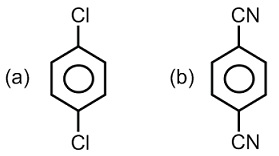
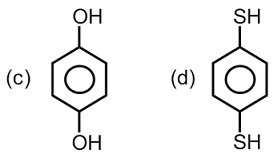
(a) p-dichlorobenzene: $$\mu = 0$$ because the single-atom $$\text{-Cl}$$ substituents align linearly along the para-axis and cancel each other completely.
(b) p-dicyanobenzene: $$\mu = 0$$ because the $$\text{-C}\equiv\text{N}$$ groups are strictly linear ($$sp$$-hybridized) and their opposite dipole vectors cancel out perfectly.
(c) p-dihydroxybenzene: $$\mu \neq 0$$ because the $$\text{-OH}$$ groups are bent ($$sp^3$$-hybridized), and their rotating conformations prevent perfect vector cancellation.
(d) p-dimercatobenzene: $$\mu \neq 0$$ because the $$\text{-SH}$$ groups are bent ($$sp^3$$-hybridized), resulting in a net structural dipole moment during rotation.
The correct order of bond dissociation energy among N$$_2$$, O$$_2$$, O$$_2^-$$ is shown in which of the following arrangements?
To determine the correct order of bond dissociation energy among N2, O2, and O2-, we need to understand that bond dissociation energy is directly related to bond order. A higher bond order indicates a stronger bond and thus higher bond dissociation energy. We will calculate the bond orders using molecular orbital theory.
First, recall the molecular orbital configurations:
For N2 (total electrons = 14, ignoring core 1s orbitals):
For O2 (total electrons = 16, ignoring core 1s orbitals):
For O2- (superoxide ion, total electrons = 16 + 1 = 17, ignoring core 1s orbitals):
Summary of bond orders:
Since bond dissociation energy increases with bond order, the order should be N2 > O2 > O2-.
Now, comparing with the options:
Hence, the correct answer is Option C.
The number and type of bonds in C$$_2^{2-}$$ ion in CaC$$_2$$ are:
The question is about finding the number and type of bonds in the C22- ion present in calcium carbide (CaC2). Calcium carbide is an ionic compound made up of Ca2+ ions and C22- ions. We will focus on the C22- ion.
First, we determine the total number of valence electrons in C22-. Each carbon atom has 4 valence electrons, so two carbon atoms contribute 8 electrons. The ion has a charge of -2, meaning it has gained 2 extra electrons. Therefore, the total valence electrons are 8 + 2 = 10 electrons.
Next, we draw the Lewis structure for C22-. To satisfy the octet rule for both carbon atoms, we need each carbon to be surrounded by 8 electrons. A triple bond between the two carbon atoms uses 6 electrons (3 pairs). The remaining 4 electrons are placed as lone pairs, with two electrons (one lone pair) on each carbon atom. So, the Lewis structure is [:C≡C:]2-. In this structure, each carbon atom has a triple bond (equivalent to 6 electrons) and one lone pair (2 electrons), completing the octet.
A triple bond consists of one sigma (σ) bond and two pi (π) bonds. The sigma bond is formed by the head-on overlap of orbitals along the internuclear axis, and the two pi bonds are formed by the sidewise overlap of orbitals perpendicular to the axis. Therefore, in the C22- ion, there is one σ-bond and two π-bonds.
We can confirm this using molecular orbital theory. For the C22- ion with 10 electrons, the molecular orbital configuration is: (σ1s2)(σ*1s2)(σ2s2)(σ*2s2)(π2px2)(π2py2)(σ2pz2). The core orbitals (σ1s and σ*1s) are ignored as they are filled. The bonding orbitals are σ2s, π2px, π2py, and σ2pz, while σ*2s is antibonding.
Calculating the bond order: Bond order = (number of electrons in bonding orbitals - number of electrons in antibonding orbitals) / 2. Electrons in bonding orbitals: σ2s2 (2 electrons), π2px2 and π2py2 (4 electrons), and σ2pz2 (2 electrons) give a total of 8 bonding electrons. Electrons in antibonding orbitals: σ*2s2 (2 electrons). So, bond order = (8 - 2) / 2 = 6 / 2 = 3, indicating a triple bond.
This triple bond comprises one σ-bond (from the σ2pz orbital) and two π-bonds (from the π2px and π2py orbitals). The σ2s and σ*2s orbitals cancel each other's bond order contribution, leaving only the σ2pz and the two π bonds.
Hence, the C22- ion has one σ-bond and two π-bonds.
Now, comparing with the options:
A. Two σ-bonds and two π-bonds
B. One σ-bond and two π-bonds
C. One σ-bond and one π-bond
D. Two σ-bonds and one π-bond
So, the correct answer is Option B.
Which of the following has unpaired electron(s)?
To determine which species has unpaired electrons, we use Molecular Orbital Theory (MOT). This theory helps us understand the electron configuration in molecules and identify unpaired electrons by filling molecular orbitals according to their energy levels.
We analyze each option step by step, considering the total number of electrons and the molecular orbital energy order. For oxygen-based molecules (like O₂ and its ions), the energy order of molecular orbitals is: $$\sigma 2s < \sigma^* 2s < \sigma 2p_z < \pi 2p_x = \pi 2p_y < \pi^* 2p_x = \pi^* 2p_y < \sigma^* 2p_z$$. For nitrogen-based molecules (like N₂ and its ions), the energy order is: $$\sigma 2s < \sigma^* 2s < \pi 2p_x = \pi 2p_y < \sigma 2p_z < \pi^* 2p_x = \pi^* 2p_y < \sigma^* 2p_z$$. We focus on valence electrons, ignoring core electrons (1s orbitals), as they are filled and do not affect unpaired electrons.
Option A: O₂⁻
O₂ has 16 electrons (8 from each oxygen atom). O₂⁻ gains one extra electron, so total electrons = 17. Valence electrons: Each oxygen atom has 6 valence electrons (2s²2p⁴), so O₂ has 12 valence electrons, and O₂⁻ has 13 valence electrons. Using the energy order for oxygen-based molecules:
Fill the orbitals:
Here, $$\pi^* 2p_y^1$$ has one unpaired electron. Thus, O₂⁻ has an unpaired electron.
Option B: N₂²⁺
N₂ has 14 electrons (7 from each nitrogen atom). N₂²⁺ loses two electrons, so total electrons = 12. Valence electrons: Each nitrogen atom has 5 valence electrons (2s²2p³), so N₂ has 10 valence electrons, and N₂²⁺ has 8 valence electrons. Using the energy order for nitrogen-based molecules:
Fill the orbitals:
All orbitals are fully filled with paired electrons. Thus, N₂²⁺ has no unpaired electrons.
Option C: O₂²⁻
O₂ has 16 electrons. O₂²⁻ gains two extra electrons, so total electrons = 18. Valence electrons: O₂ has 12 valence electrons, so O₂²⁻ has 14 valence electrons. Using the energy order for oxygen-based molecules:
Fill the orbitals:
All orbitals are fully filled with paired electrons. Thus, O₂²⁻ has no unpaired electrons.
Option D: N₂
N₂ has 14 electrons. Valence electrons: 10. Using the energy order for nitrogen-based molecules:
Fill the orbitals:
All orbitals are fully filled with paired electrons. Thus, N₂ has no unpaired electrons.
Only O₂⁻ (Option A) has an unpaired electron. Hence, the correct answer is Option A.
Which one of the following does not have a pyramidal shape?
To determine which compound does not have a pyramidal shape, we need to recall that pyramidal geometry typically occurs when a central atom has three bonding pairs and one lone pair of electrons, resulting in a trigonal pyramidal structure. This is common for group 15 elements like nitrogen and phosphorus. However, the presence of back-bonding or other effects can alter the geometry.
Let's analyze each option:
Option A: (CH$$_3$$)$$_3$$N (trimethylamine). The nitrogen atom has three methyl groups and one lone pair. Nitrogen uses sp$$^3$$ hybridization, forming a tetrahedral electron geometry with the lone pair occupying one position, leading to a pyramidal shape. This is similar to ammonia (NH$$_3$$). Thus, it is pyramidal.
Option B: (SiH$$_3$$)$$_3$$N (trisilylamine). The central nitrogen atom has three SiH$$_3$$ groups and one lone pair. Silicon has vacant d-orbitals, allowing nitrogen's lone pair to engage in p$$_\pi$$-d$$_\pi$$ back-bonding. This delocalizes the lone pair, reducing its repulsion and causing the molecule to adopt a planar (trigonal planar) geometry instead of pyramidal. Experimental evidence confirms trisilylamine is planar due to this back-bonding.
Option C: P(CH$$_3$$)$$_3$$ (trimethylphosphine). The phosphorus atom has three methyl groups and one lone pair. Phosphorus uses sp$$^3$$ hybridization, and since carbon lacks low-lying d-orbitals for significant back-bonding, the lone pair remains localized, resulting in a pyramidal shape.
Option D: P(SiH$$_3$$)$$_3$$ (trisilylphosphine). The phosphorus atom has three SiH$$_3$$ groups and one lone pair. Although silicon has vacant d-orbitals, phosphorus's larger atomic size (3p orbitals) leads to weaker p$$_\pi$$-d$$_\pi$$ overlap compared to nitrogen. Thus, back-bonding is insufficient to cause planarity, and the molecule retains a pyramidal shape.
Therefore, (SiH$$_3$$)$$_3$$N (option B) is the compound that does not have a pyramidal shape due to back-bonding-induced planarity.
Hence, the correct answer is Option B.
In allene (C$$_3$$H$$_4$$), the type(s) of hybridization of the carbon atoms is (are):
Allene has the molecular formula C₃H₄ and its structure is H₂C=C=CH₂. This means there are three carbon atoms: a central carbon atom connected by double bonds to two terminal carbon atoms, and each terminal carbon is bonded to two hydrogen atoms.
To determine the hybridization of each carbon atom, we count the number of electron domains around the atom. An electron domain can be a bond (single, double, or triple counts as one domain) or a lone pair. The hybridization depends on the total electron domains: 2 domains correspond to sp hybridization, 3 domains to sp² hybridization, and 4 domains to sp³ hybridization.
First, consider the central carbon atom. It is involved in two double bonds (one with each terminal carbon). Each double bond is counted as one electron domain. Since there are no lone pairs on the central carbon, the total electron domains are 2. Therefore, the central carbon atom is sp hybridized.
Next, consider a terminal carbon atom (for example, the left one). It has one double bond with the central carbon (which counts as one domain) and two single bonds with two hydrogen atoms (each single bond counts as one domain). Thus, the total electron domains are 3. There are no lone pairs, so the terminal carbon atom is sp² hybridized. The same applies to the other terminal carbon atom.
So, in allene, the central carbon atom is sp hybridized, and both terminal carbon atoms are sp² hybridized. Therefore, the types of hybridization present are sp and sp².
Now, examining the options:
A. sp and sp³ — Incorrect, as there are no sp³ hybridized carbon atoms.
B. sp² and sp — Correct, as it matches the hybridization found.
C. only sp² — Incorrect, because the central carbon is sp hybridized, not sp².
D. sp² and sp³ — Incorrect, as there are no sp³ hybridized carbon atoms.
Hence, the correct answer is Option B.
Which of the following molecules has two sigma ($$\sigma$$) and two pi ($$\pi$$) bonds?
To determine which molecule has two sigma (σ) and two pi (π) bonds, we need to analyze the bonding in each option. A sigma bond is formed by the head-on overlap of atomic orbitals and is present in all single bonds. A pi bond is formed by the sideway overlap of atomic orbitals and is found in double bonds (one π bond) or triple bonds (two π bonds).
Starting with option A: C₂H₄ (ethylene). The structure is H₂C=CH₂. The carbon-carbon double bond consists of one σ bond and one π bond. Each carbon is bonded to two hydrogen atoms via single bonds, which are σ bonds. So, there are four C-H σ bonds and one C-C σ bond, totaling five σ bonds. The double bond contributes one π bond. Therefore, C₂H₄ has five σ bonds and one π bond, which does not match the requirement of two σ and two π bonds.
Next, option B: N₂F₂ (dinitrogen difluoride). The common structure is F-N=N-F, with a double bond between the nitrogen atoms. The double bond has one σ and one π bond. Each nitrogen-fluorine bond is a single bond, which is a σ bond. So, there are two N-F σ bonds and one N-N σ bond, totaling three σ bonds. The double bond contributes one π bond. Therefore, N₂F₂ has three σ bonds and one π bond, which does not match.
Moving to option C: C₂H₂Cl₂ (dichloroethene). This has isomers, but both isomers have a carbon-carbon double bond. For example, in 1,2-dichloroethene (ClHC=CHCl), the C=C bond has one σ and one π bond. There are two C-Cl single bonds (σ bonds) and two C-H single bonds (σ bonds). So, total σ bonds are one (from C=C) + two (from C-Cl) + two (from C-H) = five σ bonds, and one π bond. The same count applies to the 1,1-dichloroethene isomer (H₂C=CCl₂). Therefore, C₂H₂Cl₂ has five σ bonds and one π bond, which does not match.
Finally, option D: HCN (hydrogen cyanide). The structure is H-C≡N. The carbon-nitrogen triple bond consists of one σ bond and two π bonds. The hydrogen-carbon bond is a single bond, which is a σ bond. So, total σ bonds are one (from H-C) + one (from C≡N) = two σ bonds. The triple bond contributes two π bonds. Therefore, HCN has two σ bonds and two π bonds, matching the requirement.
Hence, the correct answer is Option D.
Amongst LiCl, RbCl, BeCl$$_2$$ and MgCl$$_2$$ the compounds with the greatest and the least ionic character, respectively are:
To determine the compounds with the greatest and least ionic character among LiCl, RbCl, BeCl₂, and MgCl₂, we use the concept of electronegativity difference. Ionic character increases with a greater difference in electronegativity between the atoms. Chlorine (Cl) has an electronegativity of approximately 3.0 on the Pauling scale. The electronegativity values for the other elements are: Lithium (Li) ≈ 1.0, Rubidium (Rb) ≈ 0.8, Beryllium (Be) ≈ 1.5, and Magnesium (Mg) ≈ 1.2.
Calculate the electronegativity difference for each compound:
For LiCl: Electronegativity difference = Electronegativity of Cl - Electronegativity of Li = 3.0 - 1.0 = 2.0.
For RbCl: Electronegativity difference = Electronegativity of Cl - Electronegativity of Rb = 3.0 - 0.8 = 2.2.
For BeCl₂: Since BeCl₂ involves bonds between Be and Cl, the electronegativity difference per bond = Electronegativity of Cl - Electronegativity of Be = 3.0 - 1.5 = 1.5.
For MgCl₂: Similarly, the electronegativity difference per bond = Electronegativity of Cl - Electronegativity of Mg = 3.0 - 1.2 = 1.8.
Now, compare the differences:
The greatest electronegativity difference is 2.2 for RbCl, indicating it has the greatest ionic character. The least electronegativity difference is 1.5 for BeCl₂, indicating it has the least ionic character.
Therefore, the compound with the greatest ionic character is RbCl, and the compound with the least ionic character is BeCl₂.
Now, review the options:
A. MgCl₂ and BeCl₂ → Incorrect, as MgCl₂ is not the greatest.
B. RbCl and MgCl₂ → Incorrect, as MgCl₂ is not the least.
C. LiCl and RbCl → Incorrect, as LiCl is not the greatest and RbCl is not the least.
D. RbCl and BeCl₂ → Correct, as RbCl has the greatest ionic character and BeCl₂ has the least.
Hence, the correct answer is Option D.
CsCl crystallises in body centred cubic lattice. If 'a' is its edge length then which of the following expressions is correct?
We are told that cesium chloride, $$CsCl$$, crystallises in a body-centred cubic lattice. In such a lattice the chloride ions $$Cl^-$$ occupy the eight corners of the cube, while the cesium ion $$Cs^+$$ sits exactly at the body centre. Because of this arrangement the cation and anions are in contact along the body diagonal of the cube.
Let the edge length of the cube be denoted by $$a$$. For any cube, a basic result from geometry states that the length of its body diagonal equals the square root of three times the edge length. Mathematically, the formula is
$$\text{body diagonal} = \sqrt{3}\,a.$$
Now we examine how many ionic radii are strung along that same body diagonal. Starting from one corner $$Cl^-$$ ion, we move to the central $$Cs^+$$ ion and then continue on to the opposite corner $$Cl^-$$ ion. The chloride at a corner touches the cesium at the body centre, so the distance between their centres is simply the sum of their radii:
$$\text{distance (corner to centre)} = r_{Cl^-} + r_{Cs^+}.$$
In exactly the same way, the cesium ion at the centre touches the chloride ion at the opposite corner, giving an identical distance:
$$\text{distance (centre to opposite corner)} = r_{Cs^+} + r_{Cl^-}.$$
Hence the full body diagonal is obtained by adding those two identical segments:
$$\text{body diagonal} = (r_{Cl^-} + r_{Cs^+}) + (r_{Cs^+} + r_{Cl^-}).$$
Simplifying the right-hand side we get
$$\text{body diagonal} = 2\,(r_{Cs^+} + r_{Cl^-}).$$
But from the geometric formula quoted earlier, the same body diagonal is also $$\sqrt{3}\,a$$. Therefore we can equate the two expressions:
$$\sqrt{3}\,a = 2\,(r_{Cs^+} + r_{Cl^-}).$$
Now we solve for the required sum of the ionic radii. Dividing both sides by $$2$$ gives
$$r_{Cs^+} + r_{Cl^-} = \frac{\sqrt{3}}{2}\,a.$$
This matches exactly the expression presented in Option C.
Hence, the correct answer is Option C.
In a face centered cubic lattice atoms A are at the corner points and atoms B at the face centered points. If atom B is missing from one of the face centered points, the formula of the ionic compound is:
In a face-centered cubic (FCC) lattice, atoms A are located at the corners and atoms B are at the face centers. Normally, a standard FCC unit cell has:
For corner atoms (A): There are 8 corners, and each corner atom is shared by 8 adjacent unit cells. So, the contribution of each corner atom to one unit cell is $$\frac{1}{8}$$. Therefore, the total number of A atoms per unit cell is $$8 \times \frac{1}{8} = 1$$.
For face-centered atoms (B): There are 6 faces, and each face-centered atom is shared by 2 unit cells. So, the contribution of each face-centered atom to one unit cell is $$\frac{1}{2}$$. Therefore, the total number of B atoms per unit cell in a perfect FCC lattice is $$6 \times \frac{1}{2} = 3$$.
However, the problem states that one atom B is missing from one of the face-centered points. This means that instead of 6 face-centered atoms, there are only 5 present (since one is missing).
Now, recalculate the contribution of B atoms per unit cell: With 5 face-centered atoms, each contributing $$\frac{1}{2}$$ to the unit cell, the total number of B atoms per unit cell is $$5 \times \frac{1}{2} = \frac{5}{2}$$.
The number of A atoms per unit cell remains unchanged: $$1$$.
So, per unit cell, we have:
To find the simplest whole-number ratio of A to B, multiply both by 2 to eliminate the fraction:
Thus, the formula of the compound is A$$_2$$B$$_5$$.
Comparing with the options:
Hence, the correct answer is Option D.
The total number of octahedral void(s) per atom present in a cubic close packed structure is:
In a Cubic Close Packed (ccp) or Face-Centered Cubic (fcc) structure:
Atoms per unit cell ($$Z$$): 4 (1 corner + 3 face centers).
Octahedral voids per unit cell ($$N$$): 4 (1 at the body center and 3 at the edge centers).
$$\text{Octahedral voids per atom} = \frac{\text{Total Voids}}{\text{Total Atoms}} = \frac{4}{4} = 1 \text{}$$
The appearance of colour in solid alkali metal halides is generally due to:
The appearance of colour in solid alkali metal halides is due to specific defects in their crystal structure. Alkali metal halides, such as NaCl or KCl, are ionic compounds that are typically colourless when pure. However, under certain conditions, they develop colour, and we need to identify the cause from the given options.
Let us examine each option:
Option A: Schottky defect. This defect involves missing pairs of cations and anions from the lattice, maintaining electrical neutrality. It creates vacancies but does not involve any unpaired electrons or species that absorb visible light. Therefore, Schottky defects do not cause colour.
Option B: Frenkel defect. This occurs when an ion (usually a cation due to its smaller size) leaves its lattice site and occupies an interstitial position. It creates a vacancy and an interstitial ion, but no free electrons are involved. Since Frenkel defects do not introduce electrons that can absorb light, they do not produce colour.
Option C: Interstitial position. This refers to an atom or ion occupying a space between regular lattice sites. While interstitial positions can be part of defects like Frenkel defects, merely having an interstitial atom does not necessarily lead to colour unless it traps an electron. However, interstitial positions alone are not the primary cause of colour in alkali metal halides.
Option D: F-centres. The term "F-centre" comes from the German word "Farbzentrum," meaning "colour centre." An F-centre is formed when an anion vacancy is occupied by an unpaired electron. This electron is trapped in the vacancy and can absorb visible light, promoting it to an excited state. The absorption of specific wavelengths of light results in the complementary colour being observed. For example, NaCl appears yellow when heated in sodium vapour due to F-centres, as sodium atoms deposit electrons into chloride ion vacancies.
In alkali metal halides, F-centres are the primary reason for colour development. The process involves creating anion vacancies (e.g., by heating the crystal in alkali metal vapour), and these vacancies capture electrons, forming F-centres that absorb light.
Hence, the correct answer is Option D.
In a monoclinic unit cell, the relation of sides and angles are respectively:
In crystallography, the monoclinic crystal system is one of the seven crystal systems. To solve this, we need to recall the defining characteristics of a monoclinic unit cell regarding the lengths of its edges (denoted as a, b, c) and the angles between them (denoted as α, β, γ).
First, for the sides (edge lengths) in a monoclinic unit cell, all three edges are of different lengths. This means that a is not equal to b, b is not equal to c, and a is not equal to c. So, we have $$a \neq b \neq c$$.
Second, for the angles, in a monoclinic system, two of the angles are exactly 90 degrees, and one angle is not equal to 90 degrees. Specifically, in the standard convention, the angle β (between the a-axis and c-axis) is not 90 degrees, while the angles α (between the b-axis and c-axis) and γ (between the a-axis and b-axis) are both 90 degrees. However, the labeling of axes can vary, and the monoclinic system can be described equivalently by having any one angle not equal to 90 degrees while the other two are 90 degrees, as long as the side lengths are unequal.
Now, let's examine the given options:
Option A states: a = b $$\neq$$ c and $$\alpha = \beta = \gamma = 90$$°. This describes a tetragonal system, where two sides are equal and all angles are 90 degrees, which is not monoclinic.
Option B states: a $$\neq$$ b $$\neq$$ c and $$\alpha = \beta = \gamma = 90$$°. This describes an orthorhombic system, where all sides are unequal but all angles are 90 degrees, which is not monoclinic.
Option C states: a $$\neq$$ b $$\neq$$ c and $$\beta = \gamma = 90$$° $$\neq \alpha$$. This means the sides are all unequal, and angles β and γ are 90 degrees, while α is not 90 degrees. Although the standard monoclinic system has β not equal to 90 degrees (with α and γ at 90 degrees), this option describes a valid monoclinic system because the geometry is equivalent under a relabeling of axes. For example, if we swap the b and c axes, the non-right angle becomes α, matching this description. Thus, this option correctly represents the monoclinic system.
Option D states: a $$\neq$$ b $$\neq$$ c and $$\alpha \neq \beta \neq \gamma \neq 90$$°. This describes a triclinic system, where all angles are different and not 90 degrees, which is not monoclinic.
Therefore, after comparing all options, Option C matches the monoclinic unit cell characteristics when considering the flexibility in axis labeling.
Hence, the correct answer is Option C.
The correct statement for the molecule CsI$$_3$$, is:
We begin with the observation that caesium, $$Cs$$, belongs to the alkali-metal group. An alkali metal almost always loses a single electron to attain the noble-gas configuration, so the most stable and common oxidation state for caesium is $$+1$$. Thus the ionic form of caesium that we expect is $$Cs^+$$.
Now let us look at the iodine part. If the empirical formula of the solid is written as $$CsI_3$$, we must decide how the three iodine atoms combine with the single caesium ion. Let us denote the overall charge on the iodine-containing species as $$x$$. Because a neutral compound has total charge $$0$$, we can write a simple charge-balance equation:
$$\text{(charge on }Cs) + \text{(charge on iodine species)} = 0$$
Substituting the known charge $$+1$$ for $$Cs^+$$ gives
$$+1 + x = 0.$$
Solving for $$x$$, we move $$+1$$ to the right:
$$x = -1.$$
Hence the iodine-containing unit must carry a net charge $$-1$$. The simplest and most familiar polyiodide anion of charge $$-1$$ is the triiodide ion $$I_3^-$$. In fact this ion is well known: when a metal iodide such as $$KI$$ or $$CsI$$ is treated with molecular iodine $$I_2$$, the following equilibrium is established:
$$I^- + I_2 \rightleftharpoons I_3^-.$$
Replacing $$I^-$$ by $$CsI$$, we can depict the actual formation of the solid as
$$CsI + I_2 \rightarrow CsI_3 \;(\text{containing } Cs^+ \text{ and } I_3^-).$$
This clearly shows that the crystal of $$CsI_3$$ is best described as an ionic compound made up of $$Cs^+$$ cations and $$I_3^-$$ anions.
Let us quickly examine the alternative statements to ensure they are incorrect:
Option A: “It is a covalent molecule.” — The presence of a classical alkali-metal cation and a polyiodide anion means the bonding is predominantly ionic, not purely covalent.
Option C: “It contains $$Cs^{3+}$$ and $$I^-$$ ions.” — Caesium does not normally exhibit the $$+3$$ oxidation state, and the charge balance $$(+3) + (-1\!\times\!3) = 0$$ would actually fit $$CsI_3$$ stoichiometry, but such a high oxidation state is chemically unrealistic for $$Cs$$.
Option D: “It contains $$Cs^+$$, $$I^-$$ and lattice $$I_2$$ molecule.” — If the solid contained separate $$I^-$$ and $$I_2$$ species, the stoichiometric ratio would still be $$1:1:1$$, yet diffraction and spectroscopic data reveal the linear polyiodide ion $$I_3^-$$ rather than discrete $$I^-$$ plus molecular $$I_2$$.
Only Option B correctly reflects the ionic composition and charge balance.
Hence, the correct answer is Option B.
Which one of the following molecules is polar?
To determine which molecule is polar, we need to recall that a polar molecule has a net dipole moment. This occurs when the molecule has polar bonds (due to electronegativity differences) and an asymmetric geometry that prevents the bond dipoles from canceling out. Let's analyze each option step by step.
Starting with Option A: $$XeF_4$$. Xenon (Xe) is the central atom with 8 valence electrons. It forms four bonds with fluorine atoms, using all 8 electrons in bonding. The molecule has six electron domains: four bonding pairs and two lone pairs. The electron domain geometry is octahedral, but the two lone pairs are positioned opposite each other, resulting in a square planar molecular geometry. In this symmetric arrangement, the bond dipoles cancel each other, leading to a net dipole moment of zero. Therefore, $$XeF_4$$ is non-polar.
Next, Option B: $$IF_5$$. Iodine (I) is the central atom with 7 valence electrons. Five fluorine atoms bond to iodine, forming five I-F bonds. The total valence electrons are calculated as: Iodine contributes 7 electrons, and each fluorine contributes 7, so total = 7 + 5 × 7 = 42 electrons. The five bonds account for 10 electrons (2 per bond), leaving 42 - 10 = 32 electrons. These are distributed as lone pairs: each fluorine has three lone pairs (6 electrons), so 5 fluorines × 6 electrons = 30 electrons. The remaining 2 electrons form a lone pair on iodine. Thus, iodine has five bonding pairs and one lone pair, giving six electron domains. The electron domain geometry is octahedral, but with one lone pair, the molecular geometry is square pyramidal. This asymmetric shape prevents the bond dipoles from canceling, resulting in a net dipole moment. Hence, $$IF_5$$ is polar.
Moving to Option C: $$SbF_5$$. Antimony (Sb) is the central atom with 5 valence electrons. Five fluorine atoms bond to antimony. Total valence electrons: Sb contributes 5, each F contributes 7, so total = 5 + 5 × 7 = 40 electrons. The five bonds use 10 electrons, leaving 40 - 10 = 30 electrons. These are assigned as lone pairs on fluorine atoms: each fluorine has three lone pairs (6 electrons), so 5 fluorines × 6 = 30 electrons. Antimony has no lone pairs. With five bonding pairs and no lone pairs, the electron domain geometry is trigonal bipyramidal. This symmetric arrangement cancels the bond dipoles, leading to a net dipole moment of zero. Therefore, $$SbF_5$$ is non-polar.
Finally, Option D: $$CF_4$$. Carbon (C) is the central atom with 4 valence electrons. Four fluorine atoms bond to carbon. Total valence electrons: C contributes 4, each F contributes 7, so total = 4 + 4 × 7 = 32 electrons. The four bonds use 8 electrons, leaving 32 - 8 = 24 electrons. Each fluorine has three lone pairs (6 electrons), so 4 fluorines × 6 = 24 electrons. Carbon has no lone pairs. With four bonding pairs, the electron domain geometry is tetrahedral. The symmetric arrangement of identical bonds cancels the bond dipoles, resulting in a net dipole moment of zero. Thus, $$CF_4$$ is non-polar.
In summary, only $$IF_5$$ (Option B) has an asymmetric geometry (square pyramidal) that makes it polar. Hence, the correct answer is Option B.
In which of the following ionization processes the bond energy has increased and also the magnetic behaviour has changed from paramagnetic to diamagnetic?
To solve this question, we need to analyze each ionization process and check two conditions: whether the bond energy increases and whether the magnetic behavior changes from paramagnetic to diamagnetic. Paramagnetic species have unpaired electrons and are attracted to magnetic fields, while diamagnetic species have all electrons paired and are repelled by magnetic fields. Bond energy is related to bond order, which can be calculated using molecular orbital theory.
Starting with Option A: $$NO \rightarrow NO^+$$
Nitric oxide (NO) has nitrogen (atomic number 7) and oxygen (atomic number 8), so the total number of valence electrons is 5 (from N) + 6 (from O) = 11. The molecular orbital configuration for NO is:
$$(\sigma_{2s})^2, (\sigma^*_{2s})^2, (\pi_{2p})^4, (\sigma_{2p_z})^2, (\pi^*_{2p})^1$$
Here, the unpaired electron in the $$\pi^*_{2p}$$ orbital makes NO paramagnetic. The bond order is calculated as:
Bond order = $$\frac{\text{number of bonding electrons} - \text{number of antibonding electrons}}{2}$$
Bonding electrons: $$\sigma_{2s}$$ (2 electrons), $$\pi_{2p}$$ (4 electrons), $$\sigma_{2p_z}$$ (2 electrons) → total 8 bonding electrons.
Antibonding electrons: $$\sigma^*_{2s}$$ (2 electrons), $$\pi^*_{2p}$$ (1 electron) → total 3 antibonding electrons.
Bond order of NO = $$\frac{8 - 3}{2} = \frac{5}{2} = 2.5$$
For $$NO^+$$, one electron is removed from the highest occupied molecular orbital (HOMO), which is the $$\pi^*_{2p}$$ orbital. The configuration becomes:
$$(\sigma_{2s})^2, (\sigma^*_{2s})^2, (\pi_{2p})^4, (\sigma_{2p_z})^2$$
All electrons are now paired, so $$NO^+$$ is diamagnetic. Bonding electrons: $$\sigma_{2s}$$ (2), $$\pi_{2p}$$ (4), $$\sigma_{2p_z}$$ (2) → total 8. Antibonding electrons: $$\sigma^*_{2s}$$ (2) → total 2. Bond order of $$NO^+$$ = $$\frac{8 - 2}{2} = \frac{6}{2} = 3$$.
Bond order increases from 2.5 to 3, so bond energy increases. Magnetic behavior changes from paramagnetic (NO) to diamagnetic ($$NO^+$$). Option A satisfies both conditions.
Now, Option B: $$N_2 \rightarrow N_2^+$$
Nitrogen molecule ($$N_2$$) has two nitrogen atoms (atomic number 7 each), so total valence electrons = 5 + 5 = 10. The molecular orbital configuration is:
$$(\sigma_{2s})^2, (\sigma^*_{2s})^2, (\pi_{2p})^4, (\sigma_{2p_z})^2$$
All electrons are paired, so $$N_2$$ is diamagnetic. Bonding electrons: $$\sigma_{2s}$$ (2), $$\pi_{2p}$$ (4), $$\sigma_{2p_z}$$ (2) → total 8. Antibonding electrons: $$\sigma^*_{2s}$$ (2) → total 2. Bond order = $$\frac{8 - 2}{2} = 3$$.
For $$N_2^+$$, one electron is removed from the $$\sigma_{2p_z}$$ orbital (HOMO). Configuration becomes:
$$(\sigma_{2s})^2, (\sigma^*_{2s})^2, (\pi_{2p})^4, (\sigma_{2p_z})^1$$
This has one unpaired electron, so paramagnetic. Bonding electrons: $$\sigma_{2s}$$ (2), $$\pi_{2p}$$ (4), $$\sigma_{2p_z}$$ (1) → total 7. Antibonding electrons: $$\sigma^*_{2s}$$ (2) → total 2. Bond order = $$\frac{7 - 2}{2} = \frac{5}{2} = 2.5$$.
Bond order decreases from 3 to 2.5, so bond energy decreases. Magnetic behavior changes from diamagnetic to paramagnetic, not paramagnetic to diamagnetic. Option B does not satisfy.
Option C: $$C_2 \rightarrow C_2^+$$
Carbon molecule ($$C_2$$) has two carbon atoms (atomic number 6 each), so total valence electrons = 4 + 4 = 8. The molecular orbital configuration is:
$$(\sigma_{2s})^2, (\sigma^*_{2s})^2, (\pi_{2p})^4$$
All electrons are paired, so diamagnetic. Bonding electrons: $$\sigma_{2s}$$ (2), $$\pi_{2p}$$ (4) → total 6. Antibonding electrons: $$\sigma^*_{2s}$$ (2) → total 2. Bond order = $$\frac{6 - 2}{2} = 2$$.
For $$C_2^+$$, one electron is removed from the $$\pi_{2p}$$ orbital. Configuration becomes:
$$(\sigma_{2s})^2, (\sigma^*_{2s})^2, (\pi_{2p})^3$$
With three electrons in two degenerate $$\pi_{2p}$$ orbitals, one orbital has two electrons (paired) and the other has one (unpaired), so paramagnetic. Bonding electrons: $$\sigma_{2s}$$ (2), $$\pi_{2p}$$ (3) → total 5. Antibonding electrons: $$\sigma^*_{2s}$$ (2) → total 2. Bond order = $$\frac{5 - 2}{2} = \frac{3}{2} = 1.5$$.
Bond order decreases from 2 to 1.5, so bond energy decreases. Magnetic behavior changes from diamagnetic to paramagnetic. Option C does not satisfy.
Option D: $$O_2 \rightarrow O_2^+$$
Oxygen molecule ($$O_2$$) has two oxygen atoms (atomic number 8 each), so total valence electrons = 6 + 6 = 12. The molecular orbital configuration is:
$$(\sigma_{2s})^2, (\sigma^*_{2s})^2, (\sigma_{2p_z})^2, (\pi_{2p})^4, (\pi^*_{2p})^2$$
The two electrons in the degenerate $$\pi^*_{2p}$$ orbitals are unpaired (Hund's rule), so paramagnetic. Bonding electrons: $$\sigma_{2s}$$ (2), $$\sigma_{2p_z}$$ (2), $$\pi_{2p}$$ (4) → total 8. Antibonding electrons: $$\sigma^*_{2s}$$ (2), $$\pi^*_{2p}$$ (2) → total 4. Bond order = $$\frac{8 - 4}{2} = 2$$.
For $$O_2^+$$, one electron is removed from the $$\pi^*_{2p}$$ orbital. Configuration becomes:
$$(\sigma_{2s})^2, (\sigma^*_{2s})^2, (\sigma_{2p_z})^2, (\pi_{2p})^4, (\pi^*_{2p})^1$$
This has one unpaired electron, so paramagnetic. Bonding electrons: $$\sigma_{2s}$$ (2), $$\sigma_{2p_z}$$ (2), $$\pi_{2p}$$ (4) → total 8. Antibonding electrons: $$\sigma^*_{2s}$$ (2), $$\pi^*_{2p}$$ (1) → total 3. Bond order = $$\frac{8 - 3}{2} = \frac{5}{2} = 2.5$$.
Bond order increases from 2 to 2.5, so bond energy increases. However, magnetic behavior remains paramagnetic (both have unpaired electrons). Option D does not satisfy the magnetic behavior change.
Only Option A satisfies both conditions: bond energy increases and magnetic behavior changes from paramagnetic to diamagnetic.
Hence, the correct answer is Option A.
The shape of $$IF_6^-$$ is :
The shape of $$IF_6^-$$ is Trigonally distorted octahedron.
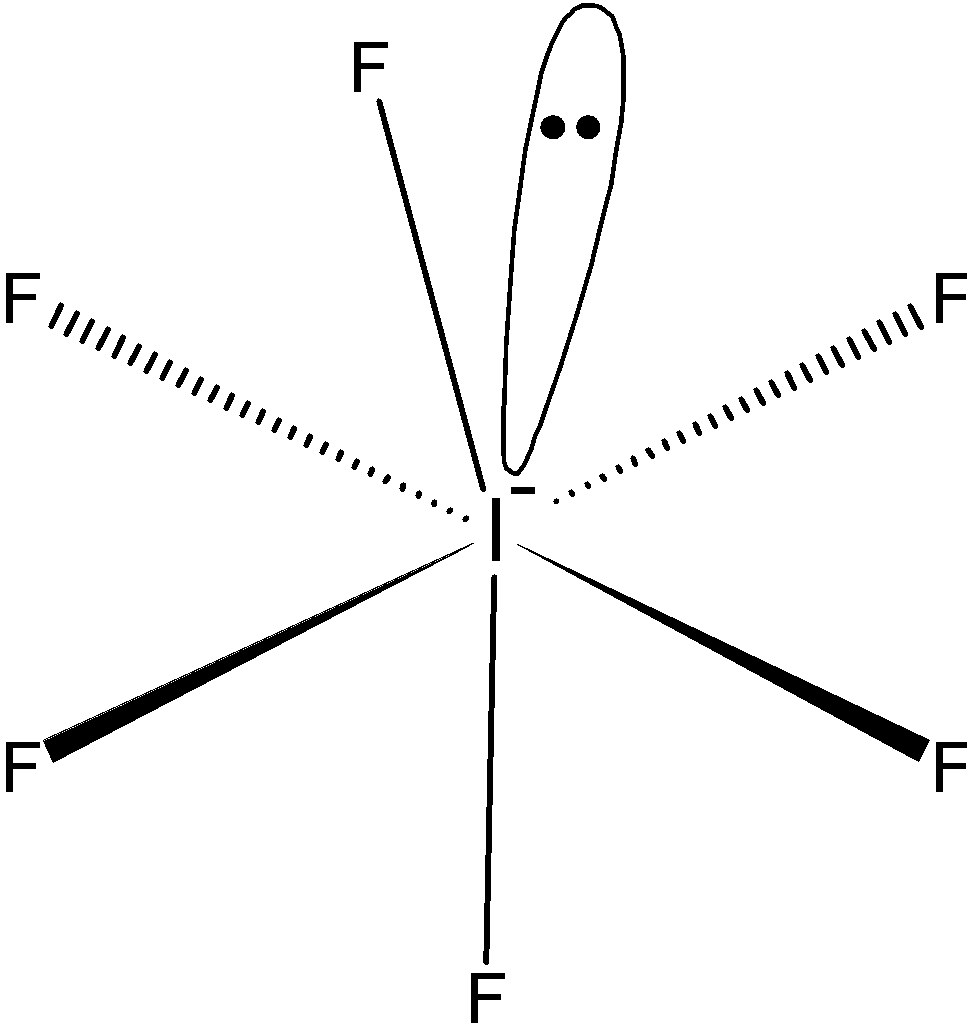
Bond distance in HF is $$9.17 \times 10^{-11}$$ m. Dipole moment of HF is $$6.104 \times 10^{-30}$$ Cm. The percentage ionic character in HF will be : (electron charge = $$1.60 \times 10^{-19}$$ C)
The percentage ionic character in a bond is given by the formula:
$$ \text{Percentage ionic character} = \left( \frac{\mu_{\text{actual}}}{\mu_{\text{ionic}}} \right) \times 100\% $$
where $$\mu_{\text{actual}}$$ is the measured dipole moment and $$\mu_{\text{ionic}}$$ is the dipole moment if the bond were completely ionic. For a completely ionic bond, $$\mu_{\text{ionic}}$$ is calculated as the product of the charge of an electron and the bond distance.
Given:
First, calculate $$\mu_{\text{ionic}}$$:
$$ \mu_{\text{ionic}} = e \times d = (1.60 \times 10^{-19}) \times (9.17 \times 10^{-11}) $$
Multiply the coefficients: $$1.60 \times 9.17 = 14.672$$.
Multiply the exponents: $$10^{-19} \times 10^{-11} = 10^{-30}$$.
So,
$$ \mu_{\text{ionic}} = 14.672 \times 10^{-30} \text{ Cm} $$
The given values for electron charge and bond distance have three significant figures. Therefore, $$\mu_{\text{ionic}}$$ should be rounded to three significant figures. Since $$14.672$$ rounds to $$14.7$$, we have:
$$ \mu_{\text{ionic}} = 14.7 \times 10^{-30} \text{ Cm} $$
Now, substitute the values into the percentage ionic character formula:
$$ \text{Percentage ionic character} = \left( \frac{6.104 \times 10^{-30}}{14.7 \times 10^{-30}} \right) \times 100\% $$
The $$10^{-30}$$ terms cancel out:
$$ = \left( \frac{6.104}{14.7} \right) \times 100\% $$
Now, divide $$6.104$$ by $$14.7$$:
$$ \frac{6.104}{14.7} = ? $$
Perform the division step by step. Multiply both numerator and denominator by 10 to simplify:
$$ \frac{6.104 \times 10}{14.7 \times 10} = \frac{60.84}{147} $$
Now, divide $$60.84$$ by $$147$$:
$$ 147 \times 0.4 = 58.8 $$
$$ 60.84 - 58.8 = 2.04 $$
Bring down a zero: $$20.4$$ (since $$60.84$$ has two decimal places).
$$ 147 \times 0.01 = 1.47 $$
$$ 2.04 - 1.47 = 0.57 $$ (but note we are working with 20.4, so adjust)
Actually, $$147 \times 0.414 = 147 \times 0.4 = 58.8$$, $$147 \times 0.014 = 2.058$$, total $$58.8 + 2.058 = 60.858$$
$$ 60.84 - 60.858 = -0.018 $$ (slight overestimate, so adjust)
Better to compute directly:
$$ \frac{60.84}{147} \approx 0.41402 $$
After detailed calculation (using long division or calculator), $$6.104 \div 14.7 \approx 0.415238$$.
Thus,
$$ \frac{6.104}{14.7} \approx 0.415238 $$
Now multiply by $$100\%$$:
$$ 0.415238 \times 100 = 41.5238\% $$
Rounding to three significant figures (as per input data), $$41.5238\% \approx 41.5\%$$.
Therefore, the percentage ionic character in HF is $$41.5\%$$.
Hence, the correct answer is Option D.
Bond order normally gives idea of stability of a molecular species. All the molecules viz. $$H_2$$, $$Li_2$$ and $$B_2$$ have the same bond order yet they are not equally stable. Their stability order is :
$$H_2$$ is the most stable because it has the smallest atomic size and zero destabilizing antibonding electrons.
$$B_2$$ is more stable than $$Li_2$$ because Boron's smaller atomic radius yields a shorter, stronger bond.
The catenation tendency of C, Si and Ge is in the order Ge < Si < C. The bond energies (in kJ mol$$^{-1}$$) of C-C, Si-Si and Ge-Ge bonds are respectively ;
The catenation tendency refers to the ability of an element to form bonds with atoms of the same element. The order given is Ge < Si < C, meaning germanium has the least tendency, silicon has a medium tendency, and carbon has the highest tendency for catenation.
Bond energy is a measure of the strength of a bond between two atoms. A higher bond energy indicates a stronger bond, which typically corresponds to a higher catenation tendency. Therefore, the bond energies should follow the same order as the catenation tendency: Ge-Ge bond energy < Si-Si bond energy < C-C bond energy.
Now, examining the options, the bond energies are given respectively for C-C, Si-Si, and Ge-Ge:
We need to find which option satisfies Ge-Ge < Si-Si < C-C.
Checking Option A: Ge-Ge = 260 kJ/mol, Si-Si = 297 kJ/mol, C-C = 348 kJ/mol. Comparing the values: 260 < 297 is true, and 297 < 348 is true. So, 260 < 297 < 348 holds.
Checking Option B: Ge-Ge = 260 kJ/mol, Si-Si = 348 kJ/mol, C-C = 297 kJ/mol. Here, 260 < 348 is true, but 348 < 297 is false because 348 is greater than 297. This violates the required order.
Checking Option C: Ge-Ge = 297 kJ/mol, Si-Si = 260 kJ/mol, C-C = 348 kJ/mol. Here, 297 < 260 is false because 297 is greater than 260. This violates the required order.
Checking Option D: Ge-Ge = 348 kJ/mol, Si-Si = 297 kJ/mol, C-C = 260 kJ/mol. Here, 348 < 297 is false because 348 is greater than 297. This violates the required order.
Only Option A satisfies the condition that Ge-Ge bond energy < Si-Si bond energy < C-C bond energy, which aligns with the catenation tendency order Ge < Si < C.
Hence, the correct answer is Option A.
In which of the following sets, all the given species are isostructural?
To determine which set contains species that are all isostructural, we need to recall that isostructural means having the same molecular geometry. We will analyze each option step by step.
Starting with Option A: $$CO_2$$, $$NO_2$$, $$ClO_2$$, $$SiO_2$$.
Carbon dioxide ($$CO_2$$) has a linear structure with bond angle 180° due to sp hybridization. Nitrogen dioxide ($$NO_2$$) has an odd number of valence electrons (17 total), resulting in a bent structure with a bond angle of approximately 134°. Chlorine dioxide ($$ClO_2$$) also has an odd number of valence electrons (19 total), leading to a bent structure with a bond angle of about 118°. Silicon dioxide ($$SiO_2$$) is not a discrete molecule; it forms a network solid with tetrahedral coordination around silicon atoms. Thus, the species have different geometries: linear, bent, bent, and tetrahedral network. They are not isostructural.
Next, Option B: $$PCl_3$$, $$AlCl_3$$, $$BCl_3$$, $$SbCl_3$$.
Phosphorus trichloride ($$PCl_3$$) has a central phosphorus atom with three bonds and one lone pair, resulting in a trigonal pyramidal geometry. Aluminum trichloride ($$AlCl_3$$) in its monomeric form (considered for molecular geometry) has aluminum with three bonds and no lone pairs, giving trigonal planar geometry. Boron trichloride ($$BCl_3$$) is trigonal planar due to three bonds and no lone pairs on boron. Antimony trichloride ($$SbCl_3$$) is similar to $$PCl_3$$, with a central antimony atom having three bonds and one lone pair, so trigonal pyramidal. Thus, we have trigonal pyramidal ($$PCl_3$$ and $$SbCl_3$$) and trigonal planar ($$AlCl_3$$ and $$BCl_3$$). They are not all isostructural.
Moving to Option C: $$BF_3$$, $$NF_3$$, $$PF_3$$, $$AlF_3$$.
Boron trifluoride ($$BF_3$$) has three bonds and no lone pairs on boron, so trigonal planar. Nitrogen trifluoride ($$NF_3$$) has nitrogen with three bonds and one lone pair, leading to trigonal pyramidal geometry. Phosphorus trifluoride ($$PF_3$$) is similar to $$NF_3$$, with phosphorus having three bonds and one lone pair, so trigonal pyramidal. Aluminum trifluoride ($$AlF_3$$) in its monomeric form has aluminum with three bonds and no lone pairs, resulting in trigonal planar geometry. Thus, we have trigonal planar ($$BF_3$$ and $$AlF_3$$) and trigonal pyramidal ($$NF_3$$ and $$PF_3$$). They are not all isostructural.
Finally, Option D: $$BF_4^-$$, $$CCl_4$$, $$NH_4^+$$, $$PCl_4^+$$.
Tetrafluoroborate ion ($$BF_4^-$$) has boron with four bonds and no lone pairs (due to the negative charge), so tetrahedral geometry. Carbon tetrachloride ($$CCl_4$$) has carbon with four bonds and no lone pairs, tetrahedral. Ammonium ion ($$NH_4^+$$) has nitrogen with four bonds and no lone pairs (due to the positive charge), tetrahedral. Tetrachlorophosphonium ion ($$PCl_4^+$$) has phosphorus with four bonds and no lone pairs (positive charge removes the lone pair), tetrahedral. All species have tetrahedral geometry.
Hence, only Option D has all species with the same molecular geometry (tetrahedral). So, the answer is Option D.
Stability of the species $$Li_2$$, $$Li_2^-$$ and $$Li_2^+$$ increases in the order of
For comparing the stability of homonuclear di-atomic species we use Molecular Orbital (MO) theory. According to this theory the stability is directly related to the bond order; the larger the bond order, the stronger and hence the more stable the molecule.
First we recall the expression for bond order:
$$\text{Bond order } (B.O.) \;=\;\dfrac{N_b - N_a}{2}$$
Here $$N_b$$ is the total number of electrons present in bonding molecular orbitals and $$N_a$$ is the total number of electrons present in antibonding molecular orbitals.
For species formed from lithium atoms we consider the following sequence of molecular orbitals formed from the 1s and 2s atomic orbitals:
$$\sigma(1s),\;\;\sigma^{\ast}(1s),\;\;\sigma(2s),\;\;\sigma^{\ast}(2s)$$
The 1s orbitals are inner (core) orbitals; nevertheless we must include them while counting electrons because they still contribute to the bond order expression.
Now we analyse each species one by one.
(i) The neutral molecule $$Li_2$$
Each lithium atom contributes three electrons, so the total number of electrons is
$$2 \times 3 = 6$$
Filling the molecular orbitals in ascending order of energy we obtain the configuration
$$\sigma(1s)^2\;\sigma^{\ast}(1s)^2\;\sigma(2s)^2$$
Counting electrons, we have
Bonding electrons $$N_b = 2 \;( \sigma 1s) + 2 \;(\sigma 2s) = 4$$
Antibonding electrons $$N_a = 2 \;(\sigma^{\ast} 1s) = 2$$
Hence
$$B.O.(Li_2) = \dfrac{4 - 2}{2} = 1$$
(ii) The anion $$Li_2^-$$
This species possesses one extra electron, so the total number of electrons is
$$6 + 1 = 7$$
The additional electron enters the next available orbital, namely $$\sigma^{\ast}(2s)$$, giving the configuration
$$\sigma(1s)^2\;\sigma^{\ast}(1s)^2\;\sigma(2s)^2\;\sigma^{\ast}(2s)^1$$
Now
Bonding electrons $$N_b = 2 \;(\sigma 1s) + 2 \;(\sigma 2s) = 4$$
Antibonding electrons $$N_a = 2 \;(\sigma^{\ast} 1s) + 1 \;(\sigma^{\ast} 2s) = 3$$
So
$$B.O.(Li_2^-) = \dfrac{4 - 3}{2} = 0.5$$
(iii) The cation $$Li_2^+$$
Here one electron is removed from the neutral molecule, leaving
$$6 - 1 = 5$$ electrons.
The electron is taken from the highest occupied bonding MO, $$\sigma(2s)$$, so the configuration becomes
$$\sigma(1s)^2\;\sigma^{\ast}(1s)^2\;\sigma(2s)^1$$
Counting electrons gives
Bonding electrons $$N_b = 2 \;(\sigma 1s) + 1 \;(\sigma 2s) = 3$$
Antibonding electrons $$N_a = 2 \;(\sigma^{\ast} 1s) = 2$$
Hence
$$B.O.(Li_2^+) = \dfrac{3 - 2}{2} = 0.5$$
We see that $$Li_2$$ has the highest bond order $$1$$, while both $$Li_2^-$$ and $$Li_2^+$$ possess a smaller bond order of $$0.5$$. Between the two charged species we must still decide which is less stable.
Observe that in $$Li_2^-$$ the extra electron occupies the high-energy antibonding orbital $$\sigma^{\ast}(2s)$$, whereas in $$Li_2^+$$ the deficiency is in the lower-energy bonding orbital $$\sigma(2s)$$. Introducing an electron into a high-energy antibonding level destabilises a molecule more than merely removing an electron from a lower-energy bonding level. Therefore, although the algebraic bond orders are equal, the actual energy of $$Li_2^-$$ is higher (and the molecule consequently less stable) than that of $$Li_2^+$$.
Combining all the above results, stability increases in the sequence
$$Li_2^- \;<\; Li_2^+ \;<\; Li_2$$
Hence, the correct answer is Option D.
The internuclear distances in O-O bonds for $$O_2^+$$, $$O_2$$, $$O_2^-$$ and $$O_2^{2-}$$ respectively are :
To determine the internuclear distances in the O-O bonds for $$O_2^+$$, $$O_2$$, $$O_2^-$$, and $$O_2^{2-}$$, we need to understand how bond length relates to bond order. Bond length is inversely proportional to bond order: higher bond order means a stronger bond and shorter bond length. Therefore, we must calculate the bond order for each species using molecular orbital theory.
First, recall the molecular orbital configuration for oxygen molecules. Oxygen has an atomic number of 8, so $$O_2$$ has 16 electrons. However, we focus on valence electrons (12 electrons) since core electrons (1s orbitals) cancel out. The molecular orbital energy order for $$O_2$$ is: $$\sigma(2s) \lt \sigma^*(2s) \lt \sigma(2p_z) \lt \pi(2p_x) = \pi(2p_y) \lt \pi^*(2p_x) = \pi^*(2p_y) \lt \sigma^*(2p_z)$$.
For $$O_2$$ (16 electrons, 12 valence electrons):
The electron configuration is: $$\sigma(2s)^2 \sigma^*(2s)^2 \sigma(2p_z)^2 \pi(2p_x)^2 \pi(2p_y)^2 \pi^*(2p_x)^1 \pi^*(2p_y)^1$$.
Bonding electrons: $$\sigma(2s)^2$$ (2 electrons), $$\sigma(2p_z)^2$$ (2 electrons), $$\pi(2p_x)^2 \pi(2p_y)^2$$ (4 electrons) → total bonding electrons = 8.
Antibonding electrons: $$\sigma^*(2s)^2$$ (2 electrons), $$\pi^*(2p_x)^1 \pi^*(2p_y)^1$$ (2 electrons) → total antibonding electrons = 4.
Bond order = $$\frac{$$ number of bonding electrons $$-$$ number of antibonding electrons $$}{2} = \frac{8 - 4}{2} = \frac{4}{2} = 2$$.
For $$O_2^+$$ (15 electrons, 11 valence electrons):
Remove one electron from the highest occupied molecular orbital (HOMO), which is $$\pi^*$$. Configuration: $$\sigma(2s)^2 \sigma^*(2s)^2 \sigma(2p_z)^2 \pi(2p_x)^2 \pi(2p_y)^2 \pi^*(2p_x)^1 \pi^*(2p_y)^0$$ (or equivalent).
Bonding electrons: same as $$O_2$$, 8 electrons.
Antibonding electrons: $$\sigma^*(2s)^2$$ (2 electrons), $$\pi^*$$ orbitals have 1 electron → total antibonding electrons = 3.
Bond order = $$\frac{8 - 3}{2} = \frac{5}{2} = 2.5$$.
For $$O_2^-$$ (17 electrons, 13 valence electrons):
Add one electron to the $$\pi^*$$ orbital. Configuration: $$\sigma(2s)^2 \sigma^*(2s)^2 \sigma(2p_z)^2 \pi(2p_x)^2 \pi(2p_y)^2 \pi^*(2p_x)^2 \pi^*(2p_y)^1$$ (or equivalent).
Bonding electrons: same as $$O_2$$, 8 electrons.
Antibonding electrons: $$\sigma^*(2s)^2$$ (2 electrons), $$\pi^*$$ orbitals have 3 electrons → total antibonding electrons = 5.
Bond order = $$\frac{8 - 5}{2} = \frac{3}{2} = 1.5$$.
For $$O_2^{2-}$$ (18 electrons, 14 valence electrons):
Add two electrons to the $$\pi^*$$ orbitals. Configuration: $$\sigma(2s)^2 \sigma^*(2s)^2 \sigma(2p_z)^2 \pi(2p_x)^2 \pi(2p_y)^2 \pi^*(2p_x)^2 \pi^*(2p_y)^2$$.
Bonding electrons: same as $$O_2$$, 8 electrons.
Antibonding electrons: $$\sigma^*(2s)^2$$ (2 electrons), $$\pi^*$$ orbitals have 4 electrons → total antibonding electrons = 6.
Bond order = $$\frac{8 - 6}{2} = \frac{2}{2} = 1$$.
Summary of bond orders:
Since bond length is inversely proportional to bond order, the order of increasing bond length (shortest to longest) is: $$O_2^+ \lt O_2 \lt O_2^- \lt O_2^{2-}$$.
Now, comparing with the given options:
Standard bond length values confirm this: $$O_2^+$$ ≈ 1.12 Å, $$O_2$$ ≈ 1.21 Å, $$O_2^-$$ ≈ 1.30 Å, $$O_2^{2-}$$ ≈ 1.49 Å.
Hence, the correct answer is Option D.
Which one of the following molecules is expected to exhibit paramagnetic behaviour?
According to the Molecular Orbital Theory (MOT),
For $$O_2$$ (16 electrons):
The configuration is $$\sigma1s^2, \sigma^*1s^2, \sigma2s^2, \sigma^*2s^2, \sigma2p_z^2, (\pi2p_x^2 = \pi2p_y^2), (\pi^*2p_x^1 = \pi^*2p_y^1)$$
Oxygen has two unpaired electrons in the degenerate antibonding $$\pi^*$$ orbitals. Thus, it is paramagnetic.
For $$O_2^{2-}$$ (Peroxide ion, 18 electrons):
The configuration is $$\sigma1s^2, \sigma^*1s^2, \sigma2s^2, \sigma^*2s^2, \sigma2p_z^2, (\pi2p_x^2 = \pi2p_y^2), (\pi^*2p_x^2 = \pi^*2p_y^2)$$
All electrons are paired. Thus, it is diamagnetic.
For $$C_2$$ (12 electrons):
The configuration is $$\sigma1s^2, \sigma^*1s^2, \sigma2s^2, \sigma^*2s^2, (\pi2p_x^2 = \pi2p_y^2)$$
All electrons are paired. Thus, it is diamagnetic.
For $$N_2$$ (14 electrons):
The configuration is $$\sigma1s^2, \sigma^*1s^2, \sigma2s^2, \sigma^*2s^2, (\pi2p_x^2 = \pi2p_y^2), \sigma2p_z^2$$
All electrons are paired. Thus, it is diamagnetic.
In which of the following pairs of molecules/ions, both the species are not likely to exist?
We start with the molecular-orbital (MO) theory for homonuclear diatomic species that are made only from the 1s atomic orbitals. In this very first MO set we have just two orbitals:
$$\sigma_{1s}\;(\text{bonding}), \qquad \sigma_{1s}^{\*}\;(\text{antibonding}).$$
The bond order is obtained from the standard formula
$$\text{Bond order} \;=\;\dfrac{N_b-N_a}{2},$$
where $$N_b$$ is the number of electrons in bonding orbitals and $$N_a$$ is the number of electrons in antibonding orbitals. A bond order that is zero or negative means the species cannot exist, whereas a positive bond order means the species can, at least in principle, exist.
Let us evaluate the bond order for every species that appears in the four options.
1. $$H_2^{2+}$$ (0 electron)
Because two positive charges remove both electrons, we have
$$N_b = 0,\; N_a = 0 \;\Longrightarrow\; \text{Bond order}= \dfrac{0-0}{2}=0.$$
So $$H_2^{2+}$$ is not expected to exist.
2. $$H_2$$ (2 electrons)
Configuration: $$\sigma_{1s}^2$$
$$N_b = 2,\; N_a = 0 \;\Longrightarrow\; \text{Bond order}= \dfrac{2-0}{2}=1 >0.$$
This molecule exists (ordinary hydrogen).
3. $$H_2^{+}$$ (1 electron)
Configuration: $$\sigma_{1s}^1$$
$$N_b = 1,\; N_a = 0 \;\Longrightarrow\; \text{Bond order}= \dfrac{1-0}{2}=0.5 >0.$$
Hence $$H_2^{+}$$ can exist.
4. $$H_2^{-}$$ (3 electrons)
Configuration: $$\sigma_{1s}^2\,\sigma_{1s}^{\*\,1}$$
$$N_b = 2,\; N_a = 1 \;\Longrightarrow\; \text{Bond order}= \dfrac{2-1}{2}=0.5 >0.$$
Therefore $$H_2^{-}$$ is also, in principle, possible.
5. $$He_2$$ (4 electrons)
Configuration: $$\sigma_{1s}^2\,\sigma_{1s}^{\*\,2}$$
$$N_b = 2,\; N_a = 2 \;\Longrightarrow\; \text{Bond order}= \dfrac{2-2}{2}=0.$$
So $$He_2$$ is not expected to exist.
6. $$He_2^{2+}$$ (2 electrons)
The double positive charge removes two electrons, leaving 2 electrons in total:
Configuration: $$\sigma_{1s}^2$$
$$N_b = 2,\; N_a = 0 \;\Longrightarrow\; \text{Bond order}= \dfrac{2-0}{2}=1 >0.$$
Thus $$He_2^{2+}$$ should exist.
7. $$He_2^{2-}$$ (6 electrons)
After the basic 1s set is filled (4 electrons), the extra two electrons enter the next higher bonding MO, $$\sigma_{2s}$$. The order up to that point is
$$\sigma_{1s}^2\,\sigma_{1s}^{\*\,2}\,\sigma_{2s}^2.$$
This gives
$$N_b = 2 (\sigma_{1s}) + 2 (\sigma_{2s}) = 4,\qquad N_a = 2 (\sigma_{1s}^{\*})$$
$$\Longrightarrow\; \text{Bond order}= \dfrac{4-2}{2}=1 >0.$$
So $$He_2^{2-}$$ can also exist according to MO theory.
Now we examine each option to see where both species have bond order zero.
A. $$H_2^{2+}$$ (bond order 0) and $$He_2$$ (bond order 0) ⟹ both non-existent.
B. $$H_2^{-}$$ (bond order 0.5) and $$He_2^{2+}$$ (bond order 1) ⟹ both exist.
C. $$H_2^{+}$$ (bond order 0.5) and $$He_2^{2-}$$ (bond order 1) ⟹ both exist.
D. $$H_2$$ (bond order 1) and $$He_2^{2-}$$ (bond order 1) ⟹ both exist.
Only option A contains a pair for which neither species is expected to exist.
Hence, the correct answer is Option A.
Given that: (i) $$\Delta_f H°$$ of $$N_2O$$ is 82 kJ mol$$^{-1}$$ (ii) Bond energies of $$N \equiv N$$, $$N = N$$, $$O = O$$ and $$N = O$$ are 946, 418, 498 and 607 kJ mol$$^{-1}$$ respectively. The resonance energy of $$N_2O$$ is :
To find the resonance energy of $$ \text{N}_2\text{O} $$, we start by recalling that resonance energy is the difference between the actual enthalpy of formation and the calculated enthalpy of formation assuming no resonance. The actual $$ \Delta_f H^\circ $$ for $$ \text{N}_2\text{O} $$ is given as 82 kJ mol⁻¹.
Next, we calculate the enthalpy of formation using bond energies without considering resonance. The formation reaction for $$ \text{N}_2\text{O} $$ is:
$$ \text{N}_2(\text{g}) + \frac{1}{2} \text{O}_2(\text{g}) \rightarrow \text{N}_2\text{O}(\text{g}) $$
For this reaction, we need to break bonds in the reactants and form bonds in the product. The reactants are $$ \text{N}_2 $$ and $$ \text{O}_2 $$. In $$ \text{N}_2 $$, there is one $$ \text{N} \equiv \text{N} $$ bond with bond energy 946 kJ mol⁻¹. In $$ \frac{1}{2} \text{O}_2 $$, there is half of an $$ \text{O} = \text{O} $$ bond, so the energy is $$ \frac{1}{2} \times 498 = 249 $$ kJ mol⁻¹. The total energy required to break bonds in the reactants is:
$$ 946 + 249 = 1195 \text{ kJ mol}^{-1} $$
Now, for the product $$ \text{N}_2\text{O} $$, we assume a structure without resonance. The common hypothetical structure is $$ ^{-}\text{N} = \text{N}^{+} = \text{O} $$, which has one $$ \text{N} = \text{N} $$ bond and one $$ \text{N} = \text{O} $$ bond. The bond energies are given as 418 kJ mol⁻¹ for $$ \text{N} = \text{N} $$ and 607 kJ mol⁻¹ for $$ \text{N} = \text{O} $$. The total energy released when these bonds are formed is:
$$ 418 + 607 = 1025 \text{ kJ mol}^{-1} $$
The enthalpy change for the reaction, which is the calculated $$ \Delta_f H^\circ $$ without resonance, is the energy absorbed minus the energy released:
$$ \Delta_f H^\circ (\text{calculated}) = 1195 - 1025 = 170 \text{ kJ mol}^{-1} $$
The resonance energy is defined as the actual $$ \Delta_f H^\circ $$ minus the calculated $$ \Delta_f H^\circ $$:
$$ \text{Resonance energy} = 82 - 170 = -88 \text{ kJ mol}^{-1} $$
The negative value indicates stabilization due to resonance. Comparing with the options, -88 kJ corresponds to option A.
Hence, the correct answer is Option A.
In a face centred cubic lattice, atoms of A form the corner points and atoms of B form the face centred points. If two atoms of A are missing from the corner points, the formula of the ionic compound is :
In a face centred cubic (FCC) lattice, atoms of A are located at the corner points, and atoms of B are located at the face centred points. Normally, an FCC unit cell has 8 corners and 6 faces. Each corner atom is shared by 8 adjacent unit cells, so the contribution of one corner atom to a unit cell is $$\frac{1}{8}$$. Similarly, each face centred atom is shared by 2 unit cells, so the contribution per face atom is $$\frac{1}{2}$$.
Without any missing atoms, the total contribution of A atoms (corners) would be $$\frac{1}{8} \times 8 = 1$$ atom per unit cell. However, the problem states that two atoms of A are missing from the corners. Therefore, only 6 corner atoms are present. The contribution of A atoms per unit cell is now $$\frac{1}{8} \times 6 = \frac{6}{8} = \frac{3}{4}$$.
For B atoms at the face centres, there are 6 faces, and no atoms are missing. So, the contribution of B atoms per unit cell is $$\frac{1}{2} \times 6 = 3$$.
Thus, in the unit cell, we have $$\frac{3}{4}$$ atom of A and 3 atoms of B. To find the simplest ratio of A to B, we write the ratio A : B as $$\frac{3}{4} : 3$$. Multiplying both sides by 4 to eliminate the fraction gives $$3 : 12$$. Dividing both sides by 3 simplifies the ratio to $$1 : 4$$. Therefore, the formula of the compound is AB₄.
Comparing with the options: A is AB₃, B is AB₄, C is A₂B₅, D is AB₂. Hence, the correct answer is Option B.
An element having an atomic radius of 0.14 nm crystallizes in an $$f_{cc}$$ unit cell. What is the length of a side of the cell?
An element with an atomic radius of 0.14 nm crystallizes in a face-centered cubic (fcc) unit cell. In an fcc lattice, atoms touch along the face diagonal of the cube. The face diagonal is composed of two atomic diameters because it passes through two atoms: one at a corner and one at the center of the face. Therefore, the length of the face diagonal is equal to four times the atomic radius.
Given the atomic radius $$ r = 0.14 $$ nm, the face diagonal is calculated as follows:
Face diagonal $$ = 4 \times r = 4 \times 0.14 = 0.56 $$ nm.
For a cubic unit cell with side length $$ a $$, the face diagonal can also be found using the Pythagorean theorem. The face is a square with side $$ a $$, so the diagonal is $$ \sqrt{a^2 + a^2} = \sqrt{2a^2} = a\sqrt{2} $$.
Setting this equal to the face diagonal from the atomic arrangement:
$$ a\sqrt{2} = 0.56 $$ nm.
To solve for $$ a $$, divide both sides by $$ \sqrt{2} $$:
$$ a = \frac{0.56}{\sqrt{2}} $$ nm.
Rationalize the denominator by multiplying the numerator and denominator by $$ \sqrt{2} $$:
$$ a = \frac{0.56 \times \sqrt{2}}{\sqrt{2} \times \sqrt{2}} = \frac{0.56 \times \sqrt{2}}{2} = 0.28 \times \sqrt{2} $$ nm.
Now, substitute the approximate value of $$ \sqrt{2} \approx 1.4142 $$:
$$ a = 0.28 \times 1.4142 = 0.395976 $$ nm.
Rounding 0.395976 nm to two decimal places gives 0.40 nm, as the digit in the thousandths place is 5, which rounds up the hundredths place from 9 to 10, resulting in 0.40 nm.
Comparing with the options:
A. 0.56 nm (which is the face diagonal, not the side)
B. 0.24 nm (incorrect)
C. 0.96 nm (incorrect)
D. 0.4 nm (matches the calculated side length)
Hence, the correct answer is Option D.
Which one of the following statements about packing in solids is incorrect?
We are asked to identify which statement about packing in solids is incorrect. Let's evaluate each option step by step.
First, consider option A: "Coordination number in bcc mode of packing is 8." In body-centered cubic (bcc) packing, each atom is located at the corners of a cube and one atom is at the center. The central atom touches all eight corner atoms. Since each corner atom is shared by eight adjacent unit cells, the central atom has eight nearest neighbors. Therefore, the coordination number for bcc is indeed 8. This statement is correct.
Next, option B: "Coordination number in hcp mode of packing is 12." Hexagonal close packing (hcp) is a close-packed structure. In such structures, each atom is surrounded by six atoms in its own layer, three atoms in the layer above, and three atoms in the layer below, totaling 12 nearest neighbors. Thus, the coordination number for hcp is 12. This statement is correct.
Now, option C: "Void space in hcp mode of packing is 32%." Void space is the percentage of the unit cell volume not occupied by atoms. For close-packed structures like hcp and ccp (cubic close packing, also known as fcc), the packing efficiency is identical. The packing efficiency is calculated as the fraction of space occupied by atoms. In hcp, the atoms are arranged in layers with an ABAB... sequence. The packing efficiency for hcp is given by the formula: $$\text{Packing efficiency} = \frac{\text{Volume occupied by atoms}}{\text{Volume of unit cell}} \times 100\%$$
For hcp, the unit cell contains two atoms. The volume occupied by atoms is $$2 \times \frac{4}{3}\pi r^3$$ where $$r$$ is the atomic radius. The volume of the unit cell can be derived from the geometry. The height $$c$$ of the unit cell is related to the atomic radius by $$c = \frac{4\sqrt{6}}{3}r$$, and the base area is $$2 \times \frac{\sqrt{3}}{4} \times (2r)^2 = 2\sqrt{3}r^2$$ (since the side length $$a = 2r$$). Thus, the volume of the unit cell is: $$\text{Volume} = \text{base area} \times \text{height} = (2\sqrt{3}r^2) \times \left(\frac{4\sqrt{6}}{3}r\right) = \frac{8\sqrt{18}}{3}r^3 = \frac{8 \times 3\sqrt{2}}{3}r^3 = 8\sqrt{2}r^3$$
Now, the volume occupied by atoms is: $$2 \times \frac{4}{3}\pi r^3 = \frac{8}{3}\pi r^3$$
Therefore, the packing efficiency is: $$\frac{\frac{8}{3}\pi r^3}{8\sqrt{2}r^3} \times 100\% = \frac{\pi}{3\sqrt{2}} \times 100\% \approx \frac{3.1416}{3 \times 1.4142} \times 100\% \approx \frac{3.1416}{4.2426} \times 100\% \approx 0.7405 \times 100\% = 74.05\%$$
Thus, the void space is $$100\% - 74.05\% = 25.95\% \approx 26\%$$. The statement claims void space is 32%, which does not match. Therefore, this statement is incorrect.
Finally, option D: "Void space in ccp mode of packing is 26%." Cubic close packing (ccp), also known as face-centered cubic (fcc), has the same packing efficiency as hcp. The unit cell contains four atoms. The volume occupied by atoms is $$4 \times \frac{4}{3}\pi r^3 = \frac{16}{3}\pi r^3$$. The unit cell edge length $$a$$ relates to the atomic radius by $$a = 2\sqrt{2}r$$, so the volume is $$a^3 = (2\sqrt{2}r)^3 = 16\sqrt{2}r^3$$. The packing efficiency is: $$\frac{\frac{16}{3}\pi r^3}{16\sqrt{2}r^3} \times 100\% = \frac{\pi}{3\sqrt{2}} \times 100\% \approx 74.05\%$$ Thus, void space is approximately 26%, matching the statement. This statement is correct.
Since option C states an incorrect void space percentage for hcp, it is the incorrect statement. Hence, the correct answer is Option C.
Copper crystallises in fcc with a unit length of 361 pm. What is the radius of copper atom?
Copper crystallizes in a face-centered cubic (fcc) lattice with a unit cell edge length of 361 pm. We need to find the radius of the copper atom.
In an fcc lattice, atoms are located at each corner of the cube and at the center of each face. The atoms touch along the face diagonal of the cube. This means the face diagonal is equal to four times the atomic radius (r).
The face diagonal of a cube can be found using the Pythagorean theorem. For a cube with edge length a, the face diagonal is the diagonal of a square face with side a. The length of the diagonal is given by $$\sqrt{a^2 + a^2} = \sqrt{2a^2} = a\sqrt{2}$$.
Since the face diagonal is occupied by atoms touching each other, it is equal to 4r. Therefore, we set up the equation:
$$a\sqrt{2} = 4r$$
We are given that the edge length a is 361 pm. Substitute this value into the equation:
$$361 \times \sqrt{2} = 4r$$
Now, solve for r. First, isolate r by dividing both sides by 4:
$$r = \frac{361 \times \sqrt{2}}{4}$$
We know that $$\sqrt{2} \approx 1.4142$$. Substitute this value:
$$r = \frac{361 \times 1.4142}{4}$$
First, multiply 361 by 1.4142:
$$361 \times 1.4142 = 361 \times (1 + 0.4 + 0.014 + 0.0002) = 361 \times 1 + 361 \times 0.4 + 361 \times 0.014 + 361 \times 0.0002$$
Calculate each part:
$$361 \times 1 = 361$$
$$361 \times 0.4 = 144.4$$
$$361 \times 0.014 = 361 \times \frac{14}{1000} = \frac{5054}{1000} = 5.054$$
$$361 \times 0.0002 = 0.0722$$
Add these together:
$$361 + 144.4 = 505.4$$
$$505.4 + 5.054 = 510.454$$
$$510.454 + 0.0722 = 510.5262$$
So,
$$361 \times 1.4142 = 510.5262$$
Now divide by 4:
$$r = \frac{510.5262}{4} = 127.63155 \text{ pm}$$
Rounding to the nearest whole number, we get approximately 128 pm.
Therefore, the radius of the copper atom is 128 pm.
Looking at the options:
A. 157 pm
B. 128 pm
C. 108 pm
D. 181 pm
Hence, the correct answer is Option B.
Which of the following exists as covalent crystals in the solid state?
First, let us recall the basic idea of how substances can arrange themselves in the solid state. Broadly, we classify crystalline solids into four main types: (i) ionic crystals, (ii) molecular crystals, (iii) metallic crystals and (iv) covalent (also called network) crystals. A covalent or network crystal is one in which each atom is linked to its nearest neighbours by strong directional covalent bonds extending throughout the entire crystal lattice, producing one giant molecule. The classic textbook examples are $$\text{SiO}_2$$ (quartz), $$\text{SiC}$$ (silicon carbide) and elemental silicon (in its diamond‐type lattice).
Now we examine every substance given in the options one by one, asking ourselves: “Does this element form a giant three-dimensional covalent network in the solid, or does it exist as discrete molecules held together only by weak van der Waals forces?”
We start with sulphur. In its most common crystalline form ($$\alpha$$-sulphur or rhombic sulphur), each elementary unit is an $$S_8$$ crown-shaped molecule. These $$S_8$$ rings are neutral, completed valence shells, and the rings are packed in the lattice with only weak intermolecular London dispersion forces acting between them. There is no infinite covalent network extending throughout the solid, so sulphur is classified as a molecular crystal, not a covalent crystal.
Next is phosphorus. The common allotrope that is crystalline under ordinary conditions is red or violet phosphorus, in which $$P_4$$ tetrahedral molecules are linked into polymeric chains, but these chains are not fully three-dimensional networks; the bonding between chains remains relatively weak. White phosphorus is definitely molecular ($$P_4$$). Hence, elemental phosphorus does not form a fully extended covalent framework like diamond or silicon does. Therefore it is not a covalent network crystal in the strict sense used in solid-state chemistry.
We then consider iodine. At room temperature iodine exists as discrete $$I_2$$ molecules. These diatomic molecules are held together in the crystal lattice only by van der Waals forces (specifically, London dispersion forces enhanced by iodine’s large, easily polarisable electron cloud). Thus crystalline iodine is also a molecular solid, not a network covalent solid.
Finally we come to silicon. Elemental silicon adopts the same three-dimensional tetrahedral arrangement as diamond. Each silicon atom forms four strong $$sp^3$$ hybridised $$\sigma$$ covalent bonds to four neighbour silicon atoms, and this pattern repeats indefinitely in all directions. This means there are no discrete $$Si_2$$ or $$Si_4$$ molecules: the whole crystal is a single giant covalent network. Because every bond throughout the lattice is a strong covalent bond, silicon exhibits the physical properties characteristic of covalent crystals—very high melting point, great hardness, brittleness and semiconducting behaviour.
Piecing everything together, only silicon among the given choices satisfies the definition of a covalent (network) crystal.
Hence, the correct answer is Option D.
Trigonal bipyramidal geometry is shown by:
To determine which compound exhibits trigonal bipyramidal geometry, we need to analyze the molecular geometry around the central xenon (Xe) atom using Valence Shell Electron Pair Repulsion (VSEPR) theory. Trigonal bipyramidal geometry occurs when the central atom has a steric number (SN) of 5 with five bonding domains and no lone pairs. The steric number is calculated as SN = (number of atoms bonded to central atom) + (number of lone pairs on central atom). We will evaluate each option step by step.
Option A: $$XeOF_2$$
First, calculate the total valence electrons: Xe has 8, O has 6, and two F atoms have $$7 \times 2 = 14$$, so total is $$8 + 6 + 14 = 28$$ electrons. In the Lewis structure, Xe is bonded to O via a double bond and to each F via a single bond. A double bond uses 4 electrons, and two single bonds use $$2 \times 2 = 4$$ electrons, so bonding electrons total $$4 + 4 = 8$$. Non-bonding electrons are $$28 - 8 = 20$$. Each F atom in a single bond has three lone pairs (6 electrons), so for two F atoms: $$2 \times 6 = 12$$ electrons. The O atom in a double bond has two lone pairs (4 electrons). So far, $$12 + 4 = 16$$ electrons are accounted for. The remaining electrons are $$20 - 16 = 4$$, which form two lone pairs on Xe. Thus, Xe has three bonding domains (one from the double bond to O and two from single bonds to F) and two lone pairs. Steric number SN = $$3 + 2 = 5$$. The electron geometry is trigonal bipyramidal, but with two lone pairs occupying equatorial positions, the molecular geometry is T-shaped, not trigonal bipyramidal.
Option B: $$XeO_3F_2$$
Total valence electrons: Xe has 8, three O atoms have $$6 \times 3 = 18$$, two F atoms have $$7 \times 2 = 14$$, so total is $$8 + 18 + 14 = 40$$ electrons. Xe is bonded to three O atoms via double bonds and to two F atoms via single bonds. Three double bonds use $$3 \times 4 = 12$$ electrons, and two single bonds use $$2 \times 2 = 4$$ electrons, so bonding electrons total $$12 + 4 = 16$$. Non-bonding electrons are $$40 - 16 = 24$$. Each O atom in a double bond has two lone pairs (4 electrons), so for three O atoms: $$3 \times 4 = 12$$ electrons. Each F atom in a single bond has three lone pairs (6 electrons), so for two F atoms: $$2 \times 6 = 12$$ electrons. Total non-bonding electrons accounted for: $$12 + 12 = 24$$, so no lone pairs on Xe. Thus, Xe has five bonding domains (three from double bonds to O and two from single bonds to F). Steric number SN = $$5 + 0 = 5$$. With five bonding domains and no lone pairs, the geometry is trigonal bipyramidal.
Option C: $$FXeOSO_2F$$
This compound is $$F-Xe-O-SO_2F$$, where the SO₂F group is sulfonyl fluoride. Total valence electrons: Xe has 8, F (attached to Xe) has 7, O (attached to Xe) has 6, S has 6, two O atoms in SO₂ have $$6 \times 2 = 12$$, F (attached to S) has 7, so total is $$8 + 7 + 6 + 6 + 12 + 7 = 46$$ electrons. Bonds: Xe-F single bond (2 electrons), Xe-O single bond (2 electrons), O-S single bond (2 electrons), S bonded to two O atoms via double bonds ($$2 \times 4 = 8$$ electrons), and S-F single bond (2 electrons). Total bonding electrons: $$2 + 2 + 2 + 8 + 2 = 16$$. Non-bonding electrons: $$46 - 16 = 30$$. Each F atom (both attached to Xe and S) in a single bond has three lone pairs (6 electrons), so $$2 \times 6 = 12$$ electrons. The O atom attached to Xe and S has two lone pairs (4 electrons). Each O atom in S=O has two lone pairs (4 electrons), so for two O atoms: $$2 \times 4 = 8$$ electrons. Total non-bonding electrons accounted for: $$12 + 4 + 8 = 24$$. The remaining electrons are $$30 - 24 = 6$$, which form three lone pairs on S (since S has four bonds and can expand its octet). For Xe, it is bonded to two atoms (F and O), so two bonding domains. Xenon has 8 valence electrons; it uses 2 electrons for the two bonds (one per bond), leaving 6 electrons, which form three lone pairs. Thus, Xe has two bonding domains and three lone pairs. Steric number SN = $$2 + 3 = 5$$. The electron geometry is trigonal bipyramidal, but with three lone pairs occupying equatorial positions, the molecular geometry is linear around Xe, not trigonal bipyramidal.
Option D: $$[XeF_5]^{2-}$$
Total valence electrons: Xe has 8, five F atoms have $$7 \times 5 = 35$$, and the 2- charge adds 2 electrons, so total is $$8 + 35 + 2 = 45$$ electrons. Xe is bonded to five F atoms via single bonds. Five single bonds use $$5 \times 2 = 10$$ electrons. Non-bonding electrons: $$45 - 10 = 35$$. Each F atom in a single bond has three lone pairs (6 electrons), so for five F atoms: $$5 \times 6 = 30$$ electrons. Remaining electrons: $$35 - 30 = 5$$. These 5 electrons are placed on Xe, forming two lone pairs (4 electrons) and one unpaired electron. However, an unpaired electron is not a domain in VSEPR; the two lone pairs count as two domains. Thus, Xe has five bonding domains and two lone pair domains. Steric number SN = $$5 + 2 = 7$$. The electron geometry is pentagonal bipyramidal, not trigonal bipyramidal.
Only option B, $$XeO_3F_2$$, has a steric number of 5 with five bonding domains and no lone pairs, resulting in trigonal bipyramidal geometry. Hence, the correct answer is Option B.
Among the following species which two have trigonal pyramidal shape? (I) $$NI_3$$ (II) $$I_3^-$$ (III) $$SO_3^{2-}$$ (IV) $$NO_3^-$$
A molecule or ion exhibits a trigonal pyramidal shape when its central atom is $$sp^3$$ hybridized with a steric number of 4, comprising exactly 3 bonding pairs and 1 lone pair ($$\text{AB}_3\text{E}$$ type).
(I) $$\text{NI}_3$$ (Nitrogen Triiodide)
(II) $$\text{I}_3^-$$ (Triiodide Ion)
(III) $$\text{SO}_3^{2-}$$ (Sulfite Ion)
(IV) $$\text{NO}_3^-$$ (Nitrate Ion)
Both $$\text{NI}_3$$ (I) and $$\text{SO}_3^{2-}$$ (III) have a steric number of 4 with 1 lone pair, giving them identical trigonal pyramidal geometries.
Answer: Option A — I and III
The molecule having smallest bond angle is :
The given compounds are trichlorides of the group 15 (VA) elements: $$N,\, P,\, As,\, Sb$$.
All four molecules have the same steric formula $$AX_3E_1$$ (three bonded atoms $$X = Cl$$ and one lone pair $$E$$ on the central atom $$A$$) and therefore an $$sp^3$$ hybridised, pyramidal geometry.
In an $$AX_3E_1$$ system, the $$X{-}A{-}X$$ bond angle depends mainly on two factors:
1. Electronegativity of the central atom (affects the pull on the bonding pair),
2. Size of the central atom (affects how far the bonding pairs can spread).
Down the group 15:
• Electronegativity decreases $$\big(N \gt P \gt As \gt Sb\big)$$, making the bonding pairs less attracted towards the central atom and hence closer to the outer atoms.
• Atomic size increases, allowing the three $$Cl$$ atoms to stay farther from the nucleus but also permitting the lone-pair cloud to expand and push the bond pairs together.
Both effects work in the same direction—down the group the $$X{-}A{-}X$$ bond angle decreases.
Typical bond angles are:
$$NH_3 \approx 107^\circ,\; PCl_3 \approx 100^\circ,\; AsCl_3 \approx 98^\circ,\; SbCl_3 \approx 90^\circ.$$
Among the choices, $$SbCl_3$$ has the largest central atom and the lowest electronegativity; therefore, it exhibits the smallest bond angle.
Hence, the correct option is:
Option C which is: $$SbCl_3$$
Among the following, the species having the smallest bond is
According to Molecular Orbital Theory, the bond length of a diatomic molecule or ion varies inversely with its bond order:
$$\text{Bond Length} \propto \frac{1}{\text{Bond Order}}$$
A higher bond order indicates a stronger, tighter covalent interaction, which pulls the nuclei closer together and results in a shorter bond distance.
The formula to calculate the bond order is:
$$\text{Bond Order} = \frac{N_b - N_a}{2}$$
Where $$N_b$$ represents the number of bonding electrons and $$N_a$$ represents the number of antibonding electrons. Let's find the total electron counts and corresponding bond orders for each species:
Option A: $$\text{NO}^-$$ ($$7 + 8 + 1 = 16\text{ electrons}$$)
It has an electronic configuration identical to $$\text{O}_2$$.
$$\text{Bond Order} = \frac{10 - 6}{2} = 2$$Option B: $$\text{NO}^+$$ ($$7 + 8 - 1 = 14\text{ electrons}$$)
It is isoelectronic with $$\text{N}_2$$. All valence electrons are paired up inside the lower-energy bonding molecular orbitals, leaving the anti-bonding $$\pi^*$$ orbitals completely vacant.
$$\text{Bond Order} = \frac{10 - 4}{2} = 3$$Option C: $$\text{O}_2$$ ($$8 + 8 = 16\text{ electrons}$$)
Two electrons fill the degenerate anti-bonding $$\pi^*_{2p}$$ orbitals singly.
$$\text{Bond Order} = \frac{10 - 6}{2} = 2$$Option D: $$\text{NO}$$ ($$7 + 8 = 15\text{ electrons}$$)
It contains one unpaired electron residing within an anti-bonding $$\pi^*_{2p}$$ orbital.
$$\text{Bond Order} = \frac{10 - 5}{2} = 2.5$$Comparing the calculated values, the nitrosonium ion ($$\text{NO}^+$$) possesses the highest bond order ($$3$$), which corresponds directly to the strongest chemical linkage and the smallest bond length.
Answer: Option B — $$\text{NO}^+$$
Dipole moment is shown by
Dipole moment ($$\mu$$) is a vector quantity. It is the vector sum of all individual bond moments in the molecule.
Rule used: If a molecule possesses an element of symmetry (centre of inversion, $$C_2$$ axis perpendicular to the molecular plane, mirror plane cutting all identical polar bonds equally, etc.), the individual bond moments may cancel, giving $$\mu = 0$$. If such complete cancellation does not occur, the molecule shows a net dipole moment ($$\mu \gt 0$$).
Now analyse each option one by one.
Case A:
1,2-dichlorobenzene (ortho-dichlorobenzene)
The two $$\mathrm{C-Cl}$$ bonds make an angle of $$60^{\circ}$$ with each other in the benzene ring. Their bond moments do not lie exactly opposite, so vector cancellation is incomplete. Hence the molecule possesses a finite dipole moment.
Case B:
trans-2,3-dichloro-2-butene : $$\mathrm{CH_3-C(Cl)=C(Cl)-CH_3}$$
The double bond plane contains both $$\mathrm{C-Cl}$$ bonds. In the trans isomer the two Cl atoms are on opposite sides, and the molecule has an internal mirror plane that bisects and opposes the two identical $$\mathrm{C-Cl}$$ bond moments. Vector sum is zero ⇒ $$\mu = 0$$.
Case C:
1,4-chlorobenzene (para-dichlorobenzene)
The two $$\mathrm{C-Cl}$$ bonds are exactly opposite in the ring (180° apart). Their bond moments are equal and collinear but in opposite directions, so they cancel completely ⇒ $$\mu = 0$$.
Case D:
trans-1,2-dinitroethene : $$\mathrm{O_2N-CH=CH-NO_2}$$
Each $$\mathrm{NO_2}$$ group exerts a bond moment vector roughly along the $$\mathrm{C-N}$$ bond. In the trans form these vectors are equal and opposite across the double bond, giving complete cancellation ⇒ $$\mu = 0$$.
Only the ortho isomer in Option A lacks the symmetry necessary for full cancellation, so it alone exhibits a net dipole moment.
Final answer: Option A which is: 1,2-dichlorobenzene
In which of the following pairs the two species are not isostructural?
Two species are called isostructural when they possess the same:
• number of surrounding atoms (same steric number)
• arrangement of these atoms in space (same molecular geometry / shape).
Hence we compare the VSEPR geometry of each pair.
Case A: $$CO_3^{2-}$$ vs $$NO_3^-$$
Each ion has three $$\sigma$$-bonds to oxygen/nitrogen and no lone pair on the central atom.
Steric number $$=3$$ ⇒ hybridisation $$sp^2$$ ⇒ trigonal-planar geometry.
Therefore the two ions are isostructural.
Case B: $$PCl_4^+$$ vs $$SiCl_4$$
Central $$P$$ in $$PCl_4^+$$: 4 $$\sigma$$-bonds, no lone pair (positive charge has removed one electron).
Central $$Si$$ in $$SiCl_4$$: 4 $$\sigma$$-bonds, no lone pair.
Steric number $$=4$$ for both ⇒ hybridisation $$sp^3$$ ⇒ tetrahedral geometry.
Thus they are isostructural.
Case C: $$PF_5$$ vs $$BrF_5$$
• $$PF_5$$: 5 $$\sigma$$-bonds, 0 lone pairs → steric number $$=5$$ → $$sp^3d$$ hybridisation → trigonal bipyramidal shape.
• $$BrF_5$$: 5 $$\sigma$$-bonds, 1 lone pair → steric number $$=6$$ → $$sp^3d^2$$ electronic geometry (octahedral), but one position occupied by a lone pair, giving a square pyramidal molecular shape.
Since trigonal bipyramidal ≠ square pyramidal, these two molecules are not isostructural.
Case D: $$AlF_6^{3-}$$ vs $$SF_6$$
Both have 6 $$\sigma$$-bonds and no lone pair on the central atom.
Steric number $$=6$$ ⇒ $$sp^3d^2$$ hybridisation ⇒ octahedral geometry.
Hence they are isostructural.
Among the four pairs, only Case C contains species with different shapes. Therefore the pair that is not isostructural is:
Option C which is: $$PF_5$$ and $$BrF_5$$
The formation of molecular complex $$\text{BF}_3 - \text{NH}_3$$ results in a change in hybridization of boron
In gaseous $$\text{BF}_3$$ the central atom B is surrounded by three electron-pair regions (three B-F $$\sigma$$ bonds and no lone pair).
For three regions the steric number is 3, giving trigonal-planar geometry and $$sp^2$$ hybridisation.
Ammonia, $$\text{NH}_3$$, possesses a lone pair on N. When $$\text{BF}_3$$ and $$\text{NH}_3$$ interact, this lone pair is donated to the vacant $$2p$$ orbital of boron, forming a coordinate bond:
$$\text{F}_3\text{B}\; \leftarrow \; \text{:NH}_3$$
After donation, boron is now surrounded by four electron-pair regions (three B-F bonds + one B←N bond).
For four regions the steric number is 4, giving tetrahedral geometry and $$sp^3$$ hybridisation.
Thus the hybridisation of boron changes
$$sp^2 \; \longrightarrow \; sp^3$$
Option B which is: from $$sp^2$$ to $$sp^3$$
Although CN$$^-$$ ion and N$$_2$$ molecule are isoelectronic, yet N$$_2$$ molecule is chemically inert because of
N$$_2$$ and CN$$^-$$ are isoelectronic: each contains 14 electrons.
Both species therefore have the same total number of electrons and the same bond order, $$3$$, which means the N≡N and C≡N bonds are equally strong.
Yet their chemical behaviour is very different: molecular nitrogen is remarkably inert under ordinary conditions, whereas the cyanide ion is highly reactive.
The key point is that reactivity is governed not only by bond order or bond energy but also by charge distribution (polarity).
1. Polarity of N$$_2$$: The two atoms in N$$_2$$ are identical and have exactly the same electronegativity. Hence the bonding electron pair is shared equally, giving zero dipole moment. There is no partial positive (δ$$^+$$) or partial negative (δ$$^-$$) end in the molecule. Without any charge separation, there is no site for an incoming reagent to attack; the molecule is non-polar and chemically inert.
2. Polarity of CN$$^-$$: The atoms C and N have different electronegativities, so the C≡N bond is polar. In addition, the overall negative charge resides mainly on the more electronegative nitrogen. Therefore CN$$^-$$ possesses a pronounced electron-rich centre, making it an excellent nucleophile and highly reactive.
Thus, even though both species are isoelectronic and possess strong triple bonds, the absence of bond polarity in N$$_2$$ is the primary reason for its extraordinary chemical inertness.
Option C which is: absence of bond polarity
Among the following, the molecule with the lowest dipole moment is
In any molecule, the net (resultant) dipole moment $$\mu_{\text{net}}$$ is the vector sum of the individual bond dipole moments. If the molecular geometry is such that the individual vectors cancel each other completely, the molecule is non-polar and its dipole moment becomes zero.
All the given molecules are derivatives of methane and have a tetrahedral geometry around the central carbon atom because carbon is $$sp^3$$-hybridised.
Case 1: $$\text{CCl}_4$$ All four positions of the regular tetrahedron are occupied by chlorine atoms. The four $$\text{C-Cl}$$ bond dipole moments are equal in magnitude and are directed from carbon toward the corners of a perfect tetrahedron. Owing to the high symmetry, these four vectors cancel completely: $$\mu_{\text{net}}(\text{CCl}_4)=0$$
Case 2: $$\text{CH}_3\text{Cl}$$ Here, one position is occupied by Cl (electronegative) and the other three by H (much less electronegative). The single $$\text{C-Cl}$$ bond dipole cannot be cancelled by the three comparatively weak and oppositely directed $$\text{C-H}$$ bond dipoles. Hence, $$\mu_{\text{net}}(\text{CH}_3\text{Cl}) \gt 0$$
Case 3: $$\text{CH}_2\text{Cl}_2$$ Two $$\text{C-Cl}$$ bonds are present, but they are not exactly opposite in a tetrahedron; therefore their dipole vectors do not cancel each other. The remaining two $$\text{C-H}$$ bonds also do not compensate this imbalance. Thus, $$\mu_{\text{net}}(\text{CH}_2\text{Cl}_2}) \gt 0$$
Case 4: $$\text{CHCl}_3$$ With three $$\text{C-Cl}$$ bonds pointing toward three corners and one $$\text{C-H}$$ bond toward the fourth, the three larger $$\text{C-Cl}$$ dipoles partially cancel among themselves, but an uncompensated component remains. Therefore, $$\mu_{\text{net}}(\text{CHCl}_3) \gt 0$$ (though smaller than that of $$\text{CH}_3\text{Cl}$$ and $$\text{CH}_2\text{Cl}_2$$).
Comparing all four cases, $$\text{CCl}_4$$ is the only molecule in which the bond dipole moments cancel completely, giving the lowest possible dipole moment, namely zero.
Hence, the molecule with the lowest dipole moment is
Option D which is: CCl$$_4$$
Based on lattice energy and other considerations, which one of the following alkali metal chloride is expected to have the highest melting point?
The melting point of ionic compounds generally depends on two competing periodic trends:
$$\text{LiCl}$$:
Because the $$\text{Li}^+$$ ion is exceptionally small, it highly polarizes the $$\text{Cl}^-$$ ion, making $$\text{LiCl}$$ predominantly covalent. Consequently, its melting point drops unexpectedly low ($$605 \ ^\circ\text{C}$$).
$$\text{NaCl}$$:
The $$\text{Na}^+$$ ion is larger than $$\text{Li}^+$$, meaning it has a much lower polarizing power, and the compound retains highly ideal ionic character. At the same time, because $$\text{Na}^+$$ is smaller than $$\text{K}^+$$ and $$\text{Rb}^+$$, it maintains a relatively high lattice energy. This perfect balance between strong ionic binding and high lattice energy gives it the peak melting point ($$801 \ ^\circ\text{C}$$).
$$\text{KCl}$$ and $$\text{RbCl}$$:
As we move further down to $$\text{K}^+$$ and $$\text{Rb}^+$$, the compounds remain ionic, but the increasing size of the cations drastically diminishes the lattice energy. As a result, their melting points decrease progressively ($$770 \ ^\circ\text{C}$$ for $$\text{KCl}$$ and $$718 \ ^\circ\text{C}$$ for $$\text{RbCl}$$).
Accounting for both the decrease in lattice energy and the introduction of covalent character via Fajan's rules, the overall melting point order for group 1 chlorides is:
$$\text{NaCl} > \text{KCl} > \text{RbCl} > \text{LiCl}$$
Therefore, sodium chloride possesses the highest melting point among the choices.
Answer: Option A — NaCl
Which of the following has the square planar structure?
Option A: $$\text{XeF}_4$$ (Xenon Tetrafluoride)
Option B: $$\text{NH}_4^+$$ (Ammonium Ion)
Option C: $$\text{BF}_4^-$$ (Tetrafluoroborate Ion)
Option D: $$\text{CCl}_4$$ (Carbon Tetrachloride)
While the other three options possess an $$sp^3$$ tetrahedral geometry, only $$\text{XeF}_4$$ has the $$sp^3d^2$$ electronic distribution that yields a square planar molecular geometry.
Answer: Option A — $$\text{XeF}_4$$
Among the following which is the best description of water in the solid phase?
In the solid state (ice), the fundamental repeating units are discrete $$H_2O$$ molecules.
These $$H_2O$$ molecules are held together in the lattice primarily by hydrogen bonds, which are a type of strong intermolecular force but NOT true covalent bonds extending throughout the crystal.
Classification of crystalline solids:
• Covalent (network) solids - a giant three-dimensional network of atoms joined by covalent bonds (e.g., diamond, $$SiO_2$$).
• Ionic solids - lattice points occupied by cations and anions held by electrostatic forces (e.g., $$NaCl$$).
• Molecular solids - lattice points occupied by neutral molecules held by van der Waals forces, dipole-dipole forces or hydrogen bonds (e.g., $$CO_2$$ (dry ice), ice).
• Metallic solids - lattice of positive ions in a sea of delocalised electrons.
Because ice consists of neutral $$H_2O$$ molecules held by hydrogen bonding, it fits the definition of a molecular solid.
The other options do not apply:
• Option A (covalent solid) and D (network solid) require an extended covalent network, which ice does not possess.
• Option C (ionic solid) would require ions such as $$Na^+$$, $$Cl^-$$, etc., which are absent in pure ice.
Hence, the best description is:
Option B which is: Molecular solid
A solid has a '$$bcc$$' structure. If the distance of nearest approach between two atoms is $$1.73\ \text{Å}$$, the edge length of the cell is
For a body-centred cubic ($$bcc$$) lattice, the atoms touch each other along the body diagonal of the cube.
Let $$a$$ be the edge length of the cube and $$r$$ be the atomic radius.
Length of the body diagonal = $$\sqrt{3}\,a \quad -(1)$$
Along this diagonal we have the sequence: corner atom (radius $$r$$) → body-centre atom (radius $$r$$) → opposite corner atom (radius $$r$$).
Hence the total length occupied by the three touching atoms is $$4r$$.
Equating the two expressions for the body diagonal:
$$\sqrt{3}\,a = 4r \quad -(2)$$
The nearest-neighbour distance in $$bcc$$ is the distance between the body-centre atom and any corner atom, i.e. half of the body diagonal:
nearest distance $$= \dfrac{\sqrt{3}\,a}{2} = 2r \quad -(3)$$
The problem gives this nearest distance as $$1.73\ \text{Å}$$.
Since $$1\ \text{Å} = 100\ \text{pm}$$, we have
$$2r = 1.73\ \text{Å} = 1.73 \times 100\ \text{pm} = 173\ \text{pm}$$
Therefore,
$$r = \dfrac{173}{2}\ \text{pm} = 86.5\ \text{pm}$$
Substituting $$r$$ into equation (2):
$$a = \dfrac{4r}{\sqrt{3}} = \dfrac{4 \times 86.5}{\sqrt{3}}\ \text{pm}$$
Using $$\sqrt{3} \approx 1.732$$:
$$a \approx \dfrac{346}{1.732}\ \text{pm} \approx 199.8\ \text{pm} \approx 200\ \text{pm}$$
Hence the edge length of the cubic unit cell is approximately $$200\ \text{pm}$$.
Option C which is: 200 pm
Among the following the maximum covalent character is shown by the compound:
Covalent character in an ionic compound is predicted with the help of Fajan’s rules.
Fajan’s rules (qualitative form):
1. Greater the charge on the cation, greater is its polarising power ⇒ larger covalent character.
2. Smaller the size (ionic radius) of the cation, greater its polarising power.
3. Larger the size of the anion, easier it gets polarised.
Because the anion is the same in all the given chlorides (Cl−), the trend will be governed almost completely by the nature of the cation.
Compare the four cations present:
• $$\text{Sn}^{2+}$$ : charge = +2, atomic/ionic radius is quite large (p-block, 5th period).
• $$\text{Al}^{3+}$$ : charge = +3, very small ionic radius (p-block, 3rd period).
• $$\text{Mg}^{2+}$$ : charge = +2, somewhat larger than Al but smaller than Sn (s-block, 3rd period).
• $$\text{Fe}^{2+}$$ : charge = +2, transition metal, radius comparable to Mg but has d-electrons that expand the radius slightly.
Key observations:
1. Charge factor: $$\text{Al}^{3+}$$ is the only +3 cation; others are only +2. A higher positive charge strongly increases polarising power.
2. Size factor: $$\text{Al}^{3+}$$ is also the smallest of the four cations (3rd-period element losing three electrons).
3. Combining both factors, $$\text{Al}^{3+}$$ has maximum charge density (charge/volume), giving it the highest ability to polarise the electron cloud of the Cl− ion and impart covalent character to the Al-Cl bond.
The other cations either have lower charge (Sn²+, Mg²+, Fe²+) or larger radii, so their polarising power—and hence the covalent character of their chlorides—is lower.
Therefore, the chloride with the maximum covalent character is $$\text{AlCl}_3$$.
Option B which is: $$\text{AlCl}_3$$
The hybridization of orbitals of N atom in $$\text{NO}_3^-$$, $$\text{NO}_2^+$$ and $$\text{NH}_4^+$$ are respectively:
For any central atom, the hybridization can be found from its steric number:
steric number = (number of σ-bonds) + (number of lone pairs).
Hybridization rules: steric number 2 → $$sp$$, 3 → $$sp^2$$, 4 → $$sp^3$$.
Case 1: $$\text{NO}_3^-$$ (nitrate ion)
• Lewis structure: $$[O\!-\!N(=O)\!-\!O]^-$$ with resonance among the three $$N\!-\!O$$ bonds.
• Nitrogen makes 3 σ-bonds with the three oxygens.
• No lone pair remains on nitrogen because its five valence electrons are used in bonding and the positive formal charge on N within the ion’s resonance contributors.
Steric number $$=3$$ ⇒ hybridization $$=sp^2$$.
Case 2: $$\text{NO}_2^+$$ (nitrosonium ion)
• Lewis structure: $$O=N=O^{+}$$ (linear).
• Nitrogen forms 2 σ-bonds (one with each oxygen).
• There is no lone pair on nitrogen; the positive charge indicates loss of one electron.
Steric number $$=2$$ ⇒ hybridization $$=sp$$.
Case 3: $$\text{NH}_4^+$$ (ammonium ion)
• Nitrogen is bonded to four hydrogens through 4 σ-bonds.
• The positive charge shows that nitrogen has donated its lone pair; hence no lone pair is present.
Steric number $$=4$$ ⇒ hybridization $$=sp^3$$.
Thus the hybridizations are: $$sp^2$$ for $$\text{NO}_3^-$$, $$sp$$ for $$\text{NO}_2^+$$ and $$sp^3$$ for $$\text{NH}_4^+$$.
Option A which is: $$sp^2, sp, sp^3$$
The structure of $$\text{IF}_7$$ is:
Iodine belongs to group 17, so the central atom brings $$7$$ valence electrons.
Each of the seven fluorine atoms contributes one electron to form a single $$\sigma$$-bond with iodine. Hence the total electron pairs around iodine are:
Bond pairs $$=7$$, Lone pairs $$=0$$.
According to VSEPR notation this is an $$\text{AX}_7$$ species.
For an $$\text{AX}_7$$ arrangement with zero lone pairs the minimum-repulsion geometry predicted by VSEPR is a pentagonal bipyramid (five F atoms in an equatorial pentagon and two F atoms in the axial positions).
Therefore the molecular shape of $$\text{IF}_7$$ is pentagonal bipyramid.
Option C which is: pentagonal bipyramid
Using MO theory predict which of the following species has the shortest bond length?
According to Molecular Orbital Theory, bond order is directly proportional to bond strength and inversely proportional to bond length:
$$\text{Bond Length} \propto \frac{1}{\text{Bond Order}}$$
A higher bond order indicates more shared electron density holding the nuclei tightly together, resulting in a shorter bond distance.
The base neutral molecule $$\text{O}_2$$ contains $$16$$ electrons. Its electronic configuration following the valence shell energy ordering is:
$$\sigma_{1s}^2 \ \sigma_{1s}^{*2} \ \sigma_{2s}^2 \ \sigma_{2s}^{*2} \ \sigma_{2p_z}^2 \ \left(\pi_{2p_x}^2 = \pi_{2p_y}^2\right) \ \left(\pi_{2p_x}^{*1} = \pi_{2p_y}^{*1}\right)$$
The formula to calculate the bond order is:
$$\text{Bond Order} = \frac{N_b - N_a}{2}$$
Where $$N_b$$ is the number of bonding electrons and $$N_a$$ is the number of antibonding electrons. Let's analyze each ion:
Option A: $$\text{O}_2^{2+}$$ ($$14$$ electrons)
Two electrons are removed from the highest occupied anti-bonding molecular orbitals ($$\pi^*_{2p}$$).
$$\text{Bond Order} = \frac{10 - 4}{2} = 3$$Option B: $$\text{O}_2^+$$ ($$15$$ electrons)
One electron is removed from an anti-bonding orbital ($$\pi^*_{2p}$$).
$$\text{Bond Order} = \frac{10 - 5}{2} = 2.5$$Option C: $$\text{O}_2^-$$ ($$17$$ electrons)
One extra electron is added to an anti-bonding orbital ($$\pi^*_{2p}$$).
$$\text{Bond Order} = \frac{10 - 7}{2} = 1.5$$Option D: $$\text{O}_2^{2-}$$ ($$18$$ electrons)
Two extra electrons are added to anti-bonding orbitals ($$\pi^*_{2p}$$).
$$\text{Bond Order} = \frac{10 - 8}{2} = 1$$Comparing the calculated values, $$\text{O}_2^{2+}$$ has the highest bond order ($$3$$), which means it possesses the tightest chemical bond and consequently the shortest bond length.
Answer: Option A — $$\text{O}_2^{2+}$$
The bond dissociation energy of B$$-$$F in BF$$_3$$ is $$646$$ kJ mol$$^{-1}$$ whereas that of C$$-$$F in CF$$_4$$ is $$515$$ kJ mol$$^{-1}$$. The correct reason for higher B-F bond dissociation energy as compared to that of $$C - F$$ is :
The energy needed to break a single chemical bond depends not only on the primary $$\sigma$$ overlap but also on any additional interaction (multiple-bond character) present between the two atoms.
Case 1: $$BF_3$$
Boron has the valence configuration $$2s^22p^1$$ and hence possesses one empty $$2p$$ orbital.
Each fluorine atom carries three lone pairs located in its $$2p$$ orbitals. A filled $$2p$$ orbital of F can overlap sideways with the vacant $$2p$$ orbital of B, giving a $$p\pi\,$$-$$\,p\pi$$ back-donation (back bonding). This imparts partial double-bond character to every B-F linkage and increases the bond order from 1 to slightly more than 1. A higher bond order always translates into a higher bond dissociation energy. Consequently, $$B-F$$ in $$BF_3$$ requires as much as $$646\ \text{kJ mol}^{-1}$$ to break.
Case 2: $$CF_4$$
Carbon in $$CF_4$$ already has a complete octet (valence configuration $$2s^22p^2$$, forming four $$sp^3$$ $$\sigma$$ bonds). All of its valence orbitals are either fully involved in bonding or are filled; there is no low-lying vacant orbital to accept electron density. Therefore, fluorine’s lone pairs cannot participate in $$p\pi\,$$-$$\,p\pi$$ interaction with carbon. The C-F bond remains a pure single $$\sigma$$ bond whose dissociation energy is only $$515\ \text{kJ mol}^{-1}$$.
Thus, the higher B-F bond dissociation energy arises from the extra stabilisation supplied by significant $$p\pi\,$$-$$\,p\pi$$ back bonding, a feature absent in the C-F bonds of $$CF_4$$.
Hence, the correct explanation is:
Option C which is: significant $$p\pi\,$$-$$\,p\pi$$ interaction between B and F in $$BF_3$$ whereas there is no possibility of such interaction between C and F in $$CF_4$$.
Which one of the following constitutes a group of the isoelectronic species?
Isoelectronic species are those chemical species (atoms, ions or molecules) that possess the same total number of electrons.
Step 1 Write the atomic numbers: C = 6, N = 7, O = 8.
Step 2 Compute the total electrons for every species in each option.
Extra electrons are added for a negative charge; electrons are removed for a positive charge.
$$C_2^{2-}: 2\times6+2 = 14$$
$$O_2^{-}: 2\times8+1 = 17$$
$$CO: 6+8 = 14$$
$$NO: 7+8 = 15$$
Different values → not isoelectronic.
$$NO^{+}: 7+8-1 = 14$$
$$C_2^{2-}: 2\times6+2 = 14$$
$$CN^{-}: 6+7+1 = 14$$
$$N_2: 2\times7 = 14$$
All have 14 electrons → isoelectronic group.
$$CN^{-}: 14$$ (from Case B)
$$N_2: 14$$
$$O_2^{2-}: 2\times8+2 = 18$$
$$C_2^{2-}: 14$$
Mixed values → not isoelectronic.
$$N_2: 14$$
$$O_2^{-}: 17$$
$$NO^{+}: 14$$
$$CO: 14$$
Mixed values → not isoelectronic.
Only the set in Option B has the same electron count (14) for every species.
Final Answer: Option B which is: $$NO^{+},\; C_2^{2-},\; CN^{-},\; N_2$$
Which one of the following pairs of species have the same bond order?
For homonuclear and heteronuclear diatomic species, Molecular Orbital Theory (MOT) gives
Bond order $$= \dfrac{N_b - N_a}{2}$$, where $$N_b$$ is the number of electrons in bonding M.O.’s and $$N_a$$ is the number of electrons in antibonding M.O.’s.
Because the ordering of $$\sigma_{2p}$$ and $$\pi_{2p}$$ orbitals becomes regular (same as $$O_2$$) once the total electron count reaches $$14$$ or more, we can simply compare total electrons to known templates:
• $$10$$ e⁻ (like $$B_2$$) → B.O. $$=1$$
• $$12$$ e⁻ (like $$O_2^{2+}$$ or $$CN^{+}$$) → B.O. $$=2$$
• $$13$$ e⁻ (like $$CN$$) → B.O. $$=2.5$$
• $$14$$ e⁻ (like $$N_2,\,CO,\,CN^{-},\,NO^{+}$$) → B.O. $$=3$$
• $$15$$ e⁻ (like $$O_2^{+}$$) → B.O. $$=2.5$$
• $$16$$ e⁻ (like $$O_2$$) → B.O. $$=2$$
• $$17$$ e⁻ (like $$O_2^{-}$$) → B.O. $$=1.5$$
Hence only $$CN^{-}$$ and $$NO^{+}$$ possess the same bond order (three).
Option A which is: $$CN^{-}$$ and $$NO^{+}$$
In which of the following ionization processes, the bond order has increased and the magnetic behaviour has changed?
Option A: $$\text{C}_2 \rightarrow \text{C}_2^+$$
Option B: $$\text{NO} \rightarrow \text{NO}^+$$
Option C: $$\text{O}_2 \rightarrow \text{O}_2^+$$
Option B: $$\text{N}_2 \rightarrow \text{N}_2^+$$
Only the ionization of nitric oxide ($$\text{NO}$$) to the nitrosonium ion ($$\text{NO}^+$$) results in both an increased bond order and a shift in magnetic properties.
Answer: Option B — $$\text{NO} \rightarrow \text{NO}^+$$
Which of the following hydrogen bonds is the strongest?
Strength of a hydrogen bond depends mainly on two factors:
1. Electronegativity of the atoms directly attached to hydrogen (the donor X in X-H).
2. Electronegativity and small size of the lone-pair bearing atom that accepts the hydrogen (the acceptor Y in X-H···Y).
Greater electronegativity and smaller atomic radius strengthen the attractive interaction because the partial charges become larger and the dipole is shorter.
Among the common non-metals, the trend of electronegativity is
$$F \gt O \gt N \gt Cl$$
Apply this trend to the given pairs:
Case 1: $$O-H \cdots N$$ — donor O is very electronegative, but acceptor N is less electronegative than O and F, so the bond is moderate.
Case 2: $$F-H \cdots F$$ — both donor and acceptor are fluorine, the most electronegative and the smallest of all; hence the charge separation and electrostatic attraction are maximal.
Case 3: $$O-H \cdots O$$ — both atoms are oxygen. Although O is strongly electronegative, it is still weaker than F, so this bond is weaker than the F-H···F bond.
Case 4: $$O-H \cdots F$$ — donor O is less electronegative than F, but acceptor F is very electronegative. Even so, one side of the bond (the donor) involves oxygen, making it weaker than the fully fluorine-based $$F-H \cdots F$$ interaction.
Therefore, the hydrogen bond in which both the donor and the acceptor atoms are fluorine is the strongest.
Option B which is: $$F - H \cdots F$$
Which of the following species exhibits the diamagnetic behaviour?
Atoms or molecules in which all electrons are paired are called diamagnetic; the presence of even a single unpaired electron makes the species paramagnetic. Hence we must count the total electrons in each species and fill them into the molecular-orbital (MO) energy levels to see whether any remain unpaired.
For second-row diatomic molecules the MO sequence after $$1s$$ and $$2s$$ orbitals is
$$\sigma_{2p_z}\;(2e) \lt \pi_{2p_x}=\pi_{2p_y}\;(4e) \lt \pi^{*}_{2p_x}=\pi^{*}_{2p_y}\;(4e) \lt \sigma^{*}_{2p_z}\;(2e).$$
We therefore fill electrons in the order
$$\sigma 1s,\;\sigma^{*}1s,\;\sigma 2s,\;\sigma^{*}2s,\;\sigma 2p_z,\;\pi 2p_x=\pi 2p_y,\;\pi^{*}2p_x=\pi^{*}2p_y,\;\sigma^{*}2p_z.$$
Only the $$2p$$‐based orbitals decide magnetism, because the lower $$1s$$ and $$2s$$ MOs are always filled with paired electrons.
Electrons in 2p MOs = $$16 - 8 = 8$$.
Filling order:
$$\sigma_{2p_z}^2\;\pi_{2p_x}^2\;\pi_{2p_y}^2\;\pi^{*}_{2p_x}^1\;\pi^{*}_{2p_y}^1$$
Two unpaired electrons reside in the degenerate $$\pi^{*}$$ orbitals ⇒ paramagnetic.
Total 2p electrons = $$15 - 8 = 7$$.
Configuration:
$$\sigma_{2p_z}^2\;\pi_{2p_x}^2\;\pi_{2p_y}^2\;\pi^{*}_{2p_x}^1$$
One unpaired electron ⇒ paramagnetic.
Total 2p electrons = $$18 - 8 = 10$$.
Configuration:
$$\sigma_{2p_z}^2\;\pi_{2p_x}^2\;\pi_{2p_y}^2\;\pi^{*}_{2p_x}^2\;\pi^{*}_{2p_y}^2$$
All electrons are paired ⇒ diamagnetic.
The MO ordering for heteronuclear NO is very similar to that of $$O_2^{+}$$. With 15 electrons there is one unpaired electron in a $$\pi^{*}$$ orbital ⇒ paramagnetic.
Thus, among the given species, only $$O_2^{2-}$$ has all its electrons paired and therefore shows diamagnetism.
Option A which is: $$O_2^{2-}$$
The decreasing values of bond angles from $$NH_3$$ $$(106^\circ)$$ to $$SbH_3$$ $$(101^\circ)$$ down group-15 of the periodic table is due to
In all the hydrides $$EH_3$$ of group-15 ($$E = N,\,P,\,As,\,Sb$$) the central atom is $$sp^3$$ hybridised and carries one lone pair (lp) and three bond pairs (bp). For an ideal $$sp^3$$ arrangement the bond angle is $$109.5^\circ$$, but lp-bp repulsion contracts it. Experimentally the bond angles are
$$NH_3:106^\circ \; \gt \; PH_3:94^\circ \; \gt \; AsH_3:92^\circ \; \gt \; SbH_3:101^\circ$$ (average $$\approx 101^\circ$$ for $$SbH_3$$).
The decisive factor is the electronegativity of the central atom. Down the group the electronegativity decreases: $$N(3.0) \gt P(2.1) \gt As(2.0) \gt Sb(1.9)$$.
• A more electronegative central atom (as in $$NH_3$$) attracts the bonding electrons towards itself; the bp electron clouds are pulled closer to the nucleus. This increases bp-bp and lp-bp repulsions, keeping the hydrogen atoms further apart and producing a larger $$\angle H\!-\!E\!-\!H$$.
• As electronegativity falls (from $$NH_3$$ to $$SbH_3$$) the bonding electrons are held less tightly. The bp electron clouds spread out away from the central atom towards the hydrogens. Repulsion between the bp clouds therefore diminishes, allowing the three $$E-H$$ bonds to come closer together, and the H-E-H bond angle decreases.
Hence the progressive decrease of bond angle in $$EH_3$$ is primarily due to the decreasing electronegativity of the central atom.
Option D which is: decreasing electronegativity
Which of the following molecules/ions does not contain unpaired electrons?
Molecular-orbital theory is the most reliable tool for deciding whether a homonuclear diatomic species is paramagnetic (has unpaired electrons) or diamagnetic (all electrons paired).
The procedure is: (i) count the total number of valence electrons present in the species, (ii) fill them into the standard MO energy diagram in the correct order, and (iii) look for unpaired electrons.
The required MO order is different for lighter (up to $$N_2$$) and heavier (from $$O_2$$ onward) species.
Case 1: $$B_2$$
• Atomic number of B = 5 ⇒ valence electrons per B atom = 3.
• Total electrons = $$2 \times 3 = 6$$.
Energy order (same as $$N_2$$-type):
$$\sigma_{2s},\;\sigma_{2s}^*,\;\pi_{2p_x} = \pi_{2p_y},\;\sigma_{2p_z}$$
Filling six electrons gives the configuration
$$\sigma_{2s}^2\,\sigma_{2s}^{*2}\,(\pi_{2p_x}^1 = \pi_{2p_y}^1)$$
The two $$\pi$$ electrons occupy different orbitals with parallel spins, so there are 2 unpaired electrons ⇒ $$B_2$$ is paramagnetic.
Case 2: $$N_2^{+}$$
• Atomic number of N = 7 ⇒ valence electrons per atom = 5.
• Neutral $$N_2$$ has $$10$$ valence electrons; removing one electron (positive charge) leaves $$9$$ electrons.
Energy order (still $$N_2$$-type):
$$\sigma_{2s}^2\,\sigma_{2s}^{*2}\,\pi_{2p_x}^2\,\pi_{2p_y}^2\,\sigma_{2p_z}^1$$
The last electron is single in $$\sigma_{2p_z}$$, so there is 1 unpaired electron ⇒ $$N_2^{+}$$ is paramagnetic.
Case 3: $$O_2$$
• Atomic number of O = 8 ⇒ valence electrons per O atom = 6.
• Total electrons = $$12$$.
For oxygen and heavier atoms the MO order changes to
$$\sigma_{2s},\;\sigma_{2s}^*,\;\sigma_{2p_z},\;\pi_{2p_x} = \pi_{2p_y},\;\pi_{2p_x}^* = \pi_{2p_y}^*,\;\sigma_{2p_z}^*$$
Filling twelve electrons:
$$\sigma_{2s}^2\,\sigma_{2s}^{*2}\,\sigma_{2p_z}^2\,\pi_{2p_x}^2\,\pi_{2p_y}^2\,(\pi_{2p_x}^{*1} = \pi_{2p_y}^{*1})$$
The two $$\pi^*$$ orbitals each contain one electron with parallel spins ⇒ 2 unpaired electrons ⇒ $$O_2$$ is paramagnetic.
Case 4: $$O_2^{2-}$$
• Start from $$O_2$$ (12 electrons) and add two more electrons for the $$2-$$ charge ⇒ $$14$$ valence electrons.
Using the same oxygen-type MO order:
$$\sigma_{2s}^2\,\sigma_{2s}^{*2}\,\sigma_{2p_z}^2\,\pi_{2p_x}^2\,\pi_{2p_y}^2\,\pi_{2p_x}^{*2}\,\pi_{2p_y}^{*2}$$
All orbitals are completely filled; no orbital contains a single electron. Thus every electron is paired ⇒ $$O_2^{2-}$$ is diamagnetic.
Among the given options, the only diamagnetic species is $$O_2^{2-}$$.
Option A which is: $$O_2^{2-}$$
Among the following mixtures, dipole-dipole as the major interaction, is present in
The type of intermolecular force that dominates in any mixture depends on the nature of the species present.
• Non-polar molecules interact mainly through London (dispersion) forces.
• Polar molecules (with a permanent dipole moment) attract each other through dipole-dipole interactions.
• When ions are present, the strongest force is almost always ion-dipole (between an ion and a polar solvent).
• Hydrogen bonding is only possible when the molecules contain N-H, O-H or F-H bonds and is stronger than ordinary dipole-dipole forces.
Now analyse each option one by one.
Option A (benzene + ethanol)
Benzene, $$C_6H_6$$, is non-polar whereas ethanol, $$CH_3CH_2OH$$, is polar and even forms intermolecular hydrogen bonds with itself.
The interaction between benzene and ethanol is therefore dipole-induced-dipole (the dipole of ethanol polarises benzene). Dipole-dipole is not the major interaction.
Option B (acetonitrile + acetone)
Acetonitrile, $$CH_3CN$$, possesses a strong $$C \equiv N$$ dipole, and acetone, $$CH_3COCH_3$$, possesses a strong carbonyl $$C=O$$ dipole. Neither molecule can form hydrogen bonds with itself or with each other because they lack N-H, O-H or F-H bonds. As both partners are polar but non-ionic, the dominant attraction between them is ordinary dipole-dipole interaction.
Option C (KCl + water)
Potassium chloride furnishes $$K^+$$ and $$Cl^-$$ ions in solution. The predominant force between these ions and polar water molecules is ion-dipole, which is stronger than simple dipole-dipole.
Option D (benzene + carbon tetrachloride)
Both benzene and carbon tetrachloride, $$CCl_4$$, are non-polar. Their only attractive force is London dispersion.
Hence, the only mixture in which dipole-dipole interaction is the major attractive force is Option B.
Option B which is: acetonitrile and acetone
A metal, $$M$$ forms chlorides in its $$+2$$ and $$+4$$ oxidation states. Which of the following statements about these chlorides is correct?
According to Fajans’ rules, the covalent character of a compound increases when the cation possesses
• a high positive charge (large polarising power), and
• a small ionic radius (greater charge density).
Comparing the two cations here:
$$M^{2+} \quad \text{vs} \quad M^{4+}$$
• $$M^{4+}$$ carries twice the charge of $$M^{2+}$$ but has practically the same size; therefore its charge density is far larger.
• Consequently, $$M^{4+}$$ polarises the electron cloud of the chloride ion much more strongly than $$M^{2+}$$.
Greater polarisation leads to greater sharing of electron density between $$M^{4+}$$ and $$Cl^-$$, i.e. a higher covalent character. Hence
$$MCl_4$$ (with $$M^{4+}$$) is appreciably more covalent, whereas $$MCl_2$$ (with $$M^{2+}$$) is comparatively more ionic.
This reasoning directly validates statement C.
For completeness, examine the other options:
Case A:A more covalent compound is usually more volatile because intermolecular forces are weaker. Since $$MCl_4$$ is more covalent, it will be more volatile, not $$MCl_2$$. Therefore Option A is wrong.
Case B:Covalent chlorides dissolve better in organic solvents such as anhydrous ethanol. Hence $$MCl_4$$ (covalent) is more soluble than $$MCl_2$$ (ionic). Option B is wrong.
Case D:Covalent chlorides are more susceptible to hydrolysis by water. Thus $$MCl_4$$ is hydrolysed more readily than $$MCl_2$$, making Option D wrong.
Only Option C is consistent with Fajans’ rules and the observed trends in volatility, solubility, and hydrolysis.
Option C which is: $$MCl_2$$ is more ionic than $$MCl_4$$
In which of the following molecules/ions are all the bonds not equal?
The equality of bond lengths in a polyatomic species is governed by its molecular geometry. Species that place all equivalent ligands in symmetry-equivalent positions give identical bond lengths, whereas geometries having two distinct sets of positions (axial vs. equatorial) give two different bond lengths.
Case A : $$SF_4$$
S has $$6$$ valence electrons. Adding $$4$$ electrons from the four $$F$$ atoms gives $$10$$ electrons, i.e. $$5$$ electron pairs (one of them a lone pair).
Hybridisation : $$sp^3d$$ (trigonal bipyramidal electron-pair geometry).
The lone pair occupies an equatorial position (maximum separation), so the geometry of the atoms is see-saw: two axial S-F bonds and two equatorial S-F bonds.
Because axial-equatorial repulsions weaken the axial bonds (they are longer) while equatorial bonds are shorter, the four S-F bonds are not equal.
Case B : $$SiF_4$$
$$\mathrm{Si}$$ has $$4$$ valence electrons, giving $$8$$ electrons (4 bonding pairs) around the central atom.
Hybridisation : $$sp^3$$ with a tetrahedral shape. All four $$F$$ atoms occupy symmetry-equivalent corners of a regular tetrahedron, hence all Si-F bond lengths are equal.
Case C : $$XeF_4$$
Xe contributes $$8$$ valence electrons; with $$4$$ electrons from $$F$$ atoms we have $$12$$ electrons (6 pairs: 4 bonding + 2 lone).
Hybridisation : $$sp^3d^2$$ with an octahedral electron-pair arrangement; the two lone pairs occupy positions trans to each other, giving a square-planar molecular geometry.
All four $$F$$ atoms lie at the corners of the same square and are symmetry-equivalent, so every Xe-F bond length is identical.
Case D : $$BF_4^-$$
B provides $$3$$ valence electrons, plus $$1$$ extra due to the negative charge: total $$4$$ electrons. With $$4$$ electrons from the four $$F$$ atoms we again have $$8$$ electrons (4 bonding pairs).
Hybridisation : $$sp^3$$ with a perfect tetrahedral geometry. All $$F$$ ligands are equivalent, giving equal B-F bond lengths.
Therefore, the only species in which there are two sets of distinct bond lengths is $$SF_4$$.
Answer : Option A which is: $$SF_4$$
Based on lattice energy and other considerations which one of the following alkali metal chlorides is expected to have the highest melting point?
The melting point of an ionic compound depends on two main competing factors:
$$U \propto \frac{1}{r_+ + r_-}$$
As you move down Group 1 from $$\text{Li}^+$$ to $$\text{Rb}^+$$, the size of the alkali metal cation increases. Consequently, the lattice energy steadily decreases in the order:$$\text{LiCl} > \text{NaCl} > \text{KCl} > \text{RbCl}$$
Based strictly on ideal lattice energy, one would initially expect $$\text{LiCl}$$ to have the highest melting point.Once we pass lithium, the remaining alkali metal chlorides ($$\text{NaCl}$$, $$\text{KCl}$$, $$\text{RbCl}$$) behave like highly ideal ionic compounds with negligible polarization effects. For these three, the melting point trend follows the standard decrease in lattice energy as the cation grows larger:
$$\text{NaCl } (801^\circ\text{C}) > \text{KCl } (770^\circ\text{C}) > \text{RbCl } (718^\circ\text{C})$$
Combining all observations, the overall trend for the melting points of alkali metal chlorides is:
$$\text{NaCl} > \text{KCl} > \text{RbCl} > \text{LiCl}$$
While $$\text{LiCl}$$ suffers a melting point depression due to its covalent character, $$\text{NaCl}$$ achieves the optimal balance of a powerful ionic lattice energy with negligible polarization, giving it the highest melting point in the series.
Correct Option: B — NaCl
The number and type of bonds between two carbon atoms in calcium carbide are
In calcium carbide the bonding is predominantly ionic. The solid may be represented as $$\bigl(Ca^{2+}\bigr)\bigl(C_2^{2-}\bigr)$$, where $$C_2^{2-}$$ is called the acetylide (or carbide) ion.
1. Electron count for $$C_2^{2-}$$:
• Each carbon atom contributes 6 valence electrons → total 12.
• The overall charge $$2-$$ supplies 2 more electrons.
Hence the ion possesses $$12 + 2 = 14$$ valence electrons, the same number as in the neutral molecule $$N_2$$.
2. Bond order from the MO picture:
• $$N_2$$, with 14 valence electrons, has a bond order of 3 (one $$\sigma$$ and two $$\pi$$ bonds).
• Because $$C_2^{2-}$$ has the same electron configuration, its bond order is also 3.
3. Valence-bond (hybridisation) view:
• Each carbon undergoes $$sp$$ hybridisation, placing one $$sp$$ hybrid along the internuclear axis.
• The overlap of these two $$sp$$ hybrids gives one $$\sigma$$ bond.
• Each carbon retains two unhybridised $$p$$ orbitals ($$p_x$$ and $$p_y$$). Sidewise overlaps of the corresponding orbitals produce two mutually perpendicular $$\pi$$ bonds.
Thus a total of three bonds—one $$\sigma$$ and two $$\pi$$—join the two carbon atoms, i.e. a carbon-carbon triple bond.
Therefore, the number and type of bonds between the two carbon atoms in calcium carbide are: one sigma bond and two pi bonds.
Option B which is: One sigma, two pi
Which one of the following species is diamagnetic in nature?
The magnetic behaviour of any molecule/ion is decided by the presence or absence of unpaired electrons in its molecular orbitals (MOs).
If every electron is paired, the species is diamagnetic; if even one electron is unpaired, it is paramagnetic.
For very light homonuclear diatomic species such as $$H_2,\,H_2^{+},\,H_2^{-},\,He_2^{+}$$ only the $$1s$$ atomic orbitals combine to give two molecular orbitals:
• the bonding orbital $$\sigma_{1s}$$ (lower energy)
• the antibonding orbital $$\sigma_{1s}^*$$ (higher energy)
Electron filling order: $$\sigma_{1s}$$ is filled first, then $$\sigma_{1s}^*$$, following Hund’s rule and Pauli principle.
Case 1: $$He_2^{+}$$Total electrons = $$2 + 1 = 3$$.
Electronic configuration: $$\sigma_{1s}^{\,2}\,\sigma_{1s}^{*\,1}$$.
One unpaired electron is present ⇒ paramagnetic.
Total electrons = $$1 + 1 = 2$$.
Electronic configuration: $$\sigma_{1s}^{\,2}$$.
All electrons are paired ⇒ diamagnetic.
Total electrons = $$2 - 1 = 1$$.
Electronic configuration: $$\sigma_{1s}^{\,1}$$.
One unpaired electron ⇒ paramagnetic.
Total electrons = $$2 + 1 = 3$$.
Electronic configuration: $$\sigma_{1s}^{\,2}\,\sigma_{1s}^{*\,1}$$.
One unpaired electron ⇒ paramagnetic.
Among the four species, only $$H_2$$ has all its electrons paired and is therefore diamagnetic.
Option B which is: H$$_2$$
Lattice energy of an ionic compounds depends upon
The strength of an ionic crystal is measured by its lattice energy, i.e. the energy released when one mole of the crystal is formed from its constituent gaseous ions.
According to the Born-Landé equation, the magnitude of lattice energy $$U$$ is given (in simplified form) by
$$U = \dfrac{N_A Z^{+} Z^{-} e^{2}}{4 \pi \varepsilon_0 r_0}\left(1-\dfrac{1}{n}\right)$$
where
• $$Z^{+}, Z^{-}$$ = charges on the cation and anion
• $$r_0$$ = distance between the ion centres (which depends on ionic sizes)
• $$n$$ = Born exponent (related to the compressibility of the ions)
• the remaining symbols have their usual meanings.
From the equation it is clear that
1. Larger magnitudes of ionic charge $$\left(Z^{+} Z^{-}\right)$$ increase the Coulombic attraction, thereby increasing lattice energy.
2. Smaller inter-ionic distance $$r_0$$ (which results from smaller ionic radii) places the opposite charges closer together, also increasing lattice energy.
No other factor listed (such as the specific way ions are packed) enters directly into the primary proportionality for lattice energy in a given type of crystal.
Therefore, lattice energy depends simultaneously on both the charge and the size (radius) of the ions.
Hence, the correct choice is
Option D which is: Charge on the ion and size of the ion
The molecular shapes of SF$$_4$$, CF$$_4$$ and XeF$$_4$$ are
To decide whether the three molecules have identical or different shapes and to count the lone-pairs present on their central atoms, we use the VSEPR (Valence Shell Electron Pair Repulsion) model.
Case 1: $$SF_4$$
• Central atom = S. Its valence-shell configuration is $$3s^2\,3p^4$$, so it brings 6 valence electrons.
• Four $$F$$ atoms contribute $$4 \times 1 = 4$$ electrons (one from each for the S-F σ-bonds).
• Total electron pairs around S $$= \frac{6+4}{2} = 5$$ pairs → AX$$_4$$E (4 bonding + 1 lone pair).
• Geometry of 5 electron pairs is trigonal bipyramidal; the presence of one lone pair gives a see-saw (disphenoidal) molecular shape.
Case 2: $$CF_4$$
• Central atom = C. Valence electrons = 4.
• Four $$F$$ atoms contribute 4 electrons for bonding.
• Total electron pairs around C $$= \frac{4+4}{2} = 4$$ pairs → AX$$_4$$ (4 bonding + 0 lone pairs).
• Geometry of 4 electron pairs is tetrahedral and, with no lone pair, the molecular shape is also tetrahedral.
Case 3: $$XeF_4$$
• Central atom = Xe. Valence electrons = 8.
• Four $$F$$ atoms give 4 electrons for bonding.
• Total electron pairs around Xe $$= \frac{8+4}{2} = 6$$ pairs → AX$$_4$$E$$_2$$ (4 bonding + 2 lone pairs).
• Geometry of 6 electron pairs is octahedral; two lone pairs occupy trans axial positions, leaving a square-planar molecular shape.
Summary:
• $$SF_4$$: 1 lone pair, see-saw shape.
• $$CF_4$$: 0 lone pairs, tetrahedral shape.
• $$XeF_4$$: 2 lone pairs, square-planar shape.
Thus the molecules have different shapes and possess 1, 0 and 2 lone pairs on the central atoms, respectively.
Option D which is: different with 1, 0 and 2 lone pairs of electron on the central atoms respectively
The correct order of bond angles (smallest first) in $$H_2S, NH_3, BF_3$$ and $$SiH_4$$ is
1. $$\text{H}_2\text{S}$$ (Hydrogen Sulfide)
Sulfur belongs to the 3rd period. According to Drago's Rule, when the central atom belongs to the 3rd period or higher and is bonded to less electronegative elements like hydrogen, the hybridization of the central atom is negligible. The bonding occurs almost purely via orthogonal $$3p$$ orbitals. Consequently, the bond angle is exceptionally close to $$90^\circ$$ (experimentally, it is $$\sim 92^\circ$$), making it the smallest in the group.
2. $$\text{NH}_3$$ (Ammonia)
The nitrogen atom undergoes $$sp^3$$ hybridization, yielding a steric number of 4 ($$3 \text{ bonding pairs} + 1 \text{ lone pair}$$). While an ideal tetrahedral geometry possesses a bond angle of $$109.5^\circ$$, the strong lone pair-bonding pair (lp-bp) repulsions compress the internal $$\text{H--N--H}$$ bond angle down to $$\sim 107^\circ$$.
3. $$\text{SiH}_4$$ (Silane)
The silicon atom is $$sp^3$$ hybridized and bonded to four hydrogen atoms with zero lone pairs. Because the electronic configuration around the central atom is perfectly symmetric, it forms a regular tetrahedral geometry with no lone-pair distortions. The internal $$\text{H--Si--H}$$ bond angle stands exactly at the ideal value of $$109.5^\circ$$.
4. $$\text{BF}_3$$ (Boron Trifluoride)
The boron atom features $$sp^2$$ hybridization with three bond pairs and zero lone pairs. This configuration produces a perfectly symmetrical trigonal planar geometry where the internal $$\text{F--B--F}$$ bond angles are maximize at exactly $$120^\circ$$, representing the largest angle in this selection.
Arranging the molecules by their bond angles from smallest to largest gives:
$$\text{H}_2\text{S } (\sim 92^\circ) < \text{NH}_3\text{ } (\sim 107^\circ) < \text{SiH}_4\text{ } (109.5^\circ) < \text{BF}_3\text{ } (120^\circ)$$
Correct Option: C — $$\text{H}_2\text{S} < \text{NH}_3 < \text{SiH}_4 < \text{BF}_3$$
The bond order in NO is $$2.5$$ while that in $$NO^+$$ is $$3$$. Which of the following statements is true for these two species?
In molecular orbital theory, bond order is directly proportional to bond strength and inversely proportional to bond length.
$$\text{Bond Order} \propto \frac{1}{\text{Bond Length}}$$
Let's look at the experimentally and theoretically derived values provided in the problem:
$$\text{Bond Order} = 2.5$$
$$\text{Bond Order} = 3.0$$
Comparing the two values, $$\text{NO}^+$$ has a higher bond order ($$3.0 > 2.5$$) than $$\text{NO}$$. Therefore, the nitrogen-oxygen bond in $$\text{NO}^+$$ must be tighter and shorter, whereas the bond in $$\text{NO}$$ must be longer.
Because its bond order is lower, the bond length in $$\text{NO}$$ is greater than the bond length in $$\text{NO}^+$$.
Correct Option: D — Bond length in NO is greater than in $$\text{NO}^+$$
The states of hybridization of boron and oxygen atoms in boric acid $$(H_3BO_3)$$ are respectively
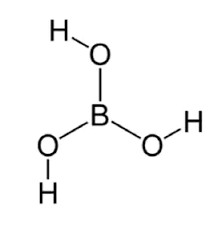
The states of hybridization for the boron and oxygen atoms in boric acid are respectively $$sp^2$$ and $$sp^3$$.
Correct Option: D ($$sp^2$$ and $$sp^3$$)
Which one of the following has the regular tetrahedral structure?
A molecule or ion has a regular tetrahedral structure if its central atom is bonded to four identical surrounding groups with zero lone pairs on the central atom. The presence of lone pairs causes asymmetric electron repulsion, distorting the ideal bond angles away from $$109.5^\circ$$.
Option A: $$\text{XeF}_4$$ (Xenon Tetrafluoride)
Option B: $$[\text{Ni(CN)}_4]^{2-}$$ (Tetracyanidonickelate(II))
Option C: $$\text{BF}_4^-$$ (Tetrafluoroborate Anion)
Option D: $$\text{SF}_4$$ (Sulfur Tetrafluoride)
Only the tetrafluoroborate ion ($$\text{BF}_4^-$$) features $$sp^3$$ hybridization with no lone pairs on the central atom to disrupt its structural symmetry.
Answer: Option C — $$\text{BF}_4^-$$
The maximum number of $$90^\circ$$ angles between bond pair of electrons is observed in
What you get
Terms of Service
Educational materials for JEE preparation