
Join Our JEE Preparation Group
Prep with like-minded aspirants; Get access to free daily tests and study material.
Sign in
Please select an account to continue using cracku.in
↓ →
Join Our JEE Preparation Group
Prep with like-minded aspirants; Get access to free daily tests and study material.
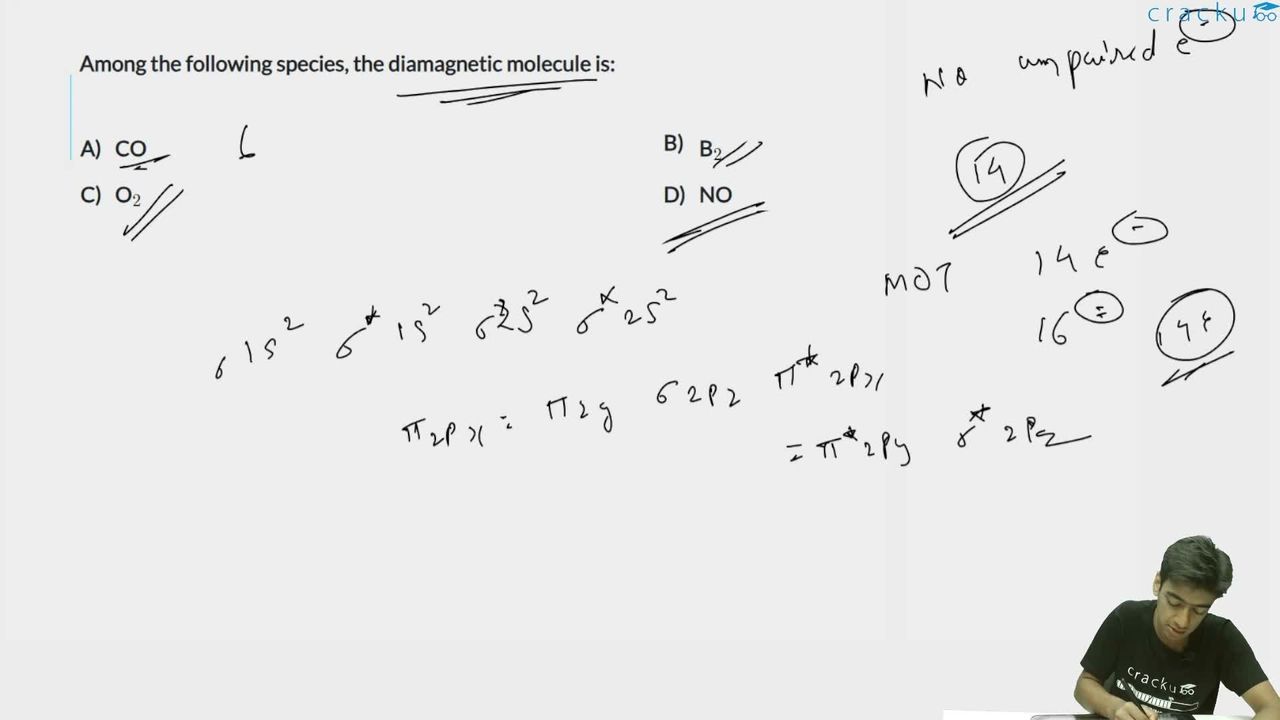
For a gaseous molecule, its magnetic behaviour is decided by the presence or absence of unpaired electrons in the molecular orbitals obtained from Molecular Orbital (MO) Theory. If all electrons are paired, the molecule is said to be diamagnetic; if one or more electrons are unpaired, the molecule becomes paramagnetic.
To check the pairing we must, for every species, (i) count the total number of valence electrons supplied by the two atoms, (ii) fill these electrons in the correct MO energy order for second-period diatomic species, and (iii) note how many electrons remain unpaired. The magnetic moment formula
$$\mu = \sqrt{n(n+2)}\; \text{BM}$$
states that $$\mu = 0$$ when $$n = 0$$, i.e. when there are no unpaired electrons, giving diamagnetism.
1. B2 : Each boron atom (Z = 5) contributes 5 electrons, so total electrons $$= 5 + 5 = 10$$. For molecules having total electrons <= 14 (up to N2) the MO energy order is
$$\sigma_{1s},\; \sigma_{1s}^{*},\; \sigma_{2s},\; \sigma_{2s}^{*},\; \pi_{2p_x} = \pi_{2p_y},\; \sigma_{2p_z},\; \pi_{2p_x}^{*} = \pi_{2p_y}^{*},\; \sigma_{2p_z}^{*}$$
Filling ten electrons step by step gives
$$\sigma_{1s}^2\;\sigma_{1s}^{*2}\;\sigma_{2s}^2\;\sigma_{2s}^{*2}\; \pi_{2p_x}^1\;\pi_{2p_y}^1$$
The last two electrons enter the degenerate $$\pi_{2p_x}$$ and $$\pi_{2p_y}$$ orbitals singly (Hund’s rule), so $$n = 2$$ → paramagnetic.
2. O2 : Each oxygen atom (Z = 8) supplies 8 electrons, so total electrons $$= 16$$. For molecules containing elements with Z ≥ 8 (O2, F2, etc.) the order changes to
$$\sigma_{1s},\; \sigma_{1s}^{*},\; \sigma_{2s},\; \sigma_{2s}^{*},\; \sigma_{2p_z},\; \pi_{2p_x} = \pi_{2p_y},\; \pi_{2p_x}^{*} = \pi_{2p_y}^{*},\; \sigma_{2p_z}^{*}$$
Placing sixteen electrons we get
$$\sigma_{1s}^2\;\sigma_{1s}^{*2}\;\sigma_{2s}^2\;\sigma_{2s}^{*2}\; \sigma_{2p_z}^2\;\pi_{2p_x}^2\;\pi_{2p_y}^2\; \pi_{2p_x}^{*1}\;\pi_{2p_y}^{*1}$$
Here the two antibonding $$\pi^*$$ orbitals each hold one unpaired electron, so $$n = 2$$ → paramagnetic.
3. NO : Nitrogen contributes 7 electrons and oxygen 8 electrons, so total electrons $$= 7 + 8 = 15$$. Being a heteronuclear molecule its exact energy ordering is slightly shifted, but the occupation pattern (verified experimentally) is
$$\sigma_{1s}^2\;\sigma_{1s}^{*2}\;\sigma_{2s}^2\;\sigma_{2s}^{*2}\; \sigma_{2p_z}^2\;\pi_{2p_x}^2\;\pi_{2p_y}^2\; \pi_{2p_x}^{*1}$$
There is one unpaired electron in $$\pi_{2p_x}^{*}$$, so $$n = 1$$ → paramagnetic.
4. CO : Carbon supplies 6 electrons and oxygen 8 electrons, giving total electrons $$= 6 + 8 = 14$$. With 14 electrons the same order as N2 is followed; filling proceeds as
$$\sigma_{1s}^2\;\sigma_{1s}^{*2}\;\sigma_{2s}^2\;\sigma_{2s}^{*2}\; \pi_{2p_x}^2\;\pi_{2p_y}^2\;\sigma_{2p_z}^2$$
Every molecular orbital is either empty or completely filled; no orbital contains a single electron. Thus the number of unpaired electrons is
$$n = 0$$
Substituting into the magnetic moment formula gives $$\mu = \sqrt{0(0+2)} = 0$$, confirming that CO is diamagnetic.
Summarising, B2, O2 and NO are paramagnetic, while only CO has all electrons paired. Hence, the correct answer is Option A.
Was this solution helpful?
Click on the Email ☝️ to Watch the Video Solution
Create a FREE account and get:
_1.webp)

Educational materials for JEE preparation

Ask our AI anything

AI can make mistakes. Please verify important information.
AI can make mistakes. Please verify important information.


