
Join Our JEE Preparation Group
Prep with like-minded aspirants; Get access to free daily tests and study material.
Sign in
Please select an account to continue using cracku.in
↓ →
Join Our JEE Preparation Group
Prep with like-minded aspirants; Get access to free daily tests and study material.
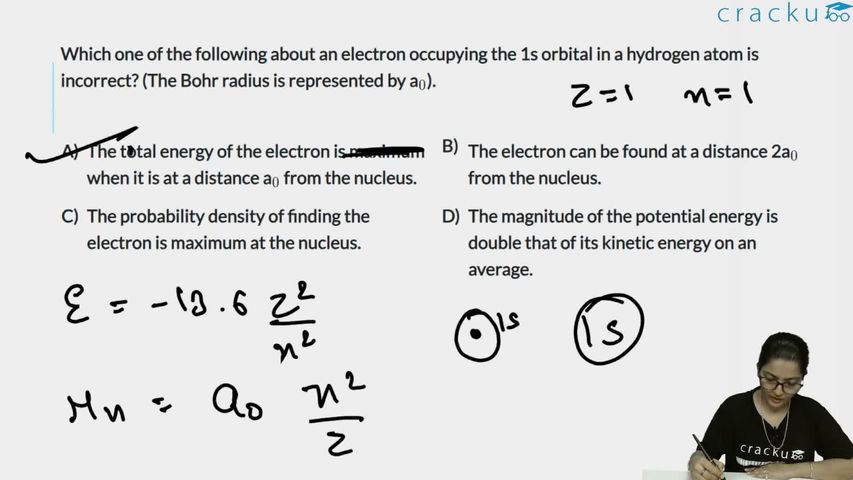
Which one of the following about an electron occupying the 1s orbital in a hydrogen atom is incorrect? (The Bohr radius is represented by a$$_0$$).
We need to identify which statement about an electron in the 1s orbital of a hydrogen atom is incorrect.
Option A: "The total energy of the electron is maximum when it is at a distance $$a_0$$ from the nucleus."
For the hydrogen atom, the most probable distance of the electron from the nucleus in the 1s orbital is the Bohr radius $$a_0$$. At this distance, the electron is in its ground state (n = 1), which is the state of minimum total energy (most negative energy), not maximum. The total energy at this distance is $$E_1 = -13.6$$ eV, which is the lowest possible energy. Therefore, this statement is incorrect.
Option B: "The electron can be found at a distance $$2a_0$$ from the nucleus."
The probability density function $$|\psi_{1s}|^2$$ for the 1s orbital is non-zero for all distances $$r > 0$$. Although the probability decreases exponentially with distance, there is still a non-zero probability of finding the electron at $$r = 2a_0$$. This statement is correct.
Option C: "The probability density of finding the electron is maximum at the nucleus."
For the 1s orbital, $$\psi_{1s} = \frac{1}{\sqrt{\pi}}\left(\frac{1}{a_0}\right)^{3/2} e^{-r/a_0}$$. The probability density $$|\psi_{1s}|^2$$ is maximum at $$r = 0$$ (at the nucleus), since $$e^{-r/a_0}$$ is maximum when $$r = 0$$. Note: the radial probability distribution $$4\pi r^2|\psi|^2$$ peaks at $$r = a_0$$, but the probability density itself is maximum at the nucleus. This statement is correct.
Option D: "The magnitude of the potential energy is double that of its kinetic energy on an average."
By the virial theorem for a Coulombic potential, $$\langle V \rangle = 2\langle E \rangle$$ and $$\langle T \rangle = -\langle E \rangle$$. Therefore $$|\langle V \rangle| = 2|\langle T \rangle|$$. The magnitude of the average potential energy is indeed double the average kinetic energy. This statement is correct.
The incorrect statement is Option A.
Was this solution helpful?
Click on the Email ☝️ to Watch the Video Solution
Create a FREE account and get:
_1.webp)

Educational materials for JEE preparation

Ask our AI anything

AI can make mistakes. Please verify important information.
AI can make mistakes. Please verify important information.


