
Join Our JEE Preparation Group
Prep with like-minded aspirants; Get access to free daily tests and study material.
Sign in
Please select an account to continue using cracku.in
↓ →
Join Our JEE Preparation Group
Prep with like-minded aspirants; Get access to free daily tests and study material.
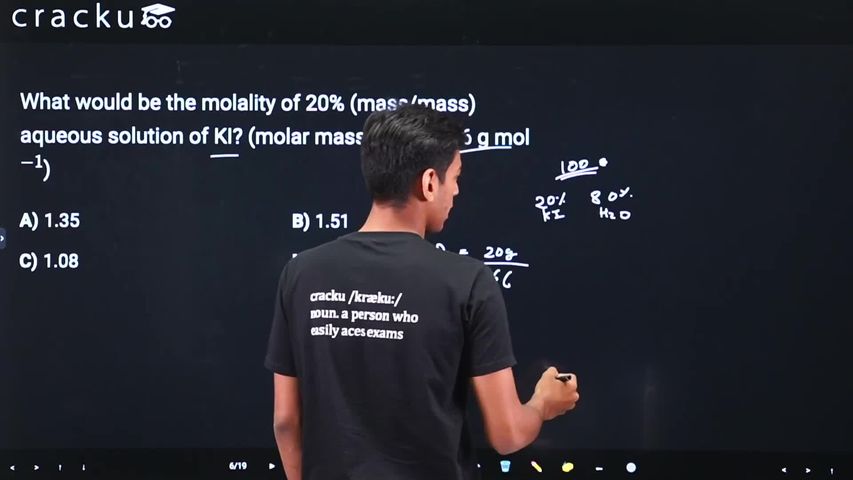
What would be the molality of 20% (mass/mass) aqueous solution of KI? (molar mass of KI = 166 g mol$$^{-1}$$)
We begin by interpreting the phrase “20 % (mass/mass) aqueous solution of KI”. By definition, a 20 % (w/w) solution contains 20 g of solute (here, KI) in every 100 g of the entire solution.
So for 100 g of the solution:
$$\text{mass of KI (solute)} = 20\ \text{g}$$
$$\text{mass of water (solvent)} = 100\ \text{g} - 20\ \text{g} = 80\ \text{g}$$
Next, we need the number of moles of KI present. We recall the formula
$$\text{Moles of solute},\ n = \frac{\text{mass of solute}}{\text{molar mass}}.$$
Substituting the given values, we obtain
$$n = \frac{20\ \text{g}}{166\ \text{g mol}^{-1}}.$$
Carrying out the division,
$$n = 0.12048\ \text{mol}.$$
The molality $$m$$ of a solution is defined as
$$m = \frac{\text{moles of solute}}{\text{mass of solvent in kilograms}}.$$
First, we express the solvent mass in kilograms:
$$80\ \text{g} = 80 \times 10^{-3}\ \text{kg} = 0.08\ \text{kg}.$$
Now we substitute into the molality formula:
$$m = \frac{0.12048\ \text{mol}}{0.08\ \text{kg}}.$$
Dividing, we get
$$m = 1.506\ \text{mol kg}^{-1}.$$
On rounding to three significant figures,
$$m \approx 1.51\ \text{mol kg}^{-1}.$$
Hence, the correct answer is Option B.
Was this solution helpful?
Click on the Email ☝️ to Watch the Video Solution
Create a FREE account and get:
_1.webp)

Educational materials for JEE preparation

Ask our AI anything

AI can make mistakes. Please verify important information.
AI can make mistakes. Please verify important information.


