
Join Our JEE Preparation Group
Prep with like-minded aspirants; Get access to free daily tests and study material.
Sign in
Please select an account to continue using cracku.in
↓ →
Join Our JEE Preparation Group
Prep with like-minded aspirants; Get access to free daily tests and study material.
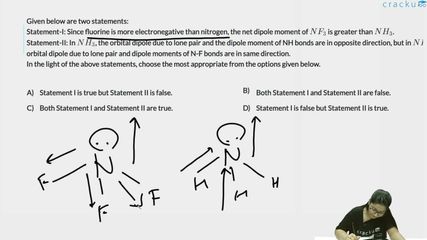
Given below are two statements:
Statement-I: Since fluorine is more electronegative than nitrogen, the net dipole moment of $$NF_3$$ is greater than $$NH_3$$.
Statement-II: In $$NH_3$$, the orbital dipole due to lone pair and the dipole moment of NH bonds are in opposite direction, but in $$NF_3$$ the orbital dipole due to lone pair and dipole moments of N-F bonds are in same direction.
In the light of the above statements, choose the most appropriate from the options given below.
Statement I claims that since fluorine is more electronegative than nitrogen, the net dipole moment of $$NF_3$$ is greater than $$NH_3$$. However, experimental dipole moments are $$\mu(NH_3) = 1.47$$ D and $$\mu(NF_3) = 0.23$$ D, so $$NF_3$$ has a much lower dipole moment than $$NH_3$$. This is because in $$NH_3$$, the lone pair dipole and the bond dipoles reinforce each other, while in $$NF_3$$ they oppose each other (partially cancelling). Statement I is false.
Statement II asserts that in $$NH_3$$ the orbital dipole due to lone pair and the dipole moments of N-H bonds are in opposite direction, but in $$NF_3$$ they are in the same direction. In reality, the situation is reversed: in $$NH_3$$ the N-H bond dipoles point from H towards N (since N is more electronegative) and the lone pair on nitrogen also contributes a dipole in the same direction (away from nitrogen, towards the lone pair region), so they reinforce each other. In $$NF_3$$ the N-F bond dipoles point from N towards F (since F is more electronegative than N), i.e., away from nitrogen, while the lone pair dipole still points in the direction from the base towards the apex (away from the lone pair), so they oppose each other, causing partial cancellation and a low dipole moment. Statement II is false.
Since both statements are false, the correct answer is Option (2): Both Statement I and Statement II are false.
Was this solution helpful?
Click on the Email ☝️ to Watch the Video Solution
Create a FREE account and get:
_1.webp)

Educational materials for JEE preparation

Ask our AI anything

AI can make mistakes. Please verify important information.
AI can make mistakes. Please verify important information.
