
Join Our JEE Preparation Group
Prep with like-minded aspirants; Get access to free daily tests and study material.
Sign in
Please select an account to continue using cracku.in
↓ →
Join Our JEE Preparation Group
Prep with like-minded aspirants; Get access to free daily tests and study material.
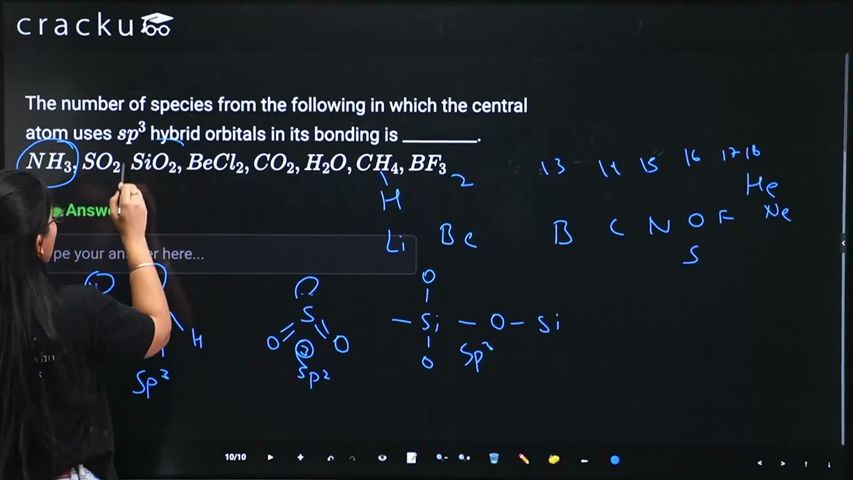
The number of species from the following in which the central atom uses $$sp^3$$ hybrid orbitals in its bonding is _________. $$NH_3, SO_2, SiO_2, BeCl_2, CO_2, H_2O, CH_4, BF_3$$
Correct Answer: 4
The hybridization of the central atom can be determined using the steric number.
$$\text{Steric Number}=\text{Number of bonded atoms}+\text{Number of lone pairs}$$
A steric number of $$4$$ corresponds to $$sp^3$$ hybridization.
For $$NH_3$$, nitrogen is bonded to three hydrogen atoms and possesses one lone pair.
$$SN=3+1=4$$
Therefore, nitrogen is $$sp^3$$ hybridized.
For $$SO_2$$, sulfur is bonded to two oxygen atoms and possesses one lone pair.
$$SN=2+1=3$$
Therefore, sulfur is $$sp^2$$ hybridized.
For $$SiO_2$$, each silicon atom in the three-dimensional covalent network is bonded to four oxygen atoms.
$$SN=4+0=4$$
Therefore, silicon is $$sp^3$$ hybridized.
For $$BeCl_2$$, beryllium is bonded to two chlorine atoms.
$$SN=2+0=2$$
Therefore, beryllium is $$sp$$ hybridized.
For $$CO_2$$, carbon is bonded to two oxygen atoms.
$$SN=2+0=2$$
Therefore, carbon is $$sp$$ hybridized.
For $$H_2O$$, oxygen is bonded to two hydrogen atoms and possesses two lone pairs.
$$SN=2+2=4$$
Therefore, oxygen is $$sp^3$$ hybridized.
For $$CH_4$$, carbon is bonded to four hydrogen atoms.
$$SN=4+0=4$$
Therefore, carbon is $$sp^3$$ hybridized.
For $$BF_3$$, boron is bonded to three fluorine atoms.
$$SN=3+0=3$$
Therefore, boron is $$sp^2$$ hybridized.
Thus, the species containing a central atom with $$sp^3$$ hybridization are $$NH_3$$, $$SiO_2$$, $$H_2O$$, and $$CH_4$$.
Hence, the total number of $$sp^3$$ hybridized species is
$$4$$
Was this solution helpful?
Click on the Email ☝️ to Watch the Video Solution
Create a FREE account and get:
_1.webp)

Educational materials for JEE preparation

Ask our AI anything

AI can make mistakes. Please verify important information.
AI can make mistakes. Please verify important information.
