
Join Our JEE Preparation Group
Prep with like-minded aspirants; Get access to free daily tests and study material.
Sign in
Please select an account to continue using cracku.in
↓ →
Join Our JEE Preparation Group
Prep with like-minded aspirants; Get access to free daily tests and study material.
We need to identify which molecule or ion has a square pyramidal shape. To determine the shape, we use VSEPR theory: first count the total electron pairs (bond pairs + lone pairs) around the central atom, then determine the geometry.
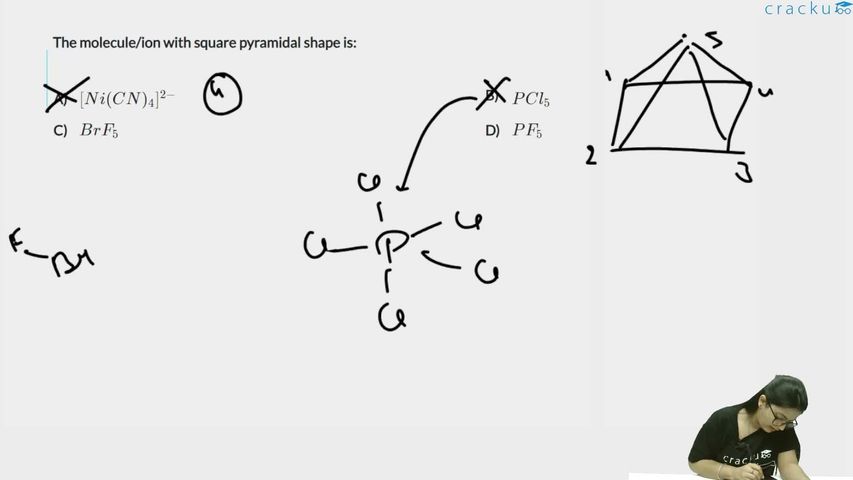
Recall: The shape of a molecule depends on the number of bond pairs (BP) and lone pairs (LP) around the central atom. A square pyramidal shape arises when there are 6 electron pairs total: 5 bond pairs and 1 lone pair (derived from octahedral electron geometry).
Option 1: $$[Ni(CN)_4]^{2-}$$
Nickel in this complex is Ni$$^{2+}$$ with electronic configuration $$[Ar] 3d^8$$. CN$$^-$$ is a strong field ligand, so it causes pairing of d-electrons. With 4 ligands and a $$d^8$$ configuration in a strong field, the complex adopts a square planar geometry ($$dsp^2$$ hybridization). This is NOT square pyramidal.
Option 2: $$PCl_5$$
Phosphorus has 5 valence electrons. Each Cl contributes 1 bond pair, giving 5 BP and 0 LP around P. With 5 bond pairs and no lone pairs, the geometry is trigonal bipyramidal ($$sp^3d$$ hybridization). This is NOT square pyramidal.
Option 3: $$BrF_5$$
Bromine has 7 valence electrons. Each F contributes 1 bond pair, giving 5 BP. The remaining electrons on Br: $$7 - 5 = 2$$ electrons = 1 lone pair (LP). So there are 5 BP + 1 LP = 6 total electron pairs around Br.
With 6 electron pairs, the electron geometry is octahedral ($$sp^3d^2$$ hybridization). When one position of the octahedron is occupied by a lone pair, the molecular shape becomes square pyramidal.
Option 4: $$PF_5$$
Phosphorus has 5 valence electrons, and each F contributes 1 bond pair, giving 5 BP and 0 LP. The geometry is trigonal bipyramidal (same as $$PCl_5$$). This is NOT square pyramidal.
Conclusion: Only $$BrF_5$$ has 5 bond pairs and 1 lone pair arranged in an octahedral electron geometry, resulting in a square pyramidal molecular shape.
The correct answer is Option (3): $$BrF_5$$.
Was this solution helpful?
Click on the Email ☝️ to Watch the Video Solution
Create a FREE account and get:
_1.webp)

Educational materials for JEE preparation

Ask our AI anything

AI can make mistakes. Please verify important information.
AI can make mistakes. Please verify important information.
